Eric Gregory retweetledi

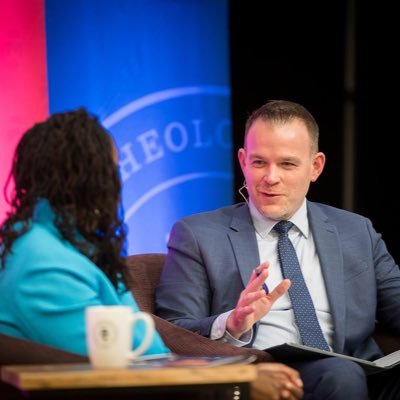
On March 23, 2026, the Center of Theological Inquiry (CTI) welcomed New York Times reporter Lauren Jackson as a featured guest in its ongoing colloquy series for the From Despair to Hope project’s residential cohort on Technology and Artificial Intelligence. Jackson—whose work spans religion, technology, and contemporary culture, and who also edits The Morning and hosts Believing for the Times—brought journalistic versatility, acuity, and empathy to a topic at the heart of CTI’s current inquiry: the spiritual implications of artificial intelligence (AI).
Jackson opened the discussion with an overview of AI-mediated spirituality, a rapidly expanding array of technologies that includes religious apps, digital devotional tools, and AI-driven chatbots offering spiritual counsel. Available at all hours and capable of responding with indefatigable patience, such systems provide unprecedented accessibility to religious knowledge and practice. And as these technologies’ astonishing popularity attests, they are already assuaging widespread yearnings. Moreover, many founders of religious apps and AI spiritual tools appear genuinely motivated by a desire to address spiritual hunger.
Nevertheless, Jackson cautioned that this success and sincerity do not eliminate the importance of critical scrutiny, since “meeting people where they are is not the same as leading them where they need to go.” For one thing, AI systems hallucinate, generating plausible but inaccurate or distorted content, often due to limitations or biases in their training data. For another, AI systems are often optimized to be affable and affirming, but religious and spiritual maturation frequently depends on guidance that challenges, corrects, or unsettles. Such AI sycophancy risks fostering entrenchment and delusion—even idolatry—rather than growth and wisdom. Finally, Jackson noted that AI-mediated spirituality may attenuate community. While religious traditions are typically constituted by shared practices, institutions, and relationships that provide spiritual formation and accountability, these technologies may encourage individualized and privatized religiosity.
Given this context, Jackson identified three areas where theology might play an especially important role in shaping the future of AI, not just as it mediates spirituality but generally. First, theology can contribute to the development of ethical guardrails for this new technology by offering normative frameworks capable of guiding the design, deployment, regulation, and use of AI. Second, theology can help articulate a robust account of human dignity. This will likely prove particularly pertinent as AI disrupts labor markets—including white-collar professions traditionally associated with identity and purpose—depersonalizes relationships and replaces human beings as the highest intelligence on the planet. Third, theology can provide doctrinally sophisticated, historically sensitive, and spiritually sound wisdom to correct AI-generated distortions in spiritual content.
Jackson concluded by acknowledging the pervasive pessimism that often surrounds contemporary discussions of AI. In response, she invoked a recent conversation with University of Virginia public theologian Charles Mathewes, who appealed to Augustine’s famous contention that “we are the times.” For Mathewes—and, Jackson suggested, for the present moment more broadly—this Augustinian insight is less a description than an exhortation. Accordingly, Jackson urged CTI’s scholars to marshal their distinctive expertise to help shape the future of AI in ways that nurture genuine human spirituality and flourishing.
English