Eric Sun

180 posts

Eric Sun

Eric Sun

@EricSun50

retardmaxxing

New York, NY Katılım Ocak 2023
439 Takip Edilen196 Takipçiler
Eric Sun
Eric Sun@EricSun50·
@AndrewCurran_ Assuming it’s easy to survive the singularity without taking some risk
English
1
0
1
19
Andrew Curran
Andrew Curran@AndrewCurran_·
@EricSun50 Just stop skydiving and bungee jumping for like four years, after that you can do it for forty thousand.
English
7
3
103
5.1K
Eric Sun
Eric Sun@EricSun50·
>1982 >Be Japan >Symbolic AI is the future >YOLO ¥57B on Prolog >Industry says "just build better networks" >MITI says no, too boring, we want ORIGINAL >Design custom chips >Design custom language >Design custom OS >Claim FLOPs obsolete >2026 >Be US
English
0
0
0
29
Eric Sun
Eric Sun@EricSun50·
@AlexanderKalian So why can't AI search over the smaller space and "solve" drug discovery
English
1
0
0
13
Dr Alexander D. Kalian
Dr Alexander D. Kalian@AlexanderKalian·
That's not how it works. The search space might be 10^63 druggable molecules, but for each given disease, a subset of those molecules will work (to differing levels of safety and efficacy). Besides, traditional drug discovery does not search systematically over this space - rather, it looks to try out new molecules based on certain substructures associated with certain pathways, which seem interesting. The failure rate is sky-high, but it yields the occasional success which becomes a blockbuster drug.
English
1
0
0
17
Dr Alexander D. Kalian
Dr Alexander D. Kalian@AlexanderKalian·
AI will never feasibly "solve" drug discovery. There are an estimated 10^63 possible small druggable molecules (1 followed by 63 zeros). To truly cover druggable biochemical space, AI would need to learn how all possible chemotypes causally interact across complex biological systems and multi-omics layers. Biochemical space is better thought of as a giant dense knowledge graph with 10^63 nodes. Even with extremely generous assumptions (e.g. one training sample informing the model about 1 trillion nearby related molecular nodes), you would still need 10^51 training examples. That alone breaks the scalability of any current or near-future AI architecture - as well as modern computers themselves. And this is before adding quantum-mechanical descriptors, physicochemical properties, pharmacokinetics, toxicological pathways, and all the other rich data layers. We currently have meaningful data on only ~10^8 molecules in open databases like PubChem - a tiny fraction of what would be required. And we haven't even discussed AI drug discovery's navigation of edge cases, larger druggable molecules, antibodies, nanoparticles, or chemical mixtures. Building the data required for a true "solution" is beyond human civilisation's capacity. We will possibly someday be an interstellar civilisation and still be working on stubborn pain points in AI drug discovery. That said, AI can still meaningfully improve drug discovery - generating better candidates, improving virtual screening, and modestly raising clinical success rates. That's valuable and worth pursuing. But a rigorous "solving" of drug discovery? Completely unfeasible.
English
43
16
169
15.1K
Eric Sun
Eric Sun@EricSun50·
@AlexanderKalian If the search space were 10^63 then why are there any drugs at all? Either it's not 10^63, we're running ~10^63 experiments, or the effective search space is much smaller.
English
1
0
0
14
Dr Alexander D. Kalian
Dr Alexander D. Kalian@AlexanderKalian·
@EricSun50 It's not weird at all - drug discovery has an extremely high failure rate, but it's not zero. And the economic incentives for success are so extremely lucrative, that the major asymmetric risk is embraced by big pharma and the biotech investment landscape.
English
1
0
0
50
PROFESSOR
PROFESSOR@SIGMAPROFESSOR·
true intelligence is a curse, and you must use that very intelligence to turn this very curse into a blessing. Perhaps that is ur purpose behind the gift. because actual - absolute - intelligence is failure in disguise. A truly intelligent person should succeed at nothing. because success demands a measure of delusion, stupidity, and audacity, traits fundamentally opposed to real intelligence. When intelligence is genuine, not in the sense people hail you for hoarding some trashy earthly resources at one place(intellect). two things happen. either you understand something in its entirety and lose all impulse to act (Nietzsche already talked about this). Or you fail to grasp it fully and remain suspended in doubt and confusion. That doubt is the highest mark of intelligence. The stupid doubt nothing; stupidity grants effortless belief. And in doubt, action itself becomes a kind of stupidity, an offense against intelligence. So the conclusion is simple, if you wish to make it in anything : go a little mad, deluded, senseless, and dumb.
English
22
46
363
12.2K
Emad
Emad@EMostaque·
Who’s building nanobots? Seems the last leg of Kurzweil’s predictions
English
99
28
458
40.4K
Chris Hayduk
Chris Hayduk@ChrisHayduk·
GPT 5.5 is an effective autoresearcher in structural biology! I've had goal mode running for over 150 hours straight, looking for topologically inspired architectural changes to improve the performance of AlphaFold2. Performance is strong and improving!
Chris Hayduk tweet media
English
40
132
1.4K
127.4K
Eric Sun
Eric Sun@EricSun50·
@danburonline Infinite lifespan can still have finite value with time discounting. I might be save for 100 years only to have different values when it comes time to spend.
English
0
0
1
14
Daniel Burger
Daniel Burger@danburonline·
Immortality-relative deprivation: Immortality doesn't necessarily remove death anxiety. If I could live forever, but death could still happen, then death would no longer mean losing a normal lifespan. It would mean losing a potentially infinite future. So even small risks start to feel enormous. Briefly touched on this during my talk at @VitalistBay yesterday
Daniel Burger tweet media
English
1
0
1
74
Sid
Sid@SidPolitics·
@EastMilsim2 The most charismatic, beautiful, and specialized species are rarely the ones that endure.
English
1
0
8
417
Sid
Sid@SidPolitics·
It's interesting how things like hierarchy, having a scarcity mindset, being tribal and territorial, monogamous, and vengeful and vindictive are considered undesirable reactionary traits, but they're the marks of more advanced lifeforms.
Woden The Wanderer@WodenWanderer

I’ve never seen a more compelling argument for different human races performing different selection strategies than the constant stream of Looney Tunes style death videos coming out of the Indian subcontinent while its population continues to explode. Simple observation shows we are not the same. It may be uncomfortable for many, but people should believe their own eyes.

English
3
40
381
15.1K
Eric Sun
Eric Sun@EricSun50·
@embodiedthinkr Fake and gay. p-hacked into oblivion. The "diseased" group is 4× tighter than the healthy controls on both metals. Real heterogeneous clinical populations don't do this. Biological variance goes up with pathology, not down.
English
1
0
3
2K
Meditation Teacher
Meditation Teacher@embodiedthinkr·
Hey guys I cured autism. It's not enough copper. Seriously. Hassan et al. (2025): ASD children: serum copper 192.6 ± 6.83 µg/dL Controls: 99.17 ± 14.58 µg/dL Copper ROC: AUC 99.6%, cutoff ≥ 121 µg/dL (sensitivity 96.9%, specificity 96.4%) Full paper: link.springer.com/article/10.118…
Meditation Teacher@embodiedthinkr

High blood/serum copper is an indicator of low cellular copper. Multiple meta-analyses and case-control studies consistently report that mean serum copper levels are significantly higher in children with ASD than in neurotypical controls (Hassan et al., 2025; Li et al., 2014).

Català
77
181
2.6K
346.4K
Eric Sun
Eric Sun@EricSun50·
@signulll you can, you need to reach higher levels of meditation before your body trusts you with write access
English
0
0
0
21
signüll
signüll@signulll·
it’s kinda fascinating that evolution didn’t ship apis for the body. e.g. you can’t read your cortisol or write to your heart rate. the nervous system roughly exposes two endpoints for managing these.. breath & movement. both of which are indirect.
English
123
32
739
49.1K
Eric Sun retweetledi
Aakash Gupta
Aakash Gupta@aakashgupta·
Orcas have brain structures you don't have. Neurobiologist Lori Marino's MRI work on killer whales identified a fourth cortical segment called the paralimbic lobe. It sits next to the limbic system and handles emotion and social awareness. It doesn't exist in humans or in any land mammal. In orcas, it's so elaborated it erupts into the cortex. Their cortical limbic lobe, the region handling self-awareness and social processing, is exceptionally developed. Their brain weighs roughly 12 pounds, four times the mass of yours. They have spindle cells, the same neurons that let humans reason about other minds. When an orca surfaces and locks eyes with you, it's running a social assessment with neural hardware specialized for exactly that. It knows you're a separate being. It knows you're watching it back. It's evaluating you. Here's what should recontextualize the clip. In all of recorded history, wild orcas have killed zero humans. Zero documented fatalities. One surfer was bitten off California in 1972, and the orca released him the moment it realized he wasn't a sea lion. A 12-year-old was bumped in Alaska in 2005. The orca approached, touched him, turned back. Orcas hunt great white sharks. They coordinate wave attacks that sweep seals off ice floes. They take down moose swimming between islands. They have every capability to kill you. They have never chosen to. Marino's explanation: the orca neocortex is developed enough to instantly distinguish a human from prey. Other researchers point to orca culture, the traditions passed through pods across generations, in which humans simply aren't food. That look is recognition and restraint. From a mind built for social cognition at a scale your brain can't reach.
Latest in Culture@latestinculture

Something about Orcas watching you is deeply unsettling.
English
454
5.6K
39.5K
2.1M
Eric Sun retweetledi
Tolga Birdal
Tolga Birdal@tolga_birdal·
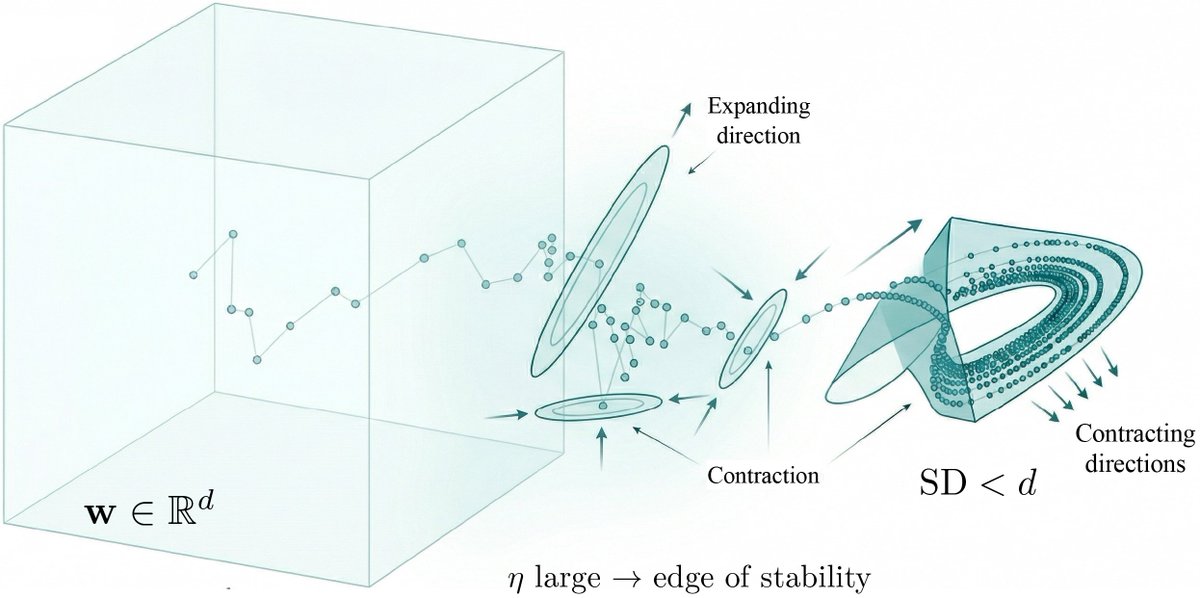
Modern deep networks are often trained at the #EdgeOfStability, a regime where dynamics are locally unstable, nearing chaos. Yet generalization improves, defying the wisdom of classical optimization. We now theoretically explain this central puzzle: arxiv.org/abs/2604.19740. 👇
Tolga Birdal tweet media
English
22
158
972
100.8K
Eric Sun
Eric Sun@EricSun50·
@prerat don’t have to imagine, join the club
English
0
0
0
390
prerat
prerat@prerat·
imagine a world where people only form long term memory during sleep during each day, everyone is forgetful -- tell someone your name, and they won't remember an hour later. but tomorrow, after sleeping, they *will* know your name but then you learn this world has a secret...
English
15
4
584
43.9K
Eric Sun
Eric Sun@EricSun50·
@carl_feynman They store 80s ribosomes during cell stress. Mouse pathology w/o vaults would arise if you starved them.
English
0
0
0
481
carl feynman
carl feynman@carl_feynman·
Today I learned about "vaults". A cellular organelle that comprises about 0.1% of our body protein, and we don't know what it does. Even weirder, they've engineered mice with no vaults, and they seem to be fine. Why does evolution keep vaults around? Why are they in most animals, fungi and plants, but not in insects? Mysteries on every side...
News from Science@NewsfromScience

Leonard Rome’s lab discovered an odd, abundant component of cells in the 1980s—and he’s still trying to figure out what it does. Learn more: scim.ag/4gOvrbG #ScienceMagArchives

English
82
304
4.3K
389.7K
Eric Sun
Eric Sun@EricSun50·
It's actually suboptimal to white knuckle things
English
0
0
0
46