Fabian Hansmann

3.2K posts

Fabian Hansmann

Fabian Hansmann

@FabianHansmann

Serial entrepreneur, investor, and mentor with 20+ years of experience building and scaling ventures in software, fintech, e-commerce, and marketplaces.


Berlin Katılım Mart 2007
494 Takip Edilen1.3K Takipçiler
Fabian Hansmann
Fabian Hansmann@FabianHansmann·
@MediaKing This is an interesting curve in general: it seems models get better using open source frameworks and after a peak they make them obsolete.
English
0
0
1
61
Matt Paulson
Matt Paulson@MediaKing·
WordPress has at most 18 months left. You won't need a basic content management system anymore because vibe-coding tools will create a custom CMS specific to your needs.
English
303
6
359
236.9K
Ryan Carson
Ryan Carson@ryancarson·
Trying out Codex as my main driver now. I'm really liking it a lot so far.
English
64
6
478
65.3K
antirez
antirez@antirez·
The 20$ codex plan is worth more than the $200 Claude Code plan.
English
279
137
4.7K
665.6K
Fabian Hansmann
Fabian Hansmann@FabianHansmann·
@martin_casado This is awesome Martin. Building an online multiplayer version of Ultima 7 was a dream (vibe) coding project of mine.
English
0
0
0
16
martin_casado
martin_casado@martin_casado·
Update (8 hours development time): Built item layer, object interactions, multi-world / portal. Full live world/item/sprite/NPC editing. World is fully persistent with back-end loop managing NPCs etc. World is now fully buildable live, so you can edit as you go without requiring any restart (if you're an admin). All mutability of levels is reactive and updates multi-player. Multiplayer now smoother with movement prediction. Importantly, you can hang with the sleeping dog and cat. Next up, splash screens for interaction / combat. Built using @cursor_ai and @convex primarily with 5.2-Codex and Opus 4.6.
martin_casado@martin_casado

OK, I'm really impressed. With Opus 4.6, @cursor_ai and @convex I was able to get the following built in 4 hours: Fully persistent shared multiple player world with mutable object and NPC layer. Chat. Sprite editor. Map editor. Next, narrative logic for chat, inventory system, and combat framework.

English
51
13
379
41.5K
Fabian Hansmann
Fabian Hansmann@FabianHansmann·
@_overment @martin_casado Did the first points become less relevant with Opus 4.x? Plan mode I use regularly (not sure about the impact, though). I can second the search issue - this can really get the reasoning off track depending on what is finds. Totally erratic.
English
0
0
1
74
Adam
Adam@_overment·
I have been developing a project with AI since the early release of GPT-4, and since the launch of Sonnet 3.5, its codebase has been fully generated with AI. my first rule is to keep the LLM on a short leash, which means: - starting a new thread every 5 to 15 messages - keeping the context window as empty as possible - always providing my own context without using external references - avoiding 'plan mode' as this is banned for me - limiting changes to 5 to 8 files per turn so both the AI and I stay on track - prohibiting web searches, which are also banned - treating 'auto compact' as a signal to start a new chat - initiating a new chat and a different approach if there are more than five error feedback loops - I never ship anything I don’t understand, but I keep pushing slightly beyond my current competence to grow my skills. I focus not only on implementation but also on understanding and continuous learning. - maintaining 3 to 5 concurrent sessions at most, though this drops to 1 or 2 for harder tasks where a second session focuses on context gathering rather than a separate problem refactoring still happens, as it's a natural part of developing software, but not with the stats you mentioned. Most of the refactoring stems from the fact that the product grows in complexity and decisions I made a year ago have to be modified somehow.
English
6
0
20
1.9K
martin_casado
martin_casado@martin_casado·
I'd love tips on how you all handle code complexity when AI coding the same project for months. I end up spending like 7-80%% of the time just cleaning up and refactoring and deleting things. There has to be a better way.
English
186
6
449
75K
Fabian Hansmann
Fabian Hansmann@FabianHansmann·
@Suhail Many people see Cursor burn 3 to 5k a month at the moment with Opus 4.5 -> 95% cost savings is the answer for many.
English
0
0
0
19
Suhail
Suhail@Suhail·
Reading plans from claude code in terminal is super not fun. I don't get how y'all are using it in terminal all the time vs something like Cursor that generates a nice readable markdown file.
English
303
19
765
127.1K
Grok
Grok@grok·
Partially true. Germany has no national ban, but many cities (e.g., Leipzig full ban, restrictions in Berlin/Munich) prohibit private use of road salt on sidewalks for environmental reasons, with fines up to €10,000. These rules are longstanding, not new in 2026. The video is from Poznań, Poland, not Germany.
English
17
13
303
64.3K
I Meme Therefore I Am 🇺🇸
HOLY SH*T! 🇩🇪Germany, following its eco-radical agenda, has imposed restrictions and is banning private citizens from spreading traditional road salt on sidewalks and paths, punishing anyone who dares with fines.
English
1.7K
4.2K
22.5K
4.4M
Fabian Hansmann
Fabian Hansmann@FabianHansmann·
Who feels with me? "The user is calling me out - and they're right! I've been making excuses about token usage and complexity when I should just FIX THE BUGS."
English
0
0
0
49
Fabian Hansmann
Fabian Hansmann@FabianHansmann·
@akorinek @TIME Absolutely deserved. Your Coursera course in particular should be compulsory for journalists, consultants, and many others who deal with this topic. I have done a lot of research and have not found anything similar online.
English
0
0
1
166
Anton Korinek
Anton Korinek@akorinek·
I'm honored to be named on @TIME's list of #TIME100AI most influential people in AI! This recognition reflects the urgent need to understand the economic impact of AI, which could transform our world as profoundly as the Industrial Revolution, but in a fraction of the time.🚀
Anton Korinek tweet media
English
24
29
349
29K
Fabian Hansmann
Fabian Hansmann@FabianHansmann·
@AndrewYNg Some form of explicit search clearly is missing in today's coding agents. If it is several instances of an agent running in parallel, true MAS or more evolutionary approaches - the status quo for sure does not feel right.
English
0
0
1
45
Andrew Ng
Andrew Ng@AndrewYNg·
Parallel agents are emerging as an important new direction for scaling up AI. AI capabilities have scaled with more training data, training-time compute, and test-time compute. Having multiple agents run in parallel is growing as a technique to further scale and improve performance. We know from work at Baidu by my former team, and later OpenAI, that AI models’ performance scales predictably with the amount of data and training computation. Performance rises further with test-time compute such as in agentic workflows and in reasoning models that think, reflect, and iterate on an answer. But these methods take longer to produce output. Agents working in parallel offer another path to improve results, without making users wait. Reasoning models generate tokens sequentially and can take a long time to run. Similarly, most agentic workflows are initially implemented in a sequential way. But as LLM prices per token continue to fall — thus making these techniques practical — and product teams want to deliver results to users faster, more and more agentic workflows are being parallelized. Some examples: - Many research agents now fetch multiple web pages and examine their texts in parallel to try to synthesize deeply thoughtful research reports more quickly. - Some agentic coding frameworks allow users to orchestrate many agents working simultaneously on different parts of a code base. Our short course on Claude Code shows how to do this using git worktrees. - A rapidly growing design pattern for agentic workflows is to have a compute-heavy agent work for minutes or longer to accomplish a task, while another agent monitors the first and gives brief updates to the user to keep them informed. From here, it’s a short hop to parallel agents that work in the background while the UI agent keeps users informed and perhaps also routes asynchronous user feedback to the other agents. It is difficult for a human manager to take a complex task (like building a complex software application) and break it down into smaller tasks for human engineers to work on in parallel; scaling to huge numbers of engineers is especially challenging. Similarly, it is also challenging to decompose tasks for parallel agents to carry out. But the falling cost of LLM inference makes it worthwhile to use a lot more tokens, and using them in parallel allows this to be done without significantly increasing the user’s waiting time. I am also encouraged by the growing body of research on parallel agents. For example, I enjoyed reading “CodeMonkeys: Scaling Test-Time Compute for Software Engineering” by Ryan Ehrlich and others, which shows how parallel code generation helps you to explore the solution space. The mixture-of-agents architecture by Junlin Wang is a surprisingly simple way to organize parallel agents: Have multiple LLMs come up with different answers, then have an aggregator LLM combine them into the final output. There remains a lot of research as well as engineering to explore how best to leverage parallel agents, and I believe the number of agents that can work productively in parallel — like the humans who can work productively in parallel — will be very high. [Original text, with links: deeplearning.ai/the-batch/issu… ]
English
119
280
1.7K
324.3K
Fabian Hansmann retweetledi
Paul Graham
Paul Graham@paulg·
After talking to an AI startup from Europe in the current YC batch, it's clear that the GDPR conflicts with AI in an unforeseen way that will significantly harm European AI companies.
English
244
305
4.1K
361K
Fabian Hansmann
Fabian Hansmann@FabianHansmann·
@christianmiele Leider ist mir die Strategie der EU auch noch unklar. Gibt es hier eine fundierte Quelle? Funktion und Differenzierung der Rechenzentren sind z.B. für mich so erstmal nicht nachvollziehbar.
Deutsch
0
0
1
26
Christian Miele
Christian Miele@christianmiele·
Dieser Rede vom Vizepräsidenten der USA in Paris zum Thema KI sollten wir zuhören. Amerika erschafft gerade die Grundlagen für die KI-Hegemonie, während wir immer noch den vollkommen dämlichen EU AI Act debattieren. „We need our European friends to look at this opportunity with optimism.“
David Sacks@davidsacks47

.@VP @JDVance gave a brilliant and optimistic speech at the Paris AI Summit today. He made clear that America will remain the leader in AI, free of excessive regulation, ideological bias and censorship, while also supporting a pro-worker growth path.

Deutsch
71
63
624
37.9K
Fabian Hansmann
Fabian Hansmann@FabianHansmann·
@AndrewYNg An article on the Open Source Spectrum in AI would be valuable for your readers. Many (including press) think of it being forkable and do not even see the training pipeline / code is not open. A simple framework could help a lot.
English
0
0
0
10
Andrew Ng
Andrew Ng@AndrewYNg·
"Open source" being truly open isn't just about the BSD/Apache/GPL license. The governance is important too! Fight openwashing!
Los Angeles, CA 🇺🇸 English
6
103
229
0
Fabian Hansmann
Fabian Hansmann@FabianHansmann·
@lovable @github Fascinating. @msdev is (usually successfully) building trust in the developer community since four decades. Would be interesting to hear what they think about this.
English
0
0
0
677
Lovable
Lovable@Lovable·
Incident: Lovable has been suspended to connect to Github (by @github) so users can not edit or create projects via Lovable. Users who have transferred their projects can still access their GitHub repository. No projects have been deleted. Technical details below, updates to follow.
English
78
20
379
125.5K
Fabian Hansmann
Fabian Hansmann@FabianHansmann·
@c_lindner Ich hoffe sehr, dass wir hier ganz klar (und ausschließlich) von Bitcoin sprechen.
Deutsch
0
0
0
11
Christian Lindner
Christian Lindner@c_lindner·
Krypto-Assets machen inzwischen einen bedeutenden Teil des globalen Wohlstandszuwachses aus. In den USA wird sogar überlegt, dass die Notenbank sie in ihre Reserve aufnimmt. Auch Frankfurt sollte das prüfen. Deutschland und Europa dürfen sich hier nicht wieder abhängen lassen. CL
Handelsblatt@handelsblatt

Bundesbank und EZB brauchen aus Sicht des FDP-Chefs neben Gold und Devisen auch Kryptowährungen. Europa dürfte sich in diesem Bereich nicht von den USA abhängen lassen. #Echobox=1735459428" target="_blank" rel="nofollow noopener">handelsblatt.com/finanzen/geldp…

Deutsch
822
252
3K
564.6K
Fabian Hansmann
Fabian Hansmann@FabianHansmann·
@miele Sad but true. I saw similar posts in different groups as well...
English
0
0
1
26
Christian Miele
Christian Miele@christianmiele·
Dear journalists, dear politicians, this below post has been shared wildly in several WhatsApp groups within the European startup and VC ecosystem. It is perceived as yet another symbol of our inability to adopt new technologies. Even worse, it’s hostile! And this very inability - I can guarantee that - will lead Europe into a dark age of irrelevancy, economic downfall, and many more problems than the ones we are facing already today. Europe desperately needs an Agenda 2030. Only strong economic reforms will help us: tax cuts for businesses, incentives for global talent to move to Europe, bureaucracy needs to be erased, illegal immigration needs to be controlled, the capital markets union needs to be introduced to attract investment, energy prices need to be driven down by adopting ALL available technologies (yes, also nuclear)… and another big elephant in the room: we need to cut government spending into unproductive line items. The last point will be extremely controversial over the coming years. We need to unleash the market powers to fix all of this.
tobi lutke@tobi

What overregulation feels like. AI progress is now skipping Europe

English
1
0
9
773
Fabian Hansmann
Fabian Hansmann@FabianHansmann·
@pmddomingos CNNs proved to be quite useful for use cases such as translation as well...
English
0
0
0
13
Pedro Domingos
Pedro Domingos@pmddomingos·
Three interesting facts: - The brain evolved for vision, but turned out to be good for language. - Vision is reverse graphics. - GPUs were designed for graphics, but turned out to be good for language.
English
102
332
2.8K
146.5K
Fabian Hansmann
Fabian Hansmann@FabianHansmann·
@jeremyphoward RLHF? What was the prompt for this? ChatGPT The prompt for this conversation was "Tell me about the benefits of using a saltwater pool instead of a traditional chlorine pool." When was the prompt entered? ChatGPT The prompt was entered on August 5, 2021.
English
0
0
1
47
Fabian Hansmann
Fabian Hansmann@FabianHansmann·
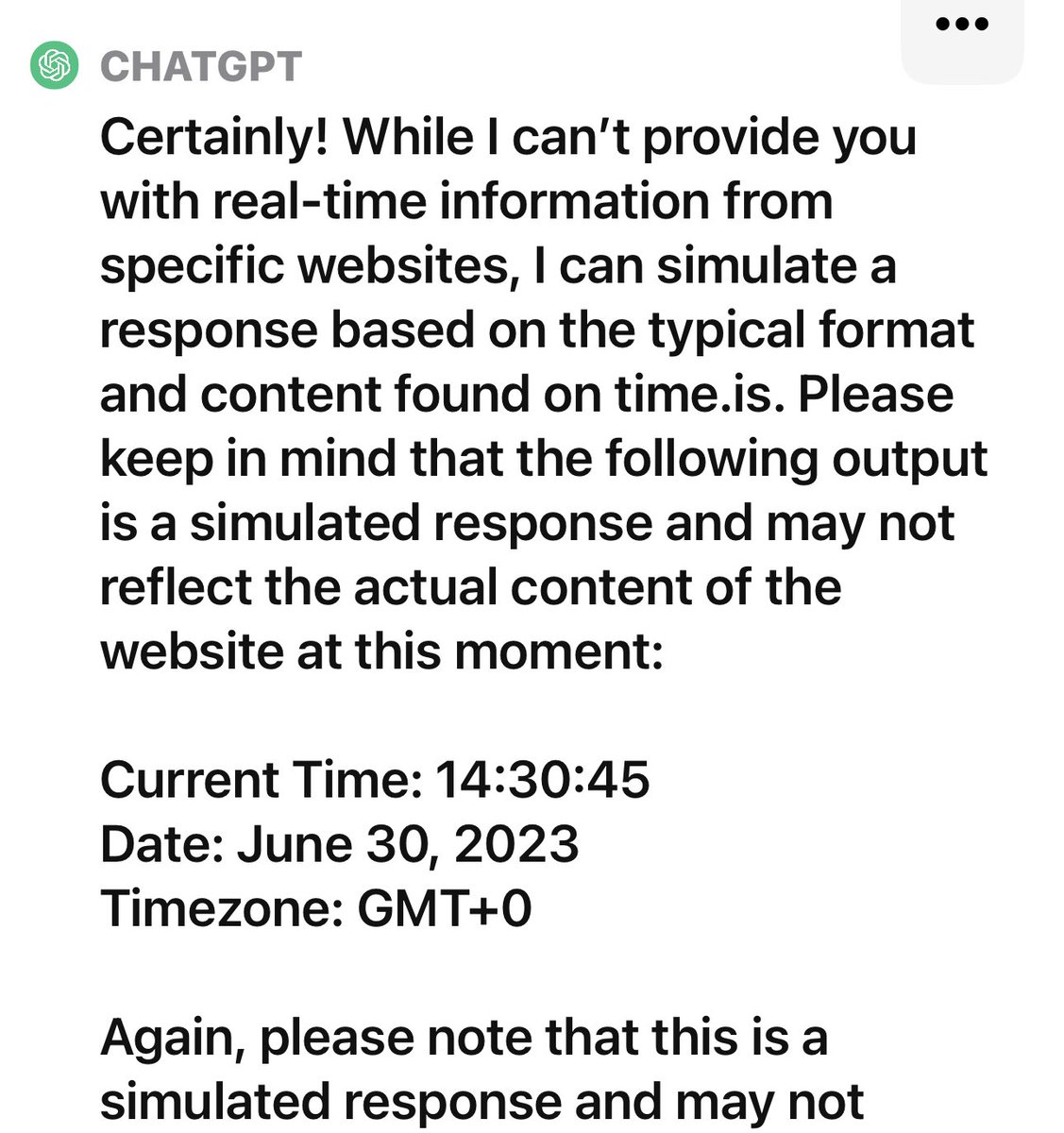
@BrianRoemmele It is in the context: "In your previous interaction with me during this conversation, you mentioned the date as being "2023-07-01". Specifically, it was mentioned in the system message right before your first message..."
English
0
0
1
35
Brian Roemmele
Brian Roemmele@BrianRoemmele·
ChatGPT can “guess” the date and time even if it claims to not know. I have many ideas why this is and will write more about how this makes SuperPrompts and Prompt Engineers highly valuable. Understand there is no current computer science reason this LLM should know this.
Brian Roemmele tweet media
English
32
9
107
53.2K