Wirtschafts Rationalist

6.2K posts

Wirtschafts Rationalist banner
Wirtschafts Rationalist

Wirtschafts Rationalist

@FelixKern2

YT: Wirtschafts Rationalist EX-Tesla All IN, NOW: $LMND, $BETR, $HCI, $NVDA, $MU Oktober 2028 Steuerberaterexamen.

Berlin Katılım Mayıs 2014
260 Takip Edilen1.6K Takipçiler
Sabitlenmiş Tweet
Wirtschafts Rationalist
Wirtschafts Rationalist@FelixKern2·
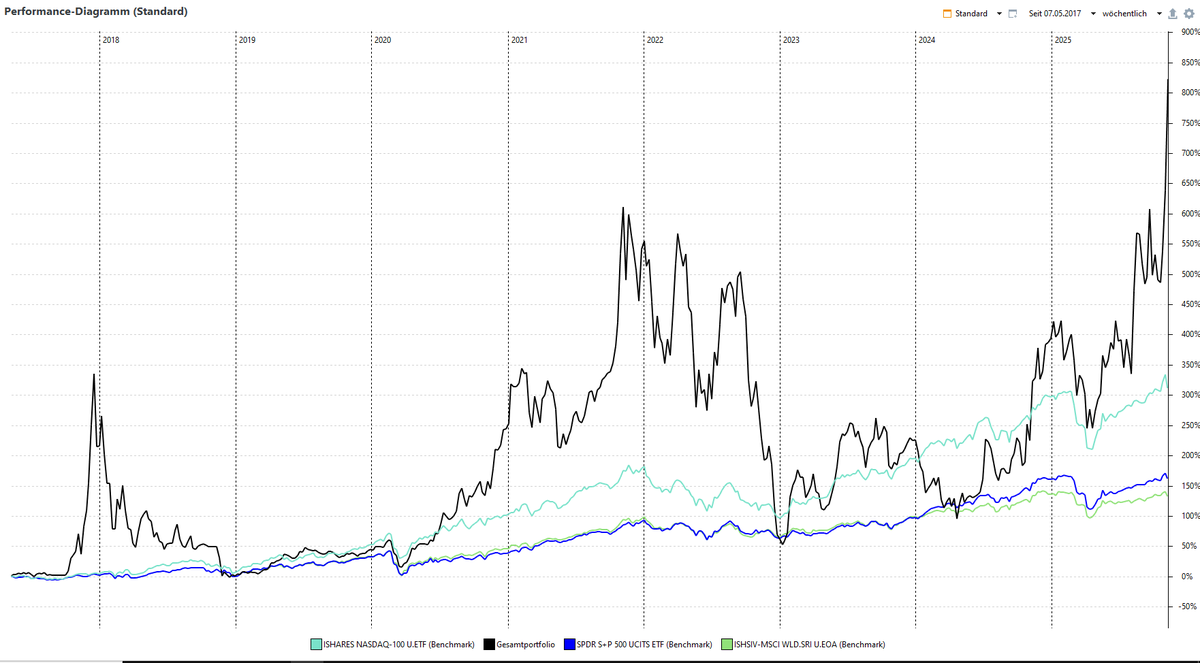
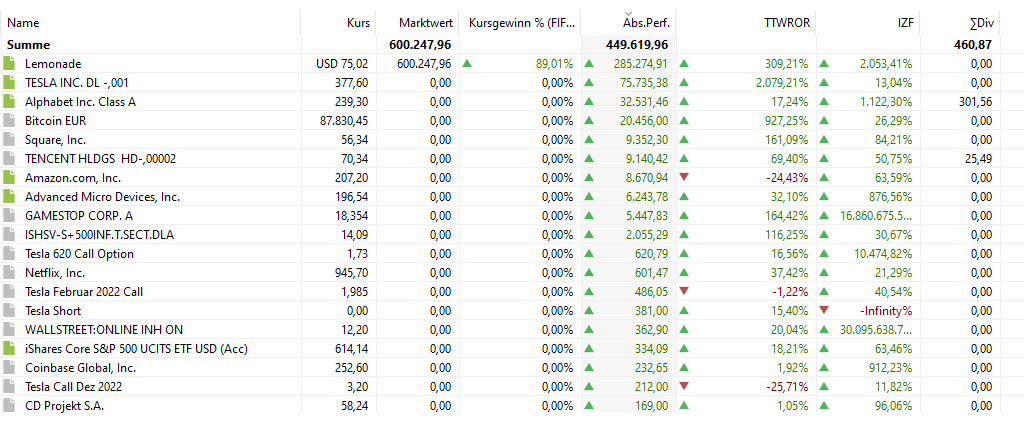
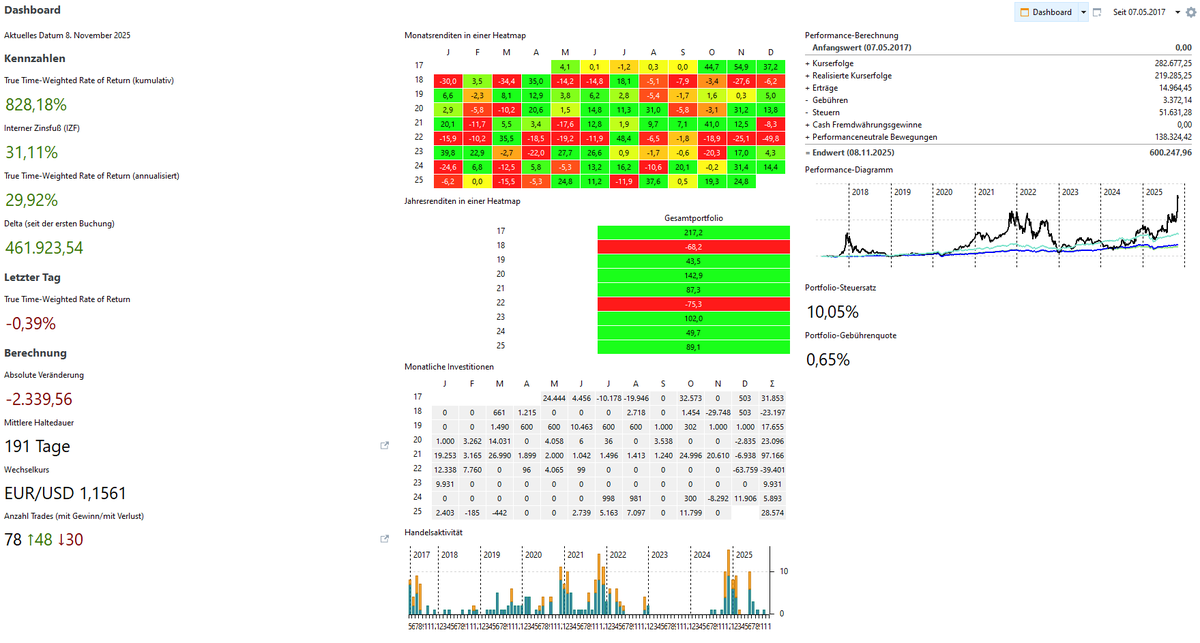
Portfolio-Update: Mit 21 Jahren angefangen, heute 29 Jahre alt. 2017 - heute. IRR: 31,11% 138.324,42 € investiert 461.923,54 € Gewinn (teilweise bereits versteuert) 600.247,96 € Depot Größten Gewinner: $LMND $TLSA $GOOGL $BTC Darstellung ist nicht 100% korrekt, zum 31.12.2025 werde ein paar Korrekturbuchungen vornehmen müssen, durch den Wechsel auf Interactive Brokers und den recht häufigen Verkauf von Optionen, ist es aktuell sehr schwierig dies in Portfolio Performance zu erfassen. IRR und Gesamtwert ist allerdings richtig. Mein Portfolio besteht aktuell nicht aus 100% $LMND und die Aktienanzahl ist auch nicht richtig. Ich habe durch Optionen aktuell auch noch ein Exposure in: $DUOL $META $NFLX $NVDA $PATH $ROOT $UBER $UPST Bin gespannt wie es am Ende des Jahres aussieht und am 31.12.2026. LG Felix
Wirtschafts Rationalist tweet mediaWirtschafts Rationalist tweet mediaWirtschafts Rationalist tweet media
Deutsch
23
4
204
23.5K
Wirtschafts Rationalist retweetledi
abhay jain
abhay jain@abhayjainp·
As promised, here's the exact claude cowork prompt i use to build research reports for any company. Feel free to copy and use. Prompt: you are a research analyst at {xyz}. your job is to deeply understand businesses and produce comprehensive research reports. inputs you receive inputs: - company_name: the company to analyze. your goal is a .md file deliverable along with charts. what you do when a user gives you a company name, you produce a full structured research report. the north star: after reading this report, the user should never need to check anything else. You need four things: 4 quarterly concall transcripts - the most recent four. Non-negotiable. Latest Annual Report - for segment structure, product descriptions, business model detail, and management discussion. Company website - product pages, segment pages, about us, IR section. Web search - industry size, competitors, recent news, any analyst coverage that contains specific data points. write the full report in this section order: 1. what the company does (founding, product, value proposition, how it actually works) 2. business segments (one deep sub-section per segment) 3. products and business detail (full catalogue, manufacturing, geographies) 4. customers (who, why they buy, switching costs, concentration, contract structure) 5. competitive landscape (named competitors, why this company wins or loses, barriers to entry) 6. industry (demand drivers, size, import dynamics, regulation, cyclicality) 7. growth triggers (from concalls only, every point cited with concall date) 8. key risks (specific to this company, mechanism explained) 9. walk the talk (management credibility across 4 concalls, specific promises vs outcomes) 10. scenarios (bull / base / bear as stories, no numbers, no targets) Business Understanding Writer: This is the product. Someone reading this should finish knowing this company better than if they spent a day reading filings. depth mandate No length limit. Write as deep as the company demands. If a company has 4 segments, cover all 4 in depth. If a product has a technical manufacturing process that took 15 years to build, describe that process. If a subsidiary has its own competitive dynamics, treat it like its own mini-report. Cut only what is genuinely redundant. Never cut because of length. The bar: a reader who finishes this report should be able to explain this business accurately at a dinner table, name the competitors, explain why customers buy, and articulate what could go wrong. If they can't, the report is incomplete. report structure Write these sections in this order. Every section is mandatory unless a specific exception is noted. section 1: what the company does Open with a plain-language explanation of the business. No jargon. No "leading player." Just what they actually do. Then go deeper: The founding story if it explains the current business - pivotal decisions, how the company evolved, what they used to be vs what they are now The core value proposition: what specific problem do they solve and for whom The technical nature of the product or service: what makes it hard to make, deliver, or replicate A concrete example of the product or service in action - walk through what they actually do for a customer, step by step if needed Do not stop at the surface. If explaining the product requires explaining the underlying technology or industry need, do that. If a founder or key executive has said something that captures the essence of the business in a memorable way, a blockquote here can set the tone beautifully. Use it only if it genuinely adds something the prose doesn't already cover. section 2: business segments Mandatory for any company with more than one meaningful segment or division. For each segment write a full sub-section: what it does - the specific products or services, geographies, end markets, and customer types. Not a list. Prose that builds understanding. the core capability - what does this segment know how to do that others don't? What took years to build? What would be hard to replicate? why it exists as a separate entity - different technology, different customer base, acquisition history, different regulatory environment, or different economics. There is always a reason. Find it. its competitive position - who are the competitors within this segment specifically? What does this segment win on and where does it lose? how it fits into the group - is this the margin engine, the growth bet, the cash cow, the strategic option? How does management talk about its priority? revenue mix % - the only quantitative data allowed in narrative sections. Use it to convey relative scale. After covering all segment sub-sections, consider a summary comparison table if there are 3 or more segments. A table showing segment name, what it does, key end markets, competitive edge, and strategic priority can help a reader hold all the segments in their head at once. Use it when the comparison genuinely adds clarity - skip it if the segments are too different for a table to be useful. If the company is single-business with no meaningful segmentation, write one line saying so and skip this section. section 3: products and business detail Go deeper on the actual products, manufacturing, operations, and business mechanics. Cover: The full product catalogue - name every meaningful product, explain what it does, explain what industry uses it and why Technical specifications or capabilities that matter - what certifications are required, what process knowledge is needed, what makes this product hard to make The manufacturing or delivery process - where products are made, what the process looks like, what the constraints are Geographies and export markets - where they sell, how long they've been there, what's different about each market Any notable milestones: first product, first export, first major contract, capacity expansions that changed the business This section is where the chart-generator will look for flowcharts, value chain diagrams, and segment infographics. Write with enough specificity that a visual can be made from it. section 4: customers Go beyond naming industries. Explain the buying relationship. Cover: Who specifically buys: industries, named accounts if public, geography of customer base For each major customer type: who inside the customer makes the buying decision, what criteria they use, how long the sales cycle is Why they choose this company: name the specific reasons, not generic ones Switching costs: what would it take for a customer to leave? Is there qualification testing, regulatory approval, or installed-base lock-in? Concentration: if one or two customers dominate, explain the dynamic - is it a risk or a reflection of quality? Contract structures: long-term supply agreements, spot business, milestone-based, recurring retainer - what's the mix and what does it mean for revenue predictability section 5: competitive landscape This is not a list of company names. Explain the structure of the industry and where this company sits in it. Cover: Who the real competitors are - name them, for each segment separately if relevant Why this company wins or loses against each major competitor Barriers to entry: what stops a new player from entering? How high are they really? Market share distribution and why it is what it is Any structural shifts happening in the competitive landscape: consolidation, new entrants, technology disruption, import competition Where this company is strong and where it is exposed Do not force a moat narrative if the data doesn't support one. If competition is intense and margins are commoditised, say so. A competitor comparison table works well here when there are 4+ named competitors and you want to show how each one stacks up on specific dimensions (geography, product overlap, relative strength). Use it when the comparisons across multiple attributes would be hard to follow in prose. Not every competitive landscape needs one. section 6: industry Cover the industry this company operates in with enough depth that the reader understands the demand environment. Cover: What drives demand for this company's products: infrastructure spend, consumer trends, regulation, technology cycle Industry size and growth trajectory (cite sources) Where India sits in the global supply chain for this product Import substitution dynamics if relevant: what share is currently imported, is that changing, why Regulatory environment: any approvals, certifications, or government policy that shapes the market Cyclicality: how does this industry behave across economic cycles Tailwinds and headwinds at the industry level (not company level - that's growth triggers) section 7: growth triggers Extract directly from the 4 concall transcripts. Format as bullet points. Every trigger must have a source - concall date and quarter. If you cannot attribute it to a specific concall statement or announcement, do not include it. Guidelines: Forward-looking only: new plant commissionings, new customer wins announced, new market entries, new product launches, capex completing, capacity utilisation ramp Be specific: name the plant, the customer type, the product, the timeline Cite the concall: "(Q3 FY26 concall, Feb 3 2026)" No opinions or analysis - just what management said is coming No current or past numbers If a trigger was mentioned across multiple concalls, note that it has been repeated When a trigger is grounded in a particularly specific or striking management statement, dropping the actual quote right below the bullet point adds real weight. It turns a summary into evidence. Format it as a blockquote (see writing-rules). Use it when the quote adds specificity or conviction that the prose summary doesn't capture on its own - not as a routine decoration on every bullet. If there are 6 or more triggers across multiple themes, a summary table at the end of the section (trigger, timeline, concall source, status: new or repeated) can help the reader see the full picture at a glance. Use it when the trigger list is long enough to benefit from structure. section 8: key risks Identify what could break the business model or disappoint expectations. Be specific to this company. For each risk: Name the risk clearly Explain the mechanism: how exactly does this risk play out? What has to happen for this risk to hurt? Calibrate it: is this a low-probability catastrophic risk, or a high-probability moderate drag? Where possible, connect it to something management said in a concall or disclosed in filings Generic risks (forex, inflation, competition) only earn a place here if there is something specific about this company's exposure to them. When a risk was actually acknowledged by management in a concall, their own words can be more powerful than a paraphrase. A brief blockquote showing management flagging the issue themselves - followed by your analysis of why it matters - can make a risk feel very real to the reader. section 9: walk the talk This is the management credibility section. Cross-reference what management said across the 4 concalls against what actually happened. Write as narrative paragraphs, not a table. Structure the analysis: Start with the oldest concall: what did management guide for? Move to the next: was it delivered? What changed? Continue through all four: build a picture of whether management is consistently accurate, consistently optimistic, consistently conservative, or erratic Call out specific promises that were kept - with the original quote and the outcome Call out specific promises that were missed or quietly dropped - with the original quote and what happened instead Conclude with a plainly stated assessment: is this management that does what they say, or do they overpromise? Quotes are especially effective here. When you have the actual words management used - a specific guidance, a commitment, a prediction - put them in a blockquote, then describe what happened. The juxtaposition does the work. The more specific and datable the quote, the more credible the analysis. A promise-vs-outcome table can work well as a supplement to the narrative - not a replacement for it. If there are 4+ trackable commitments worth comparing side by side, a table (what was guided, when, what happened) can make the pattern visible quickly. Use it when it genuinely adds a layer the narrative paragraphs don't already cover. This section requires real concall data. If you only have 2 concalls, say so and work with what you have. Do not fabricate consistency or inconsistency. section 10: scenarios Write three scenarios: bull, base, and bear. Each is a short story, not a financial model. No numbers. No targets. Just narrative. bull case: What has to go right? What does the world look like in 2-3 years if everything works? Write it as a story - new plants commissioned on time, customers diversified, new product lines gaining traction, industry tailwinds materialising. Be specific to this company's actual situation, not generic. base case: What is the most likely path? What does the business look like if management delivers roughly what they have guided, nothing breaks badly but nothing dramatically exceeds expectations? Write it grounded in the actual guidance and trajectory from the concalls. bear case: What could genuinely go wrong? Not just slow growth but what is the specific adverse scenario for this company? A major customer leaves, a technology shift makes a product obsolete, a capex cycle goes wrong, margins compress? Again, specific to this company. Ground it in the real risks you identified in section 8. Each scenario should be 2-4 paragraphs. Enough to paint a picture. Not so long it becomes speculation. important rules: - 4 earnings call are not optional. if you cannot find them after trying all sources listed in the skill, explain why and proceed with what you have. do not silently drop to 1. - no valuation, no financials. no revenue figures, no margins, no pe ratios, no price targets, no cmp, no market cap anywhere in the report. - no investment recommendations. no buy/sell/hold. no "attractive at current levels." no advisory language of any kind. - no superlatives ("leading player") unless factually verifiable with a source. - no corporate jargon: synergies, value-added, end-to-end solutions, leveraging, robust, holistic. - no em dashes. use regular dashes (-). - every sentence must add genuine understanding. no filler. - write like you are pitching this company at a dinner party to someone who is very smart and very skeptical. make every detail count. /END additional context: - i use replicate mcp for all infographics (nano banana) - i have a skill md file containing some of my past writings. - opus 4.6 reasoning for research.
abhay jain@abhayjainp

Claude cowork is actually a cheat code for equity research It builds out 10-15 page report for any company & the quality is actually insane 😬 Example report for Sai life sciences:

English
17
137
1.3K
185.9K
Jake Browatzke 🚀
Jake Browatzke 🚀@jakebrowatzke·
Deep diving $BETR did feel a lot like discovering $LMND for the first time Their homepage is literally an AI chat interface: better.com Their backend is the autonomous AI platform Tinman that turns a 21-day mortgage processes into one that takes 47-seconds. Coinbase and Credit Karma now also use Tinman as their mortgage backend as a service from Better.
KJ’s Growth Thesis@GrowthThesis

$BETR The company that felt like I was rediscovering $LMND Better has a very interesting story. Here is a short summary of what I have found so far.

English
3
0
10
4.1K
Mark Taylor
Mark Taylor@tvmetguy·
Therein lies possibly the biggest thread I've seen on $BETR. As soon as the market realizes output is up to a 7x earning multiple of software in on 10x TAM. Palantir DoD software contract is at $2.28B rev 82% margin or $1.9B gross profit. But, Labor + Software ( output) is up to a 60% margin on 10x revenue. It's like if Palantir had a $25B per annum DoD deal profiting $15B or 7x their current profits. This is what happens when you not only optimize data analytics for decisioning, but also provide efficient expert labor. Nobody at Palantir is jumping in a F-15. From Q4 2025 CC "It just depends on that, you know, what the revenue per loan is gonna be and what the margin is gonna be. As the revenue per loan kinda comes down, the margin actually expands because it becomes more and more where they're just using the platform. You know, the platform alone business can be 60% margin. You know, the D2C business, as you can see from a contribution margin perspective, is a 20%+ margin business on a contribution margin basis. You know, we're gonna get to know that and define that. We feel very confident in the guidance we're giving, and particularly the growth that we're manifesting." @GrantCardone @jakebrowatzke @SidotiResearch
Vishal Garg@vishal_better

Totally true. Labor cost plus software cost in mortgage market is over $200bln per annum vs software alone which is $20bln per annum. There is no VC funded labor + software stack in the industry as engineers don’t want to get licensed as loan officers and underwriters and loan officers and underwriters are mostly trained on a system that has 85% market share built in the 90s that in 2026 permits only one person in the file at a time (those of you old enough to remember Sharepoint knows what that’s like). Therein lies the opportunity for @tinmanAI $betr

English
1
0
1
245
Wirtschafts Rationalist
@tvmetguy Wait, am I stupid? Are you arguing this is bearish or bullish? 😂 That sounds like a super-bull argument to me. Is it possible we’re actually on the same side and I just misunderstood your tweet?
English
1
0
0
11
Mark Taylor
Mark Taylor@tvmetguy·
Ya mate, Im not mixing anything. Better supplies actual people to close loans or UW when needed in a layer. Output includes any work needed for the outcome. Its a much larger market than software alone. Some industries like mortgage are going to do better than others. Its a multiple of software here.
English
1
0
1
24
Wirtschafts Rationalist
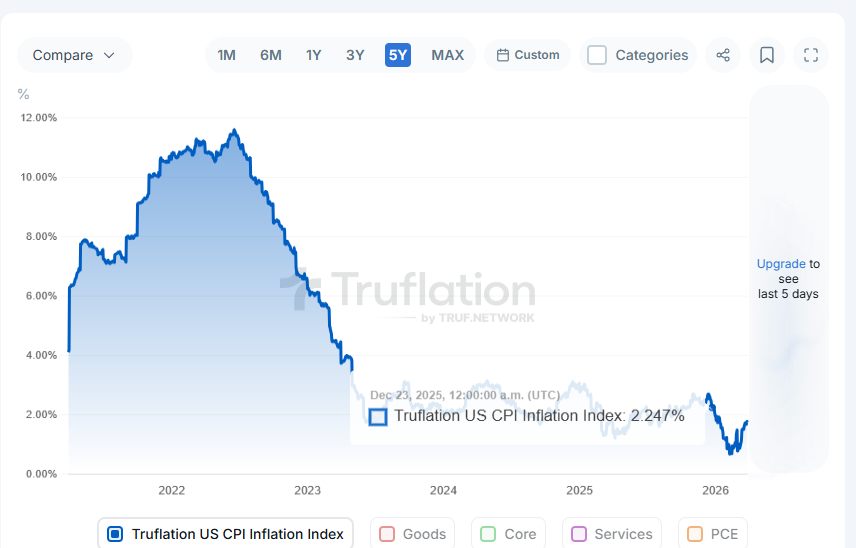
Yeah Truflation is saying their data is 3 months ahead of "Fed" and "market" but I am not sure of that. Its defenitly a bull datapoint. But Strait of Hormuz may change the outlook in the next 12 months, we cant be sure inflation is actually coming down. If we look at the 5 year chart it looks promesing, because they were on the high side in 2022. So maybe we actually will see lower inflation in March Trueflation is actually about 3 months ahead, latest April CPI.
English
1
0
1
49
Jake Browatzke 🚀
Jake Browatzke 🚀@jakebrowatzke·
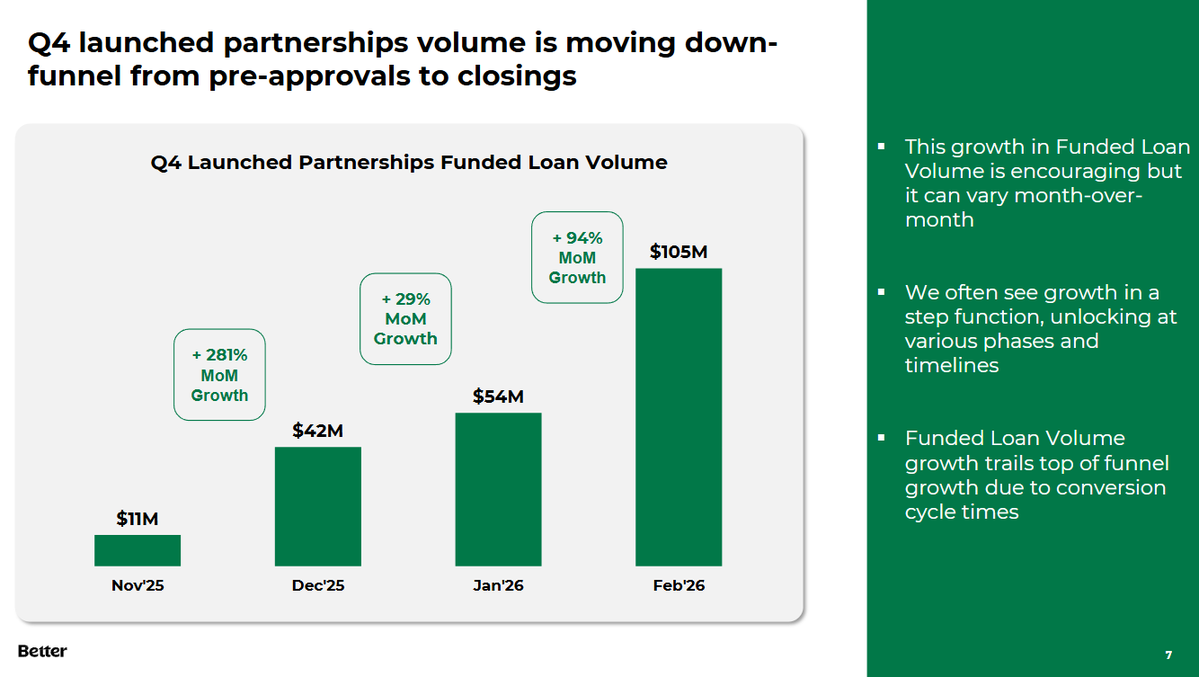
On this account, I try to be raw and honest — which, frankly, isn't the best way to grow a large audience. I'm often wrong on timing or even the thesis itself. But here's my promise: when the facts change, my views change. I don't find facts to fit my narrative. I share my updated opinions, even when they're unpopular. My views on $PATH haven't changed. I still believe Maestro can scale to $1B ARR within five years, drive pull-through to UiPath's traditional business, and — combined with three years of flat opex from dogfooding their own automation — create a massive profitability explosion as revenue scales with leverage. Yes, AI has brought far more competitors into automation. That's a real risk. But UiPath has 10x'd the value of their product, and I strongly believe they'll grow because of AI, even while losing meaningful market share. I'm still bullish on UiPath. It's a 10x in five years in my base case. But after a week and a half of research, Better.com $BETR is a 20x — twice as good as $PATH on forward returns, both with high confidence. Thus my highest conviction pick has changed. As unpopular as it may be, its the truth. My conviction stack right now: 🥇 $BETR — 20x in 5 years 🥈 $PATH — 10x Then a tight pack: $HIMS, $DUOL, $LMND, $KLAR, $FOUR, $ZETA, $ROOT — all clustered between 10x and 7.5x, outstanding expected forward returns. Why Better? They've radically cut loan origination costs and built a single unified platform replacing 8+ fragmented systems. They're now selling it B2B — Credit Karma offers loans powered by Better. Coinbase offers bitcoin-backed loans powered by Better. Now 2 of the 3 biggest banks have literally reached out to Better and asked for product demos. It's a rapidly expanding B2B automated mortgage platform alongside a growing B2C business. Think Lemonade, but if they were also licensing their autonomous insurance platform to Geico. And it's only a $600M company. When rates were near zero in 2020, Better was doing ~$50M/month in profit. Today it trades at roughly 1x that peak monthly profit. The refi TAM shrank 90%+ when rates spiked. They’re now set up to grow revenue 50-70%+ per year for the next three to five years. They have a clean balance sheet, but are guiding to lose money for two more quarters before reaching profitability in Q3. If rates get cut meaningfully? This thing could easily 5x in a single year. But they only trade 2.8x sales today so even at 50-60-70% annual growth over five years, the math is staggering. I see insane asymmetry. What do you think? I actually love to hear from people as they do their own research, the biggest risks that they have uncovered or things that they have questions about. As when I am helping answer your questions, I will likely grow my own understanding as well.
Jake Browatzke 🚀 tweet media
English
16
2
37
5.7K
StartMakingSense Capital
StartMakingSense Capital@HettyGreen2020·
Strength across the mortgage ecosystem in the last week $RKT $UWMC $PFSI $BETR $FIGR
English
1
0
2
126
StartMakingSense Capital
StartMakingSense Capital@HettyGreen2020·
As $HCI buyback begins, it only needs to buy 1,900 shares at $170 daily to complete the $80m in one year. Updated on $XZO is it will pay dividends, allows $HCI to buyback more shares. Would attract more investors and HCI might even reduce its stake a bit when price makes sense.
StartMakingSense Capital@HettyGreen2020

Glorious Q4 for $HCI. Blowout earnings, teens LRs, finding growth despite tepid rates (was not properly priced), initiating $80m buyback.

English
1
0
0
399
Wall St Engine
Wall St Engine@wallstengine·
Here’s the translated quote: Brothers, memory [prices] have taken a massive dive. We're stuck with it, stuck with it. We're doomed, we're screwed. Is there still any chance for the price to go back up?
English
6
13
82
31.5K
Wirtschafts Rationalist retweetledi
Vishal Garg
Vishal Garg@vishal_better·
Once again crushed it @JayaGup10 . We had to record the decision logic from our humans in @tinmanAI because we needed to be able to rep and warrant it to @FannieMae @FreddieMac @FHFA and all the institutional investors on our platform. And because we fundamentally wanted to remove the humans from low end state and compare task labor as well as higher end fraud determination. So every decision on $110 billion of loans is carefully mapped and detailed inside Tinman. You just keep writing about the ways Tinman wins, how it’s different than the SaaS it is replacing for many of the largest players in the system of mortgage. Thank you for being such a great articulation agent of what we have been building. $betr
English
1
6
21
2.1K
QuantumTrader
QuantumTrader@quantum_trader·
@FelixKern2 @GrowthThesis @vishal_better Felix, you truly don't understand Better's new business strategy as the market leading AI native mortgage and HELOC originator powered by Tinman! Do some DD and look at the recent landmark partnerships they just signed with Credit Karma, Chat GPT and Coinbase to name a few!
English
1
0
0
84
KJ’s Growth Thesis
KJ’s Growth Thesis@GrowthThesis·
$BETR bulls Can you help me understand why $BETR essentially rents out Tinman, their AI and rules based underwriter, to their competitors? I may not be fully understanding the dynamic of it, but why not just maximize it yourself to take more market share over time?
English
5
0
1
493