FemaleShift

1.5K posts

FemaleShift banner
FemaleShift

FemaleShift

@Female_Shift

Our initiative supports #women. We believe in a more feminine future and want things to #change. For equality, fairness in the workplace and female #leadership.

Katılım Mayıs 2020
273 Takip Edilen255 Takipçiler
FemaleShift retweetledi
Thomas J. Dettling #DigitalTransformation
⬛️ #Blog4Managers is for managers who want to understand and actively shape transformation -concise, relevant, and grounded in practice. 🔷 Instead of consuming fragmented insights, this series focuses on what truly matters: real challenges, tested approaches, and actionable learning from everyday management practice. 🔷 I share what I explore, experiment with, and refine - so we can collectively move forward in modernizing our organizations and economy. #DigitalTransformation #AI #Leadership #People #Development @AkwyZ @TamaraMcCleary @MaryRich78 @rwang0 @timo_vi @drsharwood @DrHolzwarth @HelenBevan @pierrecappelli @JimHarris @jenstirrup @GlenGilmore @subare @Ronald_vanLoon @enilev @Scobleizer @phinifa @AndrewYNg @jamesvgingerich @YuHelenYu
Thomas J. Dettling #DigitalTransformation@thomas_dettling

⬛️ Servant Leadership in the Digital/AI Age: Enabling People to Grow, Using AI Wisely 🔷 AI is changing how work gets done - but it is changing leadership even faster. The digital and AI-driven workplace introduces a new reality: knowledge is abundant, change is constant, and decisions increasingly emerge from the interaction between humans and machines. In this environment, traditional command-and-control leadership loses its effectiveness. What’s needed is a leadership approach that empowers people, enables learning, and integrates technology responsibly: Servant Leadership in the Digital/AI Age 💡 🔷 Servant Leaders place the growth and development of their people at the center. They create clarity, trust, and psychological safety - the foundations that enable teams to take ownership, think critically, and continuously learn. This is especially important when working with AI. Artificial intelligence creates value not through blind automation, but through effective human–AI collaboration: machines offer analysis, speed, and scale; humans contribute creativity, judgment, and empathy. 🔷 A core principle of this leadership model is the growth mindset. Servant Leaders believe that skills, teams, and systems can develop over time. Mistakes are not punished but treated as signals for learning. In a world defined by rapid technological change, learning agility becomes the most sustainable competitive advantage. 🔷 Equally essential is psychological safety - particularly in AI-supported decision-making. Only when team members feel safe to ask questions, challenge assumptions, and critically assess AI-generated outputs can quality, innovation, and resilience emerge. This is complemented by strong emotional intelligence: leadership today means intentionally creating orientation, empathy, and trust - even in hybrid and digital environments. 🔷 Servant Leaders are also responsible for the ethical and responsible use of AI. Transparency, fairness, and awareness of long-term impacts are not optional - they are core leadership responsibilities. Clear direction and priorities - supported by goal frameworks such as OKRs - help teams stay aligned and focused without slipping into micromanagement. 📢 Servant Leadership in the Digital/AI Age means enabling people to grow, consciously shaping human–AI collaboration, and leading through trust, clarity, and continuous learning. The real question for leaders is no longer whether to use AI - but how to lead humans in an AI-powered world. Those who embrace this mindset build not only high-performing teams, but truly future-ready organizations ✨ @Khulood_Almani @AkwyZ @MaryRich78 @rwang0 @timo_vi @drsharwood @TamaraMcCleary @DrHolzwarth @HelenBevan @pierrecappelli @JimHarris @mikeflache @jenstirrup @GlenGilmore @subare @Ronald_vanLoon @enilev @Scobleizer @AndrewYNg @YuHelenYu #ServantLeadership #Leadership #AI #ResponsibleAI #DigitalLeadership #DigitalTransformation #HumanAICollaboration #GrowthMindset #PsychologicalSafety #Innovation #Trust #Empathy #People #FutureOfWork 💫
English
0
5
4
319
FemaleShift retweetledi
Thomas J. Dettling #DigitalTransformation
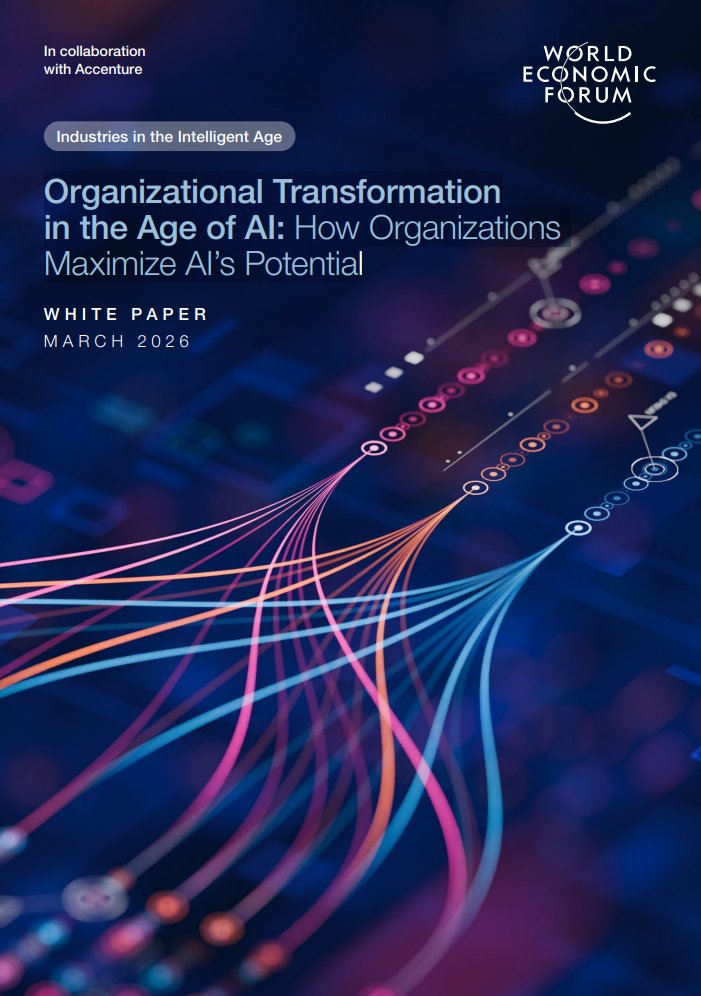
⬛️ Organizational Transformation in the Age of AI 🔷 Artificial intelligence has moved beyond curiosity and early experimentation. Across industries, organizations can point to measurable gains from adoption and are beginning to integrate AI into core enterprise workflows. 🔷 Organizational Transformation in the Age of AI: How Organizations Maximize AI's Potential examines how leading organizations are embedding AI across customer experience, operations, R&D, strategic planning and talent. 🔷 Drawing on insights from more than 450 executives in the World Economic Forum’s AI Transformation of Industries community, it highlights a shift from isolated use cases to connected systems, from episodic initiatives to continuous processes and from task automation to human value creation. 🔷 Five principles enable adoption at scale: 1⃣ Human accountability 2⃣ End-to-End operating model (redesign) 3⃣ Scalable talent systems 4⃣ Transparency-driven trust 5⃣ Disciplined experimentation ➡️ Together, they support sustained productivity, resilience and growth - provided organizations treat AI transformation not as a technology rollout, but as a fundamental shift in culture, leadership, and learning.✨ 🦋 @Khulood_Almani @AkwyZ @TamaraMcCleary @MaryRich78 @rwang0 @timo_vi @drsharwood @DrHolzwarth @HelenBevan @pierrecappelli @JimHarris @jenstirrup @GlenGilmore @subare @Ronald_vanLoon @enilev @Scobleizer @AndrewYNg @YuHelenYu #DigitalTransformation #AI #OrganisationalChange #Culture #People #Experimentation #Trust #DatadrivenWork #Industry #FutureOfWork ➡️ Download: tinyurl.com/4vsx284f | @wef
Thomas J. Dettling #DigitalTransformation tweet media
English
0
12
16
655
FemaleShift retweetledi
Thomas J. Dettling #DigitalTransformation
⬛️ The Essence of a Culture of Excellence in the Age of Digital Transformation “Excellence is not an aspiration. Excellence is the next five minutes.” — Tom Peters 🔷 A Culture of Excellence is far more than the pursuit of peak performance, operational efficiency, or the achievement of OKRs. Its true essence lies in a deeply shared inner mindset: a persistent, passionate commitment to creating meaningful impact for customers, society, and the organization itself - consistently, reflectively, and profoundly human-centered. Excellence is neither a fixed end state to be reached nor a time-bound program or initiative that can simply be “implemented.” It is a living, everyday culture, expressed in every meeting, every decision, and every interaction - in how people think, prioritize, decide, and act. 🔷 At its core, a Culture of Excellence integrates three central, deeply interwoven dimensions: radical ambition, continuous learning, and deep psychological safety. It challenges rather than pacifies or settles for compromise. It systematically transforms mistakes and setbacks into valuable learning opportunities instead of hiding or punishing them. And it creates an environment in which people have the courage and freedom to take real responsibility, ask uncomfortable questions, openly voice doubts, critically challenge ideas, and boldly explore new and unfamiliar paths - even when the outcome is uncertain. 🔷 Especially in the age of Digital Transformation, such a culture becomes a decisive strategic necessity. Digital technologies, artificial intelligence, automation, and data-driven systems not only increase technical complexity dramatically - they also accelerate decision-making to unprecedented speeds, drastically shorten development and innovation cycles, and make permanent uncertainty, volatility, and ambiguity the new normal. In such highly dynamic environments, true excellence can no longer be enforced through traditional control mechanisms, detailed master plans, or rigid hierarchies. Instead, it emerges from the intelligent use of collective intelligence, from open and trust-based dialogue across all levels, from deliberate and courageous experimentation, and from an organizational capability to learn from errors and failures faster and more systematically than competitors. 🔷 A Culture of Excellence therefore fundamentally shifts the organization’s focus: away from mere operational efficiency toward sustainable, tangible impact for all stakeholders; away from the sole emphasis on individual expertise toward the development of collective learning and adaptive capacity; and away from traditional hierarchical structures toward a culture shaped by mutual trust, clear accountability, and genuine psychological safety. 🔷 Leaders play a particularly decisive role in this transformation. They do not create excellence through top-down instructions, detailed specifications, or motivational PowerPoint presentations, but above all through authentic role modeling. This means listening deeply and actively, setting clear and ambitious expectations, openly acknowledging their own mistakes, and dealing with them constructively -through an honest “I was wrong here; let’s learn from this together,” or a sincere “What do you really think?” in critical moments. Such seemingly small gestures often have a stronger cultural impact than any formal initiative. 🔷 Ultimately, Digital Transformation is far less a purely technological challenge than a profoundly cultural one. Without a strong, living Culture of Excellence, even the most advanced technologies, algorithms, and tools remain mere instruments without sustainable impact - often expensive, yet ineffective. With such a culture, however, they become powerful, multiplicative levers for genuine and sustainable innovation, for significantly higher engagement and commitment, and for long-term, resilient success in an increasingly complex market environment. 🔷 Excellence, therefore, is not the result of successful digital transformation. It is its indispensable prerequisite—and its most powerful driver. Why? Digital transformation does not create excellence. Only in a culture of excellence can it truly succeed. 🦋 @tom_peters @Khulood_Almani @AkwyZ @TamaraMcCleary @MaryRich78 @rwang0 @timo_vi @drsharwood @DrHolzwarth @HelenBevan @pierrecappelli @JimHarris @jenstirrup @GlenGilmore @subare @Ronald_vanLoon @enilev @Scobleizer @AndrewYNg @YuHelenYu #CultureChange #FutureOfWork #People #Learning #Leadership #PsychologicalSafety #Behavior #Excellence #Innovation #DigitalTransformation Infographic by the great @tnvora
Thomas J. Dettling #DigitalTransformation tweet media
English
1
7
11
519
FemaleShift retweetledi
Thomas J. Dettling #DigitalTransformation
⬛️ The Cultural Foundations of Psychological Safety Introduction 🔷 An organization cannot mandate psychological safety; it can only enable it - or systematically prevent it. If psychological safety is to emerge seriously as a social property of the system, rather than as a well‑intentioned façade, organizational culture must meet a set of foundational conditions. These conditions go far beyond leadership tools, training programs, or value statements. They reflect deep cultural choices that become visible in everyday behavior. What follows is not a checklist, but a description of the cultural foundations required for psychological safety to take root and persist. 1⃣ Truth Over Harmony The most critical prerequisite for psychological safety is a culture in which truth is valued more highly than harmony. In many organizations, the opposite is true: loyalty, consensus, and appearing “professional” outweigh the articulation of uncomfortable realities. Conflict is avoided, tensions are smoothed over, and deviations are seen as disruption. 📢 Psychological safety requires people to say what they see, not just what is acceptable. Cultures that foster it understand that friction, dissent, and irritation are not signs of dysfunction, but signals of complexity. They distinguish clearly between personal rejection and substantive disagreement, and they do not socially sanction the latter. 📢 Where truth carries personal risk, psychological safety remains illusory. 2⃣ Separating the Person from the Contribution Psychological safety cannot develop where people are equated with their ideas, mistakes, or opinions. In many cultures, criticism of an idea is experienced as an attack on identity; errors are interpreted as character flaws; dissent is framed as disloyalty. Cultures that enable psychological safety establish a different norm: people have dignity; contributions have quality - and the two must be kept separate. This separation reduces identity defense and creates a social space where learning becomes possible. It shows up concretely in: 🔹 how feedback is phrased, 🔹 how mistakes are discussed, 🔹 whether the organization asks “Who caused this?” or “What in the system made this possible?” 📢 This is not a soft skill, but a core cultural standard. 3⃣ Power That Is Acknowledged, Not Denied Psychological safety does not emerge in the absence of power, but in contexts where power is used consciously and responsibly. Cultures that claim “hierarchy doesn’t matter here” often produce greater insecurity, because power continues to operate - only implicitly. Psychologically safe cultures acknowledge that: 🔹status exists, 🔹leaders carry disproportionate influence, and 🔹words, reactions, and silences from above matter more. The decisive question is not whether power exists, but how it is exercised. In enabling cultures, leaders use authority to reduce fear through clarity, fairness, and predictability, not through control or avoidance. Psychological safety requires mature power cultures, not only flat hierarchies. 4⃣ Learning Above Being Right - Including for Leaders Cultures that support psychological safety are fundamentally learning‑oriented. This does not mean abandoning accountability or commitment. It means that learning is structurally prioritized over defending positions. This becomes visible in whether: 🔹assumptions may be challenged, 🔹course corrections are seen as competence rather than weakness, 🔹leaders can integrate criticism without losing authority. 📢 If leaders must always be right, others cannot be honest. Psychological safety requires a culture in which not knowing, being wrong, and revising one’s view are legitimate states - even, and especially, for those in leadership roles. 5⃣ Errors as System Information, Not Moral Failure No organization can foster psychological safety while treating errors primarily as individual moral shortcomings. As long as mistakes are moralized, personalized, or made career‑relevant, openness remains irrational - regardless of official messaging. Cultures that truly enable psychological safety distinguish clearly between: 🔹learning errors in complex situations, and 🔹negligence or willful misconduct. Only then will people speak openly about mistakes without fearing social or professional harm. This distinction is a cultural competence, not a procedural detail, and it becomes most visible under pressure, scrutiny, or public attention. 📢 Psychological safety arises where errors are understood as information about the system, not deficiencies of individuals. 6⃣ Dissent That Matters, Not Just Exists Many organizations say, “You can speak up here.” Psychological safety begins only where dissent also has impact. Cultures that foster it: 🔹actively invite opposing views, 🔹protect minority opinions from social isolation, 🔹prevent symbolic or premature consensus. Not every idea is adopted — but every serious contribution is heard, examined, and dealt with explicitly. The key experience is that speaking up does not disappear into the void. Without this experience, openness fades quickly. 7⃣ Consistency Between Aspiration and Reality Psychological safety is extraordinarily sensitive to inconsistency. When values, leadership principles, or initiatives promise one thing while everyday behavior signals another, trust erodes faster than through open rigidity. Enabling cultures therefore display high everyday coherence: 🔹What actually happens when someone raises a critical issue? 🔹How does the system respond to bad news? 🔹Which stories circulate - about courage or compliance? Psychological safety is not created through communication, but through lived consequences in daily practice, especially when conditions are difficult. Conclusion 🔷 Psychological safety is not a quality of “good people.” It is the outcome of cultural choices that reveal themselves in everyday behavior - most clearly under pressure. #PsychologicalSafety #OrganizationalCulture #Leadership #CultureTransformation #LearningOrganization #GrowthMindset #LeadershipDevelopment #SystemsThinking #PowerAndLeadership #ErrorCulture #DecisionMaking #DigitalTransformation #Responsibility #Trust ✨ 🦋 @Khulood_Almani @AkwyZ @TamaraMcCleary @MaryRich78 @rwang0 @timo_vi @drsharwood @DrHolzwarth @HelenBevan @pierrecappelli @JimHarris @jenstirrup @GlenGilmore @subare @Ronald_vanLoon @enilev @Scobleizer @AndrewYNg @YuHelenYu Image by @thomas_dettling | @grok
Thomas J. Dettling #DigitalTransformation tweet media
English
0
6
13
590
FemaleShift retweetledi
Thomas J. Dettling #DigitalTransformation
⬛️ Organization of the Future: 6 Shifts to build an agentic Organization Note: #Blog4Managers is for managers who want to understand and actively shape transformation -concise, relevant, and grounded in practice. #DigitalTransformation #Skills #Education #AI #People #Leadership #Organization #FutureOfwork #ValueCreation 🌱 ✨ @Khulood_Almani @AkwyZ @TamaraMcCleary @MaryRich78 @rwang0 @timo_vi @drsharwood @DrHolzwarth @HelenBevan @pierrecappelli @JimHarris @jenstirrup @GlenGilmore @subare @Ronald_vanLoon @enilev @Scobleizer @phinifa @AndrewYNg @jamesvgingerich @YuHelenYu
Thomas J. Dettling #DigitalTransformation@thomas_dettling

⬛️ The Six Critical Shifts Toward the Agentic Organization of the Future 🔷 Artificial intelligence - especially agentic AI - is fundamentally reshaping how organizations work, make decisions, and create value. In its article “Six shifts to build the agentic organization of the future,” McKinsey argues that - 📢 "Companies must now rethink workflows, roles, leadership, structures, and culture to capture the full potential of this new technological era." 1⃣ Workflow Shift: End-to-End Redesign, AI-First Many organizations still treat AI as an add‑on, producing only modest productivity gains. The real breakthrough comes when work is redesigned AI-first, domain by domain, starting from the desired outcomes. Humans are then brought in deliberately where their unique strengths matter - judgment, empathy, creativity. This redesign breaks down silos, reduces transaction costs, and unlocks trapped value across the enterprise. 2⃣ Talent Shift: A New Human–Agent Frontier Once workflows change, roles must evolve as well. People will no longer work with tools but with agents -as colleagues. Jobs shift toward hybrid interfaces that combine human expertise with autonomous systems. This becomes the foundation for a new, co‑intelligent workforce model. 3⃣ Leadership Shift: Leading in an Agentic Era Leadership roles must also transform. Instead of overseeing operational tasks, leaders orchestrate a human–agent ecosystem - focused on speed, scalability, safety, and the responsible integration of AI‑based decision-making throughout the organization. 4⃣ Skill & Culture Shift: Continuous Reinvention An agentic organization requires a culture of ongoing learning, adaptation, and experimentation. McKinsey calls this mindset “continuous reinvention.” Employees develop not only AI fluency but skills in collaboration, system thinking, sense‑making, and critical evaluation - moving far beyond simple tool usage. 5⃣ Structural Shift: Organizing Around Value, Not Hierarchy Organizational structures move away from traditional functional hierarchies toward value‑stream‑oriented, modular designs that seamlessly integrate AI agents. Teams combine human and agentic capabilities with clearly defined accountability for outcomes. 6⃣ People Systems Shift: Education as the Engine of AI Transformation The People Systems Shift becomes a central driver of transformation. Culture, roles, career paths, performance systems, talent processes, and workforce planning all need to be reimagined for an AI‑enabled future. Through continuous education and development, leaders and talents evolve into the architects of the human–agent operating model, ensuring long‑term adaptability, organizational learning, and workforce resilience. ➡️ Why These Six Shifts Matter Transforming into an agentic organization is far more than implementing new technology. It requires companies to reconfigure their entire operating system - from how work is designed, to how people collaborate, to how decisions are made and value is generated. McKinsey describes this as the most significant organizational shift since the industrial and digital revolutions. ➡️ Agentic organizations achieve: dramatically faster decision-making, major efficiency improvements, new innovation potential, and a more resilient organizational core. Those who adopt these shifts early will gain a structural advantage in the AI era 💡 @Khulood_Almani @AkwyZ @MaryRich78 @rwang0 @timo_vi @drsharwood @TamaraMcCleary @DrHolzwarth @HelenBevan @pierrecappelli @JimHarris @mikeflache @jenstirrup @GlenGilmore @subare @Ronald_vanLoon @enilev @Scobleizer @AndrewYNg @YuHelenYu @McKinsey #ArtificialIntelligence #AgenticAI #People #Skills #AgenticOrganization #ChangeManagement #OrganizationDesign #Talent #Leadership #Culture #Skills #FutureOfWork

English
1
5
8
507
FemaleShift retweetledi
Thomas J. Dettling #DigitalTransformation
Thomas J. Dettling #DigitalTransformation@thomas_dettling

⬛️ Digital Dexterity: Why the Real Bottleneck in Transformation Isn’t Technology 🔷 Companies are investing billions in cloud, data platforms, and AI - yet many still struggle to make real progress. The reason is less surprising than it is uncomfortable: The biggest obstacle isn’t the technology itself, but the organization’s ability to use it effectively. A recent MIT Sloan research article* highlights why digital dexterity - the workforce’s ability to adapt and work productively with new technologies - is becoming a decisive competitive advantage. 🔷 Digital dexterity means people are willing and able to adopt new tools quickly, work with data, and collaborate across functions while continuously learning. This capability doesn’t emerge from tool training alone but from a culture that rewards curiosity, experimentation, and customer‑centric thinking. According to the research, four elements make the difference: 🔹 1. Reframing. Effective leaders see transformation as a cultural and organizational shift - not an IT project. They create the conditions for data‑informed decisions, cross‑functional collaboration, and continuous learning. 🔹2. Top‑down engagement. CEOs and C‑suites who experiment themselves, use data, and understand AI use cases break down resistance across the workforce. Digital transformation cannot be delegated💡 🔹 3. Bridging. Strong leaders act as translators across silos, generations, and mindsets. They demystify technology, address fears, and create psychological safety. 🔹 4. Long‑term commitment. Culture change takes years. Digital dexterity grows through continuous upskilling, not one‑off initiatives. Organizations must be ready to let go of outdated practices and anchor new ways of working. 📢 Technology becomes more powerful every year - but its value depends entirely on how people use it. Organizations that build digital dexterity are not investing in tools; they are investing in future capability. Transformation starts with leadership mindset and ends with a learning, courageous organization. Source: ➡️ MIT Sloan Management Review | Feb 17, 2026: “Why Digital Dexterity Is Key to Transformation” #DigitalTransformation #Leadership #AI #People #CultureChange #DigitalDexterity #OrgDesign #ChangeLeadership #FutureOfWork @Khulood_Almani @AkwyZ @TamaraMcCleary @MaryRich78 @rwang0 @timo_vi @drsharwood @DrHolzwarth @HelenBevan @pierrecappelli @JimHarris @jenstirrup @GlenGilmore @subare @Ronald_vanLoon @enilev @Scobleizer @AndrewYNg @YuHelenYu ✨ ➡️ Image by @Thomas_dettling | Mastering the Waves of Digital Change

English
0
3
6
172
FemaleShift retweetledi
Thomas J. Dettling #DigitalTransformation
⬛️ If you’re looking for more depth on digital transformation, check out my #Blog4Managers. I believe in reading a lot, practicing focused deep work - and watching a good video now and then. I’d recommend one of the best short videos on digital transformation (updated in 2023) by futurist Gerd Leonhard, who focuses on change, AI, and the human side of transformation. #DigitalTransformation #Change #People #Data #AI #Leadership #SystemThinking #FutureOfWork 💡 @gleonhard 🦋 @Khulood_Almani @AkwyZ @TamaraMcCleary @MaryRich78 @rwang0 @timo_vi @drsharwood @DrHolzwarth @HelenBevan @pierrecappelli @JimHarris @jenstirrup @GlenGilmore @subare @Ronald_vanLoon @enilev @Scobleizer @AndrewYNg @YuHelenYu Are you ready for exponential change? youtu.be/ystdF6jN7hc?si… via @YouTube
YouTube video
YouTube
English
0
6
6
366
FemaleShift retweetledi
Thomas J. Dettling #DigitalTransformation
⬛️ #Blog4Managers Why Sustainable Transformation Requires Co-Creation 📢 #Blog4Managers is for managers who want to understand and actively shape transformation -concise, relevant, and grounded in practice. 🔷 In practice, transformation initiatives rarely fail due to a lack of technology. More often, they fail because organizational units do not collaborate effectively. Different logics, priorities, and languages prevent existing knowledge from being integrated in a meaningful way. This is exactly where co-creation comes in - not as a one-off engagement format, but as a dialogic way of working. 🔷 A defining characteristic of co-creation is the deliberate decision not to start with solutions. Instead, the process begins with shared questions: What problem are we actually trying to solve? Where do analog-digital frictions appear in day-to-day work? Where have transitions into the digital world already begun - and what is holding them back from progressing further? How would we recognize that a change is truly effective? 🔷 This structured dialogue at eye level creates transparency. It reduces coordination overhead, fosters mutual understanding, and makes implicit functional, digital, or cultural tensions visible -tensions that often remain overlooked in traditional requirements or handoff processes. 🔷 Research on cross-organizational learning and the social construction of knowledge (e.g., Chris Argyris & Donald Schön, Ikujiro Nonaka) shows that sustainable change emerges less from formal directives and more from shared sense-making and collective problem-solving. Accordingly, a purely analytical, logic-driven approach is often insufficient in practice. Co-creation becomes effective particularly when the process is professionally facilitated - by individuals who structure the dialogue, integrate diverse perspectives, and actively support the transition from analysis to action. 🔷 A central element in this approach is experimentation. Instead of developing comprehensive concepts upfront, small, testable prototypes are intentionally created, jointly tested, and reflected upon. This aligns with established insights from agile organizational and innovation research: learning occurs iteratively - through experience, feedback, and adaptation. “Start small – scale fast” is less a method than a mindset. 🔷 This approach also fosters ownership. Challenges are not externalized but addressed collectively. Ownership emerges where participants experience that their perspectives are taken seriously and translated directly into tangible solutions. Co-creation therefore impacts not only processes or systems, but also organizational culture: functional silos are reduced, and collaboration becomes a shared act of creation. 🔷 Once prototypes are validated and their value becomes tangible in everyday work, the conditions for further development fundamentally change. Optimizations can be made in a targeted way. Scaling does not primarily occur through argumentation or formal decision-making, but on the basis of shared experience. In this sense, co-creation proves to be not an additional engagement format, but a powerful lever to initiate transformation, anchor learning processes, and increase speed of execution. 📢 Dialogue before solutions. Partnership over assumptions. Learning over perfection. 🔷 Under these conditions, co-creation becomes a robust principle of organizational renewal - independent of industry, structure, or level of maturity. 🦋 @Khulood_Almani @AkwyZ @TamaraMcCleary @MaryRich78 @rwang0 @timo_vi @drsharwood @DrHolzwarth @HelenBevan @pierrecappelli @JimHarris @jenstirrup @GlenGilmore @subare @Ronald_vanLoon @enilev @Scobleizer @AndrewYNg @YuHelenYu #CoCreation #Transformation #OrganizationalChange #People #Trust #Leadership #Collaboration #Innovation #Systemthinking #DigitalTransformation Image by @thomas_dettling | @grok
Thomas J. Dettling #DigitalTransformation tweet media
English
0
6
7
262
FemaleShift retweetledi
Thomas J. Dettling #DigitalTransformation
Thomas J. Dettling #DigitalTransformation@thomas_dettling

⬛️ What comes after a Digital Transformation? 🔶 People often ask me what comes after a digital transformation and how companies can recognize that a phase has truly been completed. But the question itself contains a certain blur. More precisely, the real question is: When is a transformation phase complete - and when does the next one begin? 🔶 Many organizations look for a clear endpoint. Yet transformation is often mistakenly treated like a project: with a start, milestones, and a defined finish. In reality, it is a capability that an organization acquires - a kind of organizational metabolism that continuously works, adapts, and responds to new impulses. And still, the individual phases of this metabolism do have clearly identifiable transitions. 📢 "Digital transformation does not end. But its phases do." @thomas_dettling ➡️ A transformation phase is complete when the old state will not return. You can recognize this on three levels: 1⃣ Technology. Technology is no longer running as a special program, pilot, or strategic initiative; it has become the organization’s everyday operating system. Data, automation, AI, and digital platforms are no longer being “introduced” - they are used, expanded, and integrated. The organization no longer debates whether it should become more digital - it already is. Technological adaptability has become part of normal operations. 2⃣ Culture. A new form of collaboration emerges. Cross-functional teams, transparent decision-making processes, and technology-oriented leadership are no longer limited to innovation pockets but have become everyday practice. Employees adjust their behavior because previous patterns have lost their effectiveness. Only when this new behavior becomes socially stable - meaning it no longer depends on specific individuals - has the phase reached its maturity. 3⃣ Value Creation. The changes generate real economic impact. Digital business models create genuine value, time-to-market decreases, and innovation arises from the interplay of business, technology, and data. Value creation no longer follows the logic of silos but the logic of integrated, digitally driven flows. ➡️ What follows when these three areas have become stable? Not another “digital transformation.” Rather, the next dimension of development, eg.: 🔸from digital, data-enabled organizations to AI-driven organizations 🔸 from AI-driven organizations to agile, highly adaptive organizations 🔸 from adaptive organizations to intelligent, self-organizing ecosystem organizations 📢 "The real milestone of transformation is not implementation. It is irreversibility." @thomas_dettling ➡️ Transformation itself never ends - but its phases do. A phase ends the moment the new state is robust enough for the next step to emerge 💡 @rwang0 @Khulood_Almani @timo_vi @drsharwood @TamaraMcCleary @AkwyZ @MaryRich78 @DrHolzwarth @HelenBevan @pierrecappelli @JimHarris @jenstirrup @GlenGilmore @subare @Ronald_vanLoon @enilev @Scobleizer @AndrewYNg @YuHelenYu #People #DigitalTransformation #AI #Maturity #AITransformation #FutureOfWork #Leadership #ChangeManagement #Innovation #Agility #Adaption #OrganizationalDevelopment #Disruption #Leadership #BusinessModel #EnterpriseAI #DigitalLeadership #Strategy #ValueCreation ✨ Image by @thomas_dettling | GPT 5.3

English
0
5
6
354
FemaleShift retweetledi
Thomas J. Dettling #DigitalTransformation
⬛️ #Blog4Managers is for managers who want to understand and actively shape transformation -concise, relevant, and grounded in practice. 🔹Instead of consuming fragmented insights, this series focuses on what truly matters: real challenges, tested approaches, and actionable learning from everyday management practice. 🔹I share what I explore, experiment with, and refine - so we can collectively move forward in modernizing our organizations and economy. #DigitalTransformation #AI #Leadership 🦋 @AkwyZ @TamaraMcCleary @MaryRich78 @rwang0 @timo_vi @drsharwood @DrHolzwarth @HelenBevan @pierrecappelli @JimHarris @jenstirrup @GlenGilmore @subare @Ronald_vanLoon @enilev @Scobleizer @phinifa @AndrewYNg @jamesvgingerich @YuHelenYu
Thomas J. Dettling #DigitalTransformation@thomas_dettling

⬛️ This question still exists in management: “And who, please, is supposed to take care of my digital transformation? I don’t have time for that.” 🔷 Digital transformation refers to the strategic, cultural, and organizational shift enabled by digital technologies. It goes far beyond the introduction of new tools and requires, above all, a new way of working and thinking, because the biggest part of our digital transformation is the way we think and work. 🔷 A central element of this transformation is the handling of data: companies must not only collect data but use it meaningfully. Without data integration- meaning the connection, cleaning, and consolidation of different data sources - digitalization remains fragmented. Only integrated, high‑quality data enables meaningful automation, powerful AI applications, better decisions, and entirely new business models. 🔷 This creates the foundation for data‑based working: a style of working and decision‑making in which data is systematically used to manage processes, test hypotheses, generate insights, and make fact‑based decisions. Data‑based working combines data, technology, and human judgment into a continuous learning and improvement process across the entire organization. To achieve this, companies need a modern digital infrastructure - digital tools, cloud, platform, network, and security architectures that can scale flexibly and enable innovation. 🔷 However, technology is not the core of transformation, because the thing that’s transforming is not the technology - it’s the technology that is transforming you. When digital transformation is consistently implemented, it creates real value and not just “a faster version of an old process. Yet the path to this value looks far less like the smooth, straight line we wish for- and far more like the messy, obstacle‑filled reality shown on the slide. 🔷 Digital transformation is not a pleasant Sunday ride; it is a demanding journey that requires persistence, reflection, and the willingness to leave old habits behind. Progress depends on shifting from document‑driven work to data‑driven work, from leadership lip service to authentic, human‑centered leadership, and from “we’ve always done it this way” to a mindset of continuous learning and adaptation. Embracing this reality - its detours, setbacks, and learning curves - enables managers to build the capabilities that truly matter: human + AI collaboration, psychological safety, genuine gratitude, living values at work, actionable feedback, and trust-building storytelling. 📢 Only when companies - and every manager within them - accept the real terrain of transformation, rather than wishing for a straight path, can they unlock the full potential of digital technologies and shape a future where people, data, and technology grow stronger together 💡 @Khulood_Almani @AkwyZ @MaryRich78 @rwang0 @timo_vi @drsharwood @TamaraMcCleary @kerstingAIML @DrHolzwarth @HelenBevan @pierrecappelli @JimHarris @jenstirrup @GlenGilmore @subare @Ronald_vanLoon @enilev @Scobleizer @AndrewYNg @YuHelenYu @phinifa 💐 Please welcome @phinifa to this excellent community of experts 💙 #DigitalTransformation #Leadership #DigitalTools #DataIntegration #AI #AgenticAI #Mindset #DataBasedWork #CultureChange #DigitalLeadership #HumanAICollaboration #FutureOfWork

English
0
5
3
329
FemaleShift retweetledi
Thomas J. Dettling #DigitalTransformation
⬛️ SpaceX’s IPO Would Make It a Top 10 Company Globally 🔷 If SpaceX lists near $1.75 trillion, it would surpass Saudi Aramco’s roughly $1.7 trillion debut in 2019, making it the largest IPO by valuation in history. 🔷 For context, that valuation would be more than double the size of JPMorgan, the largest U.S. bank, and Eli Lilly, the world’s largest pharmaceutical company. 🔷 SpaceX already handles over half of all global orbital launches. In addition to its reusable rockets, it operates Starlink, the world’s largest satellite internet network 🚀 @Khulood_Almani @AkwyZ @TamaraMcCleary @MaryRich78 @rwang0 @timo_vi @drsharwood @DrHolzwarth @HelenBevan @pierrecappelli @JimHarris @jenstirrup @GlenGilmore @subare @Ronald_vanLoon @enilev @Scobleizer @AndrewYNg @YuHelenYu @SpaceX #Satellite #Companies #Markets #Economy #OrbitalLaunch #Success #Communication #FutureIntelligence #AI #Data #Innovation📡 ➡️ Data from Companies Market Cap [tinyurl.com/ym3h9hp6] - Global Stock Rankings and @Bloomberg as of April 1, 2026: The largest U.S. companies include Nvidia, Apple, Alphabet, Microsoft, and Amazon, alongside international giants like TSMC and Saudi Aramco.
Thomas J. Dettling #DigitalTransformation tweet media
English
1
9
16
420
FemaleShift retweetledi
Thomas J. Dettling #DigitalTransformation
⬛️ #Blog4Managers is for managers who want to understand and actively shape transformation -concise, relevant, and grounded in practice. 🔹Instead of consuming fragmented insights, this series focuses on what truly matters: real challenges, tested approaches, and actionable learning from everyday management practice. 🔹I share what I explore, experiment with, and refine - so we can collectively move forward in modernizing our organizations and economy. 🔹We all need to push harder to modernize and advance our economy. Transformation is a lengthy but worthwhile process, and mutual support has become a valuable asset. My small - but highly capable - community will certainly continue to support this effort. ✨@Khulood_Almani @AkwyZ @TamaraMcCleary @MaryRich78 @rwang0 @timo_vi @drsharwood @DrHolzwarth @HelenBevan @pierrecappelli @JimHarris @jenstirrup @GlenGilmore @subare @Ronald_vanLoon @enilev @Scobleizer @phinifa @AndrewYNg @jamesvgingerich @YuHelenYu#DigitalTransformation #AI #Leadership🦋
Thomas J. Dettling #DigitalTransformation@thomas_dettling

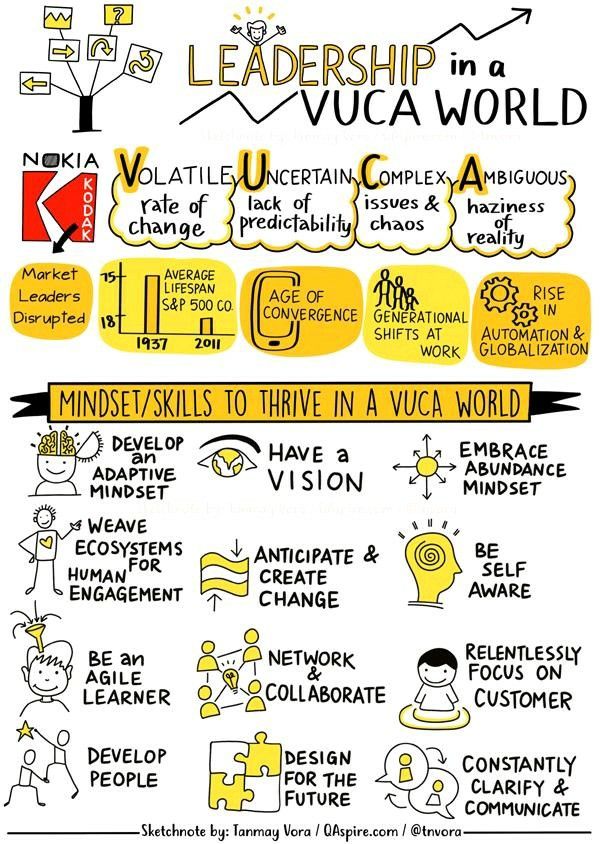
⬛️ Leading in a VUCA World: Why Awareness Matters More Than Speed 🔶 Leading in a VUCA world requires more than speed. It demands a fundamental shift in mindset- away from the illusion of stability and toward embracing change as the new normal. Volatility, Uncertainty, Complexity, and Ambiguity are no longer abstract concepts; they define the daily reality of leadership. I believed we had already internalized this. I assumed conversations about adaptability, continuous learning, and leadership as a role model were well established. I thought we had moved on - toward execution, impact, and measurable outcomes. But we have not. 🔶 In workshops, leadership dialogues, and coaching sessions, a different picture emerges. Many leaders are operating at full capacity- constantly reacting, solving, delivering. There is little time left for reflection, and even less for learning. And this is exactly where the real challenge lies💡 🔶 Because the capabilities we associate with effective leadership in a VUCA world- adaptability, collaboration, empathy, trust - do not develop under constant pressure. They require space. They require awareness. So how do we create that space? Not through more tools, frameworks, or complexity. But through deliberate deceleration. In one recent workshop, I introduced something simple: paper notebooks and pens. Each morning began with 30 minutes of uninterrupted thinking- no devices, no input, just reflection. Participants used the time to sketch ideas, connect dots, and step back from the noise. For many, it became the most valuable part of the day. 🔶 This experience highlights a critical insight: leadership development does not happen only through action- it happens through reflection on action. Without moments to process, we remain reactive. With them, we begin to see patterns, make better decisions, and act with intention. The real capability in a VUCA world is not (more and more) speed - it is awareness. 📢 Awareness allows leaders to navigate complexity without being overwhelmed. It enables empathy in times of uncertainty, builds trust in ambiguity, and supports clarity in chaos. We don’t need more tools. We need more thinking. More space. And leadership that not only reacts - but consciously shapes the future. @Khulood_Almani @AkwyZ @TamaraMcCleary @MaryRich78 @rwang0 @timo_vi @drsharwood @DrHolzwarth @HelenBevan @pierrecappelli @JimHarris @jenstirrup @GlenGilmore @subare @Ronald_vanLoon @enilev @Scobleizer @AndrewYNg @YuHelenYu#Leadership #VUCA #Speed #Awareness #Trust #Complexity #SystemThinking #Empathy #Dialogue #Learning #Innovation 💫 Infographic by the great @tnvora 💛

English
0
5
6
339
FemaleShift retweetledi
Thomas J. Dettling #DigitalTransformation
Thomas J. Dettling #DigitalTransformation@thomas_dettling

⬛️ 📢 "Transformation isn’t a project!" 🔶 Researchers have analyzed more than 250,000 scientific studies on the topic of change and transformation in organizations that have been published over the past 30 years - and validated the research findings in practice. This has resulted in a unique study that I would like to briefly outline here: 🔶 The Fraunhofer study “Effectively Leading Transformation” shows that an organization’s ability to transform has become the central competitive factor today. Technological leaps (AI, robotics, quantum computing) are colliding with companies that often cannot keep pace structurally or culturally. The result: transformation remains fragmented and generates too little impact. 🔶 The key lies in a systemic approach. Transformation is not a single project but the interaction of several dimensions. Fraunhofer identifies five core success factors in its "FORTE" model: 1⃣ Leadership & Governance: A clear strategy, accountability at top management level, and adaptive steering are essential. 2⃣ Organizational Culture & Collaboration: Transformation succeeds only through participation, a learning culture, and the ability to innovate. 3⃣ Resources & IP: Knowledge, capital, and intellectual property become strategic assets. 4⃣ Technology & Data: Data‑driven decisions and broad use of digital technologies are mandatory. 5⃣ Ecosystem & Market: Networks, partnerships, and external collaboration increase adaptability. 📢 ”A central problem is that many organizations still treat transformation as a temporary project. In reality, it is an ongoing task - the “new normal.” 🔶 Classical programs or transformation departments often reach their limits: they are too expensive, too isolated, or too reactive. The study therefore calls for a new transformation architecture: lean, continuous, and firmly embedded across the organization. Leadership must share responsibility, actively involve employees, and enable learning. What matters is not the perfect roadmap but the ability to continuously adapt. 🔶 With the "Fraunhofer Transformation Index", the study provides a data‑driven instrument that highlights strengths, weaknesses, and concrete levers. The goal: moving away from gut feeling toward measurable and steerable transformation. 📢Core message: Successful transformation does not result from isolated measures but from the interplay of strategy, culture, technology, and ecosystem. Those who manage change systematically secure their long‑term competitiveness. Transformation is not a project. It is a continuous process of adaptation💡 @Khulood_Almani @AkwyZ @TamaraMcCleary @MaryRich78 @rwang0 @timo_vi @drsharwood @DrHolzwarth @HelenBevan @pierrecappelli @JimHarris @jenstirrup @GlenGilmore @subare @Ronald_vanLoon @enilev @Scobleizer @AndrewYNg @YuHelenYu @PhilippKnauer2 @iaostuttgart#Transformation #Leadership #People #Culture #Technology #Data #Strategy #FutureOfWork #Skills #OKRs #SystemsThinking #Competitiveness

QME
0
1
2
87
FemaleShift retweetledi
Thomas J. Dettling #DigitalTransformation
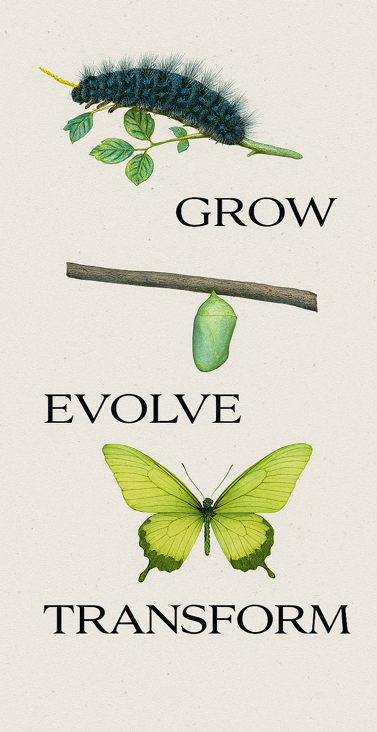
⬛️ Digital Transformation – Why We Must Finally Take It Seriously | #Blog4Managers Intro 🔷 For years, companies have been talking about digital transformation. The term appears on almost every strategy slide deck, every conference agenda, and every leadership offsite. Yet behind the glossy presentations and the multitude of pilot projects, many organizations still think, decide, and operate in a fundamentally analog way. With every day that passes without meaningful change, competitiveness silently erodes. 1⃣ Changing work and markets The world is not merely changing faster – it is changing in fundamentally different ways. Customers now expect seamless digital services, highly personalized experiences, and immediate responses. Technologies such as artificial intelligence, automation, and the cloud are advancing exponentially, while many companies continue to progress in linear steps. The gap between what is possible and what organizations actually deliver is widening with every passing month. 🔷 This is not only a question of markets. Talent expectations have shifted profoundly as well. People seek modern ways of working, a genuine sense of purpose, continuous opportunities to learn and grow, and a level of flexibility that traditional hierarchical structures often cannot provide. Organizations that stubbornly cling to rigid processes and command-and-control mindsets risk losing not only their innovative capacity, but also their attractiveness as employers. 📢 Digital Transformation Is Not an IT Project One of the most persistent and dangerous misconceptions in this field is the belief that digital transformation is primarily a technology initiative. It is not. Technology can powerfully accelerate change, but it cannot create the change itself. The true transformation is cultural and organizational in nature. 🔷 It demands a fundamental rethinking of leadership – moving away from control toward trust, genuine empowerment, and clarity in decision-making. It requires practicing real agility: the ability to act quickly, to adapt based on actual data and deep customer insight, and to simplify decision paths across the organization. And it calls for building a genuine learning organization, where experimentation is not the exception but the norm, and where mistakes are treated as valuable sources of learning rather than something to be punished or hidden. 🔷 Far too many organizations underestimate the depth of this shift. They invest significant resources in new tools and platforms, yet fail to address the necessary changes in behavior, governance structures, leadership mindset, and daily ways of working. Digital transformation, understood correctly, is the strategic, cultural, and organizational evolution enabled by digital technologies. It reaches far beyond the mere introduction of new software or systems. 2⃣ The Role of Data A central element of this evolution is the intelligent handling of data. Companies must move beyond simply collecting data to using it in a meaningful, integrated way. Without proper data integration – the systematic connection, cleansing, and consolidation of information from disparate sources – any form of digitalization remains fragmented and ultimately limited in its impact. 🔷 Only when data is of high quality and flows seamlessly can it truly enable automation, artificial intelligence, better decisions, and entirely new business models. This integration forms the foundation for what we call data-driven working: a mode of operation in which data, technology, and human judgment come together in a continuous cycle of learning, hypothesis testing, insight generation, and fact-based decision-making that spans the entire organization. 🔷 Of course, a modern digital infrastructure – consisting of selected tools, cloud platforms, a unified data model, secure networks, and co-created and scalable architectures – is necessary to support this journey. Yet we must never forget that technology itself is not the heart of transformation. As MIT Sloan School of Management has observed: 📢 “Clearly, the thing that’s transforming is not the technology – it’s the technology that is transforming you.” When digital transformation is approached with consistency and depth, it creates genuine value – not merely a faster version of yesterday’s processes. As George Westerman from MIT so aptly put it: 📢 “When digital transformation is done right, it’s like a caterpillar turning into a butterfly.” 🦋 3⃣ The Real Question The Real Question Is No Longer “Do We Need Digital Transformation?” Every serious organization already knows the answer to that question. The far more relevant and urgent question today is: “Can we survive without it?” The time for excuses, incremental pilots, and half-hearted initiatives is over. Digital transformation is not a temporary trend. It has become a fundamental survival strategy in a dynamic environment that no longer rewards those who merely adapt slowly. 🔷 The Smart Path Forward: Start Small – Scale Fast 🔹Begin with an honest self-assessment. Identify your core processes, review and question your value streams, update or eliminate outdated processes, and digitize operations step by step. 🔹Automate routine tasks wherever it makes sense – not to reduce headcount, but to free up valuable human capacity for value creation. 🔹Experiment deliberately with artificial intelligence. Leverage large language models such as GPT, Copilot, or Gemini to enhance productivity, creativity, and innovation. 🔹Sketch an initial, simple digitization landscape. Clarify digital tools, understand data flows, define data standards, map inputs and outputs, and establish basic data visualization approaches. 🔹Build a culture where technology and people reinforce each other. 🔹Lead by example with clarity, empathy, and trust. Conclusion Transformation does not ultimately fail because of technology. It fails when organizations hesitate to make necessary decisions, lack the discipline to follow through, resist changing long-established behaviors, and shy away from challenging outdated structures and power dynamics. Those who find the courage to engage deeply and act consistently today will not merely keep up – they will help shape the future 🦋 🦋 @Khulood_Almani @AkwyZ @TamaraMcCleary @MaryRich78 @rwang0 @timo_vi @drsharwood @DrHolzwarth @HelenBevan @pierrecappelli @JimHarris @jenstirrup @GlenGilmore @subare @MITSloan @MIT @Ronald_vanLoon @enilev @Scobleizer @AndrewYNg @YuHelenYu 🦋 #DigitalTransformation #DataDriven #AI #FutureOfWork #OrganizationalCulture #Leadership #Empathy #Agility #ChangeManagement #Innovation #Transformation #DeepWork #Blog4Managers Image by @thomas_dettling | @grok @xai
Thomas J. Dettling #DigitalTransformation tweet media
English
0
7
7
317
FemaleShift retweetledi
Thomas J. Dettling #DigitalTransformation
⬛️ Leading in a VUCA World: Why Awareness Matters More Than Speed 🔶 Leading in a VUCA world requires more than speed. It demands a fundamental shift in mindset- away from the illusion of stability and toward embracing change as the new normal. Volatility, Uncertainty, Complexity, and Ambiguity are no longer abstract concepts; they define the daily reality of leadership. I believed we had already internalized this. I assumed conversations about adaptability, continuous learning, and leadership as a role model were well established. I thought we had moved on - toward execution, impact, and measurable outcomes. But we have not. 🔶 In workshops, leadership dialogues, and coaching sessions, a different picture emerges. Many leaders are operating at full capacity- constantly reacting, solving, delivering. There is little time left for reflection, and even less for learning. And this is exactly where the real challenge lies💡 🔶 Because the capabilities we associate with effective leadership in a VUCA world- adaptability, collaboration, empathy, trust - do not develop under constant pressure. They require space. They require awareness. So how do we create that space? Not through more tools, frameworks, or complexity. But through deliberate deceleration. In one recent workshop, I introduced something simple: paper notebooks and pens. Each morning began with 30 minutes of uninterrupted thinking- no devices, no input, just reflection. Participants used the time to sketch ideas, connect dots, and step back from the noise. For many, it became the most valuable part of the day. 🔶 This experience highlights a critical insight: leadership development does not happen only through action- it happens through reflection on action. Without moments to process, we remain reactive. With them, we begin to see patterns, make better decisions, and act with intention. The real capability in a VUCA world is not (more and more) speed - it is awareness. 📢 Awareness allows leaders to navigate complexity without being overwhelmed. It enables empathy in times of uncertainty, builds trust in ambiguity, and supports clarity in chaos. We don’t need more tools. We need more thinking. More space. And leadership that not only reacts - but consciously shapes the future. @Khulood_Almani @AkwyZ @TamaraMcCleary @MaryRich78 @rwang0 @timo_vi @drsharwood @DrHolzwarth @HelenBevan @pierrecappelli @JimHarris @jenstirrup @GlenGilmore @subare @Ronald_vanLoon @enilev @Scobleizer @AndrewYNg @YuHelenYu#Leadership #VUCA #Speed #Awareness #Trust #Complexity #SystemThinking #Empathy #Dialogue #Learning #Innovation 💫 Infographic by the great @tnvora 💛
Thomas J. Dettling #DigitalTransformation tweet media
English
1
11
14
952
FemaleShift retweetledi
Thomas J. Dettling #DigitalTransformation
Digital Transformation is not only about Data and Technology, it's about People and Culture. Digital transformation is interpreted, understood, and practiced very differently. Clarifying this with the leadership team and 50 Data/AI-experts was essential. My task - in Partnering with @PhilippKnauer2 - over the past four days was to reassess and reprioritize all tools, developments, and applications managed by the departments, understand the needs of the customers, and define a strategic positioning that can be translated into a clear roadmap, smart plans and OKRs to create outcomes. What a great time. Now I'm on the way home 🚄 #DigitalTransformation #Strategy #Data #Leadership #People #OKRs #Impact @AkwyZ @jenstirrup @jsprondel @Khulood_Almani @MaryRich78 @subare @DrHolzwarth
Thomas J. Dettling #DigitalTransformation tweet mediaThomas J. Dettling #DigitalTransformation tweet media
English
1
10
11
328
FemaleShift retweetledi
Thomas J. Dettling #DigitalTransformation
⬛️ + + + Happy International Women's Day + + + “Men have island competencies, women are holistic problem‑solvers.” Without the amazing women, nothing would work in any organization. They are the ones who hold everything together - in hospitals, care facilities, kindergartens, schools, public administrations, companies, universities, parliaments, and in families. In many difficult situations, they are the best decision‑makers and the ones who keep a cool head. No amount of gratitude is enough. And this should be said to them - and recognized - not only on International Women’s Day.❤️ @Khulood_Almani @TamaraMcCleary @MaryRich78 @DrHolzwarth @jenstirrup @HelenBevan @subare @enilev @YuHelenYu @womensday💫 cc @AkwyZ @timo_vi @pierrecappelli @JimHarris @GlenGilmore @drsharwood @Ronald_vanLoon @rwang0 @Scobleizer @AndrewYNg #InternationalWomensDay #IWD2026
Thomas J. Dettling #DigitalTransformation tweet media
English
0
7
14
306