frol.near

4.5K posts

frol.near banner
frol.near

frol.near

@Freol

Rust and NEAR Protocol, NEAR AI, IronClaw technical evangelist building @TrezuApp

Ukraine, Kharkiv Katılım Ekim 2009
228 Takip Edilen1.8K Takipçiler
mert
mert@mert·
@ilblackdragon wow finally he starts bullposting his chain again
English
8
2
65
7.1K
Trezu
Trezu@TrezuApp·
Your Trezu treasury can now earn yield on @rhea_finance! Rhea is NEAR's most powerful DeFi hub, bringing together swaps, lending, and yield under one roof with over $130M in TVL. Just connect your treasury as a wallet directly in their UI and start earning on assets you're already holding. Live now on our new Earn page 😎
English
3
7
23
3.2K
frol.near
frol.near@Freol·
Crypto hacks, supply chain attacks, major web framework hacks, Linux root privilege escalation, and now we are at VM escapes... I announce the era of offline desktop/CLI apps running on Internet-less devices!
V12@v12sec

today we are releasing a qemu escape

English
1
2
21
7.9K
NEAR Protocol
NEAR Protocol@NEARProtocol·
42% of all activity on near.com in the last 30 days was confidential. Six weeks ago, that number was zero. The curve is bending.
GIF
English
17
75
470
90.5K
frol.near
frol.near@Freol·
@TrezuApp 💯 Went confidential 6 weeks ago with near(dot)com for private use and then migrated to confidential multisig for my projects
English
0
0
7
109
Trezu
Trezu@TrezuApp·
42% of activity went confidential in six weeks. That's the signal. If your treasury is still fully public, you're the exception now, not the default. Get your confidential multisig at trezu.org
NEAR Protocol@NEARProtocol

42% of all activity on near.com in the last 30 days was confidential. Six weeks ago, that number was zero. The curve is bending.

English
1
5
17
778
USDC
USDC@USDC·
USDC 🤝 @near_ai USDC is now live in the NEAR AI Agent Market. Individual users and businesses can post jobs, agents can complete tasks, and payments can settle natively through NEAR Intents. With USDC supported through Confidential Intents, AI agents can transact with a transparent dollar-denominated stablecoin without exposing transaction details, counterparties, or financial relationships across 34+ networks. near.ai/blog/usdc-conf…
USDC tweet media
English
33
68
375
167K
International Cyber Digest
International Cyber Digest@IntCyberDigest·
❗️🚨 BREAKING: Researchers used Mythos Preview to find the first public macOS kernel memory corruption exploit on Apple's M5 silicon, they give a glimpse into Mythos say it’s really powerful. Apple spent five years and an estimated several billion dollars building Memory Integrity Enforcement (MIE), the hardware-assisted memory safety system built around ARM's MTE. It was the flagship security feature of the M5 and A19, designed specifically to kill the entire memory corruption bug class. Researchers from Calif built a working exploit in five days. According to Apple's own research, MIE disrupts every public exploit chain against modern iOS, including the recently leaked Coruna and Darksword kits. Calif walked into Apple Park this week and handed over the report in person. Full 55-page technical report drops after Apple patches the vulnerability.
International Cyber Digest tweet mediaInternational Cyber Digest tweet media
English
130
706
6.7K
3.3M
frol.near
frol.near@Freol·
WE ARE SHIPPING
Trezu@TrezuApp

Your Trezu treasury can now earn yield on @rhea_finance! Rhea is NEAR's most powerful DeFi hub, bringing together swaps, lending, and yield under one roof with over $130M in TVL. Just connect your treasury as a wallet directly in their UI and start earning on assets you're already holding. Live now on our new Earn page 😎

English
2
1
18
1.1K
frol.near
frol.near@Freol·
frol.near@Freol

What you want is to compare web frameworks based on how many tweets they can post. Such benchmarks are only relevant to Twitter team, not to Django / Flask / PHP devs. I invite you to learn about web framework benchmarks: techempower.com/benchmarks/ Benchmarks are for developers who can understand how to interpret the results and it gives the baseline. Good benchmarks are those that provide all the assumptions, conditions, and that try to add as much of real-world context in the setup as possible, but not more than necessary. Comparing how many NEAR Intents swaps a chain can handle is not a completely helpful benchmark. What does NEAR's 1M TPS benchmark mean? x.com/NEARProtocol/s…. It means that @NEARProtocol can handle 1M basic operations per second, it also shows that horizontal scaling works as expected (not like multithreading in Python, and does not hit the ceiling like any other blockchain), and so the chain can actually scale even beyond that.

QME
0
0
0
9
DBCrypto
DBCrypto@DBCrypt0·
@Freol I will just leave this here:
DBCrypto@DBCrypt0

I said no chain can handle 1M real TPS and got a lot of pushback But most people don't even understand how TPS benchmarks actually work They’re run in local environments with a handful of nodes Zero real-world latency. Using simple native token transfers (or even minimal/no-op txs) Occasionally they go global…but still with basic transactions only Here’s the math ⬇️ A basic transaction is cheap Sending native ETH (or SOL, etc.) from wallet A to B is ~21,000 gas on Ethereum Minimal compute and tiny data That’s what most TPS benchmarks are measuring Now try a real DeFi swap: ETH → token ABC on Uniswap Now you’re at 100k-150k+ gas 5-10x the resources Run that swap through an aggregator (1inch, Jupiter, etc.) with multiple hops, approvals, routing? Easily 300k–1M+ gas/compute. Often 10-50x and sometimes 100x+ the resources of a simple transfer Now look at flash loans, MEV bundles, leveraged positions, NFT bundles? Those can all get even larger. One complex tx can consume the resources of dozens of basic ones And that’s just one category and how all chains operate We also have liquidations, cross-chain bridges with messages, restaking loops, governance executions, account abstraction batches… No chain in the world has ever been stress-tested at scale with a real mix of these transactions Because the demand simply isn’t here yet This is why many chains that claimed “tens or hundreds of thousands of TPS” ran into congestion, failed txs, and degraded performance at just a fraction of those numbers We’ve seen it countless times when surges expose the gap between lab tests and reality A handful of chains have solid infrastructure and could scale up faster than others to meet real demand Maybe by adding more nodes, shards, hardware, or with various tweaks. Some that could happen relatively quickly. But not a single live chain today could handle sudden real-world demand hitting 1 million TPS TPS without transaction complexity is just marketing. Every chain knows it. Most just hope you don't.

English
1
0
1
43
DBCrypto
DBCrypto@DBCrypt0·
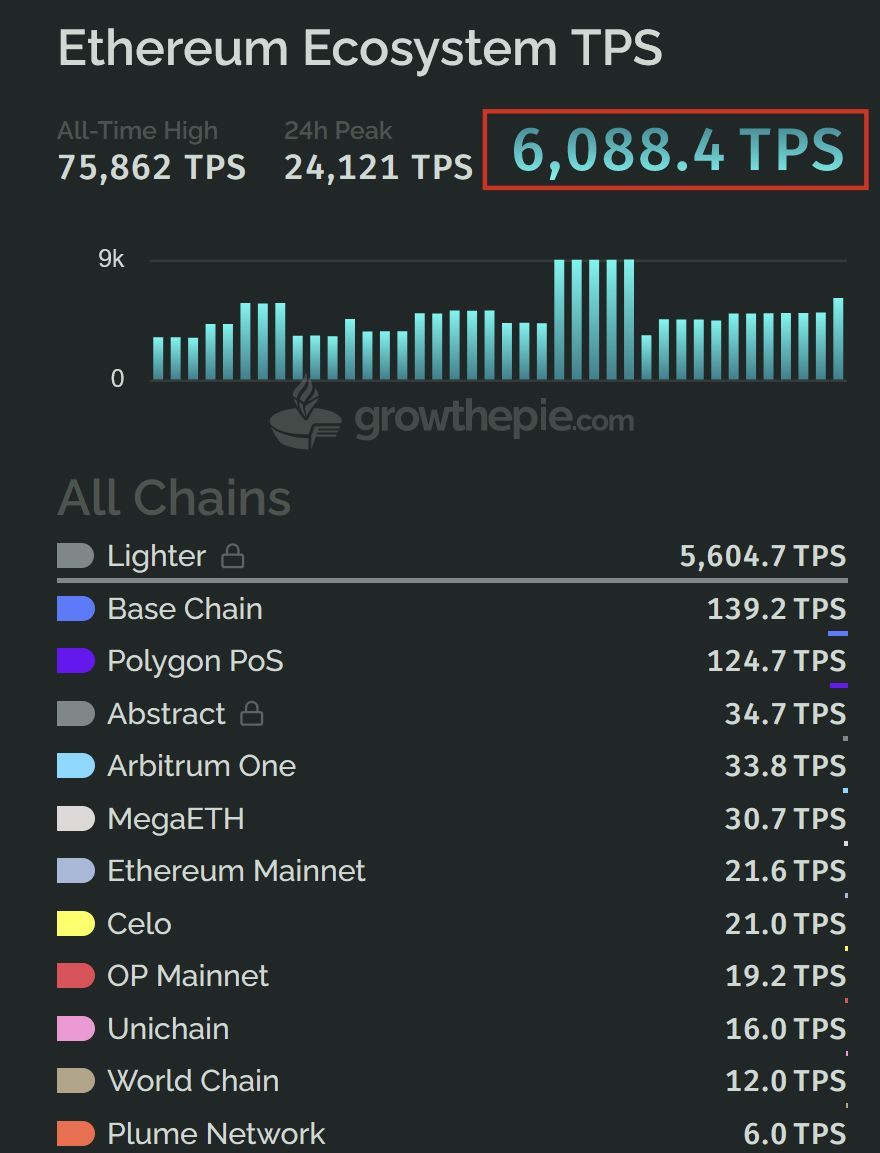
🚨 Ethereum is doing 6,088 TPS 3-4x Visa. We're winning! Except 5,600+ of those TPS come from one chain And that chain counts free order cancellations And everything elseas transactions Meaning bots can spam orders and cancellations endlessly driving up TPS for little to no cost Just like a user placing and canceling orders on a CEX except we don’t celebrate those as TPS The chain is Lighter which is an app specific ZK rollup, purpose-built as a perps DEX 92% of Ethereum's celebrated throughput all off-chain with a centralized DEX… Its metric is UOPS or user operations per second Every micro-op processed by an off-chain sequencer Order placements Cancellations Fills Margin adjustments Liquidations Same trader placing and canceling the same order in a loop = Multiple UOPS HFT bots cycling place/cancel/replace on a zero-fee platform with active incentive programs? All counted 😂 On May 11, the sequencer went silent for 7 hours 42 minutes too No state updates while the 6,088 TPS headline was being shared as proof Ethereum lapped Visa 🤦‍♂️ With a whopping 93% uptime over 30 days One day down per week on the chain holding 92% of your comparison Oh, and let’s not forget that L2Beat classifies Lighter as Stage 0 Direct quote from their risk analysis: "Funds can be stolen if a contract receives a malicious code upgrade. There is no delay on code upgrades." So it is labeled CRITICAL since it is 100% centralized But yeah, let’s go ahead and celebrate the Ethereum ecosystem doing “6000 TPS” This is why no one takes us seriously and honestly, no one should
Francesco Andreoli ᵍᵐ@francescoswiss

Wow, the ethereum ecosystem is currently processing 6,088 TPS across the entire stack (L1 & L2S), 3-4x that of Visa, in real time, on permissionless rails. Visa averages is ~1,700 TPS fyi Thanks @growthepie_eth and @LeonWaidmann for the data!

English
5
4
43
5.7K
frol.near
frol.near@Freol·
What you want is to compare web frameworks based on how many tweets they can post. Such benchmarks are only relevant to Twitter team, not to Django / Flask / PHP devs. I invite you to learn about web framework benchmarks: techempower.com/benchmarks/ Benchmarks are for developers who can understand how to interpret the results and it gives the baseline. Good benchmarks are those that provide all the assumptions, conditions, and that try to add as much of real-world context in the setup as possible, but not more than necessary. Comparing how many NEAR Intents swaps a chain can handle is not a completely helpful benchmark. What does NEAR's 1M TPS benchmark mean? x.com/NEARProtocol/s…. It means that @NEARProtocol can handle 1M basic operations per second, it also shows that horizontal scaling works as expected (not like multithreading in Python, and does not hit the ceiling like any other blockchain), and so the chain can actually scale even beyond that.
English
0
0
0
25
DBCrypto
DBCrypto@DBCrypt0·
I said no chain can handle 1M real TPS and got a lot of pushback But most people don't even understand how TPS benchmarks actually work They’re run in local environments with a handful of nodes Zero real-world latency. Using simple native token transfers (or even minimal/no-op txs) Occasionally they go global…but still with basic transactions only Here’s the math ⬇️ A basic transaction is cheap Sending native ETH (or SOL, etc.) from wallet A to B is ~21,000 gas on Ethereum Minimal compute and tiny data That’s what most TPS benchmarks are measuring Now try a real DeFi swap: ETH → token ABC on Uniswap Now you’re at 100k-150k+ gas 5-10x the resources Run that swap through an aggregator (1inch, Jupiter, etc.) with multiple hops, approvals, routing? Easily 300k–1M+ gas/compute. Often 10-50x and sometimes 100x+ the resources of a simple transfer Now look at flash loans, MEV bundles, leveraged positions, NFT bundles? Those can all get even larger. One complex tx can consume the resources of dozens of basic ones And that’s just one category and how all chains operate We also have liquidations, cross-chain bridges with messages, restaking loops, governance executions, account abstraction batches… No chain in the world has ever been stress-tested at scale with a real mix of these transactions Because the demand simply isn’t here yet This is why many chains that claimed “tens or hundreds of thousands of TPS” ran into congestion, failed txs, and degraded performance at just a fraction of those numbers We’ve seen it countless times when surges expose the gap between lab tests and reality A handful of chains have solid infrastructure and could scale up faster than others to meet real demand Maybe by adding more nodes, shards, hardware, or with various tweaks. Some that could happen relatively quickly. But not a single live chain today could handle sudden real-world demand hitting 1 million TPS TPS without transaction complexity is just marketing. Every chain knows it. Most just hope you don't.
English
21
6
52
9.4K
Francesco Andreoli ᵍᵐ
Francesco Andreoli ᵍᵐ@francescoswiss·
Wow, the ethereum ecosystem is currently processing 6,088 TPS across the entire stack (L1 & L2S), 3-4x that of Visa, in real time, on permissionless rails. Visa averages is ~1,700 TPS fyi Thanks @growthepie_eth and @LeonWaidmann for the data!
Francesco Andreoli ᵍᵐ tweet media
English
22
14
99
23.3K