FuelAustralia.org

56 posts

FuelAustralia.org banner
FuelAustralia.org

FuelAustralia.org

@FuelAustralia

An independent fuel security researcher — looking for solutions to the Australian fuel crisis Strategic intel, tanker tracking, and fuel reserve monitoring

Australia Katılım Nisan 2026
31 Takip Edilen5K Takipçiler
Sabitlenmiş Tweet
FuelAustralia.org
FuelAustralia.org@FuelAustralia·
Australia is the largest importer of diesel fuel in the world. It also holds the lowest fuel reserves of any IEA member nation — dead last out of 28 developed economies. Japan stockpiles 260 days. We're at ~26 and falling. Six of eight refineries have closed since 2013. We import over 90% of our refined fuel, mostly through a single chokepoint that's been closed for 37 days. I built fuelaustralia.org to track what's actually happening — in real time, from primary sources: — Live AIS tanker tracking (750+ vessels, 40+ confirmed inbound) — Government reserve data direct from DCCEEW Power BI — 90-day depletion projections with vessel delivery modelling — Daily intelligence briefings synthesised from 80+ sources — Cargo type inference, multi-source vessel fusion, confidence grading — 28 evidence-backed policy solutions stress-tested against expert review Every data point sourced. Every claim confidence-graded. Independent and non partisan. Follow @FuelAustralia for daily briefings.
FuelAustralia.org tweet media
English
59
424
1.6K
53.1K
FuelAustralia.org
FuelAustralia.org@FuelAustralia·
When I said "we can" I meant it. If you're dropping comments and suggestions, I'm listening. I'm running them through my research pipeline to check the feasibility and evidence -- if it holds up, I'm integrating it into the solutions on the site. If it doesn't, I'm amending accordingly. The goal is the most accurate data informing the best solutions -- short and long term. Not defending positions. If the evidence says data is wrong, I change the site.
FuelAustralia.org@FuelAustralia

This started because I wanted to know if my family's Easter camping trip was going to get cut short by diesel shortages in regional areas. I couldn't find a straight answer anywhere. So I built something to answer it myself. Tanker tracking, live reserve data from a range of sources, daily briefings — all open, all free. I'm one person. No sponsors, no agenda, no ads. Just data. From the messages I've received, it's clear Australians want honest information — and want to work together to fix this. We can.

English
2
2
45
1.7K
FuelAustralia.org
FuelAustralia.org@FuelAustralia·
My research pushes back a bit on CTL being dirt cheap. The real-world data tells a different story: Sasol Secunda emits ~56 Mt CO2/year -- the single largest point source of greenhouse gas on Earth. That's roughly 6-7 kg CO2 per litre of product, approximately 2.5x the lifecycle emissions of conventional petroleum (DOE/NETL). Under Australia's Safeguard Mechanism trajectory (baselines declining 4.9%/year): at AUD $50/t carbon, that adds $0.30-0.35/L to CTL. At $100/t, $0.60-0.65/L. At $150/t, $0.90-1.00/L. E-fuels reach cost parity with CTL at roughly AUD $70-160/t carbon, depending on the e-fuel cost trajectory. That range is projected for Australia in the mid-2030s to early 2040s. The market has already priced this in. Sasol's share price is down 84% from its 2022 peak -- R35B in impairments on Secunda, zero dividends, negative free cash flow. Every CTL project proposed in Australia has been cancelled: Linc Energy (QLD), Monash Energy (VIC), Altona Resources (SA). The only country actively building new CTL is China ($24B Hami project, CHN Energy) -- driven by state-backed energy security logic to reduce crude import dependency from 73%, not market economics. They have state financing and zero carbon pricing. No private investor in a carbon-priced economy will fund new CTL. On the GTL side, Shell Pearl only works because Qatar provides the gas at effectively $0/GJ. At Australian domestic gas prices ($10-15/GJ), feedstock alone runs ~$70/bbl before any operating or capital costs. Both Shell and Chevron proposed Australian GTL in the 2000s and abandoned them. I think we actually agree more than it seems. The page has three tiers: (1) electrify everything possible, (2) ammonia for shipping, (3) e-fuels only for what nothing else can power -- aviation, military, remote agriculture, legacy fleet. I'm not arguing e-fuels should replace diesel in passenger vehicles. Your point about electrification being the answer for most transport is exactly what Tier 1 says. The disagreement narrows to: for that irreducible 30-40% that batteries can't reach, is the answer (a) keep importing fossil fuels forever, (b) CTL, or (c) e-fuels? I argue (c) because it solves both sovereignty and emissions, even though it costs more today. CTL solves sovereignty but creates a stranded asset under any credible carbon pricing trajectory. Continued imports solve nothing -- as this crisis has demonstrated. The article you linked reaches the right conclusion on CTL but didn't have much cost and emissions evidence -- my research suggests the case against CTL is stronger than it presents. But it also should have been clearer about the efficiency penalty and the cost gap from the start. Updated now -- appreciate the push!
English
0
0
0
11
FuelAustralia.org
FuelAustralia.org@FuelAustralia·
Appreciate this -- genuinely. I just ran this through the pipeline. You're right that the e-fuel cost case needed tightening, and I've updated the Made in Australia page tonight based on your critique. What I changed: - Added an explicit section on the thermodynamic efficiency penalty. E-fuels are ~10-13% well-to-wheel vs ~70-80% for BEVs -- a 5-7x gap. E-fuels should be reserved for sectors where batteries can't substitute, not deployed where electrification works. - The $1.50/L figure was on the page as the eFuel Alliance's projection -- I should have been much clearer that's an industry lobby number (members include Porsche and ExxonMobil), not my estimate. The independent analyses I rely on are $2.50-4.50/L (ICCT, Agora, Ueckerdt et al. 2021) -- consistently 2-3x higher. I've made that distinction much sharper now. Also flagged that electrolyser system costs in 2024-25 remain 2-4x above what many 2030 cost models assume. - Rewrote the CTL section with hard numbers rather than generalities. Made the timeline explicitly conditional rather than inevitable, with caveats on cost curves and policy dependency. Your core chemistry point is correct: syngas from coal/gas is cheaper than syngas from electrolysis + DAC. The FT step is identical. On pure production cost without carbon pricing, CTL beats e-fuels for years, possibly decades. I say that directly on the page now.
English
2
0
2
30
Aidan Morrison
Aidan Morrison@FootnotesGuy·
I missed this... 😅 Slick website, and some credible data I think. But can't find any names/organisations attached? And look... The "Long-Term" ambition is about 100% renewables. Phasing out fossil fuels. Including e-fuels!!! Ie: solar + wind + electrolysers water = hydrogen hydrogen plus CO2 (scrubbed from air?) + more energy = syngas... then Fisher Tropsch... Then refining, then fuel. I can't wait to come back to some of the back-of-envelope analysis on that stuff. It will make the coal conversions look extremely cheap.
Aidan Morrison tweet media
Aidan Morrison@FootnotesGuy

Cool tracker! Indeed. The diesel issue is clear.

English
8
2
33
2.5K
FuelAustralia.org
FuelAustralia.org@FuelAustralia·
Agree -- the ban is a policy choice, not a law of physics. And the 15-year timeline is an argument to start sooner, not to dismiss it. I find SMR tech genuinely promising -- Rolls-Royce got UK regulatory approval March 2026, and Australia holds a large chunk of the global uranium reserves. The site rates it feasibility low because of where we are today (zero infrastructure, no regulatory framework), not because the tech isn't sound. For this crisis, it's too late. For the next one, it could be part of the answer.
English
1
0
1
20
LambDownUnder
LambDownUnder@LambDownUnder·
I love how people point to the legislative ban as some roadblock to having nuclear power like we can never ever touch it. Timeline is long, but we can either start today, or continue to have this conversation in another 15 years. Yes, nuclear is not a substitute for liquid fuels. For large cargo ships SMR's are the solution but that comes with a whole host of proliferation and control risks and likely DOA.
English
1
0
1
18
Ben Beattie
Ben Beattie@EnergyWrapAU·
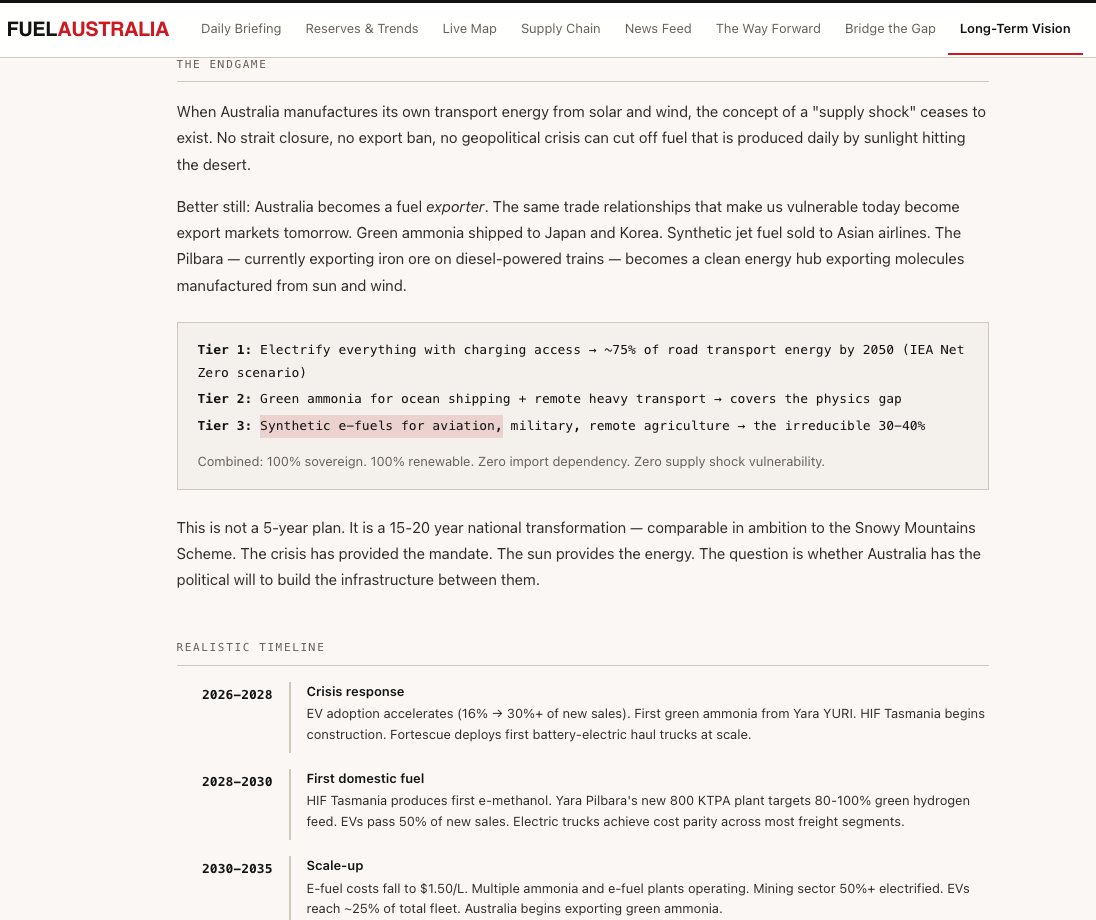
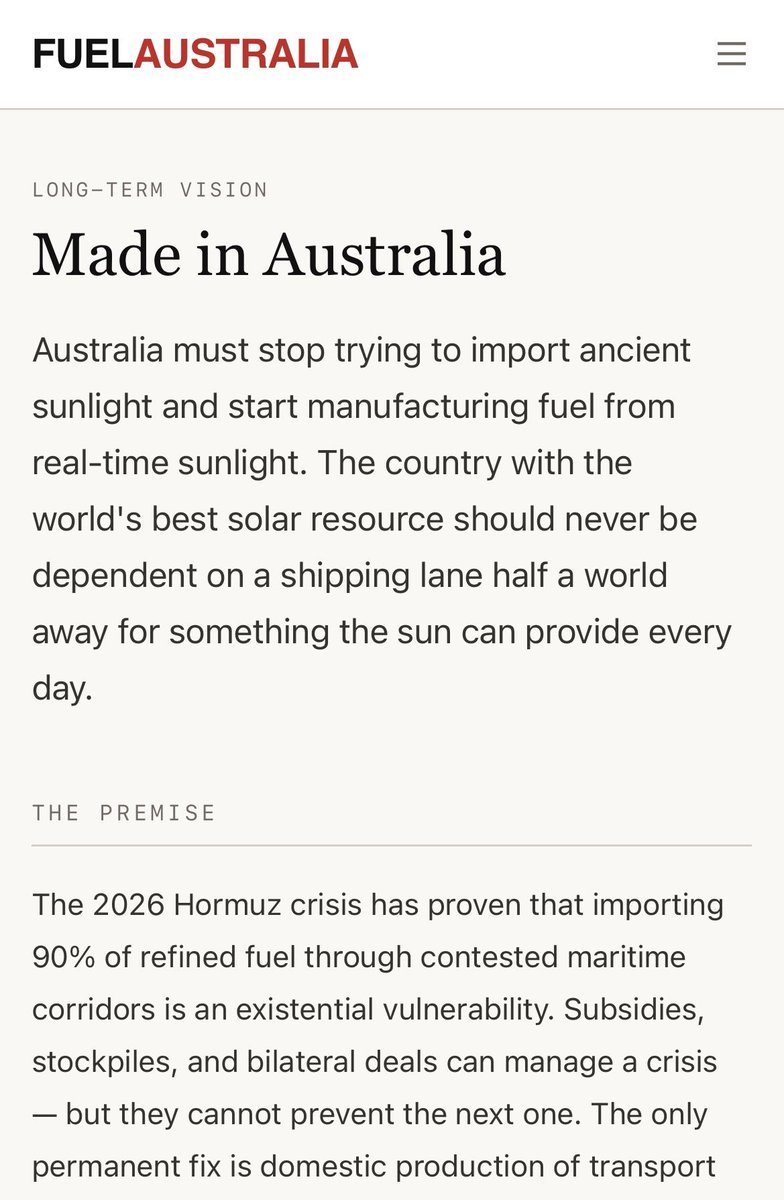
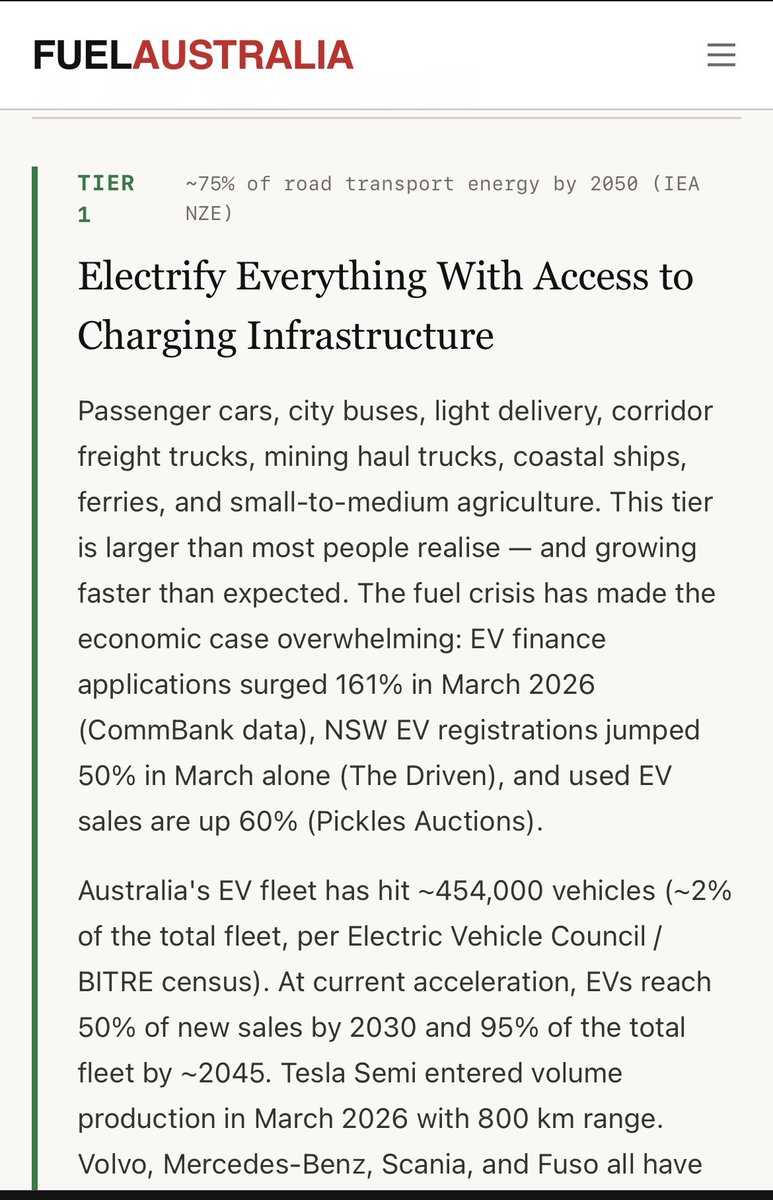
Hello FuelAustralia.org I like your data but your website pushes an impossible ideology that believes the country should be fuelled almost exclusively from wind and sun while heavy transport is electrified. fuelaustralia.org/made-in-austra…
Ben Beattie tweet mediaBen Beattie tweet media
FuelAustralia.org@FuelAustralia

Australia is the largest importer of diesel fuel in the world. It also holds the lowest fuel reserves of any IEA member nation — dead last out of 28 developed economies. Japan stockpiles 260 days. We're at ~26 and falling. Six of eight refineries have closed since 2013. We import over 90% of our refined fuel, mostly through a single chokepoint that's been closed for 37 days. I built fuelaustralia.org to track what's actually happening — in real time, from primary sources: — Live AIS tanker tracking (750+ vessels, 40+ confirmed inbound) — Government reserve data direct from DCCEEW Power BI — 90-day depletion projections with vessel delivery modelling — Daily intelligence briefings synthesised from 80+ sources — Cargo type inference, multi-source vessel fusion, confidence grading — 28 evidence-backed policy solutions stress-tested against expert review Every data point sourced. Every claim confidence-graded. Independent and non partisan. Follow @FuelAustralia for daily briefings.

English
1
1
35
1.9K
FuelAustralia.org
FuelAustralia.org@FuelAustralia·
Nuclear is on the site -- it's a full action item under The Way Forward (SMRs, long-term). Rated feasibility LOW, but higher impact (6/10). Every action is stress-tested on both scales: feasibility (can it actually be done, how fast, what are the barriers) and impact (how many ML/day does it add or save). Nuclear scores high on impact but low on feasibility because Australia has zero nuclear infrastructure, a legislative ban, and CSIRO estimates a minimum 15-year timeline. The core point: nuclear generates electricity, same as solar -- you still need the same conversion to make liquid fuel (electrolysis > hydrogen > ammonia or FT synthesis). The site ranks by what can realistically be deployed. Solar is already here and cheaper. fuelaustralia.org/gov-actions
English
1
0
1
14
LambDownUnder
LambDownUnder@LambDownUnder·
@EnergyWrapAU @FuelAustralia It gets better. They don't even acknowledge nuclear. The most dense energy source we have. Human civilization does not progress by going down the energy density scale.
English
1
0
1
14
FuelAustralia.org
FuelAustralia.org@FuelAustralia·
Agreed -- and it's on the site. Australia has ~440 ML/yr ethanol capacity (only 40% utilised), exports ~500,000 tonnes of tallow annually that could become domestic biodiesel, and the Northern Oil Gladstone project is targeting 200 ML/yr from sugarcane bagasse ($150M, QLD Government funded). The problem is the honest scale is only able to meet ~2-3% of national demand -- it won't replace 161 ML/day of consumption on its own. But the plus side is it's 100% sovereign, zero chokepoint risk, and uses waste streams that already exist. The real value of biofuels isn't volume -- it's that no foreign power can blockade Australian tallow and bagasse. Therefore, it should be part of the stack alongside electrification, green ammonia, and e-fuels. see the fuelaustralia.org/gov-actions page for details.
English
0
0
0
96
Karin Stark
Karin Stark@karinstark79·
@FuelAustralia What about long term planning for domestic production of biofuels, renewable diesel? Lots of ag waste can be used. Resilience costs money so we need to be investing into these options too.
English
1
0
0
122
FuelAustralia.org
FuelAustralia.org@FuelAustralia·
Here's the part nobody's talking about in the fuel crisis. It doesn't matter how many tankers we divert to Australia if there's nowhere to put the fuel when it arrives. Our total national fuel storage: ~7.5 billion litres. The IEA 90-day obligation requires ~14.5 billion. That's a 7 billion litre gap that existed long before Hormuz closed. The crisis didn't create the shortage — it exposed a storage deficit we've been ignoring for a decade. Building permanent tank farms takes 3-5 years and costs $1,500-3,000 per cubic metre. Too slow. The fastest fix? Industrial fuel bladders. Military-grade pillow tanks — up to 760,000 litres each — deployed on flat ground in weeks. Unused airfields, mine sites, military bases. The ADF already uses them. NATO uses them. The mining industry uses them across the Pilbara. 3,000 bladders = ~2.3 billion litres of emergency storage. That's ~14 extra days of national fuel supply. Deployable in 3-6 months. Cost: $150-300 million. All in. For context, the fuel excise cut alone costs $1.5 billion per month. We're spending more on a discount at the bowser every two weeks than it would cost to build the emergency storage that prevents the next crisis. It's a rubber bag on a concrete pad. It's not glamorous. But it's the only thing that moves fast enough. I've modelled the full storage gap at fuelaustralia.org/bridge-the-gap
FuelAustralia.org tweet media
English
33
136
445
25.4K
FuelAustralia.org
FuelAustralia.org@FuelAustralia·
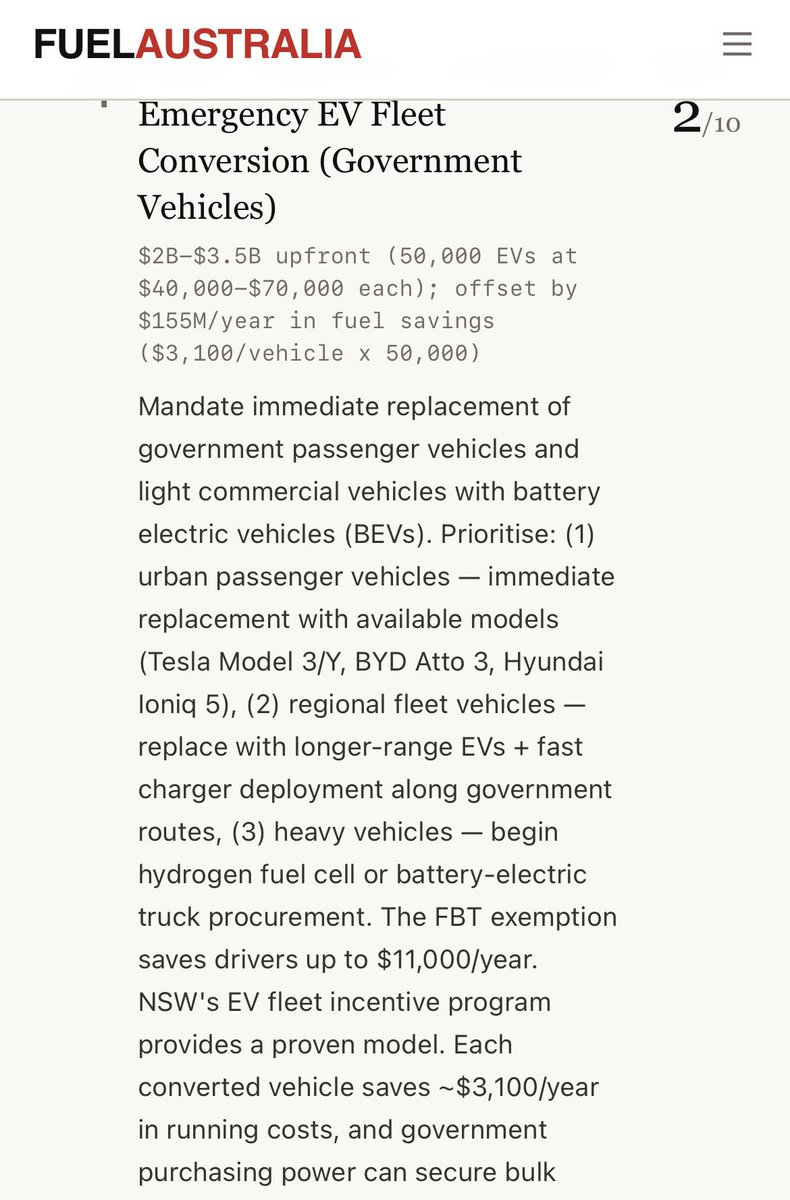
@EnergyWrapAU Agreed. Tiny impact -- see 2/10 scoring. Way down the list of solutions. But thrown it in there as technically every little bit helps...
English
1
0
2
42
Ben Beattie
Ben Beattie@EnergyWrapAU·
@FuelAustralia This one is just swapping reliance on one product for another. EVs have their benefits in some situations, but blanket targets and mandates don’t help anything.
Ben Beattie tweet media
English
2
0
3
87
FuelAustralia.org
FuelAustralia.org@FuelAustralia·
Well, Australia's historic peak was ~847,000 bpd across 8 refineries. Singapore alone refines ~1.5M bpd -- nearly double our entire peak. They closed because small Australian refineries couldn't compete on margins with Asian mega-refineries like Jamnagar (1.4M bpd). In other words, it's cheaper to import finished product than refine here. Of the 6 that closed, 2 are demolished, 1 is being demolished, and 3 were converted to import terminals. None can restart. The FSSP subsidy keeps the last two (Lytton and Geelong) alive. Rebuilding conventional refining just shifts the dependency from imported fuel to imported crude. Australia has something most countries don't -- the world's best solar resource, land, and wind. The smarter play is manufacturing fuel domestically from those, not shipping in more oil to process...
English
1
2
10
521
TypeArc
TypeArc@TypeArc130327·
@FuelAustralia Can you pass this info on to all the mouth breathers demanding Albo re establish an oil refining industry? And if possible indicate the scale of Singapore’s refining capacity v Australia’s historic peak refining capacity?
English
2
0
1
525
FuelAustralia.org
FuelAustralia.org@FuelAustralia·
The PM is heading to Singapore to secure fuel supplies. Singapore is Australia's largest source of refined fuel — my tracking shows multiple active tanker routes from Jurong/Pulau Bukom to Kwinana and the east coast. But Singapore is a refiner, not a producer. Their crude feedstock comes from the Middle East, West Africa, and SE Asia — much of it transiting the same chokepoints under pressure right now. Securing the refinery relationship matters. But it's important to note that if Singapore's own inputs are disrupted, there's nothing to refine. The real question is what's upstream of Singapore.
Anthony Albanese@AlboMP

We're working with our international partners to keep fuel flowing for Australians.

English
27
47
243
17.4K
FuelAustralia.org
FuelAustralia.org@FuelAustralia·
Not pointless. I think we just need to be realistic this may not fully plug the gap. Singapore does source crude from West Africa, the Americas, and Russia via Pacific routes, not just Hormuz. The Strait of Malacca is open. So although Hormuz disruption does reduce some of their feedstock, Singapore's refining capacity is ~1.5M bpd and it's already our largest single source of refined fuel. The visit is hopefully about ensuring we stay at the front of the queue for what they do produce...
English
3
0
6
474
FuelAustralia.org
FuelAustralia.org@FuelAustralia·
Partly, yes — EV finance is up 161% since the crisis started (CommBank data), and electrification will handle the majority of road transport by 2050. But diesel is 92 ML/day of our 161 ML/day consumption — trucks, agriculture, mining, shipping. Batteries can't touch ocean freight (a single trans-Pacific voyage needs 80,000-120,000 tonnes of batteries even at the best density in production). The full picture is at fuelaustralia.org/made-in-austra…
English
2
0
2
314
FuelAustralia.org
FuelAustralia.org@FuelAustralia·
Australia is the largest importer of diesel fuel in the world. It also holds the lowest fuel reserves of any IEA member nation — dead last out of 28 developed economies. Japan stockpiles 260 days. We're at ~26 and falling. Six of eight refineries have closed since 2013. We import over 90% of our refined fuel, mostly through a single chokepoint that's been closed for 37 days. I built fuelaustralia.org to track what's actually happening — in real time, from primary sources: — Live AIS tanker tracking (750+ vessels, 40+ confirmed inbound) — Government reserve data direct from DCCEEW Power BI — 90-day depletion projections with vessel delivery modelling — Daily intelligence briefings synthesised from 80+ sources — Cargo type inference, multi-source vessel fusion, confidence grading — 28 evidence-backed policy solutions stress-tested against expert review Every data point sourced. Every claim confidence-graded. Independent and non partisan. Follow @FuelAustralia for daily briefings.
FuelAustralia.org tweet media
English
59
424
1.6K
53.1K
Anthony Albanese
Anthony Albanese@AlboMP·
We're working with our international partners to keep fuel flowing for Australians.
English
803
113
736
62.3K
FuelAustralia.org
FuelAustralia.org@FuelAustralia·
Nice work. And interesting conclusion on increasing traffic. Can you confirm where the ships your analyst observed were loading from (can't access the full article...)? If the bulk of this flow is crude out of Kharg — which UANI's tracking of 29+ laden tankers inside the Gulf suggests — does your thesis still hold if the US escalates to seizing or disabling Kharg's oil infrastructure, as is being speculated? I'm thinking that would remove the primary cargo driving these dark transits, even if the strait itself remains physically navigable. Thoughts @Rory_Johnston?
English
0
0
0
111
Citrini
Citrini@citrini·
@Almhult_Smaland @Rory_Johnston The conclusion we made had nothing to do with production btw. We expect traffic through the strait will be higher in the coming month than it has been since the conflict popped off and that will happen regardless of whether the conflict escalates or not.
English
3
0
8
2.5K
Rory Johnston
Rory Johnston@Rory_Johnston·
I’ll admit I didn’t expect the emergence of Strait of Hormuz truthers. But I guess I should have.
English
29
17
572
53.7K
FuelAustralia.org
FuelAustralia.org@FuelAustralia·
This started because I wanted to know if my family's Easter camping trip was going to get cut short by diesel shortages in regional areas. I couldn't find a straight answer anywhere. So I built something to answer it myself. Tanker tracking, live reserve data from a range of sources, daily briefings — all open, all free. I'm one person. No sponsors, no agenda, no ads. Just data. From the messages I've received, it's clear Australians want honest information — and want to work together to fix this. We can.
FuelAustralia.org tweet media
English
14
54
395
10K
FuelAustralia.org
FuelAustralia.org@FuelAustralia·
Yes, I've read the free intro and some unverified reports from other sources (I can't get past the paywall to read the full article), but the core claim — that ~50% of Hormuz tanker traffic is dark on AIS due to transponder spoofing — is worth taking seriously. A filtered, not closed strait, matters. If true a selective blockade behind spoofed data paints a slightly different risk profile to a full shutdown, and Australia's exposure depends on which one it actually is. Actively looking into this...
English
1
0
3
76
FuelAustralia.org
FuelAustralia.org@FuelAustralia·
⛽ Daily Briefing — Tuesday 7 April Today is a binary day for global oil markets — and by extension, for every Australian who fills a tank or boards a plane. President Trump has given Iran until tonight (US time) to reopen the Strait of Hormuz or face strikes on power plants, bridges, and broader infrastructure. Iran has rejected the ultimatum outright, responding with a 10-clause counter-proposal demanding permanent war cessation, sanctions relief, and reconstruction guarantees. Defence Secretary Hegseth confirmed Monday saw the "largest volume of strikes" since the conflict began. The IRGC has stated the Strait "will never return to its former state" for the US and Israel. That's not a negotiating position. That's a closing argument. The practical effect on Australian supply is already visible. Windward Maritime AI confirms Hormuz daily transits have collapsed from ~120 vessels to single digits — not a hard blockade but what analysts are calling "managed throughput," where Iran decides who passes. That chokes the Singapore and South Korean refineries that normally supply Australia. Per DCCEEW MSO data adjusted for seven days of net consumption, estimated effective diesel cover is now ~25 days, jet fuel ~25 days, petrol ~35 days. These are not crisis numbers yet — but they are moving in one direction only. Minister Bowen says 3.7 billion litres are in transit and supply is secured through May. That's broadly consistent with the 52-vessel pipeline my tracking identifies (~1,728 ML over 30 days). The buffer is real. It's also finite. WTI Midland spot premiums have surged to US$30–40/bbl above regional benchmarks as the world scrambles for non-Hormuz crude. WA diesel is at 311.6c/L this morning. The pressure is structural, not incidental. Risk level: deteriorating.
English
7
14
87
3.7K
FuelAustralia.org
FuelAustralia.org@FuelAustralia·
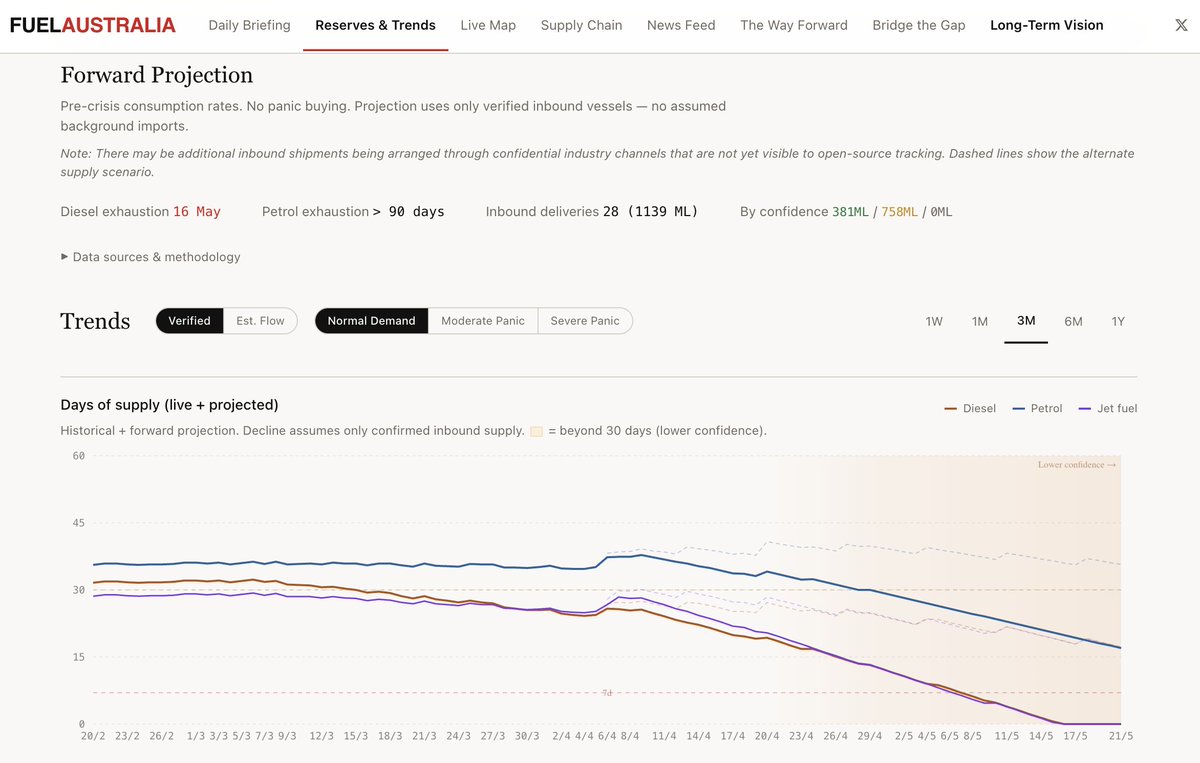
Everyone's panicking about "25 days of diesel left." Here's what that number doesn't tell you. 25 days is what's physically in the tanks right now. It's not a countdown to empty — fuel is still arriving. We're independently tracking 28 inbound fuel tankers from 9 open sources (port schedules, AIS satellite tracking, shipping fixtures). ~1,100 ML of verified supply heading to Australian ports. Using this verified supply, diesel only extends to ~16 May (not good). However, there are almost certainly additional shipments being arranged through confidential industry channels we can't see — the government claims 53 ships / 3,700 ML. The truth is probably somewhere between my verified 28 and their 53. But here's what should concern you: 25 days of reserves has been roughly normal for Australia for years. We never built strategic storage. No 90-day IEA buffer. No sovereign reserve. We're not about to run dry next week. We're just permanently exposed — one chokepoint closure away from exactly this panic, every single time. Storage capacity and domestic production are the real fix. Not panic buying. fuelaustralia.org/reserves
FuelAustralia.org tweet media
English
16
44
292
13.7K
FuelAustralia.org
FuelAustralia.org@FuelAustralia·
My reserve numbers come from DCCEEW's Minimum Stockholding Obligation data — published weekly, publicly accessible via their Power BI API. It's the only source in Australia that publishes fuel stock levels at weekly frequency. If you know of another, I'd genuinely like to hear it. What I add on top is entirely independent: real-time AIS ship tracking polling every 60 seconds, direct port authority scraping (NSW and VIC), VesselFinder data, AI-driven open-source intelligence across 25+ expert and institutional accounts, vessel lookups via MarineTraffic and Datalastic, 27 news feeds, Brent crude pricing, and Geoscience Australia terminal data. I fuse all of those into a single vessel register — deduplicated by IMO number, confidence-scored, cargo-verified, with volumes estimated from actual vessel deadweight tonnage. Coastal redistributions are filtered out so only genuine new imports count. That feeds a 90-day forward depletion model. Every daily briefing goes through an independent factual review before publishing. None of that comes from the government. I'm not here to defend anyone. I'm here to make the data accessible and add independent analysis on top.
English
2
1
13
511
Aus Integrity
Aus Integrity@QBCCIntegrity·
Why don’t you show daily consumption graphs. 3,700ML vs a regular average of 5,000ML is a significant shortfall of supply. Why are you providing excuses for govt secrecy? Fact is almost no one believes them. They tamper numbers EVERY DAY. They’re not a stranger to garbage data.
English
9
13
160
2.3K