Comet iOS is almost there! You can pre-order now! As promised: it will be smooth as butter and feel like Safari grade browser with Perplexity powering every webpage and the browser for assistance. apps.apple.com/us/app/comet-a…
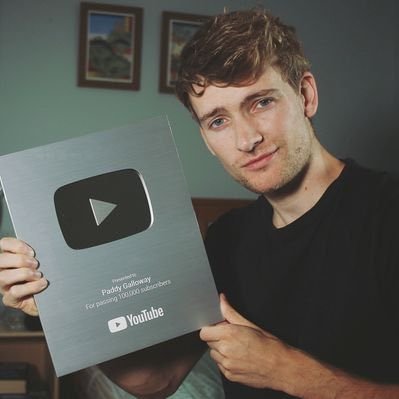
We gave our growth strategy to a tiny YouTube channel (5k subs)
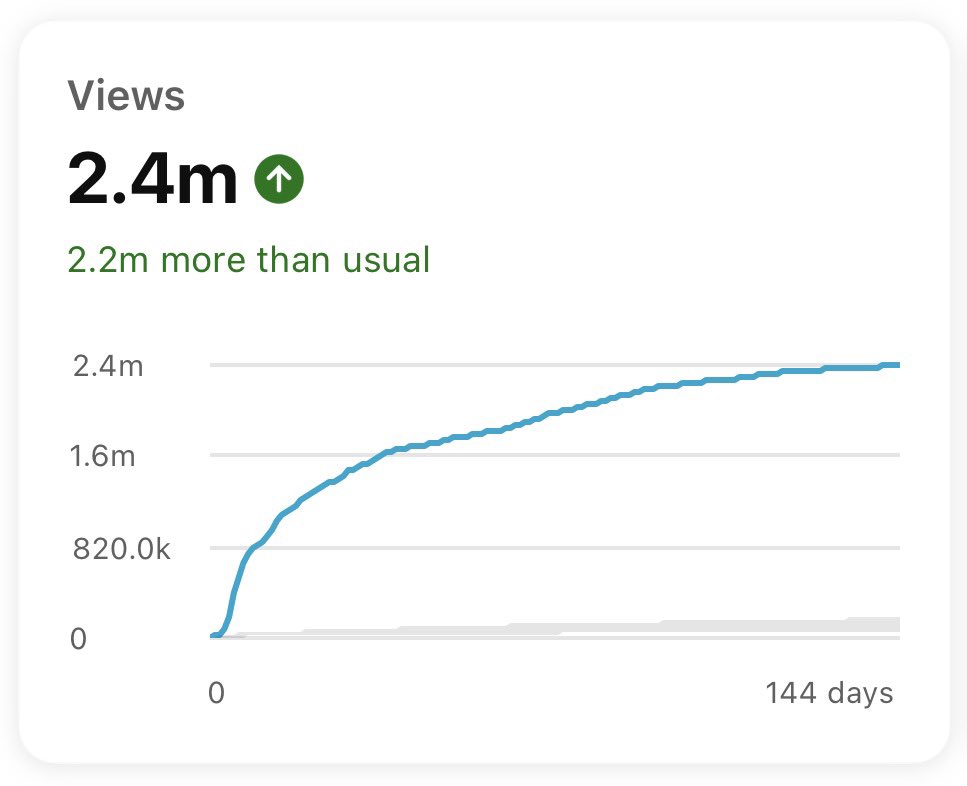
Less than a year later:
- 1k views/video to 600k+
- Made a 2.4m video
- $200/month to 6 figures/year
So f***k it… Here’s the same strategy you can use in 2026:
If you want me to help grow your channel over 8 weeks… apply to our accelerator
Applications close soon!
Also as usual one person who likes and RTs the first tweet gets a full 100% scholarship ❤️
accelerator.paddygalloway.com
Newly added feature in Gemini is game changer for Faceless Youtubers 🔥
No More AI scripts that sound robotic.
Using the leverage of NotebookLM inside Google gemini will make script writing with AI 10X powerful.
Now you don't need to write a super long prompt to train your AI to give better script output each time. The process can be tiring sometimes.
By simply creating a NotebookLM project, then feeding all the relevant info, guidelines, tips, etc. you can generate scripts that are tailored for high retention according to your niche.
In our workflow, we use this method for writing scripts that actually work and can make videos go viral.
If you want my workflow, template and process, reply with "Gemini".
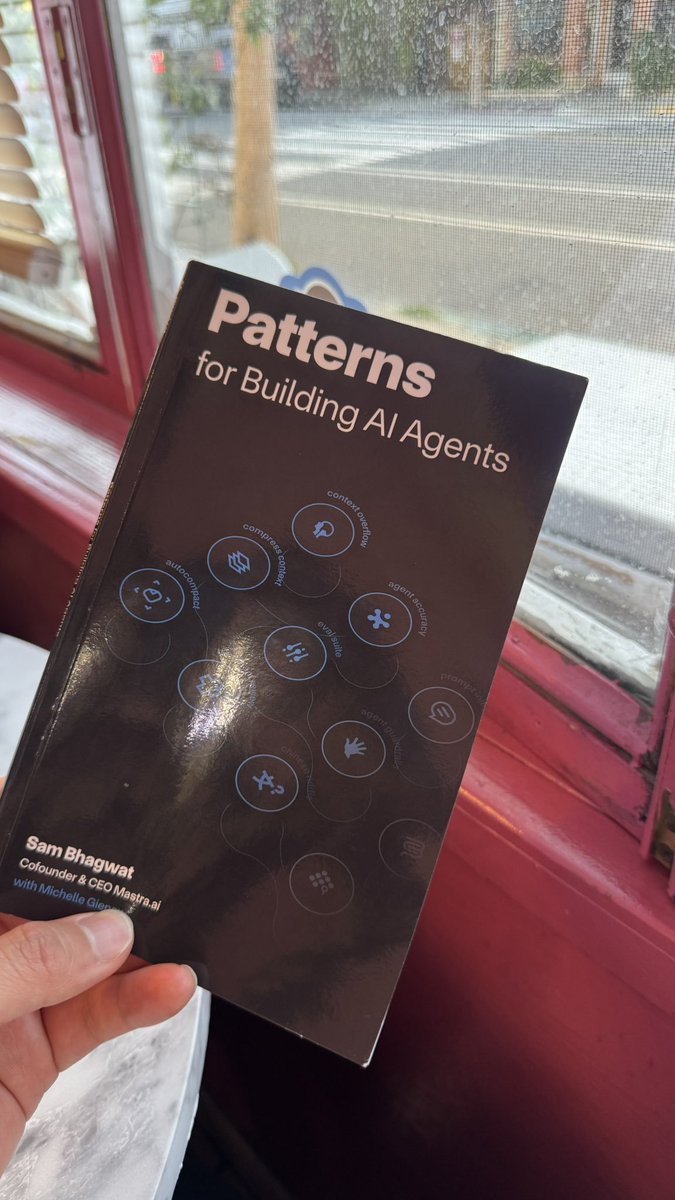
last month we wrote a new agents book: patterns for building ai agents
it has everything you need to take your agents from prototype to production, like agent design patterns, the basics of security, etc
reply to this tweet with BOOK and we'll dm you so you can get a copy
In 10 years, many more people will use crypto, but they may not know they're using crypto.
They only need to feel the benefits, not understand the systems behind it. The best tech is often invisible.
TV in the 90s: you turn it on, you watch.
TV 2025:
- turn on, wait for it to load
- popup: TV wants to update, 1.5GB. No.
- scroll sideways, find prime video app or etc
- popup: now app wants to update, 500MB. No!!
- App launching... App loading…
- select account screen
- 🫠
The importance of betting big:
In entrepreneurship, you will lose more times than you win. So you just need to make sure that when you win, you win so big, it overshadows all your losses.
No one cares about small victories or defeats.
From IPO and M&A to crypto?
The tech M&A era may be ending.
But the crypto era could be just beginning.
Because the combined effect of new policies is to make it much harder for startups to IPO or M&A, but much easier to sell equity-backed security tokens on the Internet.
Let me explain.
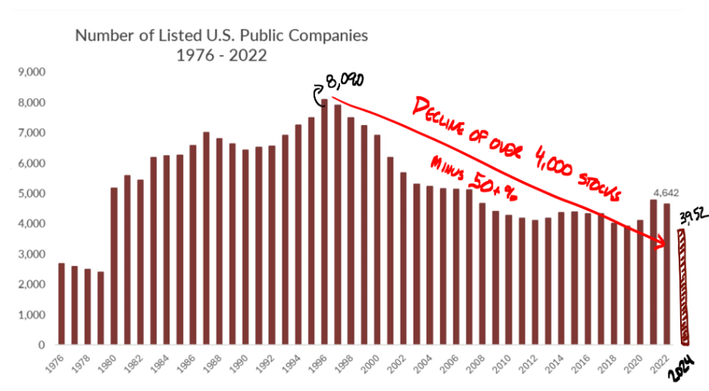
1) It's hard to IPO. First, for decades the SEC's Sarbox rules have made it onerous for small companies to go public. They made these rules to stop the next Enron, but they didn't do that (nor did they stop the financial crisis). What they did do was chop the number of publicly traded US companies in half[a] from its 1999 peak:
2) It's hard to M&A. As a consequence, starting in the mid-2000s, the conventional wisdom became that tech companies should stay private for longer. Because IPOs were hard, that meant M&A loomed much larger as a path to liquidity for venture-backed tech startups. This period of about 20 years included huge exits like Instagram ($1B), Oculus ($2B) and WhatsApp ($19B).
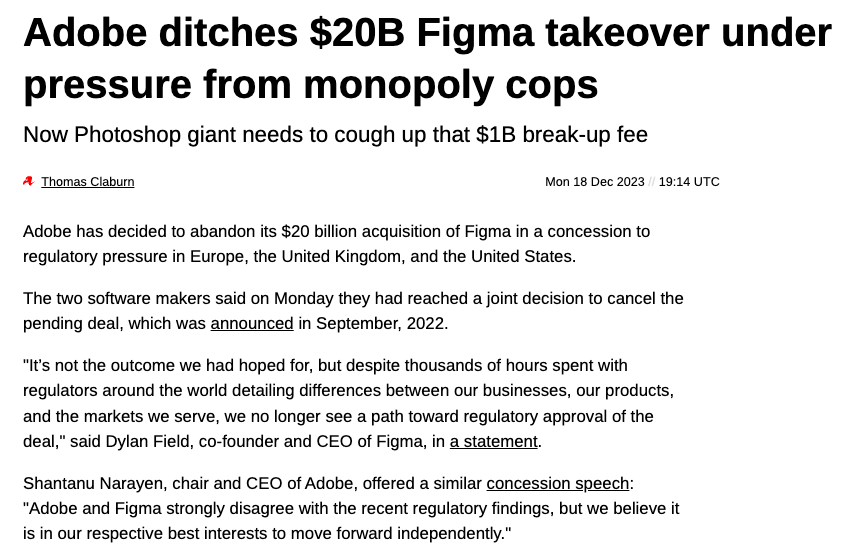
But since the advent of Lina Khan's FTC, big M&As have been blocked on the grounds that this would increase competition by disallowing big fish from eating smaller fish. That was the (ostensible) rationale for the joint EU/US/UK regulatory assault on Adobe's proposed acquisition of Figma[b], which would have been a huge exit that funded many more startups:
Khan's reasoning is fundamentally incorrect because when a big company buys a small competitor at a high price it's actually a surrender — and a huge capital injection into the VC ecosystem to create many more such competitors. If there are fewer such exits — either IPOs or M&As — then there's no capital for tech startups. And hence no competition.
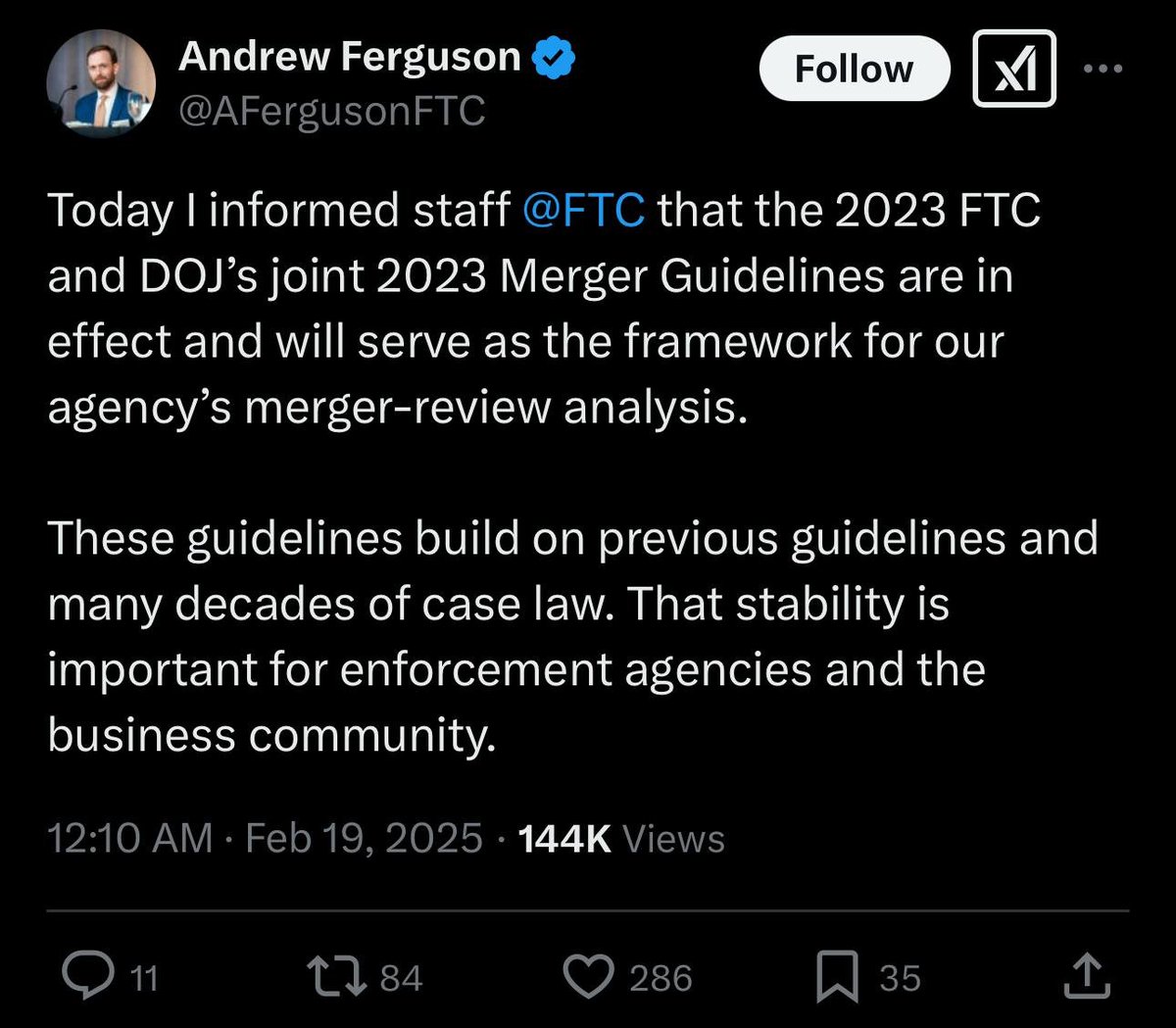
3) The new admin is still anti-M&A! Tech guys thought the new admin would be friendlier to M&A. But surprisingly, the new administration has bought into Lina Khan's logic — and is apparently continuing[c] her policies:
I think this is partly due to their (understandable) tribal animus against Big Tech companies for media-driven censorship during the 2020 election. But unless things change, it means tech M&A isn't coming back.
Moreover, there is continuity with Biden anti-M&A policies on another front. Japan's Nippon Steel was blocked from acquiring US Steel by Biden, but the new admin upheld the block. However, they seem to be offering a different path[d] where Nippon Steel invests in the US company but doesn't own it.
Regardless: neither big companies nor foreign companies may easily acquire US companies. And the thing is, M&A is already hard. It's like getting married, it's a huge production. If you layer some unpredictable government risk on top of an already difficult-to-do deal, many M&As just won't even be contemplated.
4) But the crypto window is open. However, when Gov closes a door it sometimes opens a window. Even though IPOs are still expensive, even though M&A has been made much more difficult...the new administration has de facto deregulated crypto with the launch of the presidential memecoins and the pro-crypto executive orders.
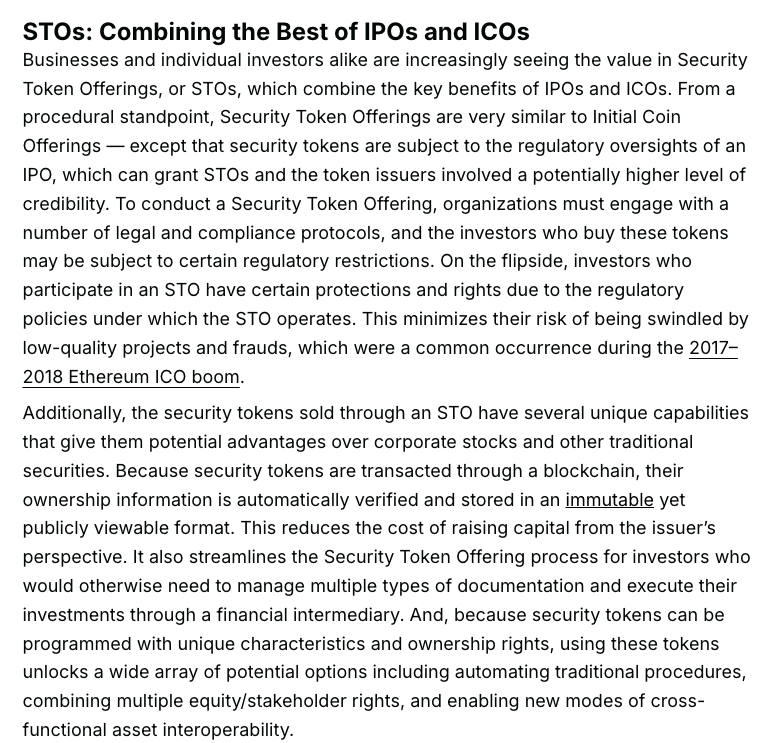
No one yet knows what the new rules are, but if you can do an unbacked memecoin you should almost certainly be able to do an equity-backed ICO, also known as a securities token offering (STO):
In fact, STOs actually fit the admin's vision that "the world should invest in US-founded coins" and that "small entities should be able to be independent for longer."
And remember their idea that Nippon Steel investing[d] in US Steel is ok, but owning it is not ok? This could be a way to square the circle. If you disallow Big Tech companies from buying Little Tech companies, you need to allow the latter to raise capital somehow in order to compete with Big Tech.
So let the world invest in them onchain without owning them, just like Nippon Steel is investing in US Steel. And just like Masa[e] and Saudi[f] are investing hundreds of billions in US companies without owning them outright.
That's a financial win/win that preserves sovereignty.
Moreover, mom and pop shops (restaurants and the like) can in theory STO as well. In theory, the STO takes the capital cost of going public from millions to zero. But you'd need to layer new decentralized regulatory mechanisms on such a market, similar to Uber/Airbnb/Amazon's star ratings and bans of bad actors.
5) From blue states to blockchains. Anyway: there are a zillion details to be worked out in terms of putting cap tables on chain and conducting high-trust public offerings with lockups and the like.
But this is ultimately where we wanted to go anyway. California is no longer the only place to operate, Delaware is no longer the best place to incorporate, and New York is no longer a great place to trust in the rule of law.
Blue states are over, but blockchains are in.
Because obviously Internet companies should exist in an Internet-native form onchain and be able to access Internet-scale capital markets via crypto. And indeed, even as the number of New York-listed stocks has been falling, the number of Internet-listed digital assets has been rising.
So, to my tech friends: yes, the tech IPO and M&A windows may be closed. But the tech STO window could be thrown wide open.
Three questions determine 99% of the happiness in your life:
1. What am I working on and why?
2. Who am I spending time with and why?
3. How well am I treating my body and why?
Everything else is noise.