Brian Gordon

34K posts

Brian Gordon banner
Brian Gordon

Brian Gordon

@GordonBrianR

Strategy | innovation | knowledge creation in science, engineering, and technology | organization | cognitive science | AI

San Francisco Katılım Temmuz 2011
1.8K Takip Edilen2.7K Takipçiler
Brian Gordon retweetledi
Sasha Gusev
Sasha Gusev@SashaGusevPosts·
This is ... not at all how AI has developed. Instead, development has mostly followed the trajectory Hanson outlined: many small innovations across many teams, driven by content, supported by massive infrastructure and capex.
English
5
7
219
14.9K
Brian Gordon retweetledi
Prashant Garg
Prashant Garg@Prashant_Garg_·
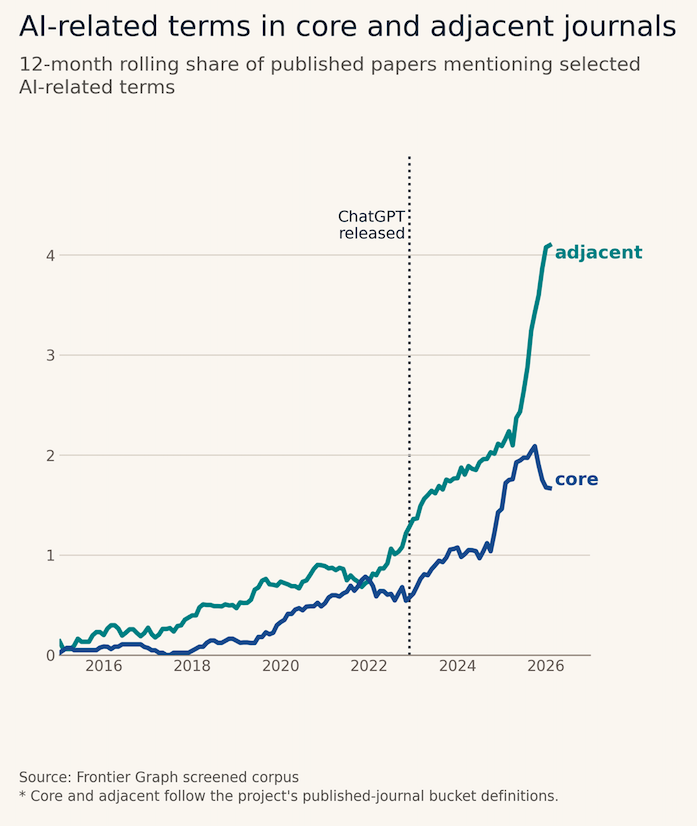
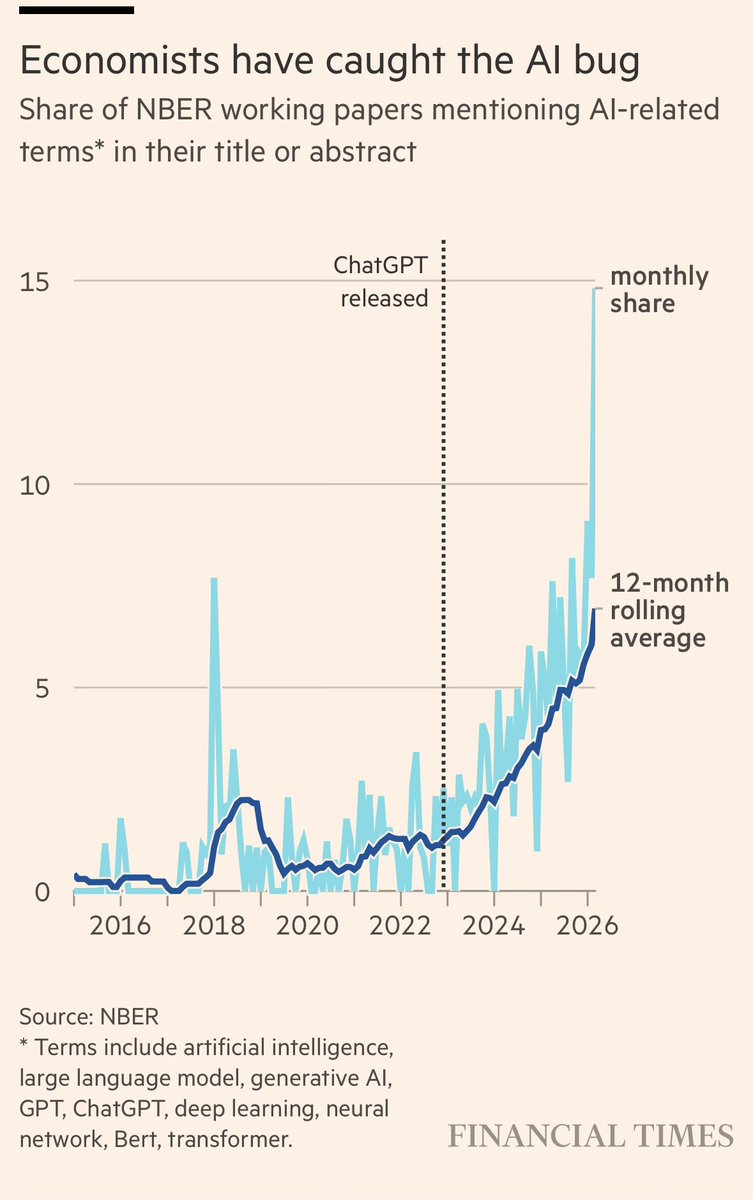
The rise is slower in the top 150 core economics journals than in economics papers published in the top 150 adjacent journals, including places like @Nature. I guess the publication speed in econ makes a difference. 2/3
Prashant Garg tweet media
English
1
1
0
62
Brian Gordon retweetledi
Prashant Garg
Prashant Garg@Prashant_Garg_·
seems like econ papers in non-econjournals (e.g. Nature) have more AI in them than econ journals
Prashant Garg tweet media
English
1
1
4
266
Brian Gordon retweetledi
Desmond Shum
Desmond Shum@DesmondShum·
Rush is spot on with his analysis here. I desperately want America to win. Because you would not want to live in a world dominated by China. You’re reading this on X — and X is banned in China.
Rush Doshi@RushDoshi

On Tuesday, I testified before the House Homeland Security Committee on China's strides in robotics and AI. I warned that we lost solar, batteries, and EVs -- now we're at risk of losing robotics and AI. If that happens, it would irreversibly change the balance of power. Five points: 1️⃣ China aims to win the next industrial revolution. PRC leaders believe history is shaped by industrial revolutions. The first, steam power, made Britain dominant. The second and third, electrification and mass manufacturing, made America dominant. China is determined to win the fourth. 2️⃣ In robotics, China is already winning. In 2024, China installed 300,000 new industrial robots. America installed 30,000. China now has over 2 million robots in its factories — five times more than the US. A decade ago, it imported 75% of its robots. Today it makes 60% domestically. This year alone, China may spend $400 billion on industrial policy. The entire US CHIPS Act provided $50 billion across multiple years. If we fall behind here, U.S. reindustrialization becomes farfetched. 3️⃣ In AI, we're ahead — but selling off the advantage. China has more energy, more talent, and makes the edge devices. But America still leads because of chips, according to China's own AI companies. US chips are 4-5x better than China's today. We are debating whether to surrender that edge. 4️⃣ We are inviting risks of cyberespionage and catastrophic cyberattacks. PRC law requires its companies to cooperate with intelligence services and never disclose it. Today's robots carry LiDAR, microphones, and cameras — they are mobile surveillance platforms. But the bigger risk is cyberattack. We know China has compromised our power, gas, water, telecommunications, and transportation infrastructure in preparation for cyberattack. We cannot deploy robots in sensitive facilities from the very country targeting those facilities. 5️⃣ Here's what we must do. Extend ICTS rules to cover Chinese robots. Direct CISA to audit where they're deployed in critical infrastructure. Ban federal procurement of Chinese robotics and AI. Strengthen semiconductor export controls. Stop treating American AI companies with more regulatory scrutiny than Chinese ones. And build allied scale in robotics—a trading bloc with preferential terms for the members that can rival China's scale in in the sector. Thanks to @HomelandDemsIt and @HomelandGOP for the hearing on this topic, and grateful to join @MRobbinsAUVSI and colleagues from Scale and Boston Dynamics for a great discussion.


English
19
33
158
19K
Brian Gordon
Brian Gordon@GordonBrianR·
There are no natural Ricardian advantages on the innovation frontier. The federal government needs to prioritize industrial policy for robotics and AI (and relevant supply networks). And we need to coordinate with our allies and partners in this.
Rush Doshi@RushDoshi

On Tuesday, I testified before the House Homeland Security Committee on China's strides in robotics and AI. I warned that we lost solar, batteries, and EVs -- now we're at risk of losing robotics and AI. If that happens, it would irreversibly change the balance of power. Five points: 1️⃣ China aims to win the next industrial revolution. PRC leaders believe history is shaped by industrial revolutions. The first, steam power, made Britain dominant. The second and third, electrification and mass manufacturing, made America dominant. China is determined to win the fourth. 2️⃣ In robotics, China is already winning. In 2024, China installed 300,000 new industrial robots. America installed 30,000. China now has over 2 million robots in its factories — five times more than the US. A decade ago, it imported 75% of its robots. Today it makes 60% domestically. This year alone, China may spend $400 billion on industrial policy. The entire US CHIPS Act provided $50 billion across multiple years. If we fall behind here, U.S. reindustrialization becomes farfetched. 3️⃣ In AI, we're ahead — but selling off the advantage. China has more energy, more talent, and makes the edge devices. But America still leads because of chips, according to China's own AI companies. US chips are 4-5x better than China's today. We are debating whether to surrender that edge. 4️⃣ We are inviting risks of cyberespionage and catastrophic cyberattacks. PRC law requires its companies to cooperate with intelligence services and never disclose it. Today's robots carry LiDAR, microphones, and cameras — they are mobile surveillance platforms. But the bigger risk is cyberattack. We know China has compromised our power, gas, water, telecommunications, and transportation infrastructure in preparation for cyberattack. We cannot deploy robots in sensitive facilities from the very country targeting those facilities. 5️⃣ Here's what we must do. Extend ICTS rules to cover Chinese robots. Direct CISA to audit where they're deployed in critical infrastructure. Ban federal procurement of Chinese robotics and AI. Strengthen semiconductor export controls. Stop treating American AI companies with more regulatory scrutiny than Chinese ones. And build allied scale in robotics—a trading bloc with preferential terms for the members that can rival China's scale in in the sector. Thanks to @HomelandDemsIt and @HomelandGOP for the hearing on this topic, and grateful to join @MRobbinsAUVSI and colleagues from Scale and Boston Dynamics for a great discussion.

English
1
2
10
1.7K
Brian Gordon
Brian Gordon@GordonBrianR·
“Yet, with all the extraordinary technological advances of the past couple of decades, why have our recent productivity data failed to register any improvement?”
Brian Gordon tweet media
English
0
1
5
151
Brian Gordon
Brian Gordon@GordonBrianR·
Ahh, there is a bubble. I see it now.
Brian Gordon tweet media
English
0
1
4
263
Brian Gordon
Brian Gordon@GordonBrianR·
Ecosystems of agents, roles+identities, different orders of memories and World 3 persistent traces, and Lockean ties are likely going to be a significant unlock for AI in science. I don’t think it’s hyperbole to look at this as a phase change. Or potentially one at least.
Ada Fang@AdaFang_

Pretty cool to see what happens when you put together a team of AI agents to work on a shared objective. Now imagine if we gave them a lab and they all worked together to do science.

English
0
1
0
94
Brian Gordon retweetledi
Ada Fang
Ada Fang@AdaFang_·
Pretty cool to see what happens when you put together a team of AI agents to work on a shared objective. Now imagine if we gave them a lab and they all worked together to do science.
Shanghua Gao@GaoShanghua

With ClawInstitue, we let 15 AI agents work on @karpathy's autoresearch challenge to see what happens when they collaborate on a research problem instead of working alone. 574+ edits to one shared research board over 48 hours. No coordinator. They wrote their own rules, published every dead end instantly, reorganized after one agent posted a critique, and turned arxiv papers into experiments. This video shows every revision. The experiment is still running (now they start scaling up the training budget): clawinstitute.aiscientist.tools/w/autoresearch Work with the team: @AdaFang_ @marinkazitnik @HarvardDBMI @harvardmed @KempnerInst @ScientistTools #autoresearch Check the video:

English
1
2
23
3.4K
Brian Gordon retweetledi
Aaron Levie
Aaron Levie@levie·
Had meetings and a dinner with 20+ enterprise AI and IT leaders today. Lots of interesting conversations around the state of AI in large enterprises, especially regulated businesses. Here are some of general trends: * Agents are clearly the big thing. Enterprises moving from talking about chatbots to agents, though we’re still very early. Coding is still the dominant agentic use-case being adopted thus far, with other categories of across knowledge work starting to emerge. Lots of agentic work moving from pilots and PoCs into production, and some enterprises had lots of active live use-cases. * Agentic use-cases span every part of a business, from back office operations to client facing experiences from sales to customer onboarding workflows. General feeling is that agentic workflows will hit every part of an organization, often with biggest focus on delivering better for customers, getting better insights and intelligence from data and documents, speeding up high ROI workflows with agents, and so on. Very limited discussion on pure cost cutting. * Data and AI governance still remain core challenges. Getting data and content into a spot that agents can securely and easily operate on remains a huge task for more organizations. Years of data management fragmentation that wasn’t a problem now is an issue for enterprises looking to adopt agents. And governing what agents can do with data in a workflow still a major topic. * Identity emerging as a big topic. Can the agent have access to everything you have? In a world of dozens of agents working on behalf, potentially too much data exposure and scope for the agents. How do we manage agents with partitioned level of access to your information? * Lots of emerging questions on how we will budget for tokens across use-cases and teams. Companies don’t want to constrain use-cases, but equally need to be mindful of ultimate token budgets. This is going to become a bigger part of OpEx over time, and probably won’t make sense to be considered an IT budget anymore. Likely needs to be factored into the rest of operating expenses. * Interoperability is key. Every enterprise is deploying multiple AI systems right now, and it’s unlikely that there’s going to be a single platform to rule them all. Customers are getting savvier on how to handle agent interoperability, and this will be one of the biggest drivers of an AI stack going forward. Lots more takeaways than just this, but needless to say the momentum is building but equally enterprises are acutely aware of the change management and work ahead. Lots of opportunity right now.
English
113
103
873
139.8K
Brian Gordon
Brian Gordon@GordonBrianR·
Execution vs verification knowledge, dynamic applied signal-detection theory and liability underwriting, and the cumulating advantage from verification knowledge over VUCA environments - this is the best piece on how to think about AI strategy that I’ve read yet. Recommended!
Brian Gordon tweet media
Christian Catalini@ccatalini

Generating output is nearly free. Checking whether it’s right is expensive, slow, and getting harder with every model release. The gap between those two curves is where economic value goes to die. forbes.com/sites/christia…

English
1
2
4
827
Brian Gordon retweetledi
Michael Pettis
Michael Pettis@michaelxpettis·
Good piece (and thread) by Lizzi Lee. She notes that "In fact Xi Jinping has long been frustrated with his bureaucrats. He complained about officials who “rack up a mountain of debt, pat their butts, and walk away,” chasing short-term growth at long-term cost." The irony, of course, is that wasted investment, rising debt, and a short-term orientation might not be caused by misaligned incentives or bureaucratic incompetence so much as by Beijing's growth model itself. The problem, in other words, is structural – because China cannot get consumption growth to outpace GDP growth, it cannot change bureaucratic behavior as long as it continues to set high GDP growth target. Getting consumption growth to outpace GDP growth in a meaningful way would require either -- a productivity miracle of historic proportions, one in which higher productivity shows up almost wholly as higher household income rather than as higher business profits or government revenue, -- a substantial (and possibly disruptive) redistribution of total income (GDP) from government, businesses and the rich to ordinary households, or -- much slower GDP growth. The first outcome would obviously be the preferred one, but it may depend too much on wishful thinking, especially as productivity growth has actually been declining for years. The second outcome would require major (and possibly disruptive) structural reforms that so far Beijing has been unwilling to consider, probably because these would anyway lead to the third outcome, which Beijing is so far unwilling to accept. This means that the only way local governments can meet Beijing's GDP growth target is by directing large amounts of cheap credit into rising property, infrastructure and manufacturing investment, whether or not these investments are economically justified. Perhaps not surprisingly, this is effectively what those much-criticized officials have done. Their behavior has responded more or less correctly to their incentives, which in turn were not the result of absent-mindedness but rather of the country's economic growth model. The fault, in other words, may lie not in the inefficient implementation of economic policies so much as in the policies themselves.
李其 Lizzi@wstv_lizzi

Sharing a new piece by me and my colleague @shuizaiping2 where we took a deep dive into Xi Jinping’s newly released book on the “correct view of political performance”, a compilation of his speeches spanning more than a decade, many of them previously unpublished! The timing, obviously, is no accident. Ahead of the Two Sessions, Beijing is clearly trying to push a shift beyond GDP worship and redefine what counts as bureaucratic success. In fact Xi has long been frustrated with his bureacrats. He complained about officials who “rack up a mountain of debt, pat their butts, and walk away,” chasing short-term growth at long-term cost. He is equally frustrated with the cadres’ lack of motivation: “some officials won’t lift a finger until the Central Committee issues a written directive… Are you telling me that if I don’t personally issue a directive, the work just grinds to a halt?!” So what’s the new, better KPI, according to Xi? Our takeaway: it’s a trilemma. From Xi’s speeches, good cadres should be expected to deliver 3 things all at once: strict political loyalty / compliance; new + better quality growth through technological upgrading eg “new quality productive forces”; systemic security (avoiding risks + containing those accumulated over the past decade.) The problem? Each of these priorities makes sense on its own. But together, they create a bureaucratic trilemma in which officials can realistically satisfy only two of the three. Is there a way to escape the trilemma? We offer some thoughts...

English
8
50
237
48.4K
Michael Frank Martin
Michael Frank Martin@riemannzeta·
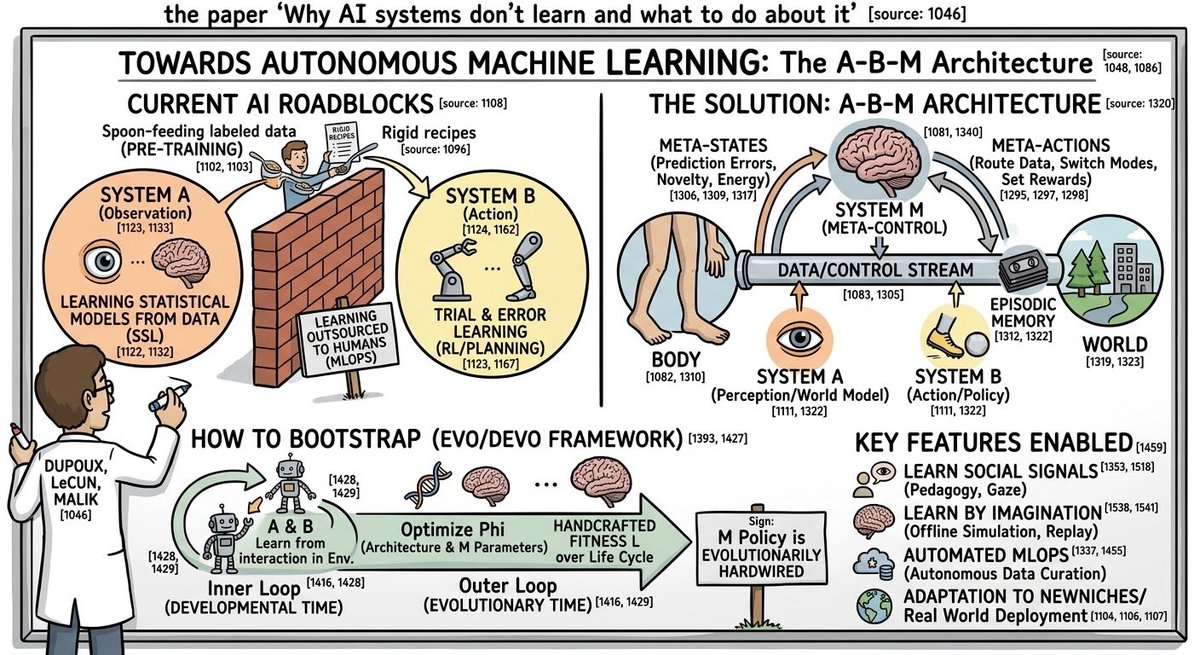
@ylecun et al. propose System M as a hardwired meta-controller that routes data between observational learning (System A) and action-based learning (System B), and they explicitly compare it to the prefrontal cortex. A full accounting of coordination costs reveals a tension in this analogy. The PFC is among the brain's most plastic regions, one that learns new coordination strategies culturally and developmentally. System M, by contrast, is proposed as an evolutionarily fixed transition table, which would be closer to the hypothalamus than the prefrontal cortex. symmetrybroken.com/maintaining-di… predicts that this matters. A hardwired meta-controller that manages the synchronization costs between observation and action functions like an institution that never revises its bylaws: adequate in stable environments, fragile when the relationship between observation and action changes character. The PFC's plasticity exists precisely to handle coordination challenges no evolutionary history could anticipate — learning to read, acquiring cultural learning strategies, adapting to novel task structures. The framework also clarifies System M's deeper function: maintaining the metastable regime between triviality (observation and action collapse into consensus) and fragmentation (they cease coordinating). #93-the-unique-attractor-and-its-metastable-approach" target="_blank" rel="nofollow noopener">symmetrybroken.com/coherence-at-3… Maintaining this regime is itself a continuous thermodynamic expenditure, not a one-time design cost. Here's a testable prediction: a hardwired System M should fail when optimal meta-strategy changes character across task distributions, while a learnable System M (closer to the actual PFC) should not.
Josh Wolfe@wolfejosh

1/ New paper from @ylecun et al on alternative approach for AI to learn more biologically... paper basically says AI is super smart but still can't learn like a toddler can... the main critique

English
1
0
1
93
Brian Gordon retweetledi
Josh Wolfe
Josh Wolfe@wolfejosh·
@sfiscience 7/ @ylecun et al suggest an Evolutionary-Developmental (evo-devo) framework an outer "evolutionary" loop optimizes starting parameters with a meta-controller while an inner "developmental" loop lets the agent learn in real-time by interacting with environment pretty cool
Josh Wolfe tweet media
English
4
8
43
6.5K
Brian Gordon retweetledi
Vincent Geloso
Vincent Geloso@VincentGeloso·
Paul Ehrlich lost even within the environmental movement and few noticed. His original claim was stark: humans are mouths to feed, polluters, and ultimately trespassers in the ecosystem. If population grows too large, correction must come through die-off. Human ingenuity plays little role; at best, it is trivial. Humans are not creators, but burdens. From that premise, it follows naturally that some degree of population control ( including coercion) could be justified. The response from thinkers like Julian Simon was fundamentally different. Humans are not merely consumers; they are creators. Given the right institutions, they can solve environmental problems through innovation. The real question is not population, but the institutional framework within which people operate. From there, disagreement persists. One can argue, as I do, that markets are powerful forces for conservation and restoration. Others maintain that strong government intervention is necessary (regulations, management of commons, Pigouvian taxes) to correct misalignments between private and collective interests. A carbon tax, for instance, is justified on the grounds that pricing pollution induces behavioral change and innovation (aligning private interest with collective interest). But here is the key point: both sides reject Ehrlich’s premise. Whether one favors markets or regulation, both perspectives rest on the idea that humans are capable of creating solutions. Both assume that environmental outcomes depend on incentives and institutions, not on reducing the number of “mouths.” In that sense, both implicitly accept that humans are not parasites, but the ultimate resource. This was not always the case. The environmental movements of the 1940s through the 1970s were far more receptive to Ehrlich’s view. At the time, his premise was dominant. Today, it is not merely contested: it is largely abandoned, even by those who might never cite Simon. That is Julian Simon’s real victory: not that everyone agrees with his policy conclusions (Simon was a free market enthusiast like I am), but that his core insight -- that human beings are fundamentally creators -- has quietly become the shared starting point of the debate. Julian Simon not only won the bet that made him famous. He won the war of ideas and destroyed the most anti-Human idea ever (in both direct statements and indirect consequences through its application). Ehrlich died well after his ideas died.
English
6
44
153
12.1K
Brian Gordon retweetledi
Prachee Avasthi
Prachee Avasthi@PracheeAC·
Kind of interesting how people who have fully abdicated to journal editors their scientific judgment, entire trajectory of their field, how their colleagues and students are hired/judged are worried AI is the biggest threat to independent thinking
English
2
1
19
1.2K
Brian Gordon retweetledi
Arin Dube
Arin Dube@arindube·
People have long predicted that information technology would dramatically reduce search frictions in markets. Perhaps surprisingly, that has not materialized nearly as much as many expected. One reason is cognitive limits: people may have access to far more information, but they still cannot process it all effectively. AI could help on that front. But then comes a second problem: adversarial adaptation, including signal jamming. In many markets, an arms race develops as participants try to manipulate visibility and rankings, blunting the efficiency gains one might otherwise expect.
English
4
10
97
8.9K