
Sabitlenmiş Tweet
Gradium
151 posts


Gradium
@GradiumAI
The voice layer for modern apps and agents. Real-time, scalable voice APIs: TTS, STT, turn-taking & voice cloning. Devs: build → https://t.co/r5CdNClhI5
Katılım Eylül 2025
1 Takip Edilen3.7K Takipçiler
Try it out here: gradium.keenable.ai
Docs: docs.gradium.ai/integrations/w…
English
Your voice agent should know how many E's the number 17 has.
And it should also be able to search the web instantly for you.
You can now integrate the @KeenableAI web search API with Gradium's API to build low-latency, voice-enabled web search.
Check out our latest demo.
English

Let's double it.
Ahead of our Computer Use Agents hackathon, we're welcoming two new sponsors.
@awscloud, powering our technology.
@GradiumAI, because voice + computer-use agents is 🔥
Thank you to all our sponsors for making this a hackathon worth clearing your calendar for.

English
We’re crossing $100M in funding and welcoming @nvidia to our cap table as part of an extension of our seed round.
This adds fuel to our momentum: real-time STT and TTS, Gradium Translate, Phonon, all shipped in a few months and with accelerating timelines between releases.
It also supports our next step: expanding to San Francisco to work closer to the startups building the future of voice AI. We're hiring there. Come build with us.

English
Let's RAISE some Voice.
The energy at the @RaiseSummit Hackathon is top tier.
Henry Rohlf Web3@HLR_web3
🚀 @RaiseSummit Hackathon Day 1 was incredible! 🔥 Builders grinding, ideas flowing, energy through the roof 💡⚡ From early-morning debugging to breakthrough demos, the talent in the room is next level 👏 Huge thanks to our partners @cursor_ai @cerebral_valley @NVIDIAAI @Vultr @CrusoeAI @GoogleDeepMind @GradiumAI @grafana and @SUSE for this incredible moment together - could not be more grateful for this weekend doing what we love 🙏 Can't wait to see what Day 2 brings 🙌 #RAISESummit #Hackathon #AI #RAISE
English
That's a wrap on @aiDotEngineer World's Fair.
Thanks to everyone who stopped by the Gradium Booth.
The team is now heading to the @RaiseSummit in Paris.

English
Gradium retweetledi

Had a long and eventful week at @aiDotEngineer
It’s time to go back to Paris and ship.
Taking back some great conversations, ideas and new friends.
Great show @swyx.
@GradiumAI and I will be back with more events.
PS: We’re hiring in SF!



English
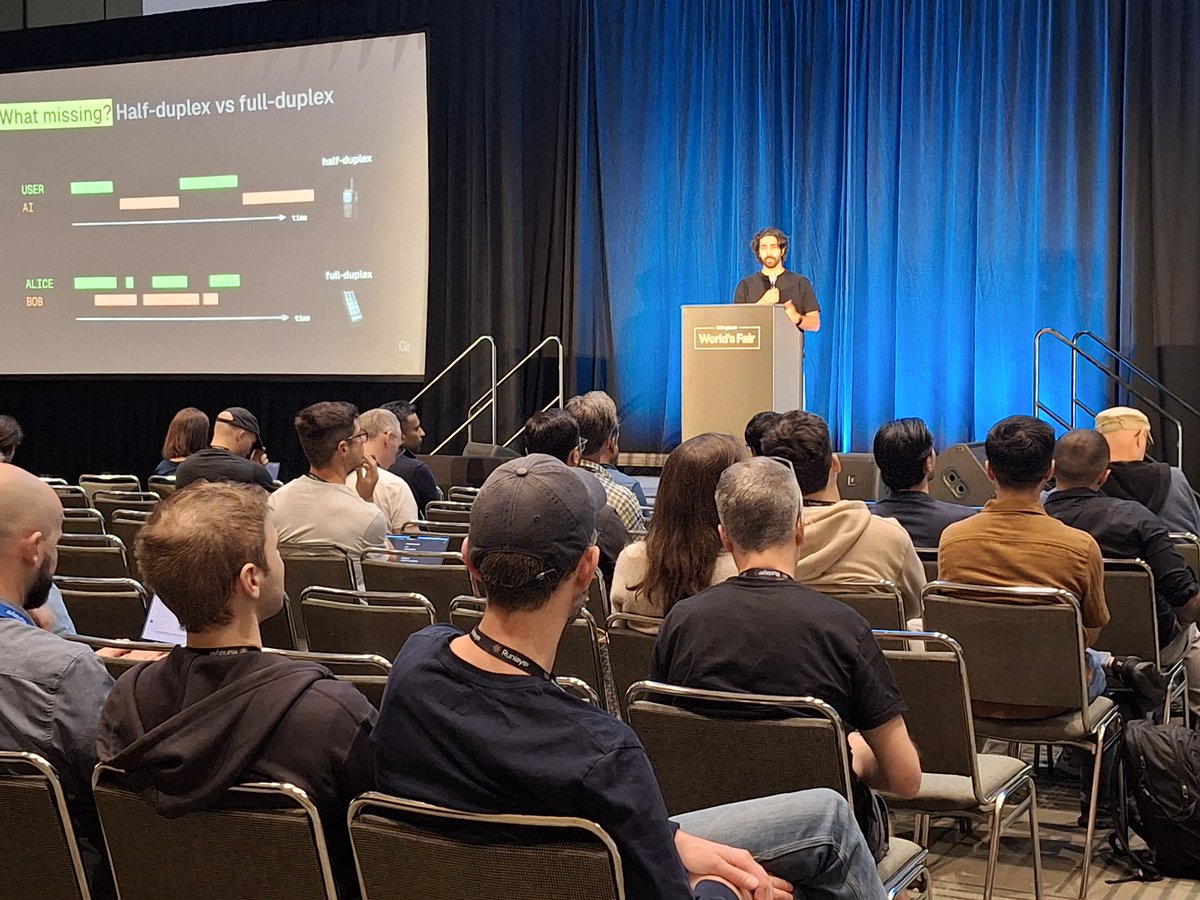
Day 2 at @aiDotEngineer wrapped up with two talks from Gradium.
@neilzegh on why most voice agents are a walkie-talkie setup.
We also ran a workshop, where the attendees went back with a digital voice clone of themselves!
Day 3 is just getting started.

English
@RaiseSummit next week, July 8-9 in Paris. @neilzegh giving a talk: Where We're Going We Don't Need Keyboards. Just Voice.
July 9 · 5:20pm, Ada Lovelace Stage
Also partnering on the RAISE Hackathon (July 4-5).

English
Gradium retweetledi

I give talks around the world, and when English isn’t the local language it can feel exclusionary.
So I built LeCaption: a macOS app that puts live, translated subtitles of your talk on screen.
Powered by @GradiumAI new stt-translate model (BYOK).
Also my first Tauri app 🦀
lecaption.com
English
We're all set for @aiDotEngineer.
Come find us at U-G 8 near Expo 4 along with @pipecat_ai to learn more about building SOTA Voice Agents.
And grab some cool swag.

English
Gradium retweetledi
One shotted a fun voice agent with @pipecat_ai and @GradiumAI to figure out with sessions to attend based on my profile at @aiDotEngineer .
My agent recommended @danielhanchen ( ofcourse! ) and few more.
Should I ship this so that everyone coming to conf can find their way around? Wdyt @swyx ?
English
AIEWF next week. We'll be at booth U-G8 with @pipecat_ai, and our CEO @neilzegh is giving 3 talks:
→ Your voice agent is just a walkie-talkie
→ Voice is the universal interface, w/ @kwindla
→ Everyone gets a digital clone
English
Today we launch stt-translate and s2s-translate: real-time speech-to-text and speech-to-speech translation. They compete with gemini-3.5-live-translate and gpt-realtime-translate on latency and quality, while allowing you to speak in any voice from our catalog or one you clone. Try them for free today on gradium.ai/translate

English
Gradium STT and TTS now powers @adoptbuddy , the emotional companion robot from @BlueFrogRobotic, deployed in schools, hospitals, and senior care.

English

Another week full of Voice AI updates! 🎙️
More news in live translation 🌍 : this time with @Google's Gemini 3.5 and @krispHQ releasing Voice Translation v3. Following the release of OpenAI's own model some weeks ago, it looks like everything in this space is accelerating.
In STT updates, @gladia_io launched a new model showing great results for business speech. On the TTS front, @MisoLabsAI released Miso One, an updated @GradiumAI model is significantly reducing errors on emails and numbers, and @resembleai AI's Chatterbox v3 is improving voice naturalness. On top of that, Inworld cut their Voice AI API prices by ~50%.
In more exotic news, @ai_coustics released Tyto, a new model that can detect problems in incoming audio in advance. There’s also an interesting new opensource tool called NoiseKit, which generates realistic datasets from clean audio for testing and training ❤️
On the platform side, @livekit launched a new version full of great improvements, plus the release of LiveKit Portal—featuring a stack intended for robotics teleoperation on top of their C++ SDK. Great job in the last weeks by the LiveKit team! 👏
Meanwhile, @retellai had a massive "Launch Week" featuring Live Monitoring, a Built-in CRM, a Colloquial Model, and Custom Dashboards 🤯 The product is looking great and the only close competitor I see these days is ElevenLabs.
Full newsletter with more updates 👇
English
Our on-device TTS model Phonon out there crushing it on TTFA and WER.
Pratim Bhosale@BhosalePratim
Long flights always give me more ideas to think about what's missing around us. Few prompts later, here's Scribble Story. On-device fully local pipeline to convert scribblings into a short story you can listen to. Using @GradiumAI Phonon and @Alibaba_Qwen
English
60+ new voices live in the Gradium catalogue. English, Spanish, French, German, and Portuguese, with eight regional accents across them. gradium.ai
GIF
English
We upgraded Gradium TTS for the cases voice agents can't get wrong: phone numbers, codes, email addresses read back right the first time. Couple of examples: English: 97% on emails, top of the field. French: leads every competitor we benchmarked. Samples + methodology → gradium.ai/blog/gradium-t…
English