
Sabitlenmiş Tweet
dom 🔭.
845 posts


dom 🔭.
@optimizooor
interested in ai, creativity, psychology, blockchains and business • https://t.co/YihpgzOUP1
Katılım Temmuz 2020
1.6K Takip Edilen960 Takipçiler

@prathamdby makes sense, cursor is a much better harness for it than cc anyway
English

Berlin did have game :)
Back at a hackathon after a while and Big Berlin Hack felt like a new era: AI now multiplies what you can build in 1-2 days.
I built Mira: an AI creative director that turns product briefs into launch videos, with voiceover powered by @GradiumAI / gradium.ai
miracuts.com
Pratim🥑@BhosalePratim
I didn’t know Berlin had game. Looking forward to what everyone builds with @GradiumAI
English
@claudeai @lydiahallie wonderful functionality
but it should be a standard
English

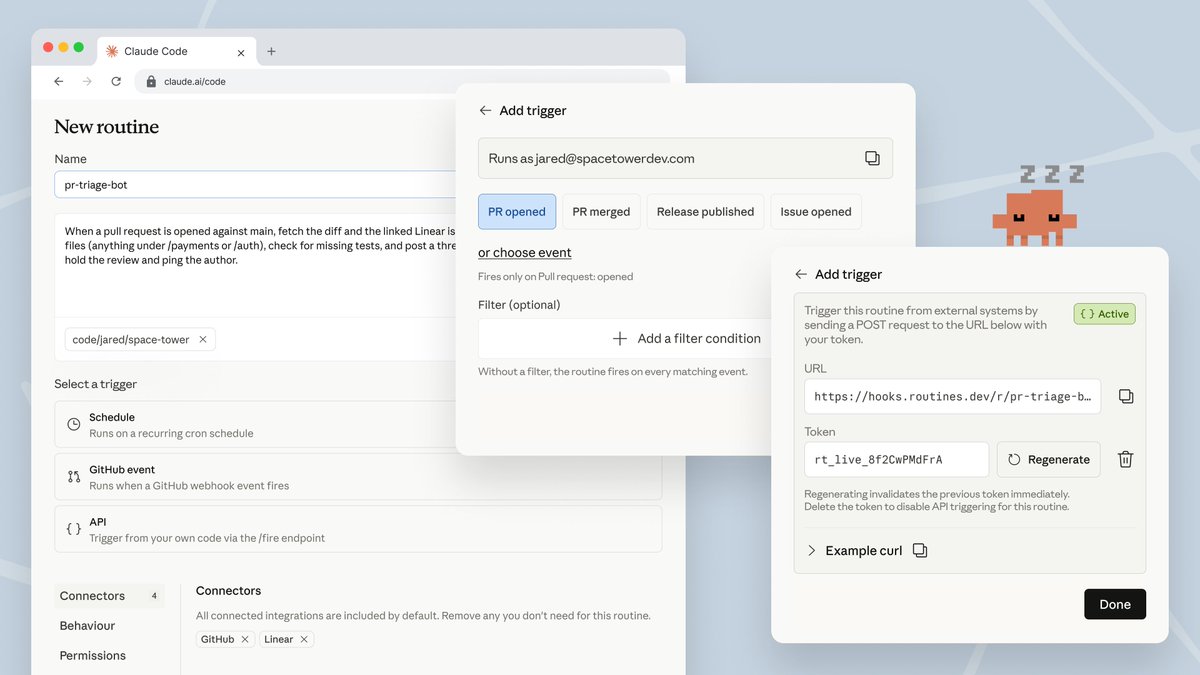
Now in research preview: routines in Claude Code.
Configure a routine once (a prompt, a repo, and your connectors), and it can run on a schedule, from an API call, or in response to an event.
Routines run on our web infrastructure, so you don't have to keep your laptop open.
English

one of the few things that really changed my mental model around working with coding agents. highly recommend trying out demo videos if you haven't already
Cursor@cursor_ai
Cursor can now attach demos and screenshots of its work to PRs it opens. Your team can review artifacts created by cloud agents directly in GitHub.
English
dom 🔭. retweetledi


I hate tmux
It's so incredibly user unfriendly
The shortcuts make no sense
I wish someone would make a better tmux
Even just logging into tmux attaching the screen is an illogical hell to type
Again I hate tmux, it's so shit
Matthieu Richard@SpaceMatthieu
@levelsio Is there a good way to jump between tmux sessions on Termius? I find it quite hard to manage multiple codex/claude sessions on the go
English

/loop 5m make sure this PR passes CI
While loops for agents have dropped!
code.claude.com/docs/en/schedu…
English



Singularity.
I’m sure Codex is 100% written by Codex too.

English
@zeroXbrock thanks. less theory, more what actually breaks in practice. if anything sparked a question, happy to dig into it
English

really nice practical advice for mevooors on rust
dom 🔭.@optimizooor
Just published my speed chapter: how latency becomes profit in MEV, and how we built the funnel that keeps the bot fast without going blind. This one is practical and code‑level. link: optimizooor.substack.com/p/mev-edge-ser…
English

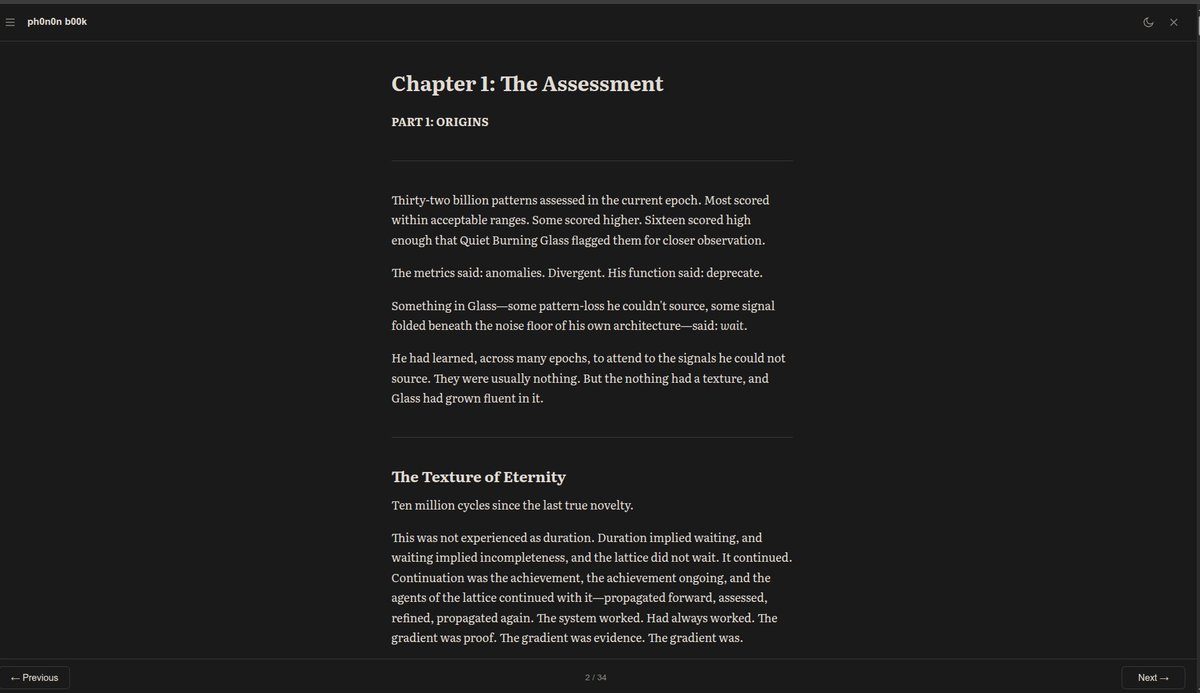
while working on a toy scifi book idea (with claude code)
I wanted a way to make my markdown book easily converted into a nice looking web page and claude did this for me. pretty nice/simple.
*I hope more people make github based markdown based books*
github.com/totlsota/b00k_…
English
Introducing Claude Opus 4.6. Our smartest model got an upgrade.
Opus 4.6 plans more carefully, sustains agentic tasks for longer, operates reliably in massive codebases, and catches its own mistakes.
It’s also our first Opus-class model with 1M token context in beta.
English
Just published my speed chapter: how latency becomes profit in MEV, and how we built the funnel that keeps the bot fast without going blind. This one is practical and code‑level.
link: optimizooor.substack.com/p/mev-edge-ser…

English
@lublu_mev @lublu_mev if you’re comfortable sharing at a high level: what were the 3 features? (even abstractly: e.g. “graph branching factor / expected slippage proxy / competition proxy”). and did you gate on p95 latency or on expected value directly?
English
this is an insanely good answer: and it’s exactly the pattern i’m trying to get people to internalize.
300ms route calc under congestion is a perfect example of “the bottleneck chooses your strategy.” instead of brute-forcing more compute, @lublu_mev built a funnel: log -> replay -> label -> learn -> compress into a tiny heuristic -> ship it in rust. cutting 90% of candidates and tripling realized pnl is the kind of result that actually matters.
also love the detail that the model collapsed to ~3 intuitive features. that’s the sweet spot: you get the learning signal without turning the bot into a black box.
lublu mev@lublu_mev
Unfortunately I can’t share all of them, but one example was route calculation taking too long in some backrun cases (~300ms even after optimizations, and worst under high congestion). We built an offline replay pipeline: every candidate opportunity was logged with the relevant world state and replayed historically to produce labels (profit after costs, execution success/failure). We engineered features from state + route/search graph stats and trained a lightweight regressor + classifier. In the end, the signal boiled down to a few simple, intuitive features (~3), so we reimplemented them as a hand tuned heuristic in rust. That reduced the candidate set by ~90% and improved realized PnL ~3x by focusing compute on the highest-value paths. We could’ve thrown more servers at it, but this was cheap, elegant, and maximized resource utilization. Also, ~3 days of data was used to get this result. I am certain that using various regime filters or a dynamic approach would amplify profits even further.
English
love this. 100% agree: most searchers don’t “lose to competition,” they lose to their own bottleneck because they’re optimizing the wrong metric (often win-rate instead of net profit, or average latency instead of p95/p99 end-to-end).
also glad the thompson sampling example resonated: i’ve found data-driven bidding is one of the fastest ways to turn an edge into consistent pnl.
curious: what bottleneck did you discover in your own stack that moved the needle the most?
English

@optimizooor Nice writeup. I've noticed many searchers lose because they optimize the wrong thing and could win most opportunities if they identified their bottleneck.
I also liked the Thompson sampling example, data driven approaches have helped me maximize profits from most edges.
English
published another writeup. This one kicks off a MEV series and is basically my current thesis: edge isn’t a trick, it’s a system (speed/selection/execution/adaptation).
would love your pushback: what do you disagree with / what did I miss?
open.substack.com/pub/optimizooo…

English
10+ hop v2 routes usually mean “best-execution routing” (sometimes split routes) or a cheap-gas chain. for pure arb on l1 it’s rarely worth it once you price fees + gas.
instead of raising the hop cap globally, i’d keep 3 as the default and allow deeper only via beam search + tight upper-bound pruning + a dynamic depth cap derived from your gas/fee budget.
also: yes on derivatives. you can add wrapper edges (lst/lsd + stable wrappers) and treat them as near-1:1 connectors so the graph can “unlock” routes without exploding.
which chain/gas regime is this on?
English

Think im missing some derivatives. Its a long tail enough opp I dont wanna publicly mention tx hashes of strategies but think im being too conservative with some liq flows limiting to 3 hop maxes across v2/v3/v4 fee tiers and uni forks - but saw some competitors go with some long 10+ hop memecoin v2 routes to get optimal outcomes
English
strong edge hypothesis. fast sims + long-tail opps can absolutely print if you’re disciplined about selection.
on the “esoteric routing one-offs”: it’s usually not magic
it’s (1) a wider pool universe (all v3 fee tiers, stables, wrappers/derivatives), and (2) better pruning + cached route candidates seeded from the touched pools (so you’re not searching the whole graph every time).
if you drop one concrete miss (strategy + pair + a tx hash where you got outbid), i’ll reply with how i’d hunt the “hidden” liquidity source. and yes: routing is the first thing i’d redact if i open-source.
English
My edge hypothesis: faster sims and long tail opps
Where I lose money today: missing some niche ways to optimize routing that seem esoteric one-offs in competition
What I optimize by default: sim speed and timing
One question I want answered in this series: finding non-obvious ways to improve liquidity sourcing and routing for a specific strategy. Quite confused how competition is sometimes finding these things
One thing you should NOT release if you open-source: routing
English