Jack Robinson
4.6K posts

Jack Robinson
@GreenJackR
Appreciate nature


This is what the transition actually looks like. Right now: • North Scotland: 0 gCO₂/kWh • South Scotland: 0 gCO₂/kWh • North West England: 0 gCO₂/kWh That’s 3 regions at true operational zero simultaneously. Not offsets. Not averages. Real supply. And this is just the start. As more wind, solar and nuclear come online, and grid links like EGL come into service: • More regions hit zero • Zero-carbon periods last longer • Regions begin to link into continuous zero-carbon zones This is how a fossil system disappears. Not overnight. But hour by hour. #NetZero #EV #HeatPump #AirPollution #Health #StopBurningStuff #EnergyStorage #IranWar

A collapse of the #AMOC could flip the Southern Ocean from carbon sink to source, potentially adding ~0.2°C of extra global warming, PIK scientists find. In their new study @CommsEarth, they simulated such a collapse under stable climate conditions: pik-potsdam.de/en/news/latest…


From pollination to soil health, biodiversity is key to achieving #ZeroHunger. Yet, the nature crisis is fuelling food insecurity. See how the Global Biodiversity Framework supports the #GlobalGoals: unep.org/interactives/b… @UNBiodiversity


24/2/26. The Hidden Environmental Costs of Artificial Turf: What Brands Don’t Tell You greenwashingindex.com/hidden-environ…


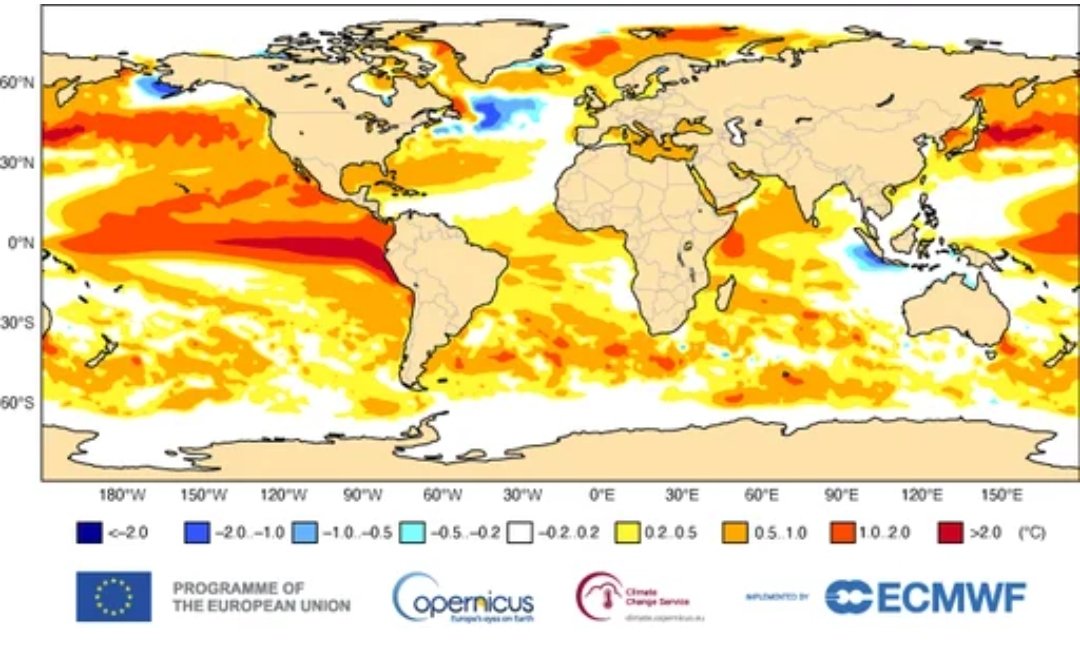
Super El Niño: 7 out of 10 climate models show a super El Niño forming in the central Pacific later this year. These are El Niño spark plumes. They leverage data from 691 ensemble members, inspired by Edward Tufte's principal of maximizing the data-ink ratio.


This is the Al-Furqan neighbourhood in Aleppo—the number of solar panels is genuinely impressive.


Finland's spent nuclear fuel repository will start operation this year. The geology is good, and the repository is near the nation's nuclear plants. Thus, the locals are supportive, and transport of waste is minimized. Article link. Another thing that I found interesting. The repository only cost $1.2 billion. By contrast, the Yucca Mountain repository in the US had a projected cost on the order of ~$100 billion. I always thought that smaller repositories, for nations that have a relatively small number of nuclear plants, would suffer from a large dis-economy of scale. Thus, their cost, per amount of waste disposed, would be much higher. And yet, Finland's repository cost LESS than Yucca, on a per GW of (national) nuclear capacity basis. Perhaps the Finnish repository benefitted from superior geology. This is good news. If you have a large country, with a large number of nuclear plants, and you dispose of all your waste in a single repository, it leads to strong NIMBY resitance. The host state feel a stigma, due to being "singled out" as the one "dump" for all the nation's waste. Having several repositories, including ones in states that have nuclear plants, would reduce this NIMBY problem. I've been receptive to the deep borehole approach for waste disposal, for this reason. It may allow final disposal right on, or near, the nuclear plants themselves. Communities agree to accept waste disposal in exchange for the large economic benefits of hosting nuclear power plants.


The AMOC is slowing down. We know it has an on/off switch. We also know it would, if turned off, cause catastrophic global impacts. Unacceptable. Here our new study showing shut-down very likely bumps up warming 0.2°C through carbon cycle feedback alone. nature.com/articles/s4324…


I've been fighting a horrible feeling of dread today. There's so much that's so deeply deeply wrong in the world that it's hard to know what's causing it.