greg shove
2.3K posts

greg shove
@GregShove
CEO of @section_school -the new business school for the tech economy. Founder of @SocialChorus. Weekends include CrossFit, soccer, grilling and angel investing.
Bay Area, CA Katılım Mayıs 2007
580 Takip Edilen2.8K Takipçiler

A few days before the deadline, I’d find myself in that familiar pool of anxiety : staring at a blank digital canvas, clock ticking, knowing the next 20 hours would dissolve into a blur of bullet points, chart creation, & late-night pixel-alignment.
Time to make a presentation.
With AI, I’ve slashed the time it takes to build a presentation from a full day down to just a few hours.
I start with the essence - three key ideas or stories that will resonate with my audience.
With these seeds planted, I’ll dictate to the AI to architect a 12-slide framework, calibrated for its audience (recently, sharing predictions for data in 2025 to a group of data engineers & analysts which I’ll publish next week). They are The Great Consolidation, Scale Up Architectures & Agentic Data.
I suggest a few deeper points like new query engines, virtual developer environments, separation of compute & storage, & collaborative BI.
Then I ask the AI to draft the speaker’s notes in a framework that my management coach at Google taught me - the “Clearing-Content-Transition” framework:
Clearing: Describe what’s on the slide Content: Detail 3-4 key points & supporting stories Transition: Set up the next slide naturally
Each iteration refines the narrative. “Move slide 5 to after slide 10.” “Shorten the section on AI & engineering teams fusing.” “In scale up architectures, there’s a generational transition where many of the new engineers prefer Python. Weave that in.”
The outline evolves as AI & I collaborate. We craft a surprising hook (no more “Hi, my name is…”), from Matthew Dick’s storytelling wisdom to give audiences a reason to care by introducing the Stakes.
With the outline nearly complete, the next step is to add the visual flair. “Please create a prompt for an image in for each slide.” This part isn’t yet automated, but I flipped back and forth between the prompts and an image generation AI.
Put it all together, deliver it online, read from the script a few times to practice so the delivery is a bit more spontaneous and it’s done and dusted.
Not every image or every slide can be fully automated, but many of them can. There’s something about starting a blank canvas with an AI that solves or at least bevels the edges of writer’s block.
I’ll publish the presentation on Jan 24. I’ll also publish the script alongside it & would love to hear your reactions.
tomtunguz.com/presentations-…
English
@awilkinson we can do it - we trained 15K people last year on AI (async, live and in-person). I am often in Vancouver as my brother lives in Whistler - so maybe I handle it. and btw, the training that is really needed is how to ID workflows and outputs that are the best targets for GPT.
English

I need a company to train a team of people on how to use ChatGPT.
Who should I hire? Basically: spend an afternoon with a team of people in Vancouver helping them master ChatGPT.
English
@karpathy the LMS and the courses are not the hard part - but def they could all use a major AI upgrade. It's the biz model, CAC and engagement/completion rates that are hard - esp after you work through all the early adopters and superfans. happy to share our learnings
English

⚡️ Excited to share that I am starting an AI+Education company called Eureka Labs.
The announcement:
---
We are Eureka Labs and we are building a new kind of school that is AI native.
How can we approach an ideal experience for learning something new? For example, in the case of physics one could imagine working through very high quality course materials together with Feynman, who is there to guide you every step of the way. Unfortunately, subject matter experts who are deeply passionate, great at teaching, infinitely patient and fluent in all of the world's languages are also very scarce and cannot personally tutor all 8 billion of us on demand.
However, with recent progress in generative AI, this learning experience feels tractable. The teacher still designs the course materials, but they are supported, leveraged and scaled with an AI Teaching Assistant who is optimized to help guide the students through them. This Teacher + AI symbiosis could run an entire curriculum of courses on a common platform. If we are successful, it will be easy for anyone to learn anything, expanding education in both reach (a large number of people learning something) and extent (any one person learning a large amount of subjects, beyond what may be possible today unassisted).
Our first product will be the world's obviously best AI course, LLM101n. This is an undergraduate-level class that guides the student through training their own AI, very similar to a smaller version of the AI Teaching Assistant itself. The course materials will be available online, but we also plan to run both digital and physical cohorts of people going through it together.
Today, we are heads down building LLM101n, but we look forward to a future where AI is a key technology for increasing human potential. What would you like to learn?
---
@EurekaLabsAI is the culmination of my passion in both AI and education over ~2 decades. My interest in education took me from YouTube tutorials on Rubik's cubes to starting CS231n at Stanford, to my more recent Zero-to-Hero AI series. While my work in AI took me from academic research at Stanford to real-world products at Tesla and AGI research at OpenAI. All of my work combining the two so far has only been part-time, as side quests to my "real job", so I am quite excited to dive in and build something great, professionally and full-time.
It's still early days but I wanted to announce the company so that I can build publicly instead of keeping a secret that isn't. Outbound links with a bit more info in the reply!

English

Y Combinator, the legendary startup incubator, has given thousands of founders the opportunity to change not only their lives, but the world as a whole.
What if there was a school that could do the same for your child?
I propose that we create a high school modeled after Y Combinator, made possible by taking advantage of “2 Hour Learning,” a new educational concept that uses AI-powered adaptive learning apps to allow kids to fit academics into just two hours a day.
I’d call the project Y-School, and here is how I would design it using Y Combinator’s ideals:
01. Olympic-level Projects (the Billion-dollar Businesses)
Students would come to Y-School to spend four years of afternoons (and, of course, nights and weekends) building an Olympic-level project.
I love the term Olympic-level simply because Olympic means “best in the world,” not just "good for your age."
Most adults–and parents–consistently lower their child's expectations to keep the kid from failing. But, the most important thing a teacher can do is help kids raise their standards (love how @tylercowen frames this).
High school students can be the best in the world at something. The Y-School program will help them achieve it.
02. Passion and Purpose (the Company Mission Statement)
Most 13 and 14-year-olds don't have a passion and purpose. The first stage of the Y-School program would be to help kids find this.
Some kids would come to Y-School knowing all of this and would be off to the races, while others might change their Olympic-level project every few months.
Parents should be relaxed about their child’s changing projects. What could be better than spending four years with your child experimenting to find their life's purpose?
A great exercise for finding your passion is the Ikigai framework. I've seen teens at Alpha work through and think about the four items (what they love, what they’re good at, what the world needs, and what they can make money from) for the first time.
The world makes so much more sense when they think about things through this framework. While this structure is mostly built for adults, I've seen many kids work through it and have true "a-ha" moments.
03. Become an Expert (the Industry Knowledge of Great Founders)
13 and 14-year-olds are not experts in their area of interest.
But to accomplish their goals, they need to be.
They need to become the world's experts in their field so they can have new, innovative ideas and be taken seriously. They have four years to build this knowledge, so there's plenty of time.
There are two sets of tasks that help a student become an expert. They are:
• Building a Second Brain
The first thing students will start building is their Second Brain (thanks @fortelabs!). For thirty minutes per day, they’ll research and compile their learnings.
Yes, everything you need to know is available on the internet or in an AI, but the key is to compile a Second Brain repository of your own expertise.
Our “test to pass” for a student’s Second Brain: when loaded into a GPT, it gives better answers than ChatGPT does alone (credit, of course, to @sama!).
• Finding Your Spiky POV and Personal Monopoly
As a student builds their Second Brain, it allows them to define their Spiky POV and Personal Monopoly (one of my favorite concepts from @david_perell).
The other key thing these exercises do is push kids away from the old-school path and towards the frontier of knowledge (thanks to @paulg himself for this one).
04. Build an Audience (the First Customers)
Most teens fall into one of two camps: creator or distributor. Creators are kids who want to write books, build a video game, score a musical, or create a movie. Distributors are kids who want to post six times a day on TikTok, build Roblox clans, or give speeches–networkers extraordinaire.
Creators are interested in the artistic side of a project, while distributors are interested in getting content in front of people.
Teen creators almost never want to show their work to anyone. When I was a freshman, I was super happy to just write my stories and save the file to my Google Drive.
Distributors, on the other hand, shy away from the deep work required to become a true expert. When my sister was a freshman, I always felt I had to double-check the facts she was claiming in her speeches.
But to be Olympic-level, you must be both. As one of my guides at Alpha constantly tells us, you can't run fast in your backyard and call yourself an Olympian.
And this leads to our next exercise, which is to build an audience. We’ll divide this into two parts:
• Build an audience of experts
Twitter is the best platform for this, because no matter what the domain, the experts hang out on Twitter. Spending just fifteen minutes a day interacting with a highly curated Twitter list helps keep us at the forefront of our fields.
• Build an audience of customers
The second audience teens need to reach is their customers – and the best place to reach them can vary depending on the project. Kids targeting other teens would focus on TikTok, while I go after parents with my Substack. Sometimes audiences aren’t even on the internet. I have a classmate who built a bike park from his in-person network of mountain bikers.
Building an audience allows teens to continually refine their ideas because they’re getting feedback. By nature, teens think they know everything. Having to build an audience shows teens where their ideas are strong, and where they're nonsensical.
04. Build in Public (the Public Launches)
As you become an expert and build an audience, you’re also able to build in public. Unlike Y Combinator, where participants can start coding up their app on day one, 13- and 14-year-olds don't have the skills.
So while they’re becoming an expert and building an audience, they also need to develop their skills, whether that’s learning to program a video game, doing the basics of a movie shoot, or writing the fundraising pitch for a bike park.
And there is no better way to get better than to publish their work for feedback. Successful adults are often willing to "overinvest" in ambitious teens.
Grandmasters are willing to help teens build a program to teach a million kids how to play chess. Broadway producers review musical scripts of a group of teens trying to write their first musical. I've been helped by countless (@david_perell, @SahilBloom, @rebelEducator, @Austen, and so many more). Teens will listen to third-party adults.
Parents hesitate to criticize their child's work for fear of the impact on their already tenuous relationship. The internet has no such qualms.
Real-world expertise is in the real world. It can't be a requirement of being in the classroom.
05. Monetize
While all Y Combinator projects are meant to be businesses, that's not true of Y-School projects. My first thought when I thought of Y-School was that many kids in school don't want to build a business. What about them?
Well, the skills mentioned above are useful for anyone. My friend @travelingenes is trying to save the world from cancer, not build a business, while @TovarMFriedman is trying to become the youngest congressperson in the US.
But for those who are interested in building a business, you'll be surprised at how motivating making money is.
Why Y-School will be better than a standard school
Kids on AP tracks spend a seemingly infinite number of hours – both at school and after school – on academics, and they don't have the time to do what they love.
With the 2 Hour Learning revolution, having kids spend their afternoons working on ambitious projects is so much more fulfilling than sitting in a classroom.
Parents agonize that teens waste their days scrolling TikTok and playing video games. We have the power to change that – to show kids how to stop wasting their high school years. Let’s help them explore, discover, and deeply engage in things they love.
If you are interested in helping build this program, please reach out. If you think your child would be interested in this, join us at Alpha High.
Links to the mentioned concepts are in my newsletter. Link in my bio.

English
greg shove retweetledi

In 2030, AI will be worth $4,000,000,000
But 99% of people only know ChatGPT
So I put together 2000+ BEST AI tools across 40 categories to help you run your business
And for 24 hours, it's 100% FREE!
To get it,
• Retweet
• Like & Reply "AI"
• Follow me (so that I can DM)

English
greg shove retweetledi

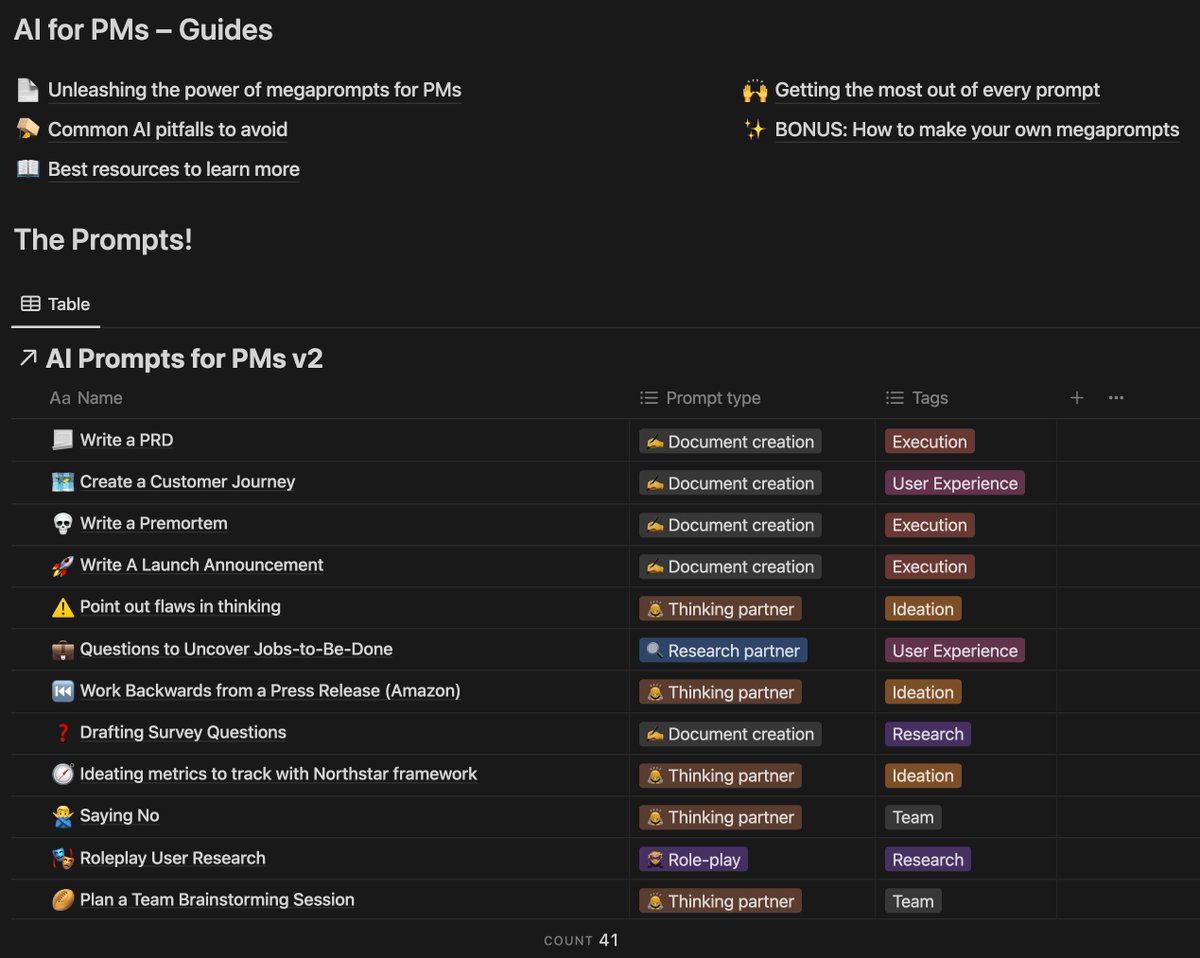
PMs: We need to master AI before AI masters us!
I've spent >100 hours making:
🔹 40+ powerful PM MEGAprompts
🔹 A list of top-tier learning resources
🔹 Guides for HOW to use AI
Soon, I'll sell it for $79.
For the next 24h: FREE!
Follow + RT + comment "🤖" and I'll DM it.
English
greg shove retweetledi

Selling my Master’s degree. Still in good condition. Never been used.
English

Today we’re launching Dover Autopilot: spin up a world-class outbound recruiting motion in minutes.
I've spent the past 4 years building @DoverHq. We’ve helped Scale AI, Stripe, Vanta and 400+ other co's make 2,000+ hires.
But we were often too expensive for startups…
1/
English
There are 3 potential operating modes in a recession - Retreat, Survive or Thrive and I will teach a simple but powerful framework that any leader can use to choose one of these modes and then react accordingly.
sign-up here: section4.com/courses/leader…
English
I have been a founder and/or CEO through four recessions - one advantage of being in this game so long.
So I’m stoked to share that I’m holding my own 2-hr workshop on Section4 called ‘Recession Proofing Your Business’ next Thursday, Jan 26th at 9am PT.
English
Sign up here: section4.com/courses/busine…
And if you need financial support or your company won’t reimburse, send me a message and I will get you in.
English
Join tomorrow, Dec 2nd at 9am ET for a 3-hr workshop where Rosalia, co-founder and CEO of Bixie will teach you the key skills to ‘think like a CFO.'
You’ll leave with a better understanding of the basics of finance and how to think clearly when it comes to the money part.
English
For the first 10 years of my career (in sales and marketing) I always felt on thin ice when presenting or working with the finance team. I solved that by going to b-school. Now there are better options, like Rosalia Gitau’s Financial Fluency Workshop.
English
Sign up here: section4.com/courses/busine… .
Do you need financial support? Send me a message and we’ll make sure you can join.
English
In order to be a great strategy leader you need to recognize when there's tough problems, and know when to tackle them head on.
Jennie Tung, a partner at Bain & Co. will teach you just that. Join us tomorrow, 11/30 from 12-3pm ET for a workshop on Problem Solving.
English
Last chance to join us tomorrow, 11/4 at 4pm ET where Eric Kim will walk us through identifying the key financial drivers within your company using the Investor Mindset Framework. Sign-up here: section4.com/courses/leader…
English
@profgalloway Come on - 3-2 win, best Emirates atmosphere ever - time to declare for #RedArmy
English