
Grifter

6.1K posts

Grifter banner
Grifter

Grifter

@Grifter801

Threat Hunting & DFIR, Hacker, Geek, DEF CON & Black Hat CFP Review Board Member, DEF CON Contest/Events/Demo Labs Dept. Head, Black Hat Staff, DC801 Founder

Salt Lake City, UT Katılım Temmuz 2007
541 Takip Edilen19.3K Takipçiler
Grifter
Grifter@Grifter801·
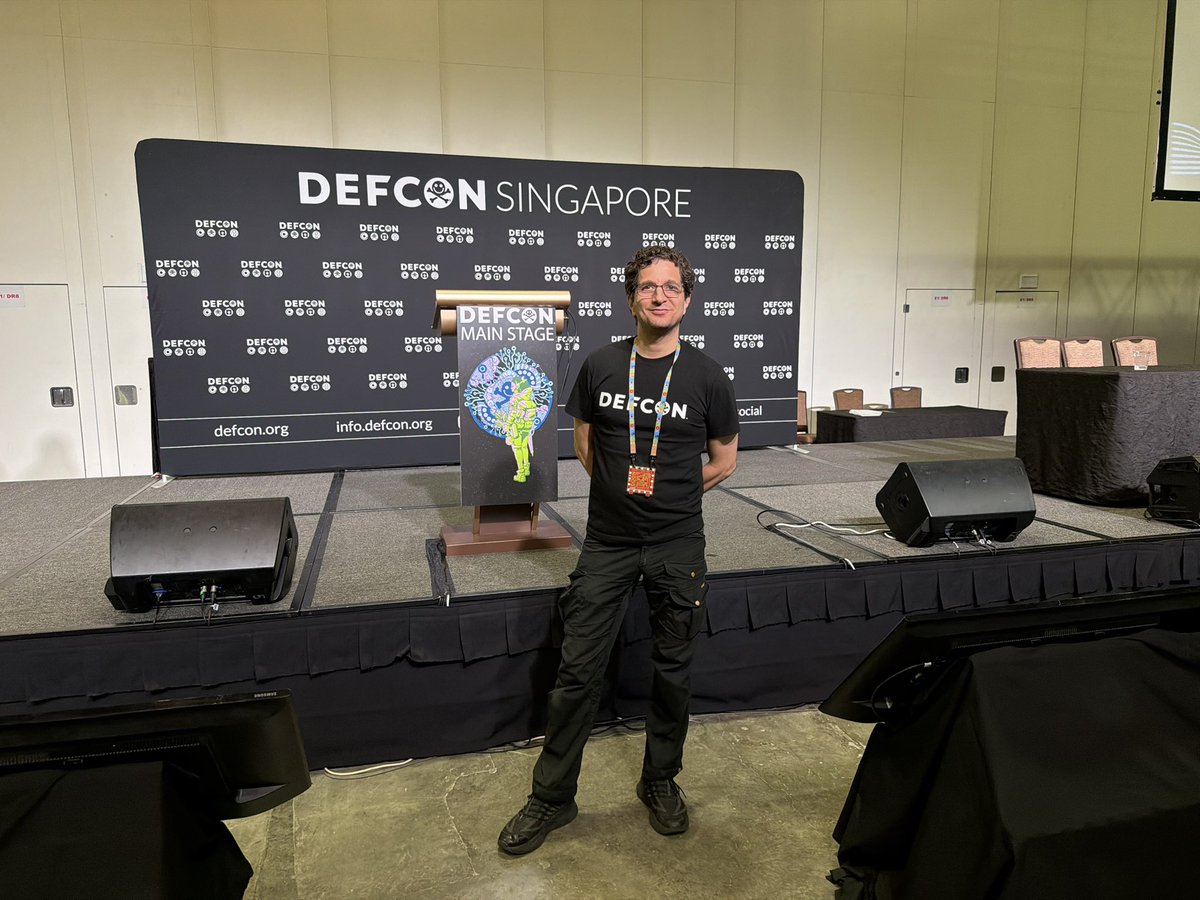
This absolute lunatic is giving a presentation while wearing @XREAL_Global Glasses so he can simultaneously view his display and notes while not taking his eyes off the crowd. 😎 @d4rkm4tter @ApresCyber
Grifter tweet media
English
1
2
25
2.3K
Grifter retweetledi
The Curious Tales
The Curious Tales@thecurioustales·
The double slit experiment has haunted physicists for over 200 years. When you shoot a single photon through two slits in a barrier, it doesn't choose one hole. It goes through both simultaneously, interferes with itself, and lands on the screen as a wave pattern, as if the particle somehow knew both paths existed and took all of them at once. The moment you place a detector to watch which slit it goes through? The wave pattern vanishes. The photon suddenly behaves like a solid particle. The act of observation collapses the quantum superposition into a single definite reality. Physicists called this "wave-particle duality" and for generations, we treated it as a quirk of space. A particle's relationship with physical barriers, physical gaps, physical measurement. What just happened changes the entire frame. Researchers didn't use slits carved into a material. They used slits carved into time itself — ultra-short switching windows in the electrical properties of a material, flickering on and off at trillionths of a second. Light passed through these temporal gaps the way it would normally pass through spatial gaps. And the interference pattern still appeared. Not across space. Across frequency. Sit with that for a moment. The wave behavior of light, the phenomenon we always associated with light spreading through physical space, reproduced itself in the time dimension. The photon interfered with its own past and future states the way it normally interferes across left and right positions. What this quietly confirms is something theoretical physicists suspected but had never demonstrated: space and time are not just mathematically symmetric in quantum mechanics. They are physically interchangeable in ways that produce identical quantum behavior. The "slits" are interchangeable coordinates. The universe doesn't distinguish between a gap in space and a gap in time when it decides how reality should unfold. The implications of that sentence are almost impossible to absorb without stopping completely. We built our entire intuition about quantum mechanics around the geometry of space — particles passing through openings, waves spreading outward, interference happening across a physical screen. Every textbook, every lecture, every thought experiment uses spatial metaphors because that's the dimension we experience as "real" and navigable. Time, by contrast, we experience as a river we're trapped inside — always moving forward, never able to go sideways in it. We don't experience temporal gaps the way we experience physical ones. A door has two holes, you can walk through either one. A moment in time doesn't seem to have "holes." Except for a photon, apparently, it does. The temporal slit experiment forces a deeply uncomfortable update to how we model light, matter, and information. If wave-particle duality operates across time the same way it operates across space, it means quantum superposition — that strange state of "being in multiple states simultaneously until observed" — is not just a spatial phenomenon. A particle can exist in multiple temporal states simultaneously. Its wave function doesn't just spread left and right. It spreads forward and backward in time. This connects to something that's been sitting at the edge of quantum mechanics for decades: the block universe theory. In Einstein's relativity, past, present, and future all exist simultaneously as coordinates in a four-dimensional spacetime fabric. "Now" is just the slice of that fabric you happen to occupy. Physicists who take this seriously argue that the reason quantum mechanics is so strange is that particles already operate in the full four-dimensional block — they're not choosing a path through space, they're tracing a path through spacetime, and what we call "probability" is our limited three-dimensional perception failing to see the complete trajectory. The temporal slit experiment edges us closer to that picture being literally, physically, measurably true. And then there's the measurement problem. The original spatial double slit experiment breaks your brain because the act of looking destroys the wave behavior. Nobody has fully agreed on why. Some say the observer collapses the wave function. Some say the detector entangles with the photon and creates decoherence. Some say the universe splits. The temporal version of the experiment opens a new front in that war. When you measure a temporal slit — when you try to determine which moment the photon passed through — does the interference across frequency collapse the same way interference across space does when you watch it? That experiment hasn't been done yet. The answer will either confirm that time and space are truly symmetric at the quantum level, or it will break the symmetry and reveal that time has a fundamentally different relationship with observation than space does. Either outcome rewrites something important. We think of physics experiments as things that happen in laboratories, relevant to scientists with particle accelerators and cryogenic equipment. But every foundational shift in quantum mechanics eventually rewires technology. The photoelectric effect sounded like a curiosity in 1905. It built every solar panel and digital camera in existence. Quantum tunneling sounded abstract. It gave us the transistor, and therefore every computer. Wave-particle duality operating across time opens the door to temporal interference as an engineering tool. Controlling how light and matter interfere across time gaps — not space gaps — could produce entirely new forms of signal processing, photonic computing, and quantum communication that don't currently exist even theoretically. The universe keeps revealing that the constraints we assumed were fundamental were just the limits of our instruments. Time always looked like a wall. Turns out it was a slit all along.
All day Astronomy@forallcurious

🚨: Scientists perform first ever double slit experiment in time sending light through temporal slits to reveal wave and particle behavior in a whole new way

English
159
793
5.7K
828.1K
Jeff Sherlock
Jeff Sherlock@olds·
What's wrong babe? You've barely touched your vibe coded CRM this week.
English
2
0
6
253
ali
ali@endingwithali·
Can someone let me know where grifters get the audacity? Is it a store in SoHo? #coder #founder #startup
English
5
6
140
5K
Grifter
Grifter@Grifter801·
@__maxreynolds Too late, Reynolds!! The community hath taken care of me.
GIF
English
1
0
2
110
Grifter
Grifter@Grifter801·
Trying to get my hands on an invite code to Polymarket, anyone out there have one they can hook me up with?
GIF
English
1
1
3
1.2K
Andy Piazza
Andy Piazza@klrgrz·
Extremely proud to represent @Unit42_Intel today at the United Nations in NYC as my colleague Evan discusses our team’s work to combat DPRK IT Workers. Let’s goooo
Andy Piazza tweet mediaAndy Piazza tweet media
English
6
3
87
3.7K
Grifter
Grifter@Grifter801·
@HackingDave What is the percentage increase of your “breakocity” if I feed you these?
Grifter tweet media
English
0
0
3
107
Dave Kennedy
Dave Kennedy@HackingDave·
If this cybersecurity thing doesn’t work out, I’m pretty good and breaking physical things and enjoy it 😂😂
English
13
2
70
3.5K
Grifter
Grifter@Grifter801·
Everybody who is thinking about giving up or dialing back on social media in 2026, I’m going to make a resolution to use it more. The universe demands balance. I will be that balance. #happynewyear
English
3
4
35
4.3K