Hal Hollis

55 posts

Hal Hollis

Hal Hollis

@HalHollis

Retired physicist and recovering academic.

Katılım Mayıs 2015
110 Takip Edilen18 Takipçiler
Hal Hollis
Hal Hollis@HalHollis·
"You made your millions because of the opportunities Canada gave you". If that's so, why haven't all Canadians like him made millions because of these opportunities? It's always the same with you vicious souls: above all else, punish the good, in the name of the good, for being good.
English
1
0
13
2.7K
Edris Jebran
Edris Jebran@EdrisJebran·
Didn’t your family flee Lebanon and done to Canada as refugees due to the exact “open immigration policies” that you are complaining about? You were offered asylum, given citizenship, a world class education. You made your millions because of the opportunities Canada gave you, the so called exit tax is just the capital gain tax on the things you need to sell, everyone has to pay that a certain point.
English
10
36
811
24K
Gad Saad
Gad Saad@GadSaad·
I decide to leave Quebec/Canada because: 1) the taxation system is astounding, rendering it nearly impossible to accumulate enough money to truly retire 2) the government's open immigration policies have made it unsafe for my family to remain here (due to the exponential increase in Jew-hatred). Today I found out that I shall have to pay a departure tax for exercising my right to leave, and the money that will be taken from me (because the obscene amount of taxes that I've already paid in full is not enough) will be given to new incoming immigrants who hate Jews. My taxes funded my forced exit and will fund the harassment of any remaining Jews in Canada. It would take me 10+ more years of work to save the amount that is likely to be taken via the departure tax. Is this moral? Ethical? Just? In any case, off to bed. Tomorrow is a new day.
English
4.3K
8.4K
51.8K
1.8M
Hal Hollis
Hal Hollis@HalHollis·
I'll have to verify the details to be sure, but it appears that one can become a tax resident (not a citizen) of Canada and still be subjected to a departure tax when you leave. This might involve only assets purchased in Canada or all of your assets depending on how long one is a tax resident.
English
0
0
0
13
KenC
KenC@kencu_web·
@RobOberTech @vesperdigital @GadSaad US taxes you wherever you live in the world, unless you renounce citizenship, and then you pay exit tax. Canada taxes you if you live in Canada. If you move away you pay exit tax, even if you remain a citizen. Which is better? Hard to say. Similar enough.
English
2
0
0
29
Vesper
Vesper@vesperdigital·
The Great Scam After what @GadSaad posted yesterday, something I had no idea existed... an "Exit Tax" I did some digging. This is what I found. Canada's departure tax is one of the biggest scam taxes on the books. Apparently when you leave the country, the government treats you as if you sold every investment you own, even if you sold nothing. You get hit with a tax bill on money you never touched, never withdrew, never spent. They literally invented a fake sale to justify taking your money. Here's what makes it even worse. The stocks they're taxing? Those are foreign companies. Apple, Samsung, whatever you hold, those grew because of what those businesses did in their own countries, their own markets, with their own workers. Canada had absolutely nothing to do with it. Zero. But they still want a cut just because you happened to live here while you owned them. They did nothing and still want to be paid like they did. And before 1996 this didn't even exist the way it does now. Chrétien's government expanded it that year and buried it in section 128.1(4)(b) of the Income Tax Act like they hoped nobody would notice. Italy doesn't do this. Portugal doesn't. Belgium, Switzerland, the UK, none of them pull this shit. You paid income tax every year. You paid sales tax. Property tax. You held up your end of the deal the whole damn time. And when you decide to go live somewhere else, they hit you with a bill for money that was never real to begin with. Canada under any Liberal is a Scam!
Vesper tweet media
English
640
2.8K
8.8K
279.7K
Hal Hollis
Hal Hollis@HalHollis·
@kencu_web @RobOberTech @vesperdigital @GadSaad More precisely, a US citizen must file a US tax return even if they live and work in, e.g., Germany. However, one (generally) gets credit for the taxes paid in foreign countries which typically more than offsets the US tax, i.e., no money is owed to the IRS.
English
1
0
1
33
Hal Hollis
Hal Hollis@HalHollis·
@t0mmyfox @GadSaad It's quite simply immoral to tax unrealized gain period. It's just plain vicious to pretend that he's sold all of his assets at FMV on the day he leaves and then demand that he pay taxes on the pretend gain with real money.
English
0
0
3
167
Tommy Fox
Tommy Fox@t0mmyfox·
@GadSaad You accumulated those gains while you resided in Canada, and you get to pay taxes on them before you leave. Pretty simple.
English
181
15
745
21.6K
Hal Hollis
Hal Hollis@HalHollis·
SpaceX has invested revenue from their NASA contracts (along with other revenue and private funding) to develop internal assets such as Starlink. Much of the valuation of SpaceX is driven by Starlink. Orbital (now Northrop Grumman) and Boeing have made no such investment, and there is little to no outside demand for their CRS and/or CCP related products outside of NASA. Is this why you hate Musk?
English
0
0
0
25
Hal Hollis
Hal Hollis@HalHollis·
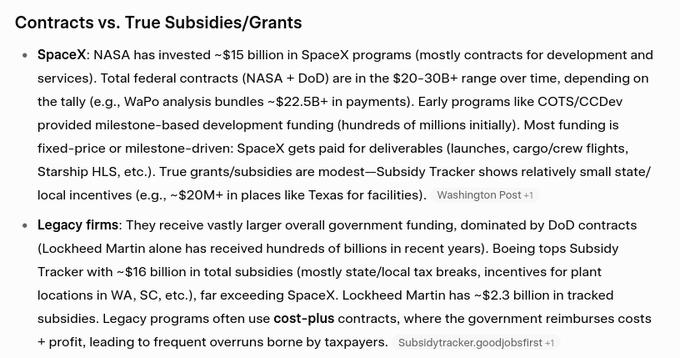
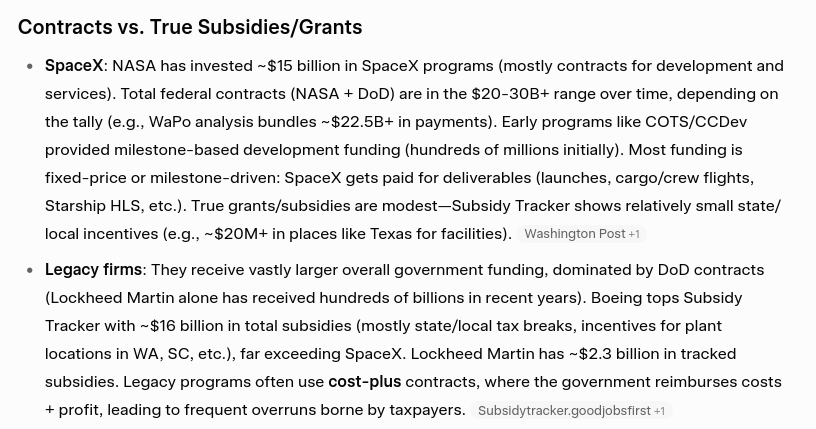
SpaceX was, in fact, 'given' billions of dollars (~ $2.6B) to develop a human rated spacecraft to safely fly astronauts to and from the ISS. Boeing was 'given' $4.2B (61% more) for the same service. The result? SpaceX has successfully flown astronauts to and from the ISS over a dozen times while Boeing has yet to accomplish this feat one time. Is this why you hate Musk?
English
1
0
0
24
Political Punk
Political Punk@actingliketommy·
Elon Musk was given tens of billions in government contracts and tax breaks and was able to take a company that’s lost $41 billion and somehow become a “trillionaire.” You will pay social security your whole life and they’ll tell you it’s an “entitlement” when you try to collect
English
945
680
2.6K
1.5M
Hal Hollis retweetledi
Andrew Wimer
Andrew Wimer@andrewwimer·
The IRS is demanding much of an 88-year-old retiree's savings; @IJ is fighting the excessive fine. Tuncay Saydam (pronounced Toon-jai) dutifully paid his taxes every year, using one of the big filing services millions of Americans work with. He didn’t know that he needed to fill out a one-page form to tell the government about a foreign bank account he was keeping as his nest egg—money he’d earned decades earlier from teaching and consulting in Europe. When the IRS audited him, they said he owed $29,000 in back taxes and $12,000 in late penalties. But because of the missing forms alone, the IRS is demanding another $437,000. That would gut Tuncay’s life savings. Tuncay earned the money in his account by being a pioneering computer science professor respected worldwide. Tuncay was born in poverty in Turkey but excelled in mathematics from a young age. He first came to the United States as a Fulbright Scholar in the early 60s and worked on early computers at the University of Texas. He helped found the first computer science program in Turkey and gained an international reputation for his work. In 1979, he was invited by the University of Delaware to teach, and a decade later he and his wife became American citizens. Today, his children and grandchildren are successful and he is retired and living near family in San Francisco. During several sabbaticals in the 80s and 90s, he taught in Switzerland and also did consulting work for Swiss telecommunications firms. He left his earnings in a bank account overseas that he intended to keep for retirement. For years, he didn’t do much with it, only moving it to Turkey after his Swiss bank decided to close all American accounts. Under the 1970 Bank Secrecy Act, Americans with foreign bank accounts containing over $10,000 must file annually a one-page “FBAR” form with the government. If someone fails to file the form, the penalty can be either $100,000 per report or half of whatever the unreported bank account contained for each unreported year. The law was passed in the intention of uncovering transnational crime, but it has become a trap for unwary retirees. A few years ago, for example, IJ appealed a similar case on behalf of a woman who had a foreign bank account that her father had passed down to her. The father had escaped Germany during the rise of Naziism and told her the money should be used in case the family ever needed to flee because of persecution. And her and Tuncay’s experiences are hardly unique. As one advocacy organization explained in Tuncay’s case, “the FBAR has ensnared everyone from Holocaust survivors and their families for maintaining ‘escape funds’ to guard against another genocide to American citizens who live overseas and simply deposit their overseas earnings into overseas accounts.” The Eighth Amendment is short and simple: “Excessive bail shall not be required, nor excessive fines imposed, nor cruel and unusual punishments inflicted.” But when a fine becomes excessive isn’t a simple matter for courts right now. In Tuncay’s case, the district court said that the IRS was best positioned to determine for itself when a fine becomes excessive. But the fine Tuncay is facing is fifteen times more than his back taxes. And for its part, the IRS stridently maintains that the Excessive Fines Clause doesn’t constrain its FBAR penalties at all. They’re “penalties,” you see, not “fines.” And if that strikes you as a distinction with a difference, you’re not alone. IJ litigated the last major excessive fines case to be considered by the Supreme Court. That 2019 decision said that the Eighth Amendment applies not just to the feds, but to state and local governments as well. There, Indiana was trying to punish a man with the forfeiture of his car for a low-level drug offense. Ultimately, the Indiana state courts agreed with IJ that forfeiting the car was “grossly disproportionate” to the serious of the crime. If the federal court were to follow the same standards IJ successfully argued for in Indiana, Tuncay would certainly owe a much more reasonable amount. Fines cannot be grossly disproportional to the offense, and Tuncay’s offense was failing to file a handful of forms, not doing anything illegal or illicit with his money. Tuncay is facing a devastating blow to his finances, but he remains optimistic and hopes that his case could make the promise of the Eighth Amendment real for more Americans. His case will be heard at the federal appeals court later this year. Stay tuned.
Andrew Wimer tweet mediaAndrew Wimer tweet mediaAndrew Wimer tweet mediaAndrew Wimer tweet media
English
5
37
175
15.6K
Konstantin Kisin
Konstantin Kisin@KonstantinKisin·
I think possibly the best thing about Elon Musk becoming a trillionaire is how angry it makes a bunch of losers who've never built a thing in their lives.
English
2K
8.9K
85.6K
1.1M
Hal Hollis
Hal Hollis@HalHollis·
Behold: pre·pos·ta·dor /prē-ˌpäs-tə-ˈdȯr/ noun 1. A person who arrogantly clings to and flamboyantly defends beliefs or opinions that are obviously, spectacularly, and preposterously wrong—yet remains completely oblivious to their absurdity, much like a matador waving a cape at a bull only they can see. 2. informal Someone whose misplaced confidence in a ridiculous idea turns them into an unwitting performer of intellectual bullfighting, cape and all. Etymology A portmanteau of preposterous (absurd, contrary to reason) + matador (the bullfighter who brandishes a cape), evoking the image of someone dramatically flaunting their flawed convictions while the rest of the world watches in bemused disbelief.
English
0
0
1
38
Hal Hollis
Hal Hollis@HalHollis·
@RubinReport @elonmusk @BernieSanders No, this is not ordinary envy and jealousy... that's somewhat relatable and understandable. This is a deep hatred of the good (the producers of values in abundance) by those with an inverted morality devoted to destroying values in the name of 'the good'.
English
0
0
1
40
Dave Rubin
Dave Rubin@RubinReport·
One @elonmusk has created more value than a trillion @BernieSanders ever could. Envy and jealously is all this is really about…
English
112
286
4.1K
41.7K
snakes
snakes@snakes979112411·
@KonstantinKisin Hey dipshit, how much of that "wealth" came from EV tax credits under Obama which literally saved Tesla from bankruptcy and direct taxpayer subsidy through Space X and Starlink
English
3
1
3
660
Hal Hollis
Hal Hollis@HalHollis·
@RoKhanna I'm quite sure that, for the American Left in general, and the Democratic Party of the United States of America in particular, there is nothing more terrifying than a prosperous and productive America.
English
0
0
1
156
Ro Khanna
Ro Khanna@RoKhanna·
This the basic difference. Republicans believe that that if you let the wealthy spend capital it will make Americans prosperous. Democrats believe that the federal government investing in the healthcare & education of our people will make America prosperous & productive.
Don Wilson@drwconvexity

@RoKhanna I am highly confident society will derive greater benefit if that capital is in Elon’s hands than in the hands of the government.

English
12.3K
566
4.3K
1.5M
Hal Hollis
Hal Hollis@HalHollis·
@DarrigoMelanie I see you, and all the others making such statements, as preposterous moral frauds. I don't think you're interested in helping reduce homelessness, etc., I think you're interested in creating more.
English
0
0
0
96
Hal Hollis
Hal Hollis@HalHollis·
God bless Elon Musk and all the good folk at SpaceX.
English
1
0
2
53
Hal Hollis
Hal Hollis@HalHollis·
@bugmanoncampus @DrJayRichards You preposterous frauds don't even give the slightest damn that your claims are obviously, plainly, and simply false. For the benefit of the still curious readers:
Hal Hollis tweet media
English
0
0
1
39
Bug Man On Campus
Bug Man On Campus@bugmanoncampus·
@DrJayRichards Well they are HEAVILY subsidized by the govt and given many MANY grants and incentives by the govt as well. Plus the hire cheap af H1Bs so.....
English
4
0
3
511
Hal Hollis
Hal Hollis@HalHollis·
@gnoble79 I suppose time will tell. Reality is the final arbiter.
English
0
0
0
15
George Noble
George Noble@gnoble79·
Peter Lynch would have HATED everything about this SpaceX IPO. I know because I worked with him at Fidelity in the 1980s. Companies like this came across our desks all the time - the hot story, the charismatic founder, the trillion-dollar promise. The answer was always the same: Pass, move on, and find a REAL business. Today, SpaceX prices at $135 a share. $1.77 TRILLION valuation while all the numbers that actually matter look TERRIBLE. "Long shots almost never pay off." Peter spent his entire career proving this. He made his money on Dunkin' Donuts, Taco Bell, Hanes, Chrysler - businesses you could walk into, understand in 30 seconds, and value off a napkin. He avoided the hot moonshot stocks of his era because the math never worked. SpaceX is one GIANT long shot... - Starship has to work at scale - Starlink margins have to hold as the satellite competition floods in - xAI has to catch OpenAI and Anthropic in a race it is currently losing - Mars has to generate returns inside our lifetimes Every one of those is a coin flip. But the $1.77 trillion price tag assumes ALL FOUR are near-certainties. Peter taught me a stock should be describable in a sentence a sixth-grader could understand. SpaceX cannot be described in a paragraph an MBA can understand. What even is SpaceX? Is it a rocket company? A satellite internet company? An AI company? A defense contractor? A Mars colonization project? The honest answer is yes to all five. Which means no real answer at all. That alone would be enough for Peter to pass. He also had a soft spot for what he called the boring profitable company. His favorite example was Kellogg's. As he put it, no matter how bad things get, people still eat cornflakes. Now look at SpaceX. It lost $4.9 BILLION in 2025. The xAI division alone burned $6.36 billion at the operating line. The only segment actually making real money is Starlink, at $11.4 billion in revenue. Strip out Starlink and you are left with a money furnace. Peter would have looked at this and bought Kellogg's instead. He would have laughed at the idea of paying $1.77 trillion for a company that loses money everywhere except one segment. By the time a hot company hits the public market, the institutions have already taken the upside and the public is being handed the bag. Just look at this offering: 30% allocated to retail investors worth $22.5 BILLION. That's triple the industry norm. I have seen this with Pets .com, Webvan, Snap, Peloton, Robinhood, Coinbase, and many more. Every one of them was the future on day one. And every one of them destroyed retail capital after the hype faded. SpaceX enters the Nasdaq-100 15 days from now. MSCI inclusion starts tomorrow. An estimated $22 to $27 BILLION in mechanical, forced buying from index funds is the entire short-term bull case. Peter built his career getting into stocks BEFORE the institutions arrived. He believed your edge came from being early. SpaceX is the opposite - every passive index fund in America is about to be forced to buy this thing at $1.77 trillion whether they want to or not. The smart money is NOT buying SpaceX today. You shouldn't either.
George Noble@gnoble79

I was 26 years old when Peter Lynch handed me this. April 28, 1983. I was the auto and retail analyst at Fidelity. Peter was in his prime, on his way to building the greatest mutual fund track record in history: 29.2% annual returns for 13 YEARS STRAIGHT, growing Magellan from $18 million to $14 billion. The Babe Ruth of investing. I'm looking at the principles he had typed up on a single sheet of paper that I've kept in my files for 42 years and I believe now is the perfect time to revisit them again. Let me walk you through a few: Rule 1B: "You need an edge to make money. Do not rely on a combination of hope and good luck." Today's retail investor has no edge. He has Reddit, Robinhood, zero-DTE options and a TikTok algorithm pushing him into whatever stock just ripped 200% the day before. That's hope and good luck wearing a fancy costume. Rule 1E: "Purchase stocks like one would purchase a business." Tesla trades at over 360 times earnings on a business deteriorating in real time, Oracle has $206 billion in liabilities against $39 billion in equity, MicroStrategy is a leveraged Bitcoin holding company priced like a software firm, and don't even get me started on SpaceX, that piece of garbage you'll be able to trade tomorrow... Nobody in their right mind would buy these as actual businesses. They buy them as stories, narratives, and lottery tickets. Peter would have called it the same way I do - these are not investments. They are speculations. GAMBLING. Rule 1G: "Study the balance sheet and cash flow statement." The hyperscalers spent over $380 billion on AI capex in 2025. Goldman says the measurable productivity payoff does not arrive until 2027 at the earliest. Oracle just reported NEGATIVE $23.7 billion in free cash flow for fiscal 2026 while borrowing at a pace that would make a leveraged buyout firm nervous. The cash flow statements are screaming but nobody is reading them. Rule 1I: "Avoid the long shot." This one cuts the deepest. The entire market has become a long shot. OpenAI is projected to post roughly $74 billion in operating losses in 2028 ALONE while priced for transformation tomorrow. Bitcoin treasury companies are multiplying off thin air. The retail investor of 2026 is making one long-shot bet after another and calling it a portfolio. Rule 3A: "When the fundamentals change, sell your mistakes." Tesla's fundamentals have changed. California registrations are down 24% year over year and inventory days went from 10 to 27. Musk himself admitted on the last earnings call that Hardware 3 cannot achieve unsupervised FSD, breaking a promise made to 4 million customers. The fundamentals have screamed change. But the stock is still at $385. The mistakes are not being sold. They are literally being doubled down on with leverage. Rule 3I: "A 30-50% profit in 12 months is great. Mediocre in three years." Today's retail crowd expects 30-50% in a WEEK. Then they wonder why they get wiped out the second the hype stops. And my favorite - Rule 3J: "Develop your own style and stick to it." That is the entire game right there. I developed mine sitting across the hall from Peter Lynch in 1983, watching him work, reading his notes, getting my own research handed back to me covered in his pencil marks. Then in 1984, my first full year managing money, I ran the #1 mutual fund in America. The Fidelity Overseas Fund was top 2 for the next six years running. I did not get there by chasing narratives. I got there by following the sheet of paper you are looking at right now. 42 years later, this single page contains more wisdom than every Fintwit thread, CNBC segment, and Wall Street price target combined. Peter retired in 1990 with the greatest mutual fund record in history. Then he sat down and wrote books explaining exactly how he did it. Only a few "investors" these days read them. And almost nobody is reading the balance sheets, the cash flow statements, or studying actual businesses today either. They are chasing AI, crypto, and whatever pumped yesterday. The wisdom on this page is timeless and it's more important than ever.

English
59
104
577
81.3K
Hal Hollis
Hal Hollis@HalHollis·
@ArturoGiov21594 @CynicalPublius I acknowledge that you've written symbols that superficially resemble a human language but lack, on my view, an essential quality thereof - that of having been the product of a functioning rational faculty.
English
0
0
0
17
SteelPirate
SteelPirate@SteelPirate00·
@CynicalPublius The owners create nothing. Labor creates everything. Without labor, ideas and the owners are nothing. Nothing in your screed or existence happens without the actual producers. The producers are collective labor. You're a braindead fucking clown and a bootlicking propagandist.
English
142
0
5
9K
Cynical Publius
Cynical Publius@CynicalPublius·
“Elon Musk is a trillionaire.” As a securities law attorney, please allow me to explain how anyone who says this is basically lying to you: 1. The Securities and Exchange Commission has a myriad of laws that prevent founders and other large stockholders of publicly traded companies from dumping their shares. There are substantial holding period requirements, volume of sales limitations and public reporting obligations for stock sales. Basically, Elon holds largely illiquid shares, he is a “trillionaire” on paper only, and the best analogy is when people peg your net worth based on your home’s market price. That’s not money in your pocket, that’s the house you live in. 2. All that money raised in the IPO? That’s not going into Elon’s pocket like the lying socialist idiots want you to believe. It’s a capital influx that will be used to make more rockets and get more payloads into orbit. It’s a CAPITAL investment—that money is like a business loan, it’s not your money to keep, it’s your money to grow the business. 3. If it WERE legal for Elon to dump his shares, the share price would crash basically instantly and the company could very well fail. If you bought SpaceX shares in the IPO, congrats. You just bought a lottery ticket, just like Elon. May the odds ever be in your favor. So the next time someone screeches about how unfair it is that Elon Musk creates wealth that benefits all of humanity, throw the truth back in their faces.
English
342
2.1K
7.8K
206.5K
Hal Hollis
Hal Hollis@HalHollis·
@BillAckman @Geiger_Capital @SavvyAuntie This. I came to realize a few years ago, that the Elizabeth Warren's of this world (of which there are many) aim, above all else, to punish the good, in the name of the good, for being _good_.
English
0
1
16
1.1K