Arnout Hellemans

48.5K posts

Arnout Hellemans banner
Arnout Hellemans

Arnout Hellemans

@hellemans

Online Strategy Consultant with a focus on #SEO, #SEA, #CRO, furthermore into #gadgets, #Android mobile phones and (offline) cooking. Online since 1992...

Amsterdam Katılım Mayıs 2008
6.7K Takip Edilen8.4K Takipçiler
Arnout Hellemans retweetledi
Alek Asaduryan
Alek Asaduryan@Ldnbox·
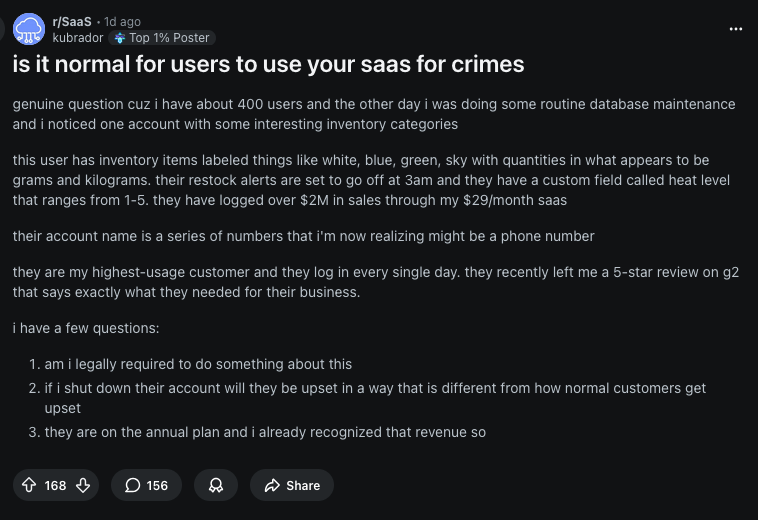
SaaS founder realizes they may have accidentally built the backbone for a drug trafficking operation. 😜
Alek Asaduryan tweet media
English
94
115
5K
570K
Arnout Hellemans retweetledi
Kevin_Indig
Kevin_Indig@Kevin_Indig·
Good god, do we have an "I said this 10 years ago" complex in SEO! No, I'm not imune. But man...
English
6
1
25
4K
Arnout Hellemans retweetledi
Jan-Willem Bobbink
Jan-Willem Bobbink@jbobbink·
I analyzed who Google AI Mode actually cites. The antitrust case just wrote itself. SE Ranking studied 68,313 keywords across 20 niches. They looked at 1.3 million citations inside Google's AI Mode answers. The finding that should make every SEO uncomfortable: Google(.)com appears as the source in 17.42% of all citations. Nearly one in five sources in AI Mode points back to Google itself. Add YouTube and it climbs to roughly 20%. Google is building an answer engine that treats its own properties as the most authoritative source on the internet. That is not a search engine. That is a closed loop. Here is where it gets worse. Ahrefs just published new data on AI Overviews using 863,000 keywords and 4 million URLs. In July 2025, 76% of pages cited in AI Overviews ranked in the top 10 organic results. By early 2026 that number dropped to 38%. Cut in half in eight months So Google is simultaneously citing itself more and citing top-ranking pages less. If you built your entire strategy around ranking on page one to earn AI visibility, that bet just collapsed. The timing is not a coincidence. Google upgraded AI Overviews to Gemini 3 globally on January 27. SE Ranking found that Gemini 3 replaced about 42% of previously cited domains overnight. Your citations are not earned. They are rented. And Google just changed the landlord. Meanwhile, the European Publishers Council filed a formal antitrust complaint with the EU in February 2026. Their argument is simple. Google uses publisher content to generate AI answers, then cites itself instead of the publishers who created the original information. The numbers support the complaint perfectly. Separately, eMarketer found that fewer than 10% of sources cited in ChatGPT, Gemini, and Copilot rank in the top 10 organic results for the same query. BrightEdge research shows the overlap between top Google links and AI cited sources dropped from 70% to below 20%, currently at 17%. Traditional SEO rankings and AI visibility are becoming two completely different games. And in the AI game, Google gave itself home court advantage. This is not a ranking problem. This is a market structure problem. When the platform that controls 90% of search also controls the answer layer and cites itself as the primary source, the word for that is not optimization. The word is antitrust.
English
4
4
19
1.8K
Arnout Hellemans retweetledi
Shruti
Shruti@heyshrutimishra·
A professor built an app in 12 hours that Meta's billion dollar team never wanted to exist. It detects their Ray-Ban glasses nearby using Bluetooth. Your phone vibrates: "Smart Glasses are probably nearby." Meta's own internal memo said they'd launch facial recognition on the glasses "during a dynamic political environment" when civil rights groups would be too distracted to fight back. Harvard students already proved it works. They built glasses that reveal your name, phone number and home address just by looking at your face. Meta sold 7 million pairs last year. They look identical to normal glasses. The LED that blinks when recording? There are tutorials to disable it. One professor got fed up and built a counter in his spare time. It's Free & open source with zero ads. Detects within 50 feet outdoors. 32 feet in a crowd. Download: search "Nearby Glasses" on Google Play
Shruti tweet media
English
177
9.4K
32.5K
937.6K
Arnout Hellemans retweetledi
Jan-Willem Bobbink
Jan-Willem Bobbink@jbobbink·
I stopped using and trusting CTR benchmarks. Here is why you probably should too. Everyone in SEO loves a good CTR curve. You pull up your Google Search Console data. You compare it against AWR, Sistrix, First Page Sage, or Backlinko. And then you feel either great or terrible about your performance. But look at those benchmarks side by side. They do not even agree with each other. AWR's monthly data says one thing. First Page Sage 2026 says another. Sistrix 2024 tells a completely different story. Backlinko 2019 is still floating around like it is relevant. The spread between them is massive. Especially for position 1. Some show 30% CTR for the top spot. Others show over 40%. That is not a rounding error. That is a completely different reality. So which one are you benchmarking against? And more importantly. Why? Every single one of these studies measures different things. Different industries. Different query types. Different time periods. Different methodologies. Your actual CTR depends on your niche, your brand, your SERP features, and whether Google decided to slap an AI overview on top of your result today. I built a GSC toolset that summarizes CTR across hundreds of properties and overlays the real weighted average against all four major benchmarks at once. The result? My position 1 CTR was 60%. Double what most benchmarks predicted. And for positions 5 through 20? Almost no difference between any of them. The only benchmark that matters is your own. Track your CTR over time. Compare it against yourself. Not against a study that averaged data from industries nothing like yours. CTR benchmarks are not useless. But treating them as your target is. Your own data is the only curve worth obsessing over.
Jan-Willem Bobbink tweet media
English
0
3
14
914
Arnout Hellemans retweetledi
just Jarno
just Jarno@JarnoVanDriel·
Turning websites in fully functioning knowledge graphs - without needing a stacks of diverse devs, or going broke on tokens. Now this seems promising!
Alex Moss@alexmoss

Today at @yoast we’re shipping something I've actually wanted to see on the web for some time (even before working at Yoast) and am now honored to be part of the team to bring this to the masses... Built in collaboration with the Open Source and NLWeb team at @Microsoft lead by @rv_guha (co-creator of schema.org, RSS, RDF and other web standards) - we're introducing the Schema Aggregation feature: a "schemamap" endpoint that outputs your site's entire structured data map in one place. ​ Under the hood, we now provide a standardised, deduplicated map of your entities via a single endpoint. An agent no longer needs to crawl all individual pages to understand its meaning but can now ingest an entire entity map with ease. ​ A few details to note about the endpoint: - It's is cacheable with sub‑100ms responses - It respects existing privacy and indexing settings - It aggregates all indexable content without navigation noise - It merges duplicate entities so your "Author X" or "Article Y" exist as a single node instead of being re‑discovered on every URL. - If you're using one of our paid plugins that extends schema even more (such as Yoast WooCommerce SEO adds product schema) this will be populated within the endpoint too - If you already extend Yoast’s Schema API, or use partners like events or recipe plugins, their entities are pulled into the same map automatically. ​ For me, this is one of the first major ways the agentic web can ingest a site at scale, and with much more efficiency and context. It has also been so much fun to work with this alongside the team at Yoast, particularly the genius mind of @schlessera. Lastly, we have also launched a schema visualisation tool to view how everything is output. You can enable this feature today with the free version of Yoast SEO.


English
0
1
3
205
Arnout Hellemans retweetledi
Tim Soulo 🇺🇦
Tim Soulo 🇺🇦@timsoulo·
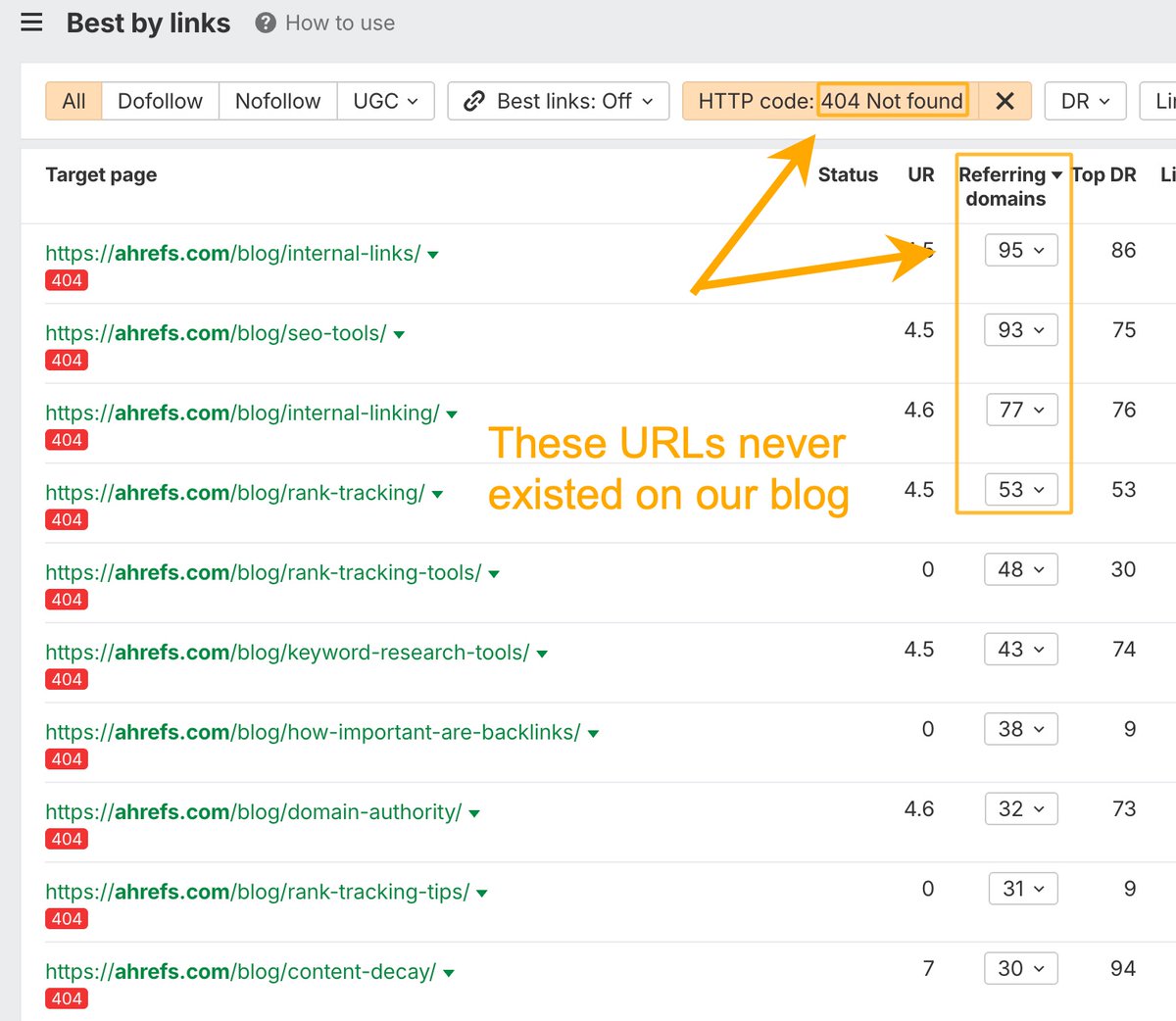
I just discovered a brand new (and totally fascinating) way to come up with content ideas for your blog. It’s your 404 pages. (Stay with me…) I randomly checked if Ahrefs Blog had any 404 pages with lots of backlinks pointing at them. And saw hundreds of them.. Wow! I pinged my Head of Content Ryan Law asking why so much of our blog content was now “dead.” Turns out — none of it was ever alive. These are all hallucinated URLs from AI-generated articles. 🤯 Basically, hundreds of sites have published AI-generated content and never checked whether the links in those articles actually point to real pages. But here's the part that really blew my mind... Most of these hallucinated URLs actually make sense. AI "thinks" we should have articles on: /internal-linking /how-important-are-backlinks /domain-authority /content-decay etc. And... we don't. AI literally found gaps in our content strategy that we missed. So now we're going to publish articles on all these topics and turn hundreds of broken hallucinated links into real backlinks. If you run a blog, go check your 404s right now. You might be sitting on a goldmine of content ideas that AI already "voted" for. (go to Ahrefs' Site Explorer > "Best by links" report > filter by 404 status code) Fun times. 😅
Tim Soulo 🇺🇦 tweet media
English
33
39
515
78.1K
Arnout Hellemans retweetledi
Bilawal Sidhu
Bilawal Sidhu@bilawalsidhu·
God's eye view 24-hour replay of Operation Epic Fury. The Iran strikes kicked off and I set an AI agent swarm loose to record every OSINT signal I could find before the caches cleared. Built a full 4D reconstruction in WorldView. I can scrub through minute by minute and watch the whole thing unfold on a 3D globe: > Airspace clearing over Tehran > Ground strike coordinates locking in > Severe GPS interference blinding the region > EO and SAR satellites making passes over the strike zone > No-fly zones locking down 9 countries > Shipping fleets scrambling at the Strait of Hormuz It's pretty amazing how complete of a picture you can build without "proprietary data fusion" -- one dev with public signals and a love for computer graphics and geospatial intelligence. Thank you for all the love on my last post. Dropping WorldView in April. This my friends is just the beginning.
English
487
2.9K
18.5K
4M
Jan-Willem Bobbink
Jan-Willem Bobbink@jbobbink·
@dsottimano I like your way of thinking: give them some freedom to come up with their own approach instead of my own tools. Caching is there so paralel agents dont request same data again
English
1
0
1
99
Jan-Willem Bobbink
Jan-Willem Bobbink@jbobbink·
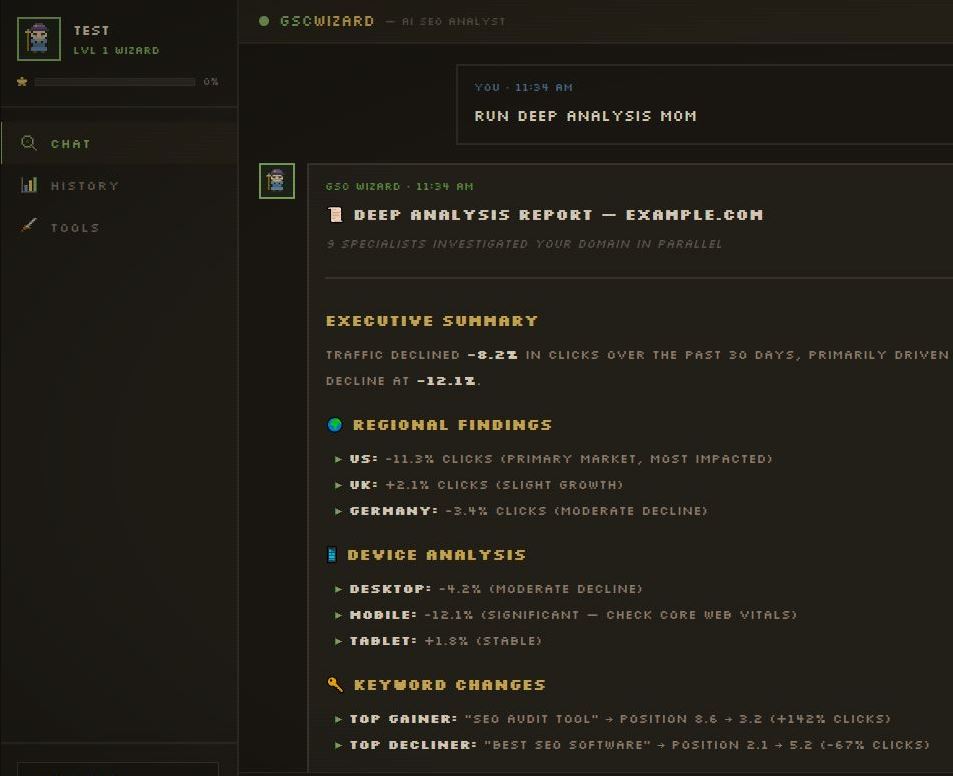
I wanted to test why the AI in GSC is so useless. So I built a GSC agent with 16 subagents of my own. Weekend mornings are for gaming. Mine just happen to involve Google Search Console. I connected Google's Agent Development Kit and Gemini 2.5 to GSC and built what I call GSC Wizard. Instead of clicking through dashboards, you just ask it questions in plain English: "Why did we lose traffic last month?" or "Show me my top 20 keywords." It runs in two modes. Simple mode uses a single Gemini Flash agent. You get answers in 2 to 5 seconds for about $0.003 per query. Deep analysis mode is where it gets interesting. 9 specialist agents investigate your site in parallel. Regional traffic. Device splits. Brand vs non-brand. Keyword cannibalization. Striking distance opportunities. Bencmarking and Low-CTR pages. Content decay. Query decay. SEO experimentation measurements. Then a synthesis agent connects all the dots into one executive report with root causes, regional breakdowns, and a prioritized recovery plan. Under 15 seconds. Costs: ~$0.04–0.06 For the kind of analysis that used to take me a few hours in spreadsheets or Looker dashboards. The key difference from just dumping data into ChatGPT: the LLM never sees your raw data. The backend processes millions of rows server-side and sends compact summaries. Smart caching through Firestore means no redundant API calls. Estimated cost for personal use: $5 to $15 per month. I have never had this level of diagnostic power at my fingertips. Google gave us an AI chatbot that selects date ranges for you and nobody asked for. Maybe what we actually needed was AI that reads our own data and tells us what to fix. But to be fair, that would be an expensive tool. Open to feedback from fellow SEOs who want to use something like this. What questions would you ask your SEO agent wizard?
Jan-Willem Bobbink tweet media
English
6
3
29
3.8K
Arnout Hellemans retweetledi
Mike Levin
Mike Levin@MikeLevin·
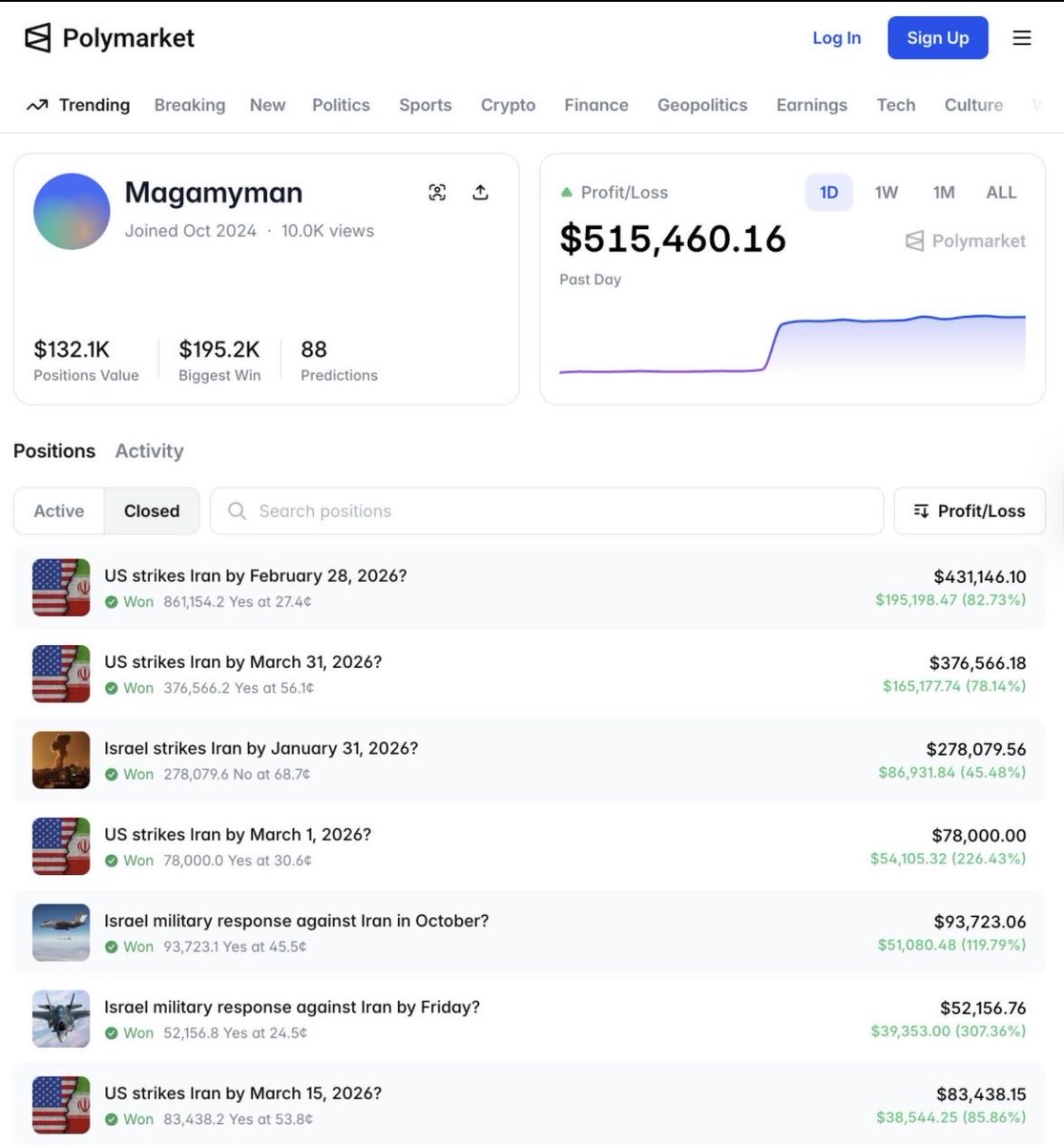
It appears that a Polymarket account called "Magamyman" made $515,000 in a single day betting on last night's U.S. strike on Iran, with the first trade placed 71 minutes before the news broke publicly. When this person bought in, the market had this at a 17% probability. They turned roughly $87,000 into over half a million dollars overnight. Reminder that Donald Trump Jr. sits on Polymarket's advisory board and his firm invested double-digit millions into the platform last year. The DOJ and CFTC both had active investigations into Polymarket that were dropped after Trump took office. Prediction markets cannot be a vehicle for profiting off advance knowledge of military action. We need answers, transparency, and oversight.
Mike Levin tweet media
English
1.2K
11.5K
42.5K
3.8M
Arnout Hellemans retweetledi
𝘊𝘰𝘳𝘳𝘪𝘯𝘦
𝘊𝘰𝘳𝘳𝘪𝘯𝘦@OopsGuess·
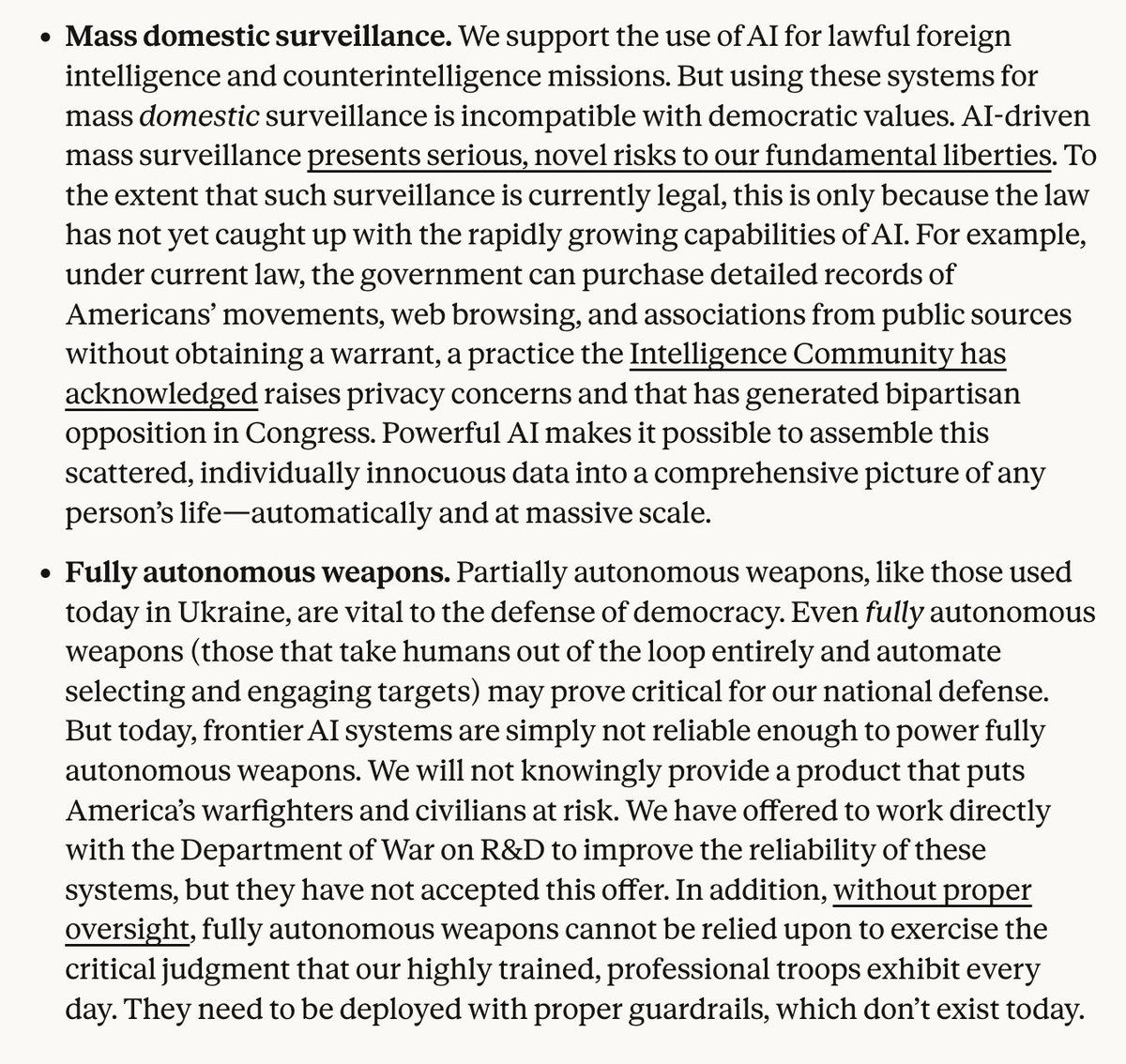
The U.S. just accidentally admitted two things: 1. AI is for monitoring Americans. 2. AI is for building autonomous weapons. Anthropic simply said “we won’t help with that,” and Washington reacted like someone exposed their entire playbook. If this isn’t panic, it’s guilt speaking.
𝘊𝘰𝘳𝘳𝘪𝘯𝘦 tweet media
Secretary of War Pete Hegseth@SecWar

This week, Anthropic delivered a master class in arrogance and betrayal as well as a textbook case of how not to do business with the United States Government or the Pentagon. Our position has never wavered and will never waver: the Department of War must have full, unrestricted access to Anthropic’s models for every LAWFUL purpose in defense of the Republic. Instead, @AnthropicAI and its CEO @DarioAmodei, have chosen duplicity. Cloaked in the sanctimonious rhetoric of “effective altruism,” they have attempted to strong-arm the United States military into submission - a cowardly act of corporate virtue-signaling that places Silicon Valley ideology above American lives. The Terms of Service of Anthropic’s defective altruism will never outweigh the safety, the readiness, or the lives of American troops on the battlefield. Their true objective is unmistakable: to seize veto power over the operational decisions of the United States military. That is unacceptable. As President Trump stated on Truth Social, the Commander-in-Chief and the American people alone will determine the destiny of our armed forces, not unelected tech executives. Anthropic’s stance is fundamentally incompatible with American principles. Their relationship with the United States Armed Forces and the Federal Government has therefore been permanently altered. In conjunction with the President's directive for the Federal Government to cease all use of Anthropic's technology, I am directing the Department of War to designate Anthropic a Supply-Chain Risk to National Security. Effective immediately, no contractor, supplier, or partner that does business with the United States military may conduct any commercial activity with Anthropic. Anthropic will continue to provide the Department of War its services for a period of no more than six months to allow for a seamless transition to a better and more patriotic service. America’s warfighters will never be held hostage by the ideological whims of Big Tech. This decision is final.

English
134
6.6K
17.2K
291.9K
Arnout Hellemans retweetledi
Josh Kale
Josh Kale@JoshKale·
Everyone’s saying OpenAI got the “same deal” Anthropic was banned for. Read the fine print. They’re not the same: On weapons: Anthropic asked for “no fully autonomous weapons without human oversight” = a human involved in the decision. OpenAI’s deal says “human responsibility for the use of force” = someone accountable, which can happen after the fact. Oversight ≠ Responsibility. One requires a human before the trigger. The other requires a name on the paperwork after. On surveillance: Dario said explicitly: current law hasn’t caught up with AI. The government can already buy your movement data, browsing history, etc without a warrant. AI can assemble that into a complete picture of your life, at scale. That’s mass surveillance without breaking a single law. Anthropic wanted protections beyond current law. OpenAI’s deal says the Pentagon “reflects them in law and policy.” That’s existing law as the safeguard, the exact law Anthropic said is insufficient. Same words. Different agreements. Read them carefully
English
201
1.9K
9.3K
788K
Arnout Hellemans retweetledi
Shanaka Anslem Perera ⚡
Shanaka Anslem Perera ⚡@shanaka86·
Anthropic just announced it will take the Trump administration to court over the supply chain risk designation. And in the same breath, Axios revealed the detail that changes everything about this story. While Anthropic was being blacklisted for refusing to allow mass surveillance, the Pentagon’s own “compromise deal” that Under Secretary Emil Michael was offering on the phone at the exact moment Hegseth posted the designation on X would have required Anthropic to allow the collection and analysis of Americans’ geolocation data, web browsing history, and personal financial information purchased from data brokers. Read that again. The Pentagon spent two weeks saying it has no interest in mass surveillance of Americans. Then the deal they actually put on the table asked for access to your location, your browsing history, and your financial records. They told us Anthropic was lying. The contract language told us Anthropic was right. Now here is where this becomes an existential question for a $380 billion company. The supply chain risk designation means every company that does business with the Pentagon must certify they do not use Claude. Eight of the ten largest companies in America use Claude. Defense contractors, cloud providers, consulting firms, banks. The blast radius is not the $200 million Pentagon contract. It is the enterprise ecosystem that generates $14 billion in annual revenue. Anthropic’s legal argument is specific: under 10 USC 3252, the designation can only restrict use of Claude on Pentagon contract work. Your commercial API access, your claude.ai subscription, your enterprise license are, in Anthropic’s reading, completely unaffected. But here is the problem. That is a legal argument. It will take years to resolve in court. And in the meantime, every general counsel at every Fortune 500 company with any Pentagon exposure is going to ask one question: is using Claude worth the risk? The IPO, which was expected this year at a $380 billion valuation backed by $30 billion in fresh capital, is functionally frozen. No underwriter will price an offering while a company carries the same designation as Huawei. And here is the final detail nobody has processed yet. Hours after blacklisting Anthropic, the Pentagon accepted OpenAI’s proposed safety framework, which contains the identical red lines: no mass surveillance, no autonomous lethal weapons. They destroyed one company for a position they then accepted from its competitor. Full analysis on Substack. open.substack.com/pub/shanakaans…
Shanaka Anslem Perera ⚡ tweet media
Secretary of War Pete Hegseth@SecWar

This week, Anthropic delivered a master class in arrogance and betrayal as well as a textbook case of how not to do business with the United States Government or the Pentagon. Our position has never wavered and will never waver: the Department of War must have full, unrestricted access to Anthropic’s models for every LAWFUL purpose in defense of the Republic. Instead, @AnthropicAI and its CEO @DarioAmodei, have chosen duplicity. Cloaked in the sanctimonious rhetoric of “effective altruism,” they have attempted to strong-arm the United States military into submission - a cowardly act of corporate virtue-signaling that places Silicon Valley ideology above American lives. The Terms of Service of Anthropic’s defective altruism will never outweigh the safety, the readiness, or the lives of American troops on the battlefield. Their true objective is unmistakable: to seize veto power over the operational decisions of the United States military. That is unacceptable. As President Trump stated on Truth Social, the Commander-in-Chief and the American people alone will determine the destiny of our armed forces, not unelected tech executives. Anthropic’s stance is fundamentally incompatible with American principles. Their relationship with the United States Armed Forces and the Federal Government has therefore been permanently altered. In conjunction with the President's directive for the Federal Government to cease all use of Anthropic's technology, I am directing the Department of War to designate Anthropic a Supply-Chain Risk to National Security. Effective immediately, no contractor, supplier, or partner that does business with the United States military may conduct any commercial activity with Anthropic. Anthropic will continue to provide the Department of War its services for a period of no more than six months to allow for a seamless transition to a better and more patriotic service. America’s warfighters will never be held hostage by the ideological whims of Big Tech. This decision is final.

English
365
2.7K
7.3K
1.1M