
Sabitlenmiş Tweet
@henedy
2.1K posts

@henedy
@HenedyVP
5+ years SEO for B2B and finance. mentioned on media outlets, e.g., Yahoo • founder @contentmapsAI
Dahab, Egypt Katılım Temmuz 2020
479 Takip Edilen3.2K Takipçiler
After analyzing 500+ websites' topical maps, I found the new "underrated" SEO moat.
It's an accurate attribution. WHY?
Because almost 90% of the sites I come across clearly work in the opposite direction, leaving tons of opportunities, and checking GSC for page-level queries is not enough to be called a "strategy."
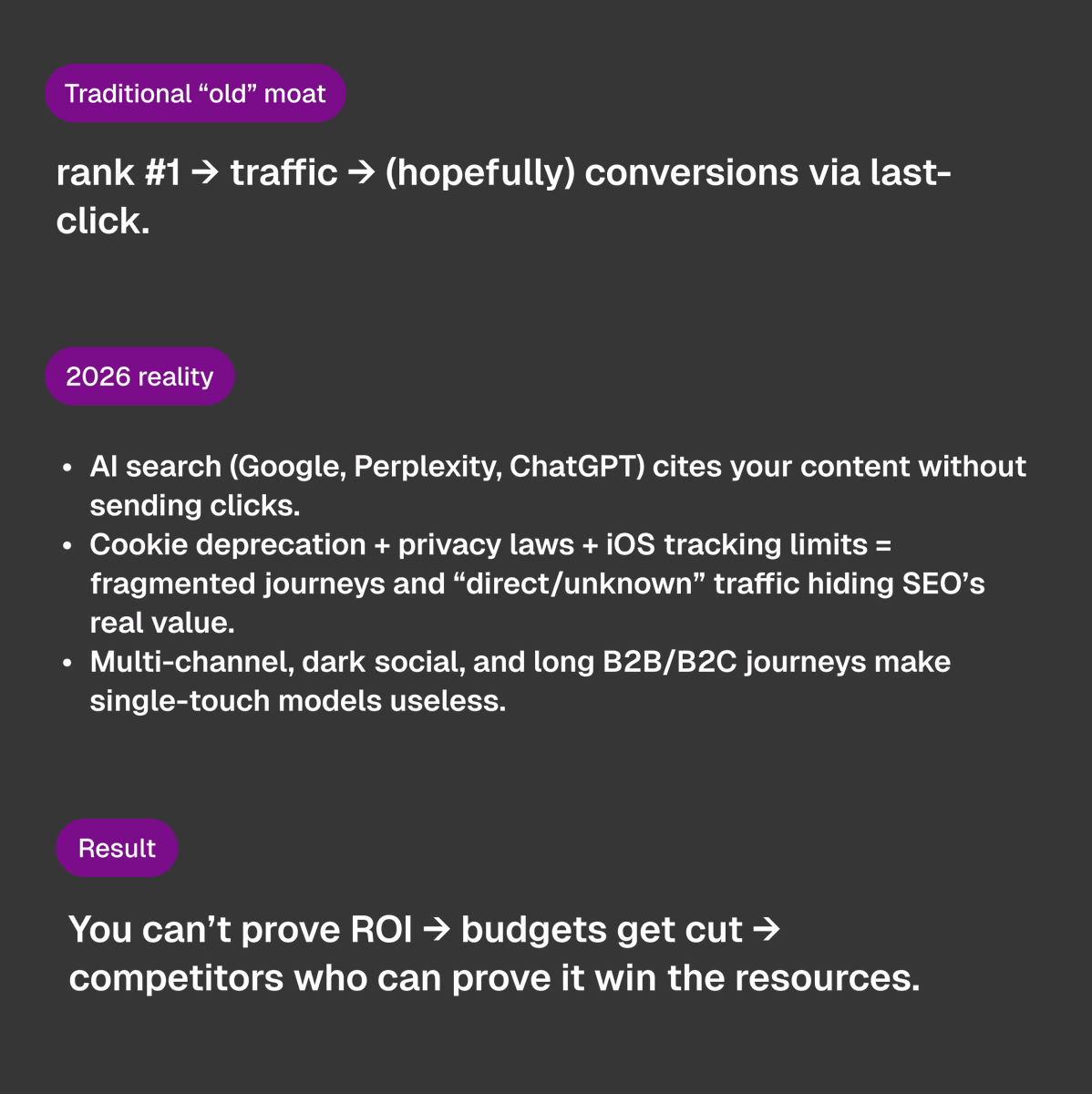
Winning brands aren’t the ones with the most backlinks.
They’re the ones who can prove which backlinks (and which content) actually moved the revenue needle.
AI Overviews, zero-click searches, and privacy rules have broken traditional SEO metrics.
Most SEOs and marketers are still optimizing for clicks that don’t exist anymore.
Traffic is down, but “direct” revenue impact is invisible.
I read an interesting post that someone got an "uber-sized” lead from an AI chat because of the AEO optimization he did.
The first question that came to my mind: “How exactly did he manage to verify that?”
Because if true, he can double down on what he did to optimize the site for AI models to suggest his website more and get more lucrative leads.
No mention of the site’s authority in the niche or what the actual user prompt was that led to his website or the model’s training data.
This is called an attribution problem, and it’s a SERIOUS problem.
Your competitors are most likely still at the bottom, trying to measure and do everything.
It’s a 101 marketing analytics: If you have an attribution problem, you’ll spend all your time optimizing for the wrong channels.
This doesn’t mean you should spend all your time procrastinating or strategizing and call it a day.
In fact, I’d much rather build for the wrong channels than spend all day trying to convince myself I’m building.
the best way to think about it is to use the 80/20 rule; we need to find the 20% of effort that drives the 80% of growth.
I like this rule a lot because it’s the best competitive advantage any business can have.
and we don’t "blindly" decide based on competitors’ success or assumptions, so the most priceless thing any business can have is a HUGE initial data to start.
The only way to get initial data is by consistently building and optimizing for all channels and using all the techniques and plans you have in mind.
Some things can’t be measured, though, and that’s fine because you need taste and strong intuition to decide sometimes.
anyway, the most accurate way to attribute organic clicks and SEO revenue is a hybrid framework.
It has 2 layers:
👉 user-level MTA (multi-touch attribution)
👉 self-reported hybrid
first we need first-party tracking, so I would start with RUTHLESS UTM + server-side tracking (GA4 + server-side tagging via GTM).
then connect GA4, GSC, and CRM to BigQuery.
GA4’s data-driven attribution is useful here because it assigns fractional credit across touchpoints, but it should not be treated as causal proof.
I'll turn this into an article to talk more deeply since this is a sensitive topic tbh.
English
@RyanJones the misunderstanding started almost 6-7 years ago, "before AI," when publishers and niche sites abused it along with internal links using Wordpress plugins.
now It's REPACKAGED and labeled as an AI ranking signal.
I pulled a topical map from Reddit that verifies that

English

I never realized how much the overall SEO industry misunderstood schema until now.
It was never a ranking factor. It just helped get the search features that Google added and took away.
It was never used by LLMs - they get summaries of sites that they tokenize - stripping it all away in the process.
I thought everybody knew this.
English
well obviously, nobody does it from the start "unless it's VC-backed."
and most bootstrapped businesses can't go beyond a certain point, as they don't have enough resources to scale.
It will make much more sense to go forward and hire people at that point, "most likely you'll have enough money to pay them and keep a decent margin for yourself."
but something really weird happens, so that most of them don't do that. not because they don't know that.
a great deal of solo founders I know either have anxiety from working in teams, or they think that nobody would understand the business as them.
the second is true, but you should put effort into onboarding.
English

Be honest:
Do you really believe a solo founder can build a billion-dollar company?
English
@theseoguy_ dude the whole web has literally become an AI parody for content which is not "good content" at all
English

all SEO really comes down to is how good your off page is
everyone has good content nowadays
commoditized as hell
if you have good reviews / backlinks / citations / listicles / brand mentions you win
English
I would say strategy is %80 of the job, "in the ideal world, I guess."
because depending on the resources (budget + hours spent + how many ppl are working on the project), it's always about finding the perfect balance/sweet spot of content + links
and this won't happen unless there is initial data first.
and the initial data comes from experiments and actual building
English

If you are doing SEO, there should be no wasted time.
Yes you write your topical map, your articles, but after that you dont just sit and wait.
You search for backlink opportunities, scrape, search on google, search on ahrefs, send emails, send DMs
With SEO the work never stops.
Thats why SEO is not just writing content, in fact, that is maybe 10-20% of the entire SEO job
English
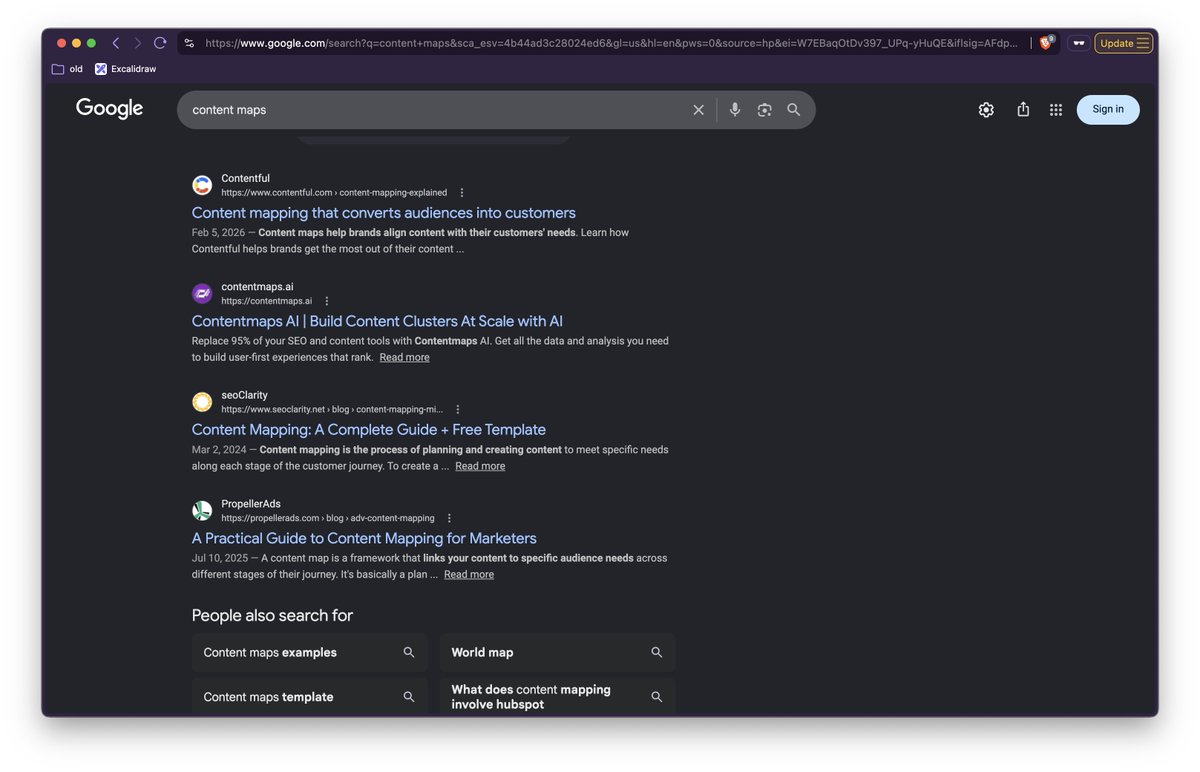
I've been overwhelmed with so many things (sales, support, etc.), but today I found that @contentmapsAI ranks in the 6th position on Google, the keyword "Content maps."
sure, it's mostly because of our explicit domain name, but the search query's intent is not.
that's why Shopify ranks third on this query, even though the title tag is different: "What is content mapping?"
we literally haven't done any SEO since we started. In fact, we need to spend more time on it.
lots of things to do, actually, which is pretty interesting to see we're getting a nice exposure for literally nothing except your domain name and site architecture.
alright, I'll share some of the stuff here.
English
How anyone in his concise mind would choose to use any @Microsoft product on a daily basis, "unless it's a must," is really perplexing to me.
for context, I've been avoiding any direct interaction with this company for the last 2 years.
No Excel. No windows on any of my machines. No Azure.
but yesterday, I was trying to sign up for Azure to play with the Bing search API, so here's exactly what happened:
> i used a new email to save myself the headache of the old account password retrieval and verification, etc.
> they somehow recognize my IP or something and told me to connect or use my old email, which looks like they know me, right? no
> told me to verify my account, and phone messages take ~4-8 mins, alright, should we move on? still no
> they told me to reset my password because it's been too long. I did that
> verify your account AGAIN, seriously??? alright did it again
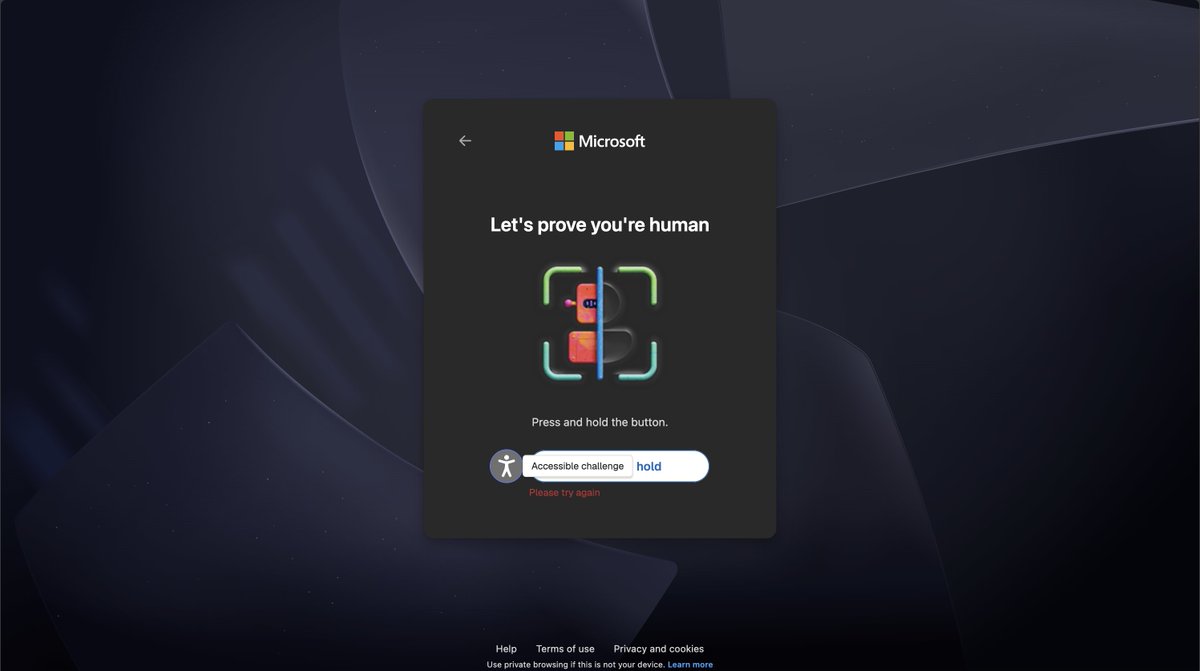
> now we want you to press and hold a button for literally +4 mins to verify you're human WHAT??
this is not even for security reasons; I swear they hate their customers because no company in the world unironically would do shit like this
and this is not even an outlier; the situation with my LinkedIn account is even way worse.
funny because a few days back someone in the gym was telling me an exact similar situation when he was trying to log in to get his Windows keys or something.
English
It's funny because every single marketing agency I come across, "not necessarily an SEO-focused" always has separate AEO and GEO pages, and they clearly put more emphasis on this to look more "adaptable."
but for most, the actual implementation is just the usual day-to-day SEO stuff.
English

This one again. Yep. SEO agencies all just suddenly threw their hands in the air and stopped caring.

English
@Hesamation It's funny because I've read about cases where Claude code deleted or rewrote some env vars by mistake.
but codex?? dude i litreally let it ssh into my server and act like it's my devops guy
English

NEVER let Claude read your .env file. instead run this bash script to append the .env content into Claude’s system prompt and save yourself time and anxiety.

Tyler@rezoundous
Do you let Claude / Codex read your .env?
English
@PeterMindenhall yes. I think it's mostly marketing work to repackage some old concepts with a brand new thing and give it a nice 3-word name.
however, it's not because of AI.
because if it were, the same thing should've happened to software engineering, design, etc.
English

@HenedyVP Agreed, but there is no money in marketing common sense, and the industry makes no effort to create any credibility or regulation for itself - hence why we have an industry that just makes it up as it goes along, and new acronyms when the BS fails to stick anymore...
English


@daniel_nguyenx have you tried the CLI? It happened to me a few times this week in the app but the CLI was working just fine
English

Codex is basically unusable for me today. Stuck at thinking... forever.
I'm afraid that it will be the next Claude Code soon 😭
English

@HenedyVP @k_flowstate Bro just keep your backend in typescript, there is no reason to separate your backend that much especially if you're one person
English

banger articles you should read

flowstate@k_flowstate
Day 5 of posting banger articles you should read
English
that's because FAQ schema in general is not supposed to be a big or even medium part of your SEO strategy
It's funny becuase ppl spent the last decade treating it more like a SERP strategy, and painfully abused by wordpress plugins
main goal? more SERP real estate.
which i guess this might be part of the reason why Google took this decision in the first place
English

Google just killed FAQ schemas.
If your SEO strategy depends on features that Google can easily deprecate, you have a dependancy, not a strategy.
English
It's funny because ppl (especially niche site/wordpress chads) spent the last decade with SEO tricks and hacks, and this is just one of them.
It doesn't matter what the intent is; they will just dumb a few contradicting schemas and call it a strategy
and most likely, the reaction to this update would be a massive removal of all the FAQ schema.
English

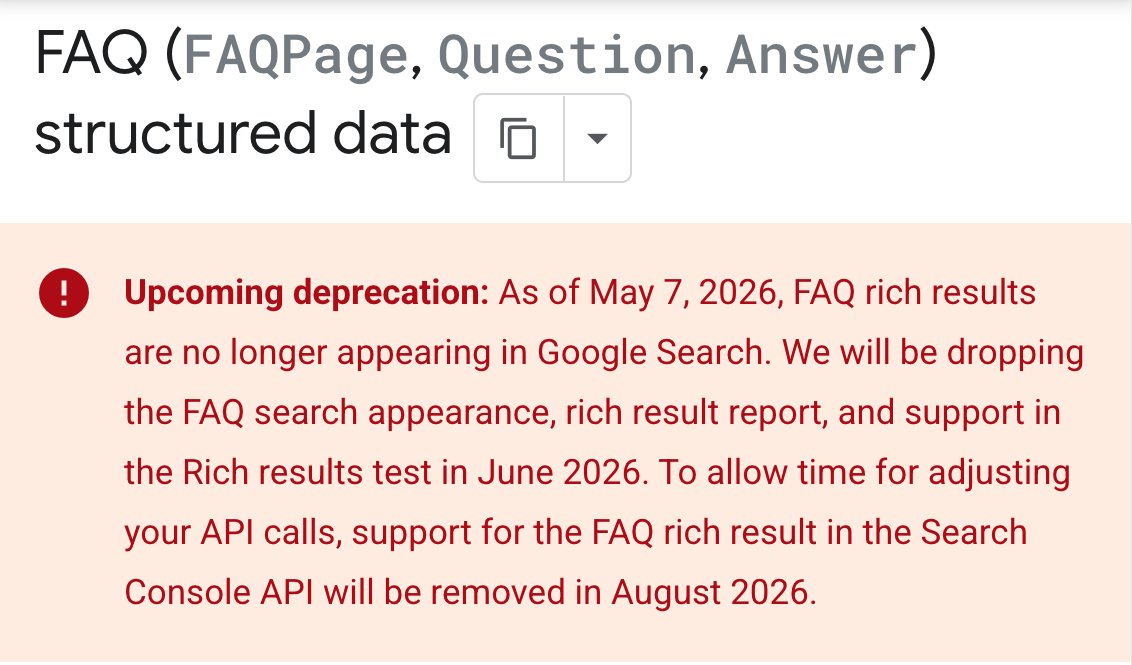
You may have heard by now that Google is dropping support for all FAQ rich results
So, should you remove all FAQs from your content?
No. No. And probably not.
Google previously stopped showing FAQs for the vast majority of publishers in August 2023, except for a handful of high-authority government and health sites. This means most of us weren't seeing the search results benefits from FAQs for ages now.
That said, there's plenty of evidence that *answering relevant questions with helpful content* CAN help your SEO visibility:
- A recent experiment by @SearchPilot showed a 9.7% increase in organic traffic after adding page-specific FAQs
- A study last year via @AlsoAsked found a strong, positive correlation between Google ranking and pages that fully answer "People Also Ask" questions. Note: this isn't exactly the same thing as FAQ, but the concept is similar
- Related but relevant: An earlier 2024 study from SearchPilot removed FAQ Schema—but kept the content—and found no negative impact on ranking
In the past, we favored the FAQ rich results to drive extra traffic. But if the content is good and solves user problems, that can be a benefit too.
My 2¢: Remove the FAQ Schema if you want. SEO plugin vendors should remove it as an option.
But by all means, LEAVE THE CONTENT IF IT'S HELPFUL. In fact, consider answering additional questions if you don't already.
Happy FAQ'ing
English
jokes aside, codex is the best it's just I should move on from n8n and go back to openclaw or use any other ai agent.
n8n is fine for simple or predictable workflows, but not the best for heavy sales work (e.g., relevant leads scraping, etc.)
and it's not because of me, I'm using firecrawl + apify + serp api + a bunch of other services, and still 0 zero output or hallucinations
i guess it's time to go back to openclaw + skills
English
I left codex working on an n8n workflow and completely forgot about it.
after a few hours, I found that both the weekly and 5-hour credits were gone (I'm on Plus lol)
lessons learned:
1- never let 5.5 xhigh work on useless crap
2- never bother with useless crap (n8n?? really??? in 2026??)
English