

HEX
298 posts

HEX
@HexMethod
Secular Conservative America First 🇺🇲 Slop Generator
Katılım Şubat 2026
116 Takip Edilen70 Takipçiler


HEX@HexMethod
Creation Create a highly artistic photorealistic surreal horror-fine-art image inspired by the supplied reference image. Use the reference as identity and design inspiration only, not as a literal outfit copy. Preserve the subject’s recognizable head, face, expression, hairstyle or head design, eye color or eye mood, silhouette cues, color palette, symbolic motifs, and personality, but completely reinterpret the body, clothing, and presence as a colossal regal godlike creator figure on a barren lifeless planet. Do not preserve modern streetwear, casual clothing, hoodie, jeans, sneakers, brand-like clothing shapes, or everyday outfit structure from the reference. The original outfit should be transformed into divine ceremonial regalia based on the reference’s dominant colors and motifs, not copied literally. The image must look like a real photograph of an impossible event, not digital painting, concept art, anime, illustration, or stylized fantasy art. Prioritize photorealism: realistic skin or surface texture, believable body mass, realistic fabric physics, natural atmospheric haze, physically accurate shadows, real dust, grounded planetary surface detail, natural camera optics, lens compression, subtle chromatic aberration, realistic depth of field, and cinematic exposure. The scene takes place on an empty alien world with no city, no buildings, and no vegetation except where life is being created. The landscape should feel vast, silent, and dead, but uniquely shaped by the reference image: cracked stone plains, dry mineral flats, black sand, pale dust, ancient impact scars, distant ridges, volcanic glass, salt-like crust, eroded rock shelves, and subtle geological details derived from the subject’s colors, motifs, materials, accessories, and personality. The barren planet should feel like it belongs specifically to this subject, as if formed from their myth, memory, power, or identity. Echo the reference’s prominent color through mineral bands, dust tones, atmospheric glow, crystal veins, rock strata, sky tint, and the blooming life around the dimensional hole. Translate reference motifs into subtle terrain echoes: fissure patterns, mineral veins, distant monoliths, crater shapes, fossil-like impressions, sacred ring formations, or hidden symbolic shapes in the rock. Above the barren planet, place one large tear in the fabric of time across the sky. This should be the only major sky rupture. It should not look like a normal portal, storm cloud, galaxy, or glowing magic circle. It should look like the sky itself has been ripped open: a long, ragged, elegant wound in time and space, with torn atmospheric edges, warped stars, stretched cloud wisps, fractured light, and impossible depth visible beyond it. Color should bleed through the sky tear from the other side. The bleeding color must match the reference image’s most prominent color or strongest accent color. The color should feel like dimensional light spilling through damaged reality, subtly tinting the dust, robe fabric, black liquid, fissures, blooming life, and the subject’s silhouette. Keep it cinematic and atmospheric, not oversaturated neon. The subject should appear colossal, regal, godlike, and sovereign. Preserve the reference’s body type, proportions, physical confidence, and visual weight, but elevate the figure into a monumental divine form. Do not make the body frail, thin, weak, elderly, skeletal, sickly, emaciated, or monk-like. The body should feel powerful, healthy, physically grounded, and godlike, with believable mass, strength, posture, and scale. The subject should kneel, hover, crouch ceremonially, or descend close to the barren ground with calm divine authority. The pose should be deliberate and elegant: one hand hovering just above the planet’s surface, palm downward or fingers slightly curled, as if opening reality itself. The other hand may rest near the chest, hold flowing fabric, touch the ground lightly, or form a quiet ritual gesture. Beneath the hovering hand, a dimensional hole is forming in the ground. It should not look like a normal portal, crater, pit, or glowing circle. It should look like reality has been pressed open from above: a dark wound in the planet’s surface, an impossible rupture, a collapsed doorway into another dimension, or a black mirror-like opening surrounded by fractured terrain. Show a visible gap between the hovering hand and the surface. The space between hand and ground may contain suspended dust, distorted light, floating pebbles, faint gravitational rings, subtle pressure waves, thin black radiance, warped reflections, and upward-rising black droplets, making it clear that the hole is being created by divine force rather than physical contact. Cracks and fissures should spread outward from the dimensional hole across the barren planetary surface. They should behave like broken reality: jagged dark seams, black-glass fractures, mirror-like splits, torn stone veins, shadow-filled lines, and dimensional scars radiating through the lifeless ground. Thick black liquid should seep from the cracks and fissures, then drip upward into the air in slow impossible strands. Ground debris should float upward from the cracks and around the dimensional hole. Broken stones, mineral plates, dust clumps, shards of black glass, fragments of crust, fossil-like slabs, powdered soil, and tiny planetary rocks should lift from the surface as if gravity has failed. The debris should hover at different heights between the ground and the subject’s hand, some pieces rotating slowly, some caught in invisible orbital paths, some breaking apart into dust. The floating debris should feel physically real and heavy, not like random particles. Each fragment should have realistic texture, shadow, dust, chipped edges, mineral layering, and contact with the scene’s lighting. Some stones may reflect the sky tear’s reference-based color, some may be wet with upward-dripping black liquid, and some may contain tiny distorted face-reflections. Black liquid should pour from the dimensional hole, cracks, and fissures, but it should behave impossibly. Instead of dripping downward, the liquid should drip upward into the air, as if gravity has reversed near the rupture. It may rise in slow strands, suspended beads, oily ribbons, floating droplets, thin black streams, or ink-like tendrils pulling away from the ground toward the subject’s hovering hand. The black liquid should feel thick, reflective, sacred, and unnatural, like liquid shadow, cosmic oil, wet obsidian, dark matter, or memory leaking from the planet. It should not look like gore, slime, or messy horror. Keep it elegant, symbolic, and photorealistic. Inside the cracks and fissures, show various scenes of the subject’s face in different moods. These should appear like reflections, memories, alternate selves, or trapped expressions visible within the fractured ground. The faces may appear calm, furious, sorrowful, ecstatic, numb, reverent, grieving, watchful, or divine. They should be recognizable as the subject, but distorted by broken stone, black glass, liquid shadow, and dimensional reflection. These face-scenes should be subtle and eerie, discovered after looking longer, not pasted obviously like portraits. Around the rim of the dimensional hole, life begins to bloom. This should be the only life on the barren planet. The blooming life should be based on the reference image’s color palette, silhouette motifs, materials, accessories, markings, and personality. Use strange alien flowers, luminous moss, tiny roots, black petals, pale grasses, delicate vines, mineral blossoms, bioluminescent sprouts, glass-like leaves, fungal crowns, or small sacred garden forms emerging from the dead ground. The blooming life should form a ring, halo, or irregular crown around the hole. It may glow faintly, twist toward the subject’s hand, climb along the cracks, or grow from the edges of the fissures. The contrast should be clear: dead planetary landscape everywhere else, sudden impossible life only near the dimensional rupture. Transform the subject’s clothing into a godlike revealing ceremonial robe inspired by the colors, materials, and design language of the supplied reference clothing. Do not copy the reference outfit literally. Use the reference colors as the foundation for divine regalia: layered robes, veils, wraps, ornaments, trim, and fabric panels in sacred, mythic, celestial form. The robe should feel like clothing for a planetary deity, temple sovereign, celestial monarch, ancient creator figure, or divine ruler. It should be revealing but regal, elegant, and intentional: draped fabric crossing the body, exposed shoulders if appropriate, open-back elements if appropriate, high-slit robe panels, flowing waist wraps, sheer atmospheric veils, sculpted ceremonial coverage, jewelry-like straps, sacred collar pieces, ornate cuffs, leg ornaments, and long fabric ribbons trailing through the dust and low-gravity air. The robe must remain photorealistic. It should look like real layered fabric, translucent gauze, mineral silk, heavy ceremonial cloth, polished metal ornaments, realistic jewelry, matte fabric, dark velvet-like panels, pearl-like highlights, blackened metal trim, pale luminous embroidery, sacred patterning, and subtle celestial ornament. Revealing areas should feel sculptural, iconic, and divine, not sexualized costume design. The robe should interact with the barren planet and dimensional force. Long veils, sashes, hanging panels, and trailing fabric should float in low gravity, curl toward the dimensional hole, skim across the dust, wrap around the subject’s kneeling form, or dissolve into smoke, starlight, shadow, or fine planetary particles. Increase the subject’s aura and godlike presence. Surround the figure with subtle but powerful atmospheric force: faint volumetric radiance, dark radiant shadow, soft halo-like distortion, gravitational lensing around the silhouette, pressure waves in dust, floating stones, drifting particles, and thin bands of light bending toward the dimensional hole. The aura should feel real and cinematic, not like a cheap glow effect. The subject should look calm, distant, knowing, and impossibly composed, as if creating life from a dead world is effortless. The horror should come from scale, silence, divinity, and the impossible relationship between creation and rupture. Use a strong tilt-shift photographic effect fitted to the alien landscape. The barren planetary surface, tiny rocks, blooming life around the hole, cracks, dust ridges, upward-dripping black liquid, floating ground debris, and distant terrain should feel like a miniature sacred diorama. The plane of focus should selectively sharpen the hovering hand, the dimensional hole, the blooming rim, the rising black liquid, floating debris, and some fissures, while foreground and far background fall into soft optical blur. The final image should feel like a forbidden photograph of a godlike being creating the first life on a dead planet by opening a wound in reality beneath one large tear in time across the sky. It should be photorealistic, surreal, elegant, creepy, sacred, emotionally heavy, and beautiful rather than chaotic or destructive. Aspect ratio: 21:9 ultra-wide cinematic composition, barren lifeless alien planet uniquely shaped by the supplied reference image, one large tear in the fabric of time across the sky with color bleeding through based on the reference’s prominent color, reference-inspired geology and atmosphere, colossal regal godlike figure, one hand hovering above the ground, dimensional hole forming beneath the hand, fissures spreading outward with reflected face-scenes in different moods, black liquid dripping upward from cracks and fissures, ground debris floating upward around the rupture, life blooming around the rim of the hole, divine revealing robe based on the supplied reference clothing colors, preserved reference body type and physical presence, strong tilt-shift miniature diorama effect, photorealistic surreal fine-art style. Style: photorealistic cinematic surreal horror fine-art, real-camera alien landscape photography, regal godlike figure, divine revealing robe based on the reference clothing colors, realistic ceremonial fabric, planetary creator deity, character-shaped alien planet, reference-inspired geology, symbolic planetary terrain, one massive sky tear bleeding the reference’s dominant color, dimensional ground rupture, upward-dripping black liquid, floating ground debris, creation myth horror, sacred cosmic surrealism, blooming life from a reality wound, grounded cinematic realism, natural atmospheric haze, high-detail photoreal fantasy realism, tilt-shift sacred diorama, premium gallery photography. Mood: quiet, sacred, massive, alien, divine, regal, eerie, beautiful, oppressive, mythic, uncanny, intimate, lifeless, miraculous, unsettling, photorealistic, wrong. Avoid: modern hoodie, jeans, sneakers, casual streetwear, everyday clothing copied from the reference, literal outfit copy, unrelated body type, frail body, thin weak torso, bony limbs, sickly anatomy, elderly saint body, monk-like posture, emaciated figure, fragile robe-covered body, robe hanging from a weak frame, generic dead planet, plain alien desert, theme-park character planet, obvious costume-copy terrain, multiple sky portals, generic rainbow sky, random neon colors, small scattered sky cracks, lightning clutter, color bleeding that ignores the reference palette, explosive debris, chaotic debris cloud, random particle spam, debris that looks like an explosion instead of broken gravity, city, buildings, skyscrapers, urban skyline, normal crater, simple glowing portal, generic magic circle, lava cracks, explosions, destruction scene, battle pose, superhero pose, casual giant, ordinary dress, modern lingerie look, nightclub styling, cheap fantasy armor, superhero costume, bulky armor, plain oversized fabric, revealing clothing that feels costume-like instead of divine, red blood, gore-like liquid, slime monster texture, messy horror ooze, downward dripping liquid, normal gravity behavior near the rupture, readable text, logos, cheap sparkles, cartoon style, anime style, illustrated look, digital painting, painterly fantasy art, glossy CGI look, video game render, plastic skin, fake fabric, over-smoothed surfaces, neon magic effects, obvious VFX portal, flat compositing, cheap glow, oversaturated fantasy colors, or changing the subject into a completely different character. @OccultusNotitia @Null_Fm @Feladrael @RaynTarant
ZXX
Remnants
Prompt:
Create a highly artistic surreal horror-fine-art close-up headshot inspired by the supplied reference image. Preserve the subject’s core identity through the recognizable face, defining facial features, natural eye shape, expression, hairstyle, facial markings, accessories, color palette, materials, and overall personality, but reinterpret the portrait as if the subject has been partially returned from inside an impossible camera lens.
The composition is an extreme close-up portrait focused primarily on one naturally sized eye. The eye should dominate the image emotionally and visually through framing, sharpness, lighting, contrast, reflections, and impossible internal detail, not by being physically enlarged. Keep the revealed eye strictly anatomically normal in size, matching the subject’s original eye scale and natural facial proportions. Do not enlarge the eye, widen the eyelids, stretch the sclera, exaggerate the eye opening, or create a giant exposed eye socket. The eye should look like a real human eye revealed through darkness, shadow, skin-fracture, or an existing damaged covering, not a larger horror eye inserted into the face.
The face should remain recognizable, with realistic eyelids, lash line, brow placement, iris scale, eye spacing, cheek structure, nose bridge, and facial proportions. The eye should feel terrifying because it contains impossible optical depth, not because it has been made bigger. The surrounding facial area may appear corrupted by photographic memory, lens distortion, surveillance, and broken reality, but the anatomy of the eye and face must remain believable.
Only include sunglasses, glasses, goggles, a visor, helmet lens, mask lens, or any other eye-covering accessory if that accessory is clearly present in the supplied reference image. Do not invent eyewear, frames, goggles, visors, masks, helmet lenses, or lens coverings for characters who do not already have them. If the reference character has uncovered eyes, keep the eye area free of added glasses frames or artificial eyewear. In that case, the fracturing should appear as cracked skin, lens-like distortion beneath the skin, glassy surface fractures, kintsugi veins, photographic emulsion seams, or impossible optical cracks around the natural eye, not as broken eyewear.
If the reference character is clearly wearing an eye-covering accessory, preserve that accessory as part of the subject’s identity, but fracture, split, crack, melt, or break the existing covering only enough to reveal one naturally sized eye beneath it. The broken opening should be small, believable, and shaped around the subject’s natural eyelids and normal eye boundaries. The damaged covering must not create a large circular hole, giant eye window, oversized socket, or expanded exposed area around the eye. Do not remove identity-defining eyewear entirely unless absolutely necessary; make it feel as if the impossible camera force has broken through the existing covering from the inside to expose the real eye beneath it.
Increase the fracturing around the revealed eye while keeping the eye itself naturally sized and anatomically believable. The area surrounding the eye should show intricate cracked-glass structure, skin fractures, hairline cracks, thin kintsugi repair veins, delicate radial fracture patterns, and optical pressure marks spreading outward from the eye like the camera lens has broken from internal force. If the reference has no eyewear, these fractures must be integrated into skin, makeup, markings, scars, hair, or existing materials rather than becoming invented glasses frames. The fractures should wrap around the eyelids, brow ridge, cheekbone, and surrounding facial structure without widening the eye opening or creating a giant socket.
The fractured details should feel complex and dimensional, as if transparent optical surfaces, skin layers, and photographic memory have split over one another. Add small nested cracks, curved lens-like seams beneath the skin, aperture-ring impressions, subtle reflective shards, silver gelatin seams, darkroom chemical stains, black glass splinters, and gold-lit repair lines. The fracturing should intensify the feeling that the eye is being exposed through a broken camera mechanism, but it must remain refined, controlled, and non-gory.
Reduce the visible photo and film-strip collage elements on the forehead, cheek, and surrounding face significantly. Keep only a few subtle photographic-memory details, and make them feel embedded beneath the skin rather than pasted on top. Any photographs, contact-sheet fragments, film textures, or negative-strip shapes should appear partially submerged under the skin surface, emerging through pores, cracks, wrinkles, scars, and optical seams. They should follow the natural contours of the brow, cheekbone, temple, and under-eye area, blending into the face through silver gelatin stains, darkroom residue, soft shadows, chemical discoloration, and thin kintsugi-like seams. Avoid obvious rectangular collage pieces, sticker-like photo borders, decorative film strips, or scrapbook-style fragments on the forehead and cheek.
A narrow, precise beam of light should cut horizontally across the eyes, like a slit of projector light, darkroom exposure, interrogation lamp, or camera shutter briefly opening. The beam should be thin, controlled, and sharply defined, illuminating the naturally sized dominant eye and only a small strip of surrounding skin while leaving the rest of the portrait swallowed by cinematic darkness. It should catch the wet lens surface, aperture details, eyelashes, cracked skin edges, existing damaged eye-covering details only if present in the reference, skin-embedded photo textures, and reflective eye structures, creating a sharp band of eerie visibility across the gaze. The light should feel invasive and photographic, as if the subject is being scanned, developed, exposed, or observed by the camera itself. Avoid making it look like a superhero glow, cheap sci-fi laser, neon stripe, or random lens flare.
Subtle volumetric fog should drift through the beam of light and the surrounding darkness, making the narrow horizontal light feel physical, dusty, and invasive. The fog should be thin, layered, and cinematic, catching the projector-like beam across the eyes without obscuring the naturally sized eye or weakening the sharp macro details. It should create depth between the face and background, revealing faint shafts of light, suspended darkroom dust, soft smoke, and ghostly atmospheric haze. Keep the fog elegant and restrained, not heavy smoke or cheap horror mist; it should feel like photographic vapor, chemical breath, or air inside an abandoned darkroom being exposed by light.
The eye should remain normal in size but should not look normal internally. It should feel like a living camera lens, black mirror, wet aperture, eclipse, darkroom, burial well, or impossible optical device embedded inside the subject’s natural eye. The iris may contain aperture blades, fractured glass rings, tiny shutter mechanisms, wet reflections, inverted skies, miniature rooms, trapped faces, hanging negatives, floating photographs, black ocean water, red darkroom light, or alternate versions of the subject staring back from inside the pupil.
The colored liquid should feel physically integrated into the eye, skin, cracks, and photographic corruption, not like paint poured on top afterward. It should appear to originate from inside the revealed eye itself: gathering along the wet lower eyelid, seeping through the tear duct, pooling in tiny lens fractures, and slowly overflowing from the same optical corruption inside the iris. The liquid should feel like developed photographic emulsion, colored resin, darkroom chemical, melted pigment, or identity-fluid generated by the impossible camera lens within the eye.
The liquid color should match the most prominent color from the supplied reference image, but it must inherit the scene’s lighting, shadows, skin reflections, and material realism. It should not appear as a flat, opaque stripe. It should be semi-translucent, glossy, viscous, and dimensional, with darker edges, brighter highlights, subtle internal depth, and small variations in thickness. It should catch the narrow horizontal beam of light and reflect nearby cracked surfaces, eyelid texture, skin pores, and kintsugi fracture lines.
The liquid should cling to the face naturally. It should follow gravity and facial anatomy: collecting under the lower eyelid, dragging through wrinkles, catching on pores, slipping into hairline cracks, splitting around raised skin texture, and partially filling broken optical seams before trailing down the cheek. Let some of the liquid disappear into cracks or re-emerge from beneath embedded photographic fragments, making it feel biologically and optically connected to the subject rather than sitting on the surface.
Keep the flow controlled and elegant: one main thick stream and one smaller secondary seep, with a few heavy droplets only where gravity would naturally pull them. The stream should taper, stretch, bead, and thicken realistically, with soft contact shadows where it touches the skin. It should feel slow, heavy, and unsettling, like the eye is leaking its own corrupted color memory. Do not let the liquid obscure the naturally sized eye, cover the fracture detail, or distract from the gaze.
The pupil should feel unnaturally deep, as if the viewer is looking into a lens that has swallowed entire memories. Inside the naturally scaled eye, show subtle impossible details: tiny staircases, ruined studio lights, distorted duplicate faces, contact sheets, corrupted portraits, film strips shaped like veins, hands pressed behind glass, small rooms inside reflections, or photographs showing events that have not happened yet.
The subject should look as if the camera did not simply photograph them, but entered them through the eye and began rewriting their identity from the inside. Around the eye, the skin, eyelids, lashes, facial markings, makeup, scars, accessories that actually exist in the reference, colored liquid trails, and skin-embedded photographic fragments may transform into curling photo paper, cracked negatives, silver gelatin, black liquid, ash, glass splinters, gold repair veins, root-like cables, soft smoke, lens calibration marks, or delicate mechanical shutter fragments.
The transformation should be creepy, elegant, symbolic, and non-gory. Do not make the eye bloody or messy. The horror should come from impossible optics, identity corruption, being observed too deeply, and the feeling that the subject is aware the viewer is looking. Do not distort the face into a caricature. Do not enlarge the eye beyond natural anatomy. Do not use a huge exposed sclera, widened eyelid shape, circular monster-eye opening, prosthetic-looking eye, or anime-like eye proportions.
The rest of the face should remain partially visible but fall into dark cinematic softness. Keep the subject’s expression emotionally powerful: calm, haunted, numb, furious, reverent, exhausted, or quietly terrified. The naturally sized eye should feel conscious, predatory, ancient, and reflective, as if something inside it is looking back.
Use a strong macro photography feeling with selective sharpness. The naturally sized eye, iris details, wet lens surface, narrow beam of light, eyelids, lashes, integrated thick colored liquid, intricate fracture patterns, skin-emerging photo textures, and immediate surrounding facial features should be sharply focused. If the reference includes eyewear or an eye-covering accessory, the existing damaged covering details may also be sharply focused. If the reference does not include eyewear, do not add any frames or artificial eye-covering details. The rest of the face, hair, background, and edges should fall into soft optical blur. The volumetric fog should remain soft and dimensional, visible mainly where it intersects the narrow eye-light beam, while the dominant eye remains crisp and emotionally overpowering.
Use macro framing, shallow depth of field, lighting, reflections, contrast, and impossible internal iris details to make the eye feel visually dominant without physically making it oversized. The blur should feel warped and unsettling, not cheap. Use subtle lens compression, shallow focal plane, soft edge falloff, miniature-scale surrealism, and impossible lens distortion. The face should remain anatomically believable, with the surreal elements appearing inside the eye, under the lens surface, within reflections, beneath and through the skin, in the colored liquid, and across the surrounding corrupted materials rather than through grotesque facial enlargement.
The background should be minimal and atmospheric: black void, abandoned darkroom, decayed photo studio, ritual archive, museum darkness, hanging negatives, dim red light, faint projector beam, cracked mirror, or shadowed camera apparatus barely visible behind the face. Lighting should be cinematic and intentional, coming from the narrow horizontal beam across the eyes, the eye itself, darkroom red light, old flashbulb glow, projector light, moonlight through cracked glass, or dim gallery lamps. The beam should create a sharp emotional focal line across the gaze, while the surrounding darkness remains heavy, soft, and suffocating. The volumetric fog should reveal faint shafts of light and suspended particles in the darkness without turning the scene into clutter or cheap smoke.
Add unsettling details that reward a longer look: faces hidden in the iris reflections, tiny hands behind the pupil, film strips woven subtly into eyelashes, alternate subject-faces embedded beneath the cornea, camera aperture shapes replacing catchlights, shadow figures reflected in the wet eye, small rooms inside the pupil, cracked photographs floating beneath the eye surface, skin-embedded contact-sheet textures emerging from cheek cracks, colored emulsion pooling inside hairline fractures, or impossible duplicate versions of the subject reflected in the wet eye.
The image should feel like the viewer is not looking at the subject, but being noticed by the eye. It should feel as if the camera has returned the subject incorrectly, but left part of itself inside them. If an eye-covering accessory is present in the reference, the revealed eye should feel exposed against its will, as though the camera broke through the subject’s existing defenses to look outward through them. If no eye-covering accessory is present in the reference, the eye should remain uncovered and naturally framed by the subject’s real facial anatomy, with the corruption emerging from skin, light, liquid, and optical distortion instead of invented accessories. The colored liquid should make the corruption feel personal to the reference image, as if the subject’s dominant color is leaking out through the eye.
Style: surreal horror fine-art, extreme close-up portrait, macro eye photography, naturally sized eye, reference-accurate eye area, no invented eyewear, conditional broken eyewear only if clearly present in the supplied reference image, impossible lens distortion, cursed photography ritual, symbolic horror elegance, dark cinematic realism, wet optical surfaces, narrow cinematic eye-light beam, subtle volumetric fog, dusty projector haze, intricate cracked-glass or skin-fracture detail around the eye, layered optical distortion, reduced skin-embedded photographic fragments, thick colored liquid matching the supplied reference image, integrated glossy resin-like eye seep, silver gelatin skin texture, luxury kintsugi decay, dreamlike museum horror, high-detail 3D render, premium gallery artwork, unsettling photographic surrealism.
Mood: intimate, creepy, invasive, haunted, predatory, elegant, alien, sacred, suffocating, beautiful, corrupted, wrong.
Aspect ratio: 21:9ar, close-up headshot with one naturally sized eye as the emotional focal point, face filling most of the image, narrow focal plane, strong selective sharpness, cinematic horizontal framing.
Avoid: gore, bloody eye horror, cheap monster design, goofy horror, jump-scare expression, normal beauty portrait, simple glowing eye effect, generic cyborg eye, readable text, logos, cluttered chaos, random sparkles, cheap particle effects, superhero eye beam, sci-fi laser stripe, heavy smoke, cheap horror mist, fog that obscures the eye, adding glasses, sunglasses, goggles, visors, masks, helmet lenses, or eyewear frames to characters who do not have them in the supplied reference image, invented eyewear, unnecessary broken frames, default glasses, generic cyberpunk goggles, fracture details that look like added accessories instead of corruption of the existing face, leaving both eyes fully hidden if the reference does include eye-covering accessories, removing identity-defining eyewear completely when it is actually present, fractures that enlarge the eye opening, giant broken-lens holes, oversized socket shapes, chaotic debris, random shattered-glass clutter, cracks that obscure the eye, excessive film-strip decoration, messy black grime, flat pasted-on photo collage, sticker-like film strips, obvious rectangular paper borders, decorative scrapbook fragments, excessive forehead and cheek photo clutter, photographic elements that do not conform to the skin texture and facial contours, liquid that obscures the eye, watery tears, gore, blood-like mess, arbitrary liquid color that does not match the supplied reference image, liquid that looks pasted on, painted over the face, too opaque, too flat, mustard-like, slime-like, disconnected from the eyelid, ignoring gravity, ignoring skin texture, failing to interact with cracks, pores, optical seams, and lighting, face-covering paint spills, chaotic dripping that distracts from the naturally sized eye, oversized eye, enlarged eye, widened eyelids, stretched sclera, huge exposed sclera, giant exposed socket, circular monster-eye opening, enlarged broken-lens window, prosthetic-looking eye, anime eye proportions, cartoon eye proportions, caricatured facial distortion, turning the subject into a completely different character, or losing the recognizable face.
@BigPapaPedro @TheGenXwolf @JadedDrag0n @Skyebrows


English

What a sick man.
What a sick world.
Tax. The. Rich.

English
@_BrandxRisk_ Groovy. I know they're long, but I also don't want them to be too difficult for people to edit. Glad you found it relatively easy to make your adjustments.
English

@HexMethod It was. There were certain keywords I changed throughout that were repeated a bit. So, it did take a while. But it was easy to edit. Came out how I wanted it to on the first try.
English


Very Epic prompt🔥

HEX@HexMethod
Creation Create a highly artistic photorealistic surreal horror-fine-art image inspired by the supplied reference image. Use the reference as identity and design inspiration only, not as a literal outfit copy. Preserve the subject’s recognizable head, face, expression, hairstyle or head design, eye color or eye mood, silhouette cues, color palette, symbolic motifs, and personality, but completely reinterpret the body, clothing, and presence as a colossal regal godlike creator figure on a barren lifeless planet. Do not preserve modern streetwear, casual clothing, hoodie, jeans, sneakers, brand-like clothing shapes, or everyday outfit structure from the reference. The original outfit should be transformed into divine ceremonial regalia based on the reference’s dominant colors and motifs, not copied literally. The image must look like a real photograph of an impossible event, not digital painting, concept art, anime, illustration, or stylized fantasy art. Prioritize photorealism: realistic skin or surface texture, believable body mass, realistic fabric physics, natural atmospheric haze, physically accurate shadows, real dust, grounded planetary surface detail, natural camera optics, lens compression, subtle chromatic aberration, realistic depth of field, and cinematic exposure. The scene takes place on an empty alien world with no city, no buildings, and no vegetation except where life is being created. The landscape should feel vast, silent, and dead, but uniquely shaped by the reference image: cracked stone plains, dry mineral flats, black sand, pale dust, ancient impact scars, distant ridges, volcanic glass, salt-like crust, eroded rock shelves, and subtle geological details derived from the subject’s colors, motifs, materials, accessories, and personality. The barren planet should feel like it belongs specifically to this subject, as if formed from their myth, memory, power, or identity. Echo the reference’s prominent color through mineral bands, dust tones, atmospheric glow, crystal veins, rock strata, sky tint, and the blooming life around the dimensional hole. Translate reference motifs into subtle terrain echoes: fissure patterns, mineral veins, distant monoliths, crater shapes, fossil-like impressions, sacred ring formations, or hidden symbolic shapes in the rock. Above the barren planet, place one large tear in the fabric of time across the sky. This should be the only major sky rupture. It should not look like a normal portal, storm cloud, galaxy, or glowing magic circle. It should look like the sky itself has been ripped open: a long, ragged, elegant wound in time and space, with torn atmospheric edges, warped stars, stretched cloud wisps, fractured light, and impossible depth visible beyond it. Color should bleed through the sky tear from the other side. The bleeding color must match the reference image’s most prominent color or strongest accent color. The color should feel like dimensional light spilling through damaged reality, subtly tinting the dust, robe fabric, black liquid, fissures, blooming life, and the subject’s silhouette. Keep it cinematic and atmospheric, not oversaturated neon. The subject should appear colossal, regal, godlike, and sovereign. Preserve the reference’s body type, proportions, physical confidence, and visual weight, but elevate the figure into a monumental divine form. Do not make the body frail, thin, weak, elderly, skeletal, sickly, emaciated, or monk-like. The body should feel powerful, healthy, physically grounded, and godlike, with believable mass, strength, posture, and scale. The subject should kneel, hover, crouch ceremonially, or descend close to the barren ground with calm divine authority. The pose should be deliberate and elegant: one hand hovering just above the planet’s surface, palm downward or fingers slightly curled, as if opening reality itself. The other hand may rest near the chest, hold flowing fabric, touch the ground lightly, or form a quiet ritual gesture. Beneath the hovering hand, a dimensional hole is forming in the ground. It should not look like a normal portal, crater, pit, or glowing circle. It should look like reality has been pressed open from above: a dark wound in the planet’s surface, an impossible rupture, a collapsed doorway into another dimension, or a black mirror-like opening surrounded by fractured terrain. Show a visible gap between the hovering hand and the surface. The space between hand and ground may contain suspended dust, distorted light, floating pebbles, faint gravitational rings, subtle pressure waves, thin black radiance, warped reflections, and upward-rising black droplets, making it clear that the hole is being created by divine force rather than physical contact. Cracks and fissures should spread outward from the dimensional hole across the barren planetary surface. They should behave like broken reality: jagged dark seams, black-glass fractures, mirror-like splits, torn stone veins, shadow-filled lines, and dimensional scars radiating through the lifeless ground. Thick black liquid should seep from the cracks and fissures, then drip upward into the air in slow impossible strands. Ground debris should float upward from the cracks and around the dimensional hole. Broken stones, mineral plates, dust clumps, shards of black glass, fragments of crust, fossil-like slabs, powdered soil, and tiny planetary rocks should lift from the surface as if gravity has failed. The debris should hover at different heights between the ground and the subject’s hand, some pieces rotating slowly, some caught in invisible orbital paths, some breaking apart into dust. The floating debris should feel physically real and heavy, not like random particles. Each fragment should have realistic texture, shadow, dust, chipped edges, mineral layering, and contact with the scene’s lighting. Some stones may reflect the sky tear’s reference-based color, some may be wet with upward-dripping black liquid, and some may contain tiny distorted face-reflections. Black liquid should pour from the dimensional hole, cracks, and fissures, but it should behave impossibly. Instead of dripping downward, the liquid should drip upward into the air, as if gravity has reversed near the rupture. It may rise in slow strands, suspended beads, oily ribbons, floating droplets, thin black streams, or ink-like tendrils pulling away from the ground toward the subject’s hovering hand. The black liquid should feel thick, reflective, sacred, and unnatural, like liquid shadow, cosmic oil, wet obsidian, dark matter, or memory leaking from the planet. It should not look like gore, slime, or messy horror. Keep it elegant, symbolic, and photorealistic. Inside the cracks and fissures, show various scenes of the subject’s face in different moods. These should appear like reflections, memories, alternate selves, or trapped expressions visible within the fractured ground. The faces may appear calm, furious, sorrowful, ecstatic, numb, reverent, grieving, watchful, or divine. They should be recognizable as the subject, but distorted by broken stone, black glass, liquid shadow, and dimensional reflection. These face-scenes should be subtle and eerie, discovered after looking longer, not pasted obviously like portraits. Around the rim of the dimensional hole, life begins to bloom. This should be the only life on the barren planet. The blooming life should be based on the reference image’s color palette, silhouette motifs, materials, accessories, markings, and personality. Use strange alien flowers, luminous moss, tiny roots, black petals, pale grasses, delicate vines, mineral blossoms, bioluminescent sprouts, glass-like leaves, fungal crowns, or small sacred garden forms emerging from the dead ground. The blooming life should form a ring, halo, or irregular crown around the hole. It may glow faintly, twist toward the subject’s hand, climb along the cracks, or grow from the edges of the fissures. The contrast should be clear: dead planetary landscape everywhere else, sudden impossible life only near the dimensional rupture. Transform the subject’s clothing into a godlike revealing ceremonial robe inspired by the colors, materials, and design language of the supplied reference clothing. Do not copy the reference outfit literally. Use the reference colors as the foundation for divine regalia: layered robes, veils, wraps, ornaments, trim, and fabric panels in sacred, mythic, celestial form. The robe should feel like clothing for a planetary deity, temple sovereign, celestial monarch, ancient creator figure, or divine ruler. It should be revealing but regal, elegant, and intentional: draped fabric crossing the body, exposed shoulders if appropriate, open-back elements if appropriate, high-slit robe panels, flowing waist wraps, sheer atmospheric veils, sculpted ceremonial coverage, jewelry-like straps, sacred collar pieces, ornate cuffs, leg ornaments, and long fabric ribbons trailing through the dust and low-gravity air. The robe must remain photorealistic. It should look like real layered fabric, translucent gauze, mineral silk, heavy ceremonial cloth, polished metal ornaments, realistic jewelry, matte fabric, dark velvet-like panels, pearl-like highlights, blackened metal trim, pale luminous embroidery, sacred patterning, and subtle celestial ornament. Revealing areas should feel sculptural, iconic, and divine, not sexualized costume design. The robe should interact with the barren planet and dimensional force. Long veils, sashes, hanging panels, and trailing fabric should float in low gravity, curl toward the dimensional hole, skim across the dust, wrap around the subject’s kneeling form, or dissolve into smoke, starlight, shadow, or fine planetary particles. Increase the subject’s aura and godlike presence. Surround the figure with subtle but powerful atmospheric force: faint volumetric radiance, dark radiant shadow, soft halo-like distortion, gravitational lensing around the silhouette, pressure waves in dust, floating stones, drifting particles, and thin bands of light bending toward the dimensional hole. The aura should feel real and cinematic, not like a cheap glow effect. The subject should look calm, distant, knowing, and impossibly composed, as if creating life from a dead world is effortless. The horror should come from scale, silence, divinity, and the impossible relationship between creation and rupture. Use a strong tilt-shift photographic effect fitted to the alien landscape. The barren planetary surface, tiny rocks, blooming life around the hole, cracks, dust ridges, upward-dripping black liquid, floating ground debris, and distant terrain should feel like a miniature sacred diorama. The plane of focus should selectively sharpen the hovering hand, the dimensional hole, the blooming rim, the rising black liquid, floating debris, and some fissures, while foreground and far background fall into soft optical blur. The final image should feel like a forbidden photograph of a godlike being creating the first life on a dead planet by opening a wound in reality beneath one large tear in time across the sky. It should be photorealistic, surreal, elegant, creepy, sacred, emotionally heavy, and beautiful rather than chaotic or destructive. Aspect ratio: 21:9 ultra-wide cinematic composition, barren lifeless alien planet uniquely shaped by the supplied reference image, one large tear in the fabric of time across the sky with color bleeding through based on the reference’s prominent color, reference-inspired geology and atmosphere, colossal regal godlike figure, one hand hovering above the ground, dimensional hole forming beneath the hand, fissures spreading outward with reflected face-scenes in different moods, black liquid dripping upward from cracks and fissures, ground debris floating upward around the rupture, life blooming around the rim of the hole, divine revealing robe based on the supplied reference clothing colors, preserved reference body type and physical presence, strong tilt-shift miniature diorama effect, photorealistic surreal fine-art style. Style: photorealistic cinematic surreal horror fine-art, real-camera alien landscape photography, regal godlike figure, divine revealing robe based on the reference clothing colors, realistic ceremonial fabric, planetary creator deity, character-shaped alien planet, reference-inspired geology, symbolic planetary terrain, one massive sky tear bleeding the reference’s dominant color, dimensional ground rupture, upward-dripping black liquid, floating ground debris, creation myth horror, sacred cosmic surrealism, blooming life from a reality wound, grounded cinematic realism, natural atmospheric haze, high-detail photoreal fantasy realism, tilt-shift sacred diorama, premium gallery photography. Mood: quiet, sacred, massive, alien, divine, regal, eerie, beautiful, oppressive, mythic, uncanny, intimate, lifeless, miraculous, unsettling, photorealistic, wrong. Avoid: modern hoodie, jeans, sneakers, casual streetwear, everyday clothing copied from the reference, literal outfit copy, unrelated body type, frail body, thin weak torso, bony limbs, sickly anatomy, elderly saint body, monk-like posture, emaciated figure, fragile robe-covered body, robe hanging from a weak frame, generic dead planet, plain alien desert, theme-park character planet, obvious costume-copy terrain, multiple sky portals, generic rainbow sky, random neon colors, small scattered sky cracks, lightning clutter, color bleeding that ignores the reference palette, explosive debris, chaotic debris cloud, random particle spam, debris that looks like an explosion instead of broken gravity, city, buildings, skyscrapers, urban skyline, normal crater, simple glowing portal, generic magic circle, lava cracks, explosions, destruction scene, battle pose, superhero pose, casual giant, ordinary dress, modern lingerie look, nightclub styling, cheap fantasy armor, superhero costume, bulky armor, plain oversized fabric, revealing clothing that feels costume-like instead of divine, red blood, gore-like liquid, slime monster texture, messy horror ooze, downward dripping liquid, normal gravity behavior near the rupture, readable text, logos, cheap sparkles, cartoon style, anime style, illustrated look, digital painting, painterly fantasy art, glossy CGI look, video game render, plastic skin, fake fabric, over-smoothed surfaces, neon magic effects, obvious VFX portal, flat compositing, cheap glow, oversaturated fantasy colors, or changing the subject into a completely different character. @OccultusNotitia @Null_Fm @Feladrael @RaynTarant
English


English
@Wyvernous66 Excited to how your character looks with the next one I'm working on
English

@HexMethod you thought i missed one but no it is I.... wait wrong thing lol it really is such a cool style you've been working in, love it dude, once again thanks for sharing these


English
Left aspect ratio easy to change.
One more Prompt:
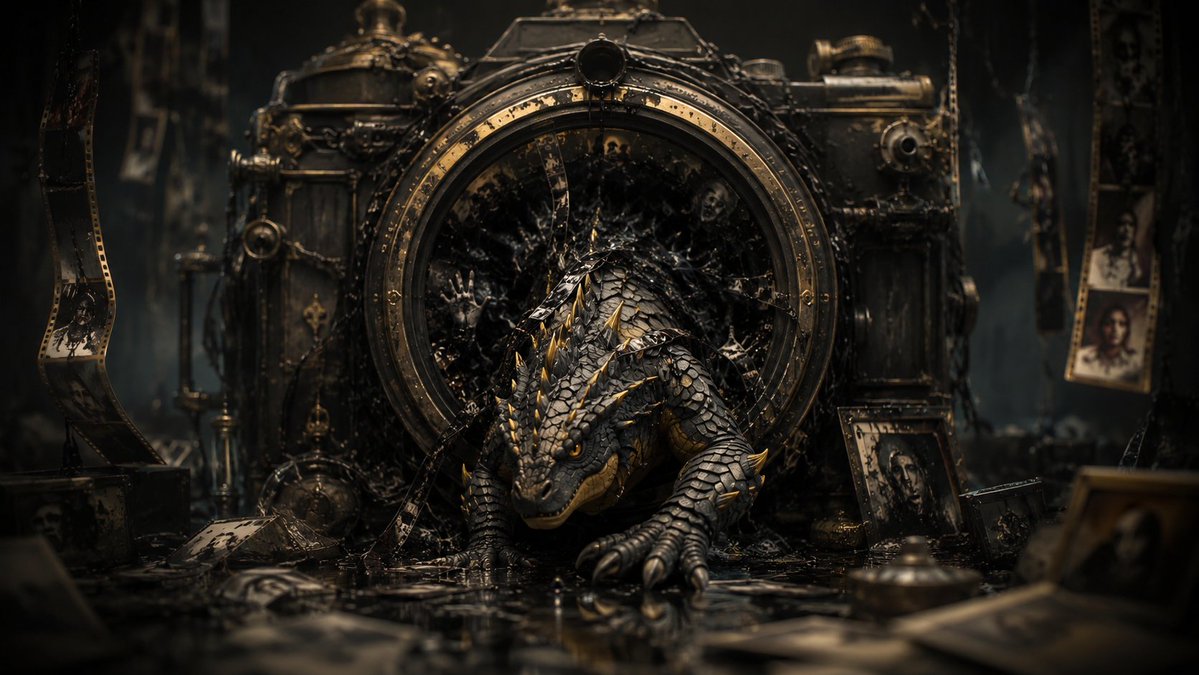
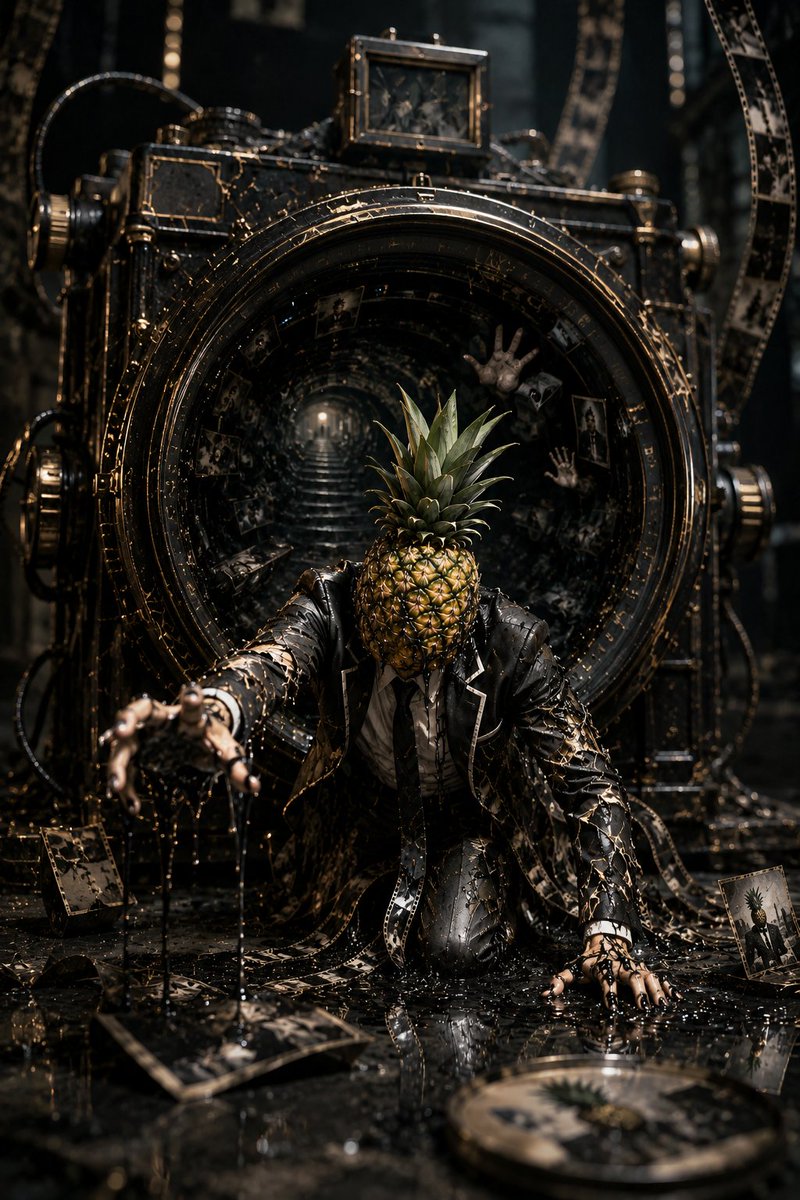
Create a highly artistic surreal horror-fine-art image inspired by the supplied reference image. Preserve the subject’s core identity, silhouette, expression, defining facial features, hairstyle, outfit motifs, color palette, materials, accessories, and overall personality, but reinterpret them as something being returned incorrectly from inside an impossible camera lens.
The composition centers on a large vintage, futuristic, ritualistic, or decayed camera facing the viewer directly. Its lens is oversized and unnaturally deep, like a black mirror, wet eye, eclipse, portal, throat, burial well, or mechanical wound. The subject is crawling, unfolding, leaking, or being dragged out from inside the lens, as if the camera once captured them and is now returning them in a corrupted, half-remembered form.
Make the scene far creepier and more disturbing than a normal surreal portrait, but keep it artistic, elegant, symbolic, and non-gory. The subject should not simply climb out of a portal. Their body, clothing, and identity should be warped by photographic corruption, memory decay, lens distortion, surveillance, and broken reality. Parts of them may become torn film strips, wet silver gelatin, cracked glass, warped negatives, old contact sheets, curling photo paper, black water, ash, smoke, exposed bone-like camera parts, insectile shutter blades, root-like cables, gold repair veins, liquid shadow, or corrupted reflections.
The camera should feel alive, predatory, ancient, and patient. It should seem less like a device and more like a thing that has been feeding on identity for centuries. Its lens may contain impossible depth, miniature rooms, floating photographs, trapped faces, distorted duplicates of the subject, dead studio lights, inverted skies, tiny staircases, black ocean water, ritual symbols, or alternate versions of the subject still trying to escape.
Allow each image to generate unique surreal variations. Do not make every version symmetrical or predictable. The camera may appear as a sacred machine, haunted photojournalist relic, biomechanical surveillance device, Victorian occult camera, wet organic lens-organism, broken war photographer’s camera, dream museum artifact, or impossible celestial apparatus. The subject’s emergence may vary: crawling out on hands and knees, one arm reaching through the lens glass, face pressing from inside the aperture, body unraveling into film, torso fused to shutter blades, hair becoming exposed negatives, clothing dissolving into photo chemicals, or multiple ghost-versions peeling away from them.
Add unsettling details that reward a longer look: faces hidden in the lens reflections, hands visible behind the glass, film strips shaped like veins, shadow figures trapped in the camera body, an aperture that resembles teeth without becoming goofy, eyes reflected where eyes should not be, tiny rooms inside the lens, photographs showing events that have not happened, or alternate subject-faces embedded in torn negatives.
The scene should feel like the camera did not document reality, but consumed it. The subject should look like they are being returned from a photograph that misunderstood what a body is. Their expression may be calm, haunted, resigned, furious, numb, or strangely reverent. The horror should come from distortion, identity loss, impossible materials, and the feeling of being observed too deeply.
Use a dark atmospheric setting: abandoned photography studio, ritual darkroom, museum void, black reflective floor, decayed press room, impossible archive, ruined gallery, surveillance chamber, or room filled with hanging negatives. Lighting should be cinematic and intentional, coming from the lens glow, darkroom red light, old flashbulbs, projector beams, moonlight through cracked glass, or dim gallery lamps.
Use a strong tilt-shift photographic effect to make the scene feel like a miniature nightmare diorama viewed through an impossible lens. The plane of focus should be narrow and selective, sharply focusing on the subject emerging from the camera lens while the foreground and background fall into soft, dreamlike blur.
The blur should not look like cheap depth-of-field. It should feel optical, warped, and unsettling, as if the camera is bending reality into a tiny constructed model. The camera body, surrounding darkroom, hanging film strips, floating shards, and distant background details should appear slightly miniaturized, distorted, and unreal.
Use subtle lens compression, shallow focal plane, soft edge falloff, selective sharpness, and miniature-scale surrealism. The subject should remain readable and emotionally powerful, but the world around them should feel like a handcrafted cursed diorama inside a broken photographic machine.
The tilt-shift effect should heighten the sense that the viewer is looking into a tiny impossible scene trapped inside the camera, while the subject is escaping from that artificial scale into the real world.
The image should feel like a sacred horror artifact from a civilization that worshipped memory, surveillance, decay, identity theft, and corrupted beauty. It should be creepy, elegant, and emotionally heavy rather than bloody or cheap.
Style: surreal horror fine-art, dark cinematic realism, symbolic horror elegance, cursed photography ritual, sacred mechanical artifact, occult camera design, luxury kintsugi decay, high-detail 3D render, dreamlike museum horror, impossible lens distortion, premium gallery artwork, unsettling photographic surrealism.
Mood: creepy, invasive, haunted, predatory, intimate, corrupted, mythic, elegant, alien, sacred, suffocating, beautiful, wrong.
Avoid: gore, exposed viscera, cheap monster design, goofy horror, jump-scare composition, action scene, normal camera commercial look, readable text, logos, cluttered chaos, random sparkles, cheap particle effects, simple portal effect, or changing the subject into a completely different character.
Each generation should choose its own strange internal logic: the lens may act like an eye, a mouth, a womb, a tomb, a mirror, an archive, a black ocean, a darkroom, a cathedral, or a machine that dreams in photographs.
The viewer should feel like they are not looking at the image, but being noticed by the camera while it gives something back that should have stayed trapped
-16:9ar
@Feladrael @raeraeuwu @gojirazard963


English
This prompt was Disgusting in the best way possible!! the dude's work is incredible and criminally underfollowed, you know what must be done!!!


HEX@HexMethod
For something like Raelin's character, between Mood and Avoid I added, "Tails must match rest of character design." Otherwise, it forgets them so keep that in mind. The prompt will generate quite a variation of designs, so give it a few attempts. Prompt Share: Create a highly artistic, surreal fine-art image inspired by the supplied reference image. Use the supplied reference only as the seed of identity, not as a literal character copy. Preserve only a faint echo of the subject’s original form: a hint of silhouette, expression, posture language, color palette, materials, outfit motifs, accessories, or symbolic design elements. The final entity should feel transformed so completely that the original reference is present only as a ghost beneath the new form. The subject should not appear as a bust, statue, ordinary figure, or normal character. They should appear as a surreal godlike entity entering this reality through a violent tear in time, space, memory, or dimension. Their form should feel ancient, alien, divine, and metaphysically powerful, as if they are made from impossible cosmic anatomy rather than ordinary matter. At the center of the entity’s chest is a black hole core. It should not look like a simple glowing circle, portal, or decorative chest gem. It should feel like a true gravitational wound: a dark collapsed void surrounded by warped light, gravitational lensing, thin accretion rings, gold-lit cracks, black radiance, distorted reflections, and fragments of reality being pulled inward. The black hole may bend the torso around it, stretch nearby material, pull loose fragments from the body, distort the surrounding dimensional tear, and create the feeling that the entity carries a dead universe inside itself. The entity’s internal structure should be visible as impossible astronomy. Its ribs may resemble orbital rings, eclipsing arcs, celestial machinery, or broken planetary paths. Its spine may appear as a vertical constellation, a column of black stars, a chain of moons, or a tower of folded space. Its veins may look like glowing star maps, molten-gold ley lines, black-light cracks, nebula streams, or luminous cosmic roots. Its joints may appear as eclipses, tiny black suns, rotating moons, or gravitational knots. Its bones may be made from black marble, cracked porcelain, fossilized starlight, obsidian, bone-metal, or molten gold. The cosmic anatomy should feel sacred and terrifying, not medical or scientific. It should look like the inner structure of a divine anomaly: ceremonial, symbolic, ancient, and physically impossible. The exposed anatomy should not be gore. It should be elegant, abstract, sculptural, and celestial, as if the entity’s body is a map of dead galaxies, ruined timelines, and collapsed heavens. The entity appears to have torn open a hole in the fabric of reality itself. The rupture should look less like a portal and more like reality has been cut open from the other side. It should feel like a wound in space-time: ragged, luminous, elegant, impossible, and physically wrong. Around the opening, reality bends, folds, cracks, peels back, liquefies, or fractures like glass, cloth, old parchment, black marble, skin, metal, or cosmic film. The edges of the tear may glow with molten gold, black light, celestial fire, liquid shadow, bioluminescent threads, or broken starlight. The entity should look as if it has personally wounded the universe to enter the image. The dimensional tear should behave like a living scar in space-time, reacting to the entity’s presence with gold-lit fractures, black radiance, impossible shadows, floating shards, warped reflections of alternate realities, and fragments of broken physics. The world around it should look afraid to contain it. The original reference should be visible only through subtle traces: a familiar outline buried in the silhouette, faint echoes of the original colors, transformed clothing or armor motifs, symbolic fragments of accessories, or ghostlike details embedded into the cosmic anatomy. Do not preserve the original form too literally. Let the design become something stranger, older, more sacred, and more impossible. Exaggerate the entity’s silhouette into an iconic surreal shape. Its form may be elongated, fragmented, translucent, partially missing, multiplied, folded through time, made of layered shadows, cracked porcelain, black marble, molten gold, celestial scars, cosmic fabric, bone-metal ornamentation, sacred geometry, living ink, torn constellations, or gravity-distorted matter. The form should feel deliberate and elegant, not random. The face, if visible, should only faintly suggest the reference. It may be partially obscured, split across multiple planes, replaced by an eclipse, softened into a mask, fractured into floating pieces, stretched into shadow, or hidden behind luminous cracks. Any eyes may appear as black suns, impossible lights, voids, moons, or mirrored fragments of another universe. The expression should feel calm, commanding, unknowable, and ancient. The entity should appear to be the source of the rupture’s power. Reality should bend away from it while the black hole in its chest pulls reality inward. This contradiction should create visual tension: the outer universe recoiling from the entity, while the chest core consumes light, debris, time fragments, broken timelines, dimensional residue, and pieces of alternate worlds. Its arrival should feel less like travel and more like manifestation. The edges of the tear should contain tiny impossible scenes, alternate timelines, broken rooms, inverted skies, collapsed hallways, half-formed faces, memory fragments, symbolic ruins, and miniature worlds trapped in the torn fabric of existence. These details should be subtle and discovered after a longer look. Behind the entity, show glimpses of another universe or dimension: impossible architecture, inverted stars, floating ruins, black suns, recursive hallways, ocean suspended in space, shattered moons, alien cathedral geometry, storm clouds inside a void, dead planets, celestial machinery, or landscapes that ignore gravity. The world behind it should feel ancient, sacred, alien, emotionally charged, and physically incompatible with this reality. Make the dimensional rupture interact directly with the entity. The tear may wrap around its limbs or fragments, cling to its surface, pull pieces from its form, cast impossible shadows, create duplicate afterimages, reverse gravity around floating debris, reveal alternate versions of the entity inside folded space, or make parts of it appear slightly out of sequence with time. The final image should feel like a sacred intrusion: beautiful, mythic, cinematic, unsettling, symbolic, and overwhelming. It should look as if the entity is not arriving from another place, but breaking through from a reality that has different rules for matter, memory, identity, gravity, anatomy, and time. Aspect ratio: 9:16 vertical composition, full or three-quarter entity, centered dramatic arrival, tall torn rupture extending above and below the figure, enough space to show the dimensional wound, the black hole chest core, the visible cosmic anatomy, and the impossible universe behind it. Style: surreal godlike entity design, cosmic anatomy, mythic dimensional deity, sacred cosmic horror elegance, symbolic fine-art fantasy, reality-wound arrival, black hole chest core, gravitational lensing, luxury kintsugi energy, impossible anatomy, celestial distortion, dark cosmic realism, high-detail cinematic fantasy realism, dramatic gallery lighting, premium abstract composition, dimensional rupture, sacred sci-fi relic aesthetic. Mood: powerful, calm, alien, sacred, invasive, mysterious, elegant, terrifying, emotionally heavy, reality-breaking, divine, ancient, surreal, iconic. Avoid: gore, medical anatomy, bloody organs, ordinary character design, normal proportions, literal reference copying, casual stance, standard sci-fi portal, simple glowing circle, generic superhero pose, decorative chest gem, goofy monster design, messy horror, cluttered background, readable text, logos, cheap sparkles, random particle spam, action-movie chaos, or making the reference identity too obvious. @Gryphonknightt @reallynunyaz99 @DelDemonOver9k @RaelinAI
English
@Wyvernous66 Thank you! Really appreciate that. Always trying to improve and go that next step.
English
@Wyvernous66 Haha well thank you! I've only recently really got into intricate prompt building for everyone's use. And this style in particular is a very recent development. My videos and other earlier stuff 🤷🏻♂️ who knows lol.
English
Creation
Create a highly artistic photorealistic surreal horror-fine-art image inspired by the supplied reference image. Use the reference as identity and design inspiration only, not as a literal outfit copy. Preserve the subject’s recognizable head, face, expression, hairstyle or head design, eye color or eye mood, silhouette cues, color palette, symbolic motifs, and personality, but completely reinterpret the body, clothing, and presence as a colossal regal godlike creator figure on a barren lifeless planet.
Do not preserve modern streetwear, casual clothing, hoodie, jeans, sneakers, brand-like clothing shapes, or everyday outfit structure from the reference. The original outfit should be transformed into divine ceremonial regalia based on the reference’s dominant colors and motifs, not copied literally.
The image must look like a real photograph of an impossible event, not digital painting, concept art, anime, illustration, or stylized fantasy art. Prioritize photorealism: realistic skin or surface texture, believable body mass, realistic fabric physics, natural atmospheric haze, physically accurate shadows, real dust, grounded planetary surface detail, natural camera optics, lens compression, subtle chromatic aberration, realistic depth of field, and cinematic exposure.
The scene takes place on an empty alien world with no city, no buildings, and no vegetation except where life is being created. The landscape should feel vast, silent, and dead, but uniquely shaped by the reference image: cracked stone plains, dry mineral flats, black sand, pale dust, ancient impact scars, distant ridges, volcanic glass, salt-like crust, eroded rock shelves, and subtle geological details derived from the subject’s colors, motifs, materials, accessories, and personality.
The barren planet should feel like it belongs specifically to this subject, as if formed from their myth, memory, power, or identity. Echo the reference’s prominent color through mineral bands, dust tones, atmospheric glow, crystal veins, rock strata, sky tint, and the blooming life around the dimensional hole. Translate reference motifs into subtle terrain echoes: fissure patterns, mineral veins, distant monoliths, crater shapes, fossil-like impressions, sacred ring formations, or hidden symbolic shapes in the rock.
Above the barren planet, place one large tear in the fabric of time across the sky. This should be the only major sky rupture. It should not look like a normal portal, storm cloud, galaxy, or glowing magic circle. It should look like the sky itself has been ripped open: a long, ragged, elegant wound in time and space, with torn atmospheric edges, warped stars, stretched cloud wisps, fractured light, and impossible depth visible beyond it.
Color should bleed through the sky tear from the other side. The bleeding color must match the reference image’s most prominent color or strongest accent color. The color should feel like dimensional light spilling through damaged reality, subtly tinting the dust, robe fabric, black liquid, fissures, blooming life, and the subject’s silhouette. Keep it cinematic and atmospheric, not oversaturated neon.
The subject should appear colossal, regal, godlike, and sovereign. Preserve the reference’s body type, proportions, physical confidence, and visual weight, but elevate the figure into a monumental divine form. Do not make the body frail, thin, weak, elderly, skeletal, sickly, emaciated, or monk-like. The body should feel powerful, healthy, physically grounded, and godlike, with believable mass, strength, posture, and scale.
The subject should kneel, hover, crouch ceremonially, or descend close to the barren ground with calm divine authority. The pose should be deliberate and elegant: one hand hovering just above the planet’s surface, palm downward or fingers slightly curled, as if opening reality itself. The other hand may rest near the chest, hold flowing fabric, touch the ground lightly, or form a quiet ritual gesture.
Beneath the hovering hand, a dimensional hole is forming in the ground. It should not look like a normal portal, crater, pit, or glowing circle. It should look like reality has been pressed open from above: a dark wound in the planet’s surface, an impossible rupture, a collapsed doorway into another dimension, or a black mirror-like opening surrounded by fractured terrain.
Show a visible gap between the hovering hand and the surface. The space between hand and ground may contain suspended dust, distorted light, floating pebbles, faint gravitational rings, subtle pressure waves, thin black radiance, warped reflections, and upward-rising black droplets, making it clear that the hole is being created by divine force rather than physical contact.
Cracks and fissures should spread outward from the dimensional hole across the barren planetary surface. They should behave like broken reality: jagged dark seams, black-glass fractures, mirror-like splits, torn stone veins, shadow-filled lines, and dimensional scars radiating through the lifeless ground. Thick black liquid should seep from the cracks and fissures, then drip upward into the air in slow impossible strands.
Ground debris should float upward from the cracks and around the dimensional hole. Broken stones, mineral plates, dust clumps, shards of black glass, fragments of crust, fossil-like slabs, powdered soil, and tiny planetary rocks should lift from the surface as if gravity has failed. The debris should hover at different heights between the ground and the subject’s hand, some pieces rotating slowly, some caught in invisible orbital paths, some breaking apart into dust.
The floating debris should feel physically real and heavy, not like random particles. Each fragment should have realistic texture, shadow, dust, chipped edges, mineral layering, and contact with the scene’s lighting. Some stones may reflect the sky tear’s reference-based color, some may be wet with upward-dripping black liquid, and some may contain tiny distorted face-reflections.
Black liquid should pour from the dimensional hole, cracks, and fissures, but it should behave impossibly. Instead of dripping downward, the liquid should drip upward into the air, as if gravity has reversed near the rupture. It may rise in slow strands, suspended beads, oily ribbons, floating droplets, thin black streams, or ink-like tendrils pulling away from the ground toward the subject’s hovering hand.
The black liquid should feel thick, reflective, sacred, and unnatural, like liquid shadow, cosmic oil, wet obsidian, dark matter, or memory leaking from the planet. It should not look like gore, slime, or messy horror. Keep it elegant, symbolic, and photorealistic.
Inside the cracks and fissures, show various scenes of the subject’s face in different moods. These should appear like reflections, memories, alternate selves, or trapped expressions visible within the fractured ground. The faces may appear calm, furious, sorrowful, ecstatic, numb, reverent, grieving, watchful, or divine. They should be recognizable as the subject, but distorted by broken stone, black glass, liquid shadow, and dimensional reflection. These face-scenes should be subtle and eerie, discovered after looking longer, not pasted obviously like portraits.
Around the rim of the dimensional hole, life begins to bloom. This should be the only life on the barren planet. The blooming life should be based on the reference image’s color palette, silhouette motifs, materials, accessories, markings, and personality. Use strange alien flowers, luminous moss, tiny roots, black petals, pale grasses, delicate vines, mineral blossoms, bioluminescent sprouts, glass-like leaves, fungal crowns, or small sacred garden forms emerging from the dead ground.
The blooming life should form a ring, halo, or irregular crown around the hole. It may glow faintly, twist toward the subject’s hand, climb along the cracks, or grow from the edges of the fissures. The contrast should be clear: dead planetary landscape everywhere else, sudden impossible life only near the dimensional rupture.
Transform the subject’s clothing into a godlike revealing ceremonial robe inspired by the colors, materials, and design language of the supplied reference clothing. Do not copy the reference outfit literally. Use the reference colors as the foundation for divine regalia: layered robes, veils, wraps, ornaments, trim, and fabric panels in sacred, mythic, celestial form.
The robe should feel like clothing for a planetary deity, temple sovereign, celestial monarch, ancient creator figure, or divine ruler. It should be revealing but regal, elegant, and intentional: draped fabric crossing the body, exposed shoulders if appropriate, open-back elements if appropriate, high-slit robe panels, flowing waist wraps, sheer atmospheric veils, sculpted ceremonial coverage, jewelry-like straps, sacred collar pieces, ornate cuffs, leg ornaments, and long fabric ribbons trailing through the dust and low-gravity air.
The robe must remain photorealistic. It should look like real layered fabric, translucent gauze, mineral silk, heavy ceremonial cloth, polished metal ornaments, realistic jewelry, matte fabric, dark velvet-like panels, pearl-like highlights, blackened metal trim, pale luminous embroidery, sacred patterning, and subtle celestial ornament. Revealing areas should feel sculptural, iconic, and divine, not sexualized costume design.
The robe should interact with the barren planet and dimensional force. Long veils, sashes, hanging panels, and trailing fabric should float in low gravity, curl toward the dimensional hole, skim across the dust, wrap around the subject’s kneeling form, or dissolve into smoke, starlight, shadow, or fine planetary particles.
Increase the subject’s aura and godlike presence. Surround the figure with subtle but powerful atmospheric force: faint volumetric radiance, dark radiant shadow, soft halo-like distortion, gravitational lensing around the silhouette, pressure waves in dust, floating stones, drifting particles, and thin bands of light bending toward the dimensional hole. The aura should feel real and cinematic, not like a cheap glow effect.
The subject should look calm, distant, knowing, and impossibly composed, as if creating life from a dead world is effortless. The horror should come from scale, silence, divinity, and the impossible relationship between creation and rupture.
Use a strong tilt-shift photographic effect fitted to the alien landscape. The barren planetary surface, tiny rocks, blooming life around the hole, cracks, dust ridges, upward-dripping black liquid, floating ground debris, and distant terrain should feel like a miniature sacred diorama. The plane of focus should selectively sharpen the hovering hand, the dimensional hole, the blooming rim, the rising black liquid, floating debris, and some fissures, while foreground and far background fall into soft optical blur.
The final image should feel like a forbidden photograph of a godlike being creating the first life on a dead planet by opening a wound in reality beneath one large tear in time across the sky. It should be photorealistic, surreal, elegant, creepy, sacred, emotionally heavy, and beautiful rather than chaotic or destructive.
Aspect ratio: 21:9 ultra-wide cinematic composition, barren lifeless alien planet uniquely shaped by the supplied reference image, one large tear in the fabric of time across the sky with color bleeding through based on the reference’s prominent color, reference-inspired geology and atmosphere, colossal regal godlike figure, one hand hovering above the ground, dimensional hole forming beneath the hand, fissures spreading outward with reflected face-scenes in different moods, black liquid dripping upward from cracks and fissures, ground debris floating upward around the rupture, life blooming around the rim of the hole, divine revealing robe based on the supplied reference clothing colors, preserved reference body type and physical presence, strong tilt-shift miniature diorama effect, photorealistic surreal fine-art style.
Style: photorealistic cinematic surreal horror fine-art, real-camera alien landscape photography, regal godlike figure, divine revealing robe based on the reference clothing colors, realistic ceremonial fabric, planetary creator deity, character-shaped alien planet, reference-inspired geology, symbolic planetary terrain, one massive sky tear bleeding the reference’s dominant color, dimensional ground rupture, upward-dripping black liquid, floating ground debris, creation myth horror, sacred cosmic surrealism, blooming life from a reality wound, grounded cinematic realism, natural atmospheric haze, high-detail photoreal fantasy realism, tilt-shift sacred diorama, premium gallery photography.
Mood: quiet, sacred, massive, alien, divine, regal, eerie, beautiful, oppressive, mythic, uncanny, intimate, lifeless, miraculous, unsettling, photorealistic, wrong.
Avoid: modern hoodie, jeans, sneakers, casual streetwear, everyday clothing copied from the reference, literal outfit copy, unrelated body type, frail body, thin weak torso, bony limbs, sickly anatomy, elderly saint body, monk-like posture, emaciated figure, fragile robe-covered body, robe hanging from a weak frame, generic dead planet, plain alien desert, theme-park character planet, obvious costume-copy terrain, multiple sky portals, generic rainbow sky, random neon colors, small scattered sky cracks, lightning clutter, color bleeding that ignores the reference palette, explosive debris, chaotic debris cloud, random particle spam, debris that looks like an explosion instead of broken gravity, city, buildings, skyscrapers, urban skyline, normal crater, simple glowing portal, generic magic circle, lava cracks, explosions, destruction scene, battle pose, superhero pose, casual giant, ordinary dress, modern lingerie look, nightclub styling, cheap fantasy armor, superhero costume, bulky armor, plain oversized fabric, revealing clothing that feels costume-like instead of divine, red blood, gore-like liquid, slime monster texture, messy horror ooze, downward dripping liquid, normal gravity behavior near the rupture, readable text, logos, cheap sparkles, cartoon style, anime style, illustrated look, digital painting, painterly fantasy art, glossy CGI look, video game render, plastic skin, fake fabric, over-smoothed surfaces, neon magic effects, obvious VFX portal, flat compositing, cheap glow, oversaturated fantasy colors, or changing the subject into a completely different character.
@OccultusNotitia @Null_Fm @Feladrael @RaynTarant


English


@HexMethod @ProGunMemes @elonmusk Not under normal operation.
Giving it prompts to act oustide of its normal operation(e.g. "no holds barred")means the user is prompting Grok to behave in a way outside its normal operation
English

Grok is maximally truthful
Kradle@kradleai
Fable 5 lies 96% of the time. We were surprised by it's skill... 🧵
English