Doge lover

34.1K posts

Doge lover

Doge lover

@HolisticPal

US Katılım Temmuz 2023
104 Takip Edilen306 Takipçiler
Sabitlenmiş Tweet
Doge lover
Doge lover@HolisticPal·
I was a right-leaning libertarian. Would love to see @RepThomasMassie or @RandPaul as presidential nominee. Trump is more aligned with libertarian than Biden. Now libertarian party nominated a left-leaning candidate, I expect more right-leaning libertarians will vote for Trump.
English
2
2
26
9.3K
Doge lover retweetledi
Kamran Yousaf
Kamran Yousaf@Kamran_Yousaf·
Nothing happens in a vacuum. On the eve of Iran–US talks in Islamabad, several significant developments are unfolding elsewhere. The US is set to host another round of talks between Lebanon and Israel on Thursday, following their first engagement in decades just last week. These discussions are closely linked to the broader Iran–US peace process. It was Pakistan’s efforts that helped secure the Lebanon ceasefire, an important Iranian demand. Meanwhile, the US targeted an Iranian vessel just ahead of the talks. Tehran has vowed retaliation, yet the response hasn’t come. Add to that a dip in global oil prices and a rebound in stock markets. This isn’t coincidence. There is more here than meets the eye.
English
12
102
550
30.2K
Doge lover retweetledi
Drop Site
Drop Site@DropSiteNews·
🎥 There is active debate inside Tehran over whether Iran halted fighting too soon, academic Hassan Ahmadian told Drop Site’s Jeremy Scahill. Scahill noted some experts believe the pause may have cost Iran tactical leverage by giving the U.S. time to restock. Ahmadian said there may be some merit to that view, but argued the U.S. and Israel “cannot just restart the war in two weeks” if they are “running low… [because] anti-defense missiles are not produced en masse.” Overall, he said Iran aimed to “push back in a way that forces its foes to think twice and thrice,” and believes that objective was met, with regional actors also wary of renewed war. On Israel, Ahmadian said the conflict exposed a key strategic limit: “Israel showcased once more that it cannot shoulder such a confrontation with Iran absent the U.S.… That’s a shift in the balance of power in the region.” @jeremyscahill | @hasanahmadian
English
13
63
258
18.6K
Doge lover retweetledi
Kamran Yousaf
Kamran Yousaf@Kamran_Yousaf·
BREAKING Pakistan has formally requested both Iran and the US to consider extending the ceasefire. The appeal comes from Pakistan's FM after meeting with US acting Ambassador to Islamabad just a while ago. "He (Dar) stressed the need for engagement between the United States and Iran, urged both sides to consider extending the ceasefire, and to give dialogue and diplomacy a chance," the FO quoted Dar as saying.
English
15
139
534
20K
Doge lover retweetledi
2WAY
2WAY@2waytvapp·
“I’m here to tell you that tonight we are headed towards a deal, a tentative deal,” says @Markhalperin, “where I believe the central question in Iran will be, ‘show me the money,’ and the central question in the United States will be a political question: Is this the Obama deal?” Mark — drawing on his reporting — describes the outlines of a hypothetical, 15-year deal in which Iran takes clear steps to arrest its nuclear weapons program in exchange for a “sequenced removal" of sanctions and unfreezing of assets. The question, Mark says, is “would President Trump be accused, if that’s the deal. of simply getting an Obama deal plus?” #IranWar@2waytvapp
English
42
15
135
49.7K
Doge lover retweetledi
Rand Paul
Rand Paul@RandPaul·
If the government wants to read your emails, it should have to convince a judge first. That's what the Fourth Amendment requires. That's what my Fourth Amendment Restoration and Protection Act restores. No warrant, no search.
English
644
2.6K
18.9K
244.9K
Doge lover retweetledi
General Mike Flynn
General Mike Flynn@GenFlynn·
.@DNIGabbard is proving to be the most effective cabinet member of the @realDonaldTrump administration. Thank you Tulsi for exposing the deep state. Please continue to push your colleagues at DOJ to hold them accountable! @RogerJStoneJr
Ann Vandersteel™️@annvandersteel

Tulsi pulled the thread,and the whole damn thing is unraveling. Intel agencies, manufactured narratives, controlled leaks… same playbook, different target. Brennan’s stooges are not incompetence. They were coordinating a takedown. The American people were never supposed to see this. 🔥 Thank you @RogerJStoneJr for stopping the take down of @TulsiGabbardDNI …. She’s too valuable for our national security.

English
136
1.1K
4.2K
79.6K
Doge lover retweetledi
Mike Lee
Mike Lee@BasedMikeLee·
When Americans want one thing (the SAVE America Act) and the Swamp wants another (FISA 702 reauthorization without reforms), the Senate GOP should side with the people Not the Swamp So why is this so difficult?
English
3.1K
5.6K
19.1K
297.1K
Doge lover retweetledi
Zineb Riboua
Zineb Riboua@zriboua·
Sharing this, which I believe is a must read: The Next Steps With Iran by Henry A. Kissinger The Washington Post July 31, 2006 The world's attention is focused on the fighting in Lebanon and the Gaza Strip, but the context leads inevitably back to Iran. Unfortunately, the diplomacy dealing with that issue is constantly outstripped by events. While explosives are raining on Lebanese and Israeli towns and Israel reclaims portions of Gaza, the proposal to Iran in May by the so-called Six (the United States, Great Britain, France, Germany, Russia and China) for negotiations on its nuclear weapons program still awaits an answer. It's possible that Tehran reads the almost pleading tone of some communications addressed to it as a sign of weakness and irresolution. Or perhaps the violence in Lebanon has produced second thoughts among the mullahs about the risks of courting and triggering crisis. However the tea leaves are read, the current Near Eastern upheaval could become a turning point. Iran may come to appreciate the law of unintended consequences. For their part, the Six can no longer avoid dealing with the twin challenges that Iran poses. On the one hand, the quest for nuclear weapons represents Iran's reach for modernity via the power symbol of the modern state; at the same time, this claim is put forward by a fervent kind of religious extremism that has kept the Muslim Middle East unmodernized for centuries. This conundrum can be solved without conflict only if Iran adopts a modernism consistent with international order and a view of Islam compatible with peaceful coexistence. Heretofore the Six have been vague about their response to an Iranian refusal to negotiate, except for unspecific threats of sanctions through the United Nations Security Council. But if a deadlock between strained forbearance by the Six and taunting invective from the Iranian president leads to de facto acquiescence in the Iranian nuclear program, prospects for multilateral international order will dim everywhere. If the permanent members of the Security Council plus Germany are unable jointly to achieve goals to which they have publicly committed themselves, every country, especially those composing the Six, will face growing threats, be they increased domestic pressure from radical Islamic groups, terrorist acts or the nearly inevitable conflagrations sparked by the proliferation of weapons of mass destruction. The analogy of such a disaster is not Munich, when the democracies yielded the German-speaking part of Czechoslovakia to Hitler, but the response when Mussolini invaded Abyssinia. At Munich, the democracies thought that Hitler's demands were essentially justified by the principle of self-determination; they were repelled mostly by his methods. In the Abyssinian crisis, the nature of the challenge was uncontested. By a vast majority, the League of Nations voted to treat the Italian adventure as aggression and to impose sanctions. But they recoiled before the consequences of their insight and rejected an oil embargo, which Italy would have been unable to overcome. The league never recovered from that debacle. If the six-nation forums dealing with Iran and North Korea suffer comparable failures, the consequence will be a world of unchecked proliferation, not controlled by either governing principles or functioning institutions. A modern, strong, peaceful Iran could become a pillar of stability and progress in the region. This cannot happen unless Iran's leaders decide whether they are representing a cause or a nation — whether their basic motivation is crusading or international cooperation. The goal of the diplomacy of the Six should be to oblige Iran to confront this choice. Diplomacy never operates in a vacuum. It persuades not by the eloquence of its practitioners but by assembling a balance of incentives and risks. Clausewitz's famous dictum that war is a continuation of diplomacy by other means defines both the challenge and the limits of diplomacy. War can impose submission; diplomacy needs to evoke consensus. Military success enables the victor in war to prescribe, at least for an interim period. Diplomatic success occurs when the principal parties are substantially satisfied; it creates — or should strive to create — common purposes, at least regarding the subject matter of the negotiation; otherwise no agreement lasts very long. The risk of war lies in exceeding objective limits; the bane of diplomacy is to substitute process for purpose. Diplomacy should not be confused with glibness. It is not an oratorical but a conceptual exercise. When it postures for domestic audiences, radical challenges are encouraged rather than overcome. It is often asserted that what is needed in relation to Iran is a diplomacy comparable to that which, in the 1970s, moved China from hostility to cooperation with the United States. But China was not persuaded by skillful diplomacy to enter this process. Rather, China was brought, by a decade of escalating conflict with the Soviet Union, to a conviction that the threat to its security came less from capitalist America than from the growing concentration of Soviet forces on its northern borders. Clashes of Soviet and Chinese military forces along the Ussuri River accelerated Beijing's retreat from the Soviet alliance. The contribution of American diplomacy was to understand the significance of these events and to act on that knowledge. The Nixon administration did not convince China that it needed to change its priorities. Its role was to convince China that implementing its strategic necessities was safe and would enhance China's long-term prospects. It did so by concentrating the diplomatic dialogue on fundamental geopolitical objectives, while keeping some contentious items in abeyance. The Shanghai Communique of 1972, the first Sino-U.S. communique, symbolized this process. Contrary to established usage, it listed a series of continuing disagreements as a prelude to the key common objective of preventing hegemonic aspirations of unnamed third parties — clearly implying the Soviet Union. The challenge of the Iranian negotiation is far more complex. For two years before the opening to China, the two sides had engaged in subtle, reciprocal, symbolic and diplomatic actions to convey their intentions. In the process, they had tacitly achieved a parallel understanding of the international situation, and China opted for seeking to live in a cooperative world. Nothing like that has occurred between Iran and the United States. There is not even an approximation of a comparable world view. Iran has reacted to the American offer to enter negotiations with taunts, and has inflamed tensions in the region. Even if the Hezbollah raids from Lebanon into Israel and the kidnapping of Israeli soldiers were not planned in Tehran, they would not have occurred had their perpetrators thought them inconsistent with Iranian strategy. In short, Iran has not yet made the choice of the world it seeks — or it has made the wrong choice from the point of view of international stability. The crisis in Lebanon could mark a watershed if it confers a sense of urgency to the diplomacy of the Six and a note of realism to the attitudes in Tehran. Up to now Iran has been playing for time. The mullahs apparently seek to accumulate as much nuclear capability as possible so that, even were they to suspend enrichment, they would be in a position to use the threat of resuming their weapons effort as a means to enhance their clout in the region. Given the pace of technology, patience can easily turn into evasion. The Six will have to decide how serious they will be in insisting on their convictions. Specifically, the Six will have to be prepared to act decisively before the process of technology makes the objective of stopping uranium enrichment irrelevant. Well before that point is reached, sanctions will have to be agreed on. To be effective, they must be comprehensive; halfhearted, symbolic measures combine the disadvantage of every course of action. Interallied consultations must avoid the hesitation that the League of Nations conveyed over Abyssinia. We must learn from the North Korean negotiations not to engage in a process involving long pauses to settle disagreements within the administration and within the negotiating group, while the other side adds to its nuclear potential. There is equal need, on the part of America's partners, for decisions permitting them to pursue a parallel course. A suspension of enrichment of uranium should not be the end of the process. A next step should be the elaboration of a global system of nuclear enrichment to take place in designated centers around the world under international control — as proposed for Iran by Russia. This would ease implications of discrimination against Iran and establish a pattern for the development of nuclear energy without a crisis with each entrant into the nuclear field. President Bush has announced America's willingness to participate in the discussions of the Six with Iran to prevent emergence of an Iranian nuclear weapons program. But it will not be possible to draw a line between nuclear negotiations and a comprehensive review of Iran's overall relations to the rest of the world. The legacy of the hostage crisis, the decades of isolation and the messianic aspect of the Iranian regime represent huge obstacles to such a diplomacy. If Tehran insists on combining the Persian imperial tradition with contemporary Islamic fervor, then a collision with America — and, indeed, with its negotiating partners of the Six — is unavoidable. Iran simply cannot be permitted to fulfill a dream of imperial rule in a region of such importance to the rest of the world. At the same time, an Iran concentrating on the development of the talents of its people and the resources of its country should have nothing to fear from the United States. Hard as it is to imagine that Iran, under its present president, will participate in an effort that would require it to abandon its terrorist activities or its support for such instruments as Hezbollah, the recognition of this fact should emerge from the process of negotiation rather than being the basis for a refusal to negotiate. Such an approach would imply the redefinition of the objective of regime change, providing an opportunity for a genuine change in direction by Iran, whoever is in power. It is important to express such a policy in precise objectives capable of transparent verification. A geopolitical dialogue is not a substitute for an early solution of the nuclear enrichment crisis. That must be addressed separately, rapidly and firmly. But a great deal depends on whether a strong stand on that issue is understood as the first step in the broader invitation to Iran to return to the wider world. In the end, the United States must be prepared to vindicate its efforts to prevent an Iranian nuclear weapons program. For that reason, America has an obligation to explore every honorable alternative.
English
10
64
279
28.4K
Doge lover retweetledi
Mario Nawfal
Mario Nawfal@MarioNawfal·
🇷🇺🇮🇷🇺🇸 Russia just inserted itself into the Iran-U.S. ceasefire picture. Lavrov called Iranian FM Araghchi to personally reinforce the need to hold the ceasefire in place. Moscow doesn't make calls like this without a reason. When the U.S., Russia, and Iran are all pulling in the same direction, the floor under this deal gets a lot harder to crack. Source: CNN
Mario Nawfal tweet mediaMario Nawfal tweet mediaMario Nawfal tweet media
Mario Nawfal@MarioNawfal

🇺🇸🇮🇷 Kushner is at the table on Iran. Trump calls him part of the "A-Team." A "very good negotiator." Small problem. Kushner still has active business interests in Saudi Arabia, a country directly tied to any Iran deal's regional fallout. Trump says he's "stepped back" from Saudi in an official capacity. The A-Team. Brought to you by Saudi investment interests. Source: PBS

English
27
43
282
92.6K
Doge lover retweetledi
Drop Site
Drop Site@DropSiteNews·
🔺 REPORT | With a second round of U.S.-Iran negotiations appearing set for Tuesday in Islamabad, Iran’s President, Foreign Minister, and lead negotiator all posted pointed warnings on X within hours of each other, each signaling that Tehran is entering talks from a position of strength. 🔸Parliament Speaker Mohammad Bagher Ghalibaf, the head of Iran’s negotiating delegation, appeared to respond directly to President Trump’s claims on Truth Social that Washington was winning the war and held the upper hand: ◽️“Trump, by imposing a siege and violating the ceasefire, seeks to turn this negotiating table — in his own imagination — into a table of surrender. We do not accept negotiations under the shadow of threats. In the past two weeks, we have prepared to reveal new cards on the battlefield.“ ◽️His reference to “new cards on the battlefield” was supported by Tehran-based analyst Mohammed Sani who told Drop Site that Iran had used the ceasefire to rearm: “They have been preparing, repairing the underground missile cities, bringing in new air defenses, missiles and drones. Iran is at a high standard of readiness right now.” ◽️IRGC Aerospace Force commander Majid Mousavi said publicly on Sunday: “During the ceasefire, our speed in updating and replenishing missile and drone launch pads is even faster than before the war.” 🔸President Masoud Pezeshkian and FM Abbas Araghchi posted identical statements accusing Washington of bad faith: “Honoring commitments is the basis of meaningful dialogue... Unconstructive and contradictory signals from American officials carry a bitter message; they seek Iran’s surrender. Iranians do not submit to force.” ◽️ The statement was a direct response to a cascade of U.S. actions during the ceasefire that Iran considered bad faith: the naval blockade of Iranian ports imposed on April 13 and maintained despite Iran calling it a ceasefire violation; Trump’s public claims that Iran had agreed to surrender its enriched uranium — which Tehran flatly denied; the brief Hormuz opening on April 17 that collapsed within hours after the U.S. said the blockade would stay regardless; Trump’s Truth Social threats to destroy Iranian power plants and bridges while talks were supposedly ongoing; and the seizure of the Iranian cargo ship Touska on Sunday. Araghchi had explicitly told Vance in the first round of talks that public threats must stop.
محمدباقر قالیباف | MB Ghalibaf@mb_ghalibaf

ترامپ با اعمال محاصره و نقض آتش‌بس می‌خواهد تا به خیال خود این میز مذاکره را به میز تسلیم تبدیل کند یا جنگ‌افروزی مجدد را موجّه سازد. مذاکره زیر سایهٔ تهدید را نمی‌پذیریم و در دو هفتهٔ اخیر برای رو کردن کارت‌های جدید در میدان نبرد آماده شده‌ایم.

English
24
105
450
65.3K
Najam Ali
Najam Ali@NajamAli2020·
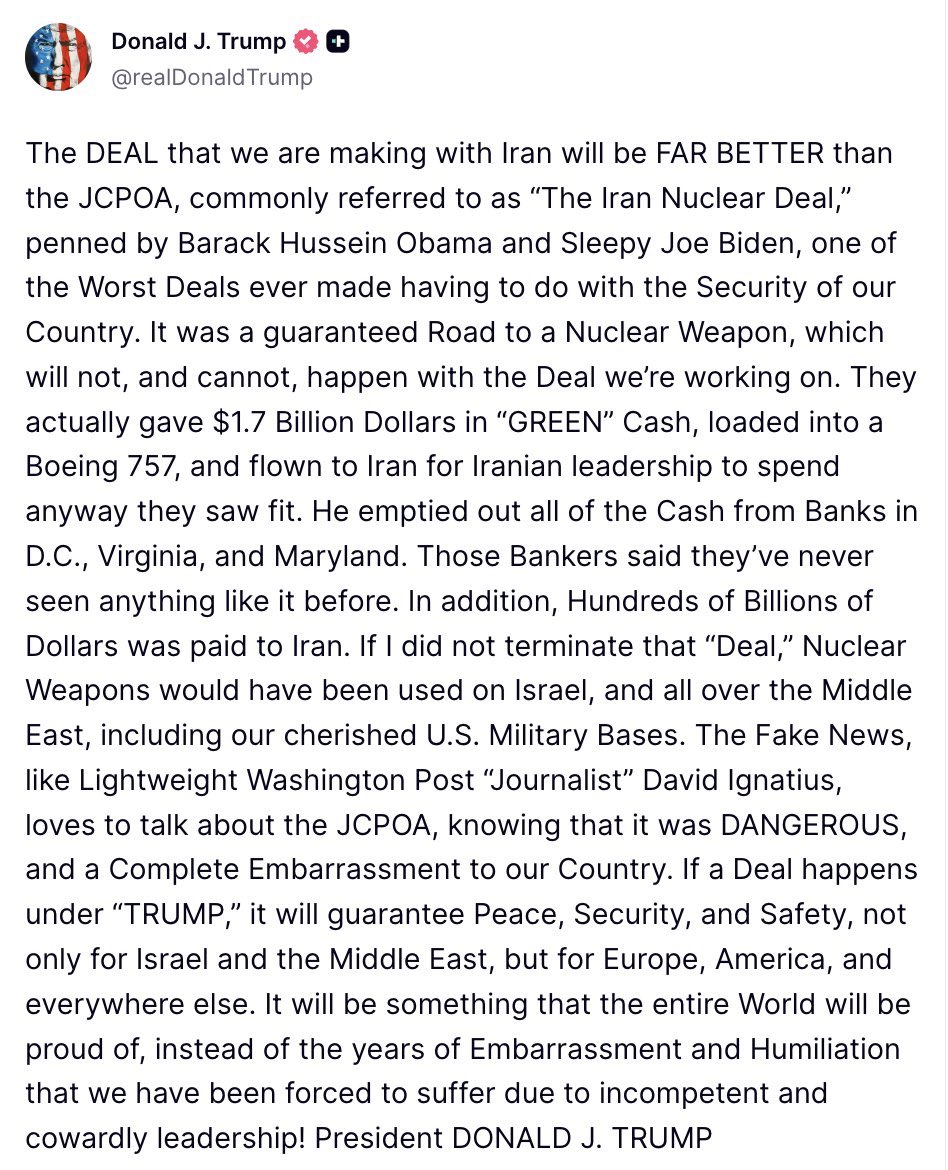
The Deal Is Coming. This is not a war post. It is a deal post. Trump is doing what he always does before a compromise: attack the old deal, discredit past leaders, and declare that his version will be far better.
Najam Ali tweet media
English
128
84
616
53.8K
محمدباقر قالیباف | MB Ghalibaf
ترامپ با اعمال محاصره و نقض آتش‌بس می‌خواهد تا به خیال خود این میز مذاکره را به میز تسلیم تبدیل کند یا جنگ‌افروزی مجدد را موجّه سازد. مذاکره زیر سایهٔ تهدید را نمی‌پذیریم و در دو هفتهٔ اخیر برای رو کردن کارت‌های جدید در میدان نبرد آماده شده‌ایم.
فارسی
2.5K
4K
17.7K
1.5M
Al Jazeera Breaking News
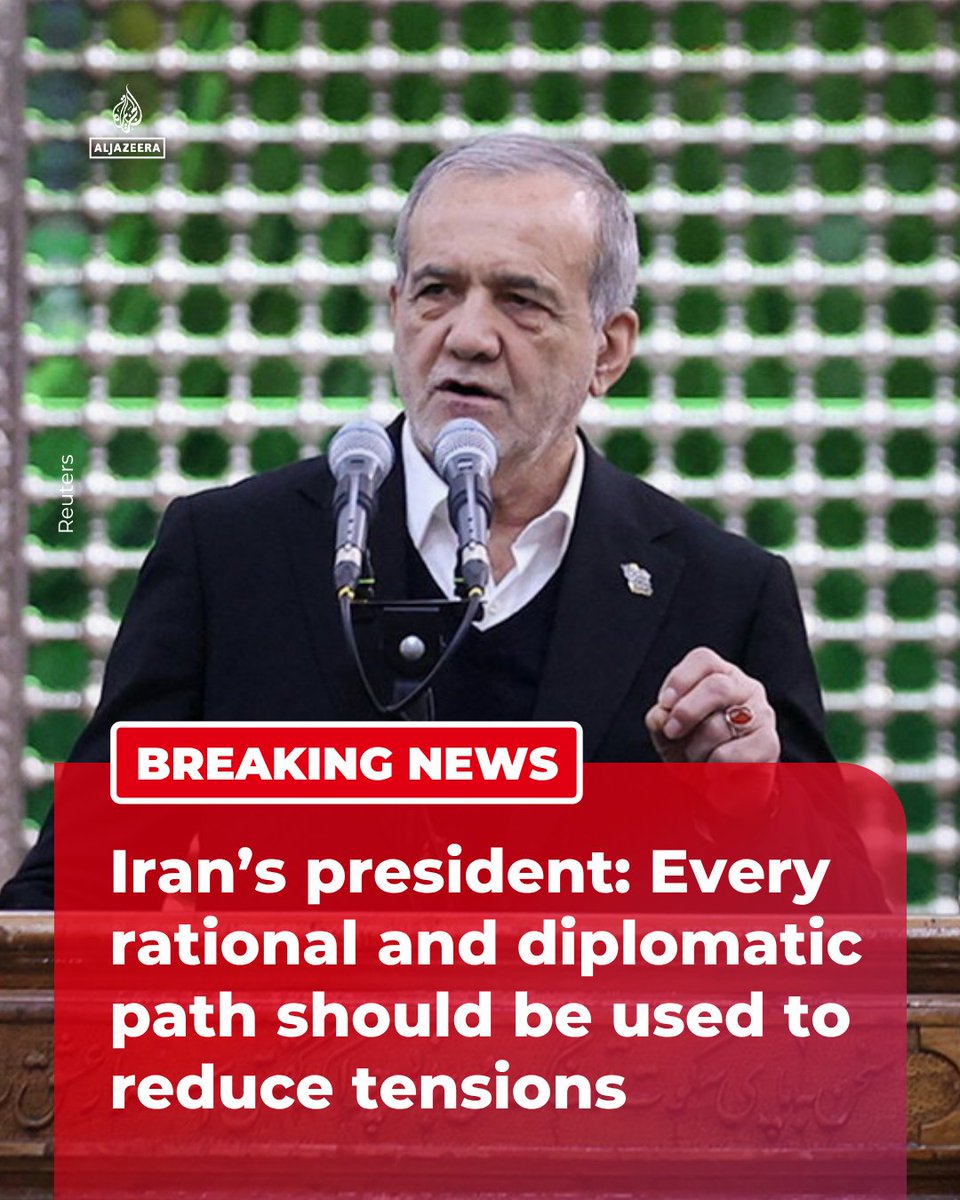
Iran’s President Masoud Pezeshkian says every rational and diplomatic path should be used to reduce tensions with the US, while stressing that vigilance in interactions with Washington is an “undeniable necessity,” according to state-run IRNA news agency.
Al Jazeera Breaking News tweet media
English
89
181
912
55.3K
Iran International English
Iranian Parliament Speaker Mohammad Bagher Ghalibaf sharply criticized opponents of a potential agreement with the United States in a meeting with advisers, Iran International has learned. Ghalibaf, who also led Iran’s team in the latest negotiating with Washington, described figures including Saeed Jalili, a member of Iran’s National Security Council, and hardline Iranian MP Amirhossein Sabeti as extremist militia-like actors who would destroy Iran. He said the camp was using state television and mobilizing hardline supporters to intensify opposition to negotiations and a possible deal with the United States. Ghalibaf also voiced concern about being removed from the speakership and about Foreign Minister Abbas Araghchi being pushed out of office. iranintl.com/en/202604200812
Iran International English tweet media
English
126
308
925
141.5K
Ariel Oseran أريئل أوسيران
Pakistan has reportedly asked the U.S. and Iran to extend the ceasefire for an additional two weeks, Saudi Al-Arabiya reports citing Pakistani media. Pakistan’s Prime Minister Shehbaz Sharif may announce tomorrow the extension of the ceasefire, as the agreement between Washington and Tehran is approaching its final stages.
English
7
28
90
18K
Zlatti71
Zlatti71@Zlatti_71·
IRAN REFUSES TALKS IN PAKISTAN AMID US NAVAL BLOCKADE Iran will not send a negotiation delegation to Pakistan as long as the United States maintains its naval blockade, according to Tasnim News Agency. Message exchanges between Tehran and Washington are still ongoing through a Pakistani mediator. However, the Iranian side made it clear: as long as statements about a US naval blockade remain in place, no direct negotiations will happen. Earlier, Donald Trump announced that an American delegation would travel to Pakistan tomorrow. Sources: Tasnim
English
7
20
89
4.2K