Hong-Ye HU

260 posts

Hong-Ye HU banner
Hong-Ye HU

Hong-Ye HU

@HongYeHu1

Postdoc Fellow @harvard_quantum

Cambridge, MA Katılım Şubat 2019
638 Takip Edilen284 Takipçiler
Sabitlenmiş Tweet
Hong-Ye HU
Hong-Ye HU@HongYeHu1·
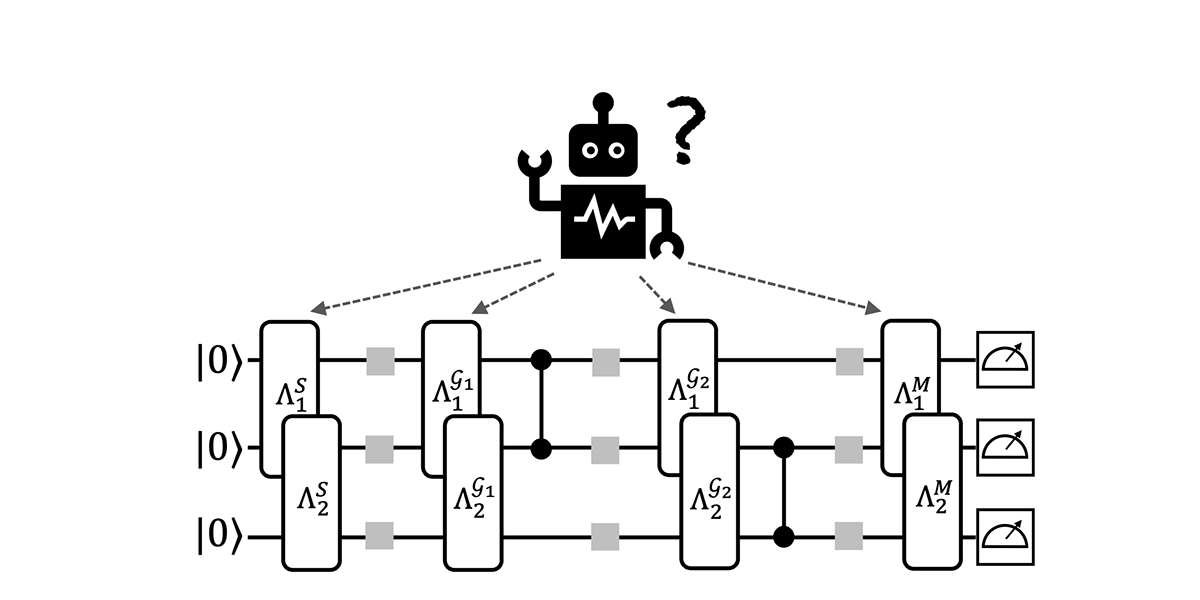
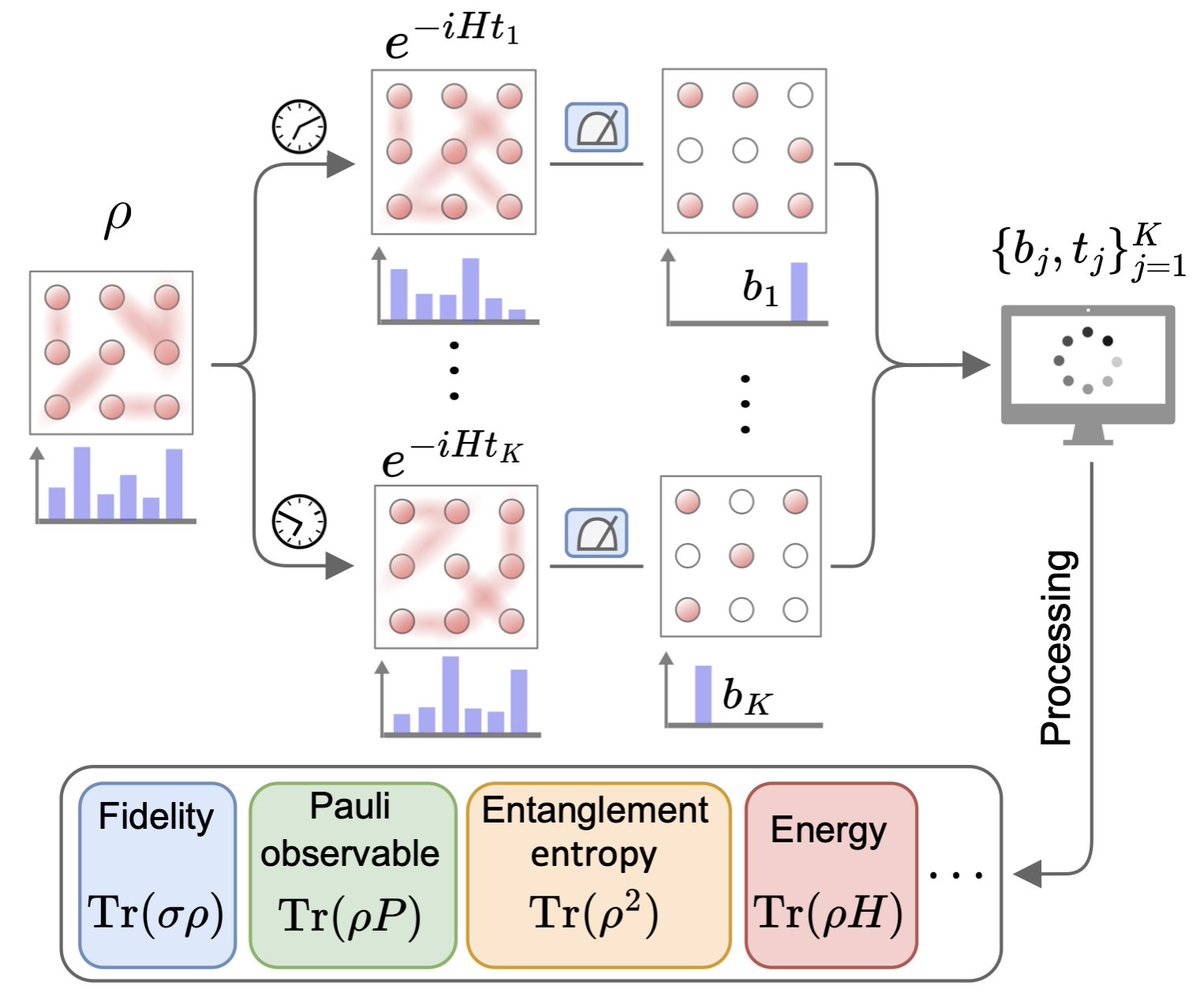
Extracting Arbitrary State Information from Analog Quantum Simulators ⛰ The challenge: Can we extract interesting properties from analog quantum simulators without fine-tuning? Furthermore, could we leverage a single Hamiltonian to achieve "randomized measurements"? 🧵[1]
Hong-Ye HU tweet media
English
0
0
11
661
Hong-Ye HU retweetledi
Oratomic, Inc.
Oratomic, Inc.@TeamOratomic·
Today, we introduce Oratomic. We are on a focused mission to build the world’s first fault-tolerant quantum computers and unlock their transformative applications. Quantum computers offer a fundamentally new way of understanding and interacting with the physical world. Our recent scientific advance finds that Shor’s algorithm is possible with as few as 10,000 reconfigurable atomic qubits: arxiv.org/abs/2603.28627 Our team integrates world-class expertise in quantum error correction, neutral atom systems, artificial intelligence, and optical engineering. We are working together to make fault-tolerant quantum computing a reality. To learn more about Oratomic and our team, visit oratomic.com
Oratomic, Inc. tweet media
English
37
91
531
68K
Hong-Ye HU retweetledi
John Preskill
John Preskill@preskill·
In this thoughtful essay, Garnet Chan reflects on recent progress using classical heuristics in computational quantum chemistry—and what it means for quantum computing. The lessons he draws can help to steer both classical and quantum approaches in scientifically productive directions. quantumfrontiers.com/2026/03/12/the…
English
2
20
139
10.1K
Hong-Ye HU
Hong-Ye HU@HongYeHu1·
@TheGregYang So sorry to hear this!! I wish you will feel better soon!
English
0
0
0
2
Greg Yang
Greg Yang@TheGregYang·
I've been suffering from Lyme disease. I'm stepping back from xAI into an informal advisory role so I can go founder mode on my health, starting today. --- The symptoms started when I got sick (cold, flu, or COVID -- I'm not sure which) in early 2025. I distinctly felt less energetic, less creative, and less agentic even weeks after "recovery." After that, my condition ebbed and flowed, but the lows kept getting lower. Accidentally eating the wrong thing would make me extremely tired, taking days to recover. Working out would leave my whole body feeble for days. There was a week where I slept 12 hours a day and still couldn't recover. Lyme is famously hard to diagnose, but luckily I have an incredible doctor. He suspected these symptoms, far from being just in my head, indicated immune issues. Detective work over a few rounds of testing revealed I have Lyme disease. I was very surprised because Lyme is said to come from tick bites (where the bump looks like a target), but I don't ever remember having one. Likely I contracted Lyme a long time ago, but until I pushed myself hard building xAI and weakened my immune system, the symptoms weren't noticeable. --- Overall, I actually feel lucky to have discovered this early. Lyme is a serious disease that only gets harder to treat with age -- patients discovering it in their 50s or 60s have a much tougher time. Lyme can also be debilitating, leaving its victims bedridden, but luckily I'm still functional and can take care of myself day to day. So while some folks have said "you shouldn't have pushed yourself so hard," I'm glad I did. I found this issue early, and now I can fix it so I can push myself even harder when I rebound. --- Chronic Lyme is not well understood in the literature or by the public. For folks suffering from it, it can be a lonely fight. But I hope my story can make it just a little less lonely.
English
1.3K
236
9.9K
1.2M
Hong-Ye HU retweetledi
PRX Quantum
PRX Quantum@PRX_Quantum·
Combining concepts from gate set tomography and Pauli noise learning yields a new protocol for noise characterization that is self-consistent and experimentally practical. @csenrui @S_Flammia 🔗 go.aps.org/49eRkjb
PRX Quantum tweet media
English
1
8
41
2.6K
Jens Eisert
Jens Eisert@jenseisert·
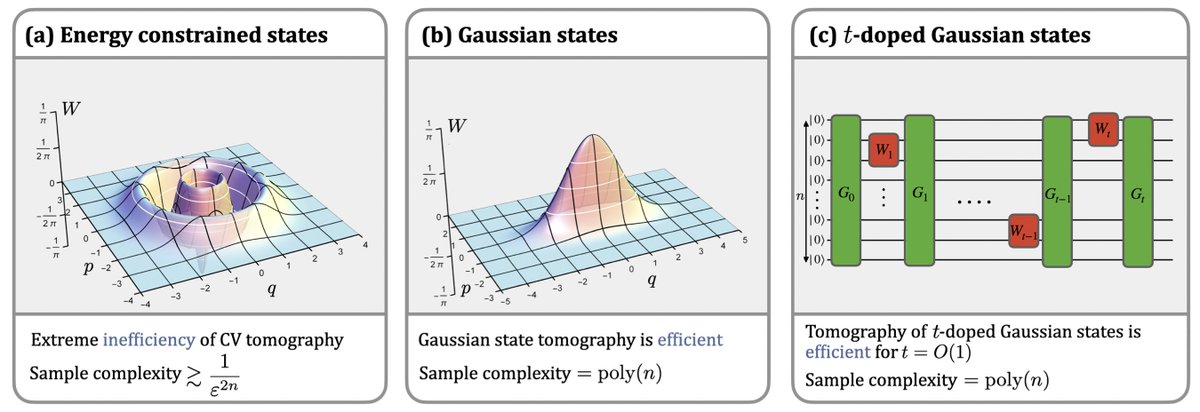
This is a publication I am extremely happy about. It is a bit rebellious, and yet it touches upon an old and important question: How can we learn an unknown quantum state from data? This is the quantum state tomography problem, and even the name “tomography” comes from the context of medical imaging, in which Radon transforms are invoked to recover higher-dimensional objects from lower-dimensional projections. Here, we prove that the old quantum state tomography is, in a precise way, a lot harder than anticipated. If one wants to recover an unknown quantum state up to a known trace-distance error, the sample complexity scales with this error to the power of the number of modes. But we also explain positive results on the recovery of Gaussian states and doped quantum states. What makes this work interesting is that it is an instance where a more precise, mathematically minded approach meets working knowledge in quantum optics. In the context of quantum technologies, researchers have become used to being precise about verification and learning schemes—think of exact errors and sample complexities. And, frankly, continuous-variable quantum state tomography is just extremely hard. I am excited to see this work appear in @NaturePhysics. nature.com/articles/s4156… Warm thanks to the dream team of @FrancescoMeleAn, @QuAntonioMele, @bittel_l, Vittorio Giovannetti, @LamiLudovico@lorenzo_leone_ and Salvatore Oliviero for this wonderful collaboration.
Jens Eisert tweet media
English
8
25
167
14.4K
Hong-Ye HU
Hong-Ye HU@HongYeHu1·
It’s really an honor our recent work with @Muzhou_Ma, @gong_weiyuan, Qi Ye, @YT59529321, @S_Flammia and Susanne Yelin has been featured on APS Physics. In this work, we explored ansatz-free Hamiltonian learning and find it can also achieve the optimal Heisenberg-limited scaling!
Physics Magazine@PhysicsMagazine

Researchers have demonstrated an algorithm that characterizes quantum systems of any size with optimal efficiency and precision without needing prior information or assumptions about the system’s structure. go.aps.org/4hr1wHO

English
1
3
13
1.1K
Jens Eisert
Jens Eisert@jenseisert·
How hard is it to verify a classical shadow? We look at the problem of establishing classical shadows from the perspective of computational complexity. lnkd.in/d3UcCEem Classical shadows are succinct classical representations of quantum states which allow one to encode a set of properties P of a quantum state rho, while only requiring measurements on logarithmically many copies of rho in the size of P. In this work, we initiate the study of verification of Hashtag#classicalshadows, denoted #classicalshadowvalidity (CSV), from the perspective of computational complexity, which asks: Given a classical shadow S, how hard is it to verify that S predicts the measurement statistics of a quantum state? We show that even for the elegantly simple classical shadow protocol of [Huang, Kueng, Preskill, Nature Physics 2020] utilizing local Clifford measurements, CSV is QMA-complete. This hardness continues to hold for the high-dimensional extension of said protocol due to [Mao, Yi, and Zhu, PRL 2025]. Among other results, we also show that CSV for exponentially many observables is complete for a quantum generalization of the second level of the polynomial hierarchy, yielding the first natural complete problem for such a class. Warm thanks to Georgios Karaiskos, Dorian Rudolph, @jj_xyz and @GharibianS78682 for this @FU_Berlin-@unipb-collaboration.
Jens Eisert tweet media
English
2
2
30
1.6K
Hong-Ye HU retweetledi
Zlatko Minev
Zlatko Minev@zlatko_minev·
Whoa, cool, 3Blue1Brown made a quantum computing video youtu.be/RQWpF2Gb-gU?si… Looking forward to watch, usually explanations are very good
YouTube video
YouTube
English
2
13
82
6.6K
Jens Eisert
Jens Eisert@jenseisert·
@HongYeHu1 Thanks a lot for coming and for the inspiring talk. Obviously, there have been many friends in your great talk.
English
1
0
2
60
Hong-Ye HU retweetledi
Jens Eisert
Jens Eisert@jenseisert·
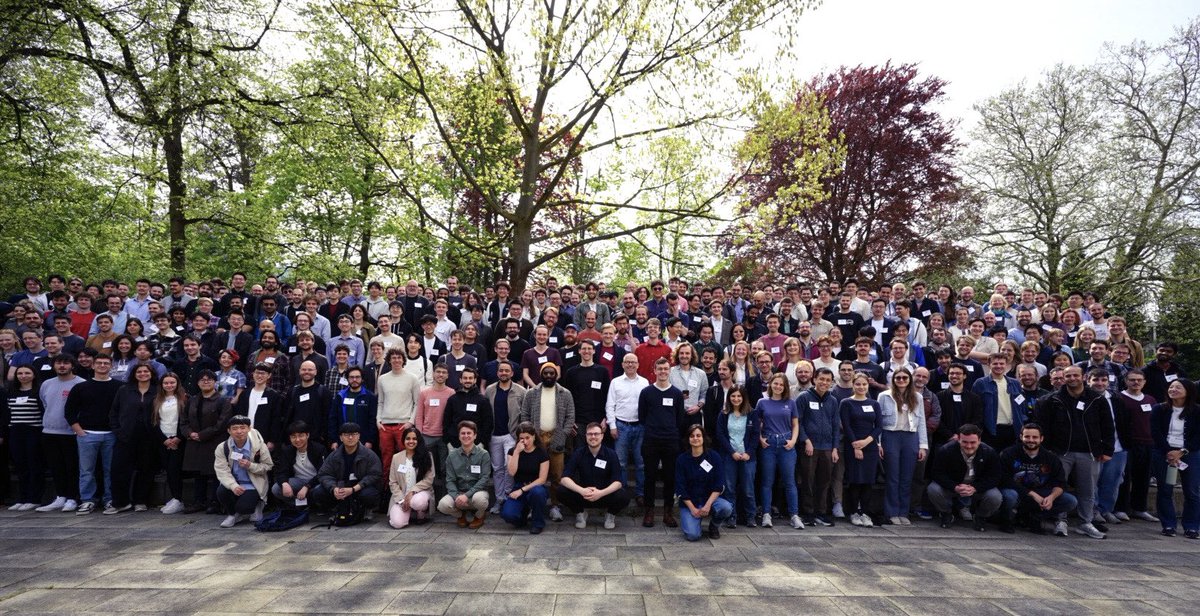
The group photo of #QCTiP2025. This is an impressive crowd of active researchers interested in quantum computing theory in practice.
Jens Eisert tweet media
English
2
8
47
3.3K
Hong-Ye HU retweetledi
Ryan LaRose
Ryan LaRose@ryanmlarose·
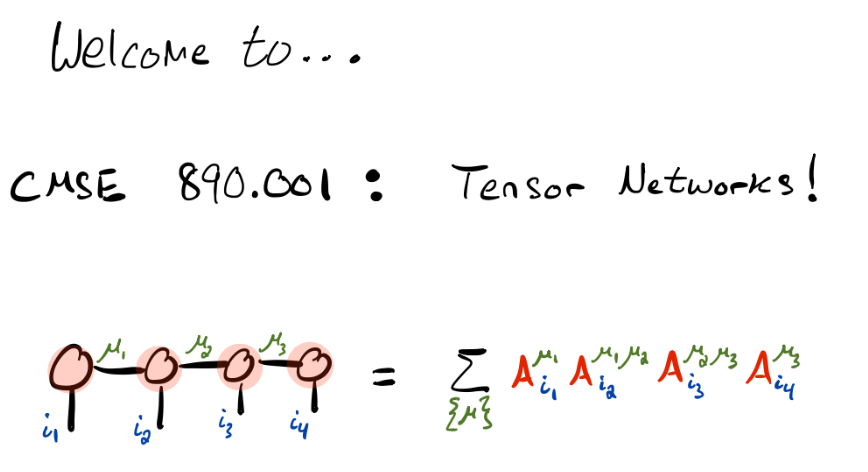
I really enjoyed teaching a new graduate course on tensor networks this semester - I just made the course syllabus with readings, (handwritten) lecture notes, and coding assignments available on my website in case they are useful to anyone: ryanlarose.com/teaching
Ryan LaRose tweet media
English
4
22
187
11.2K