LonelyWarrior

496 posts

LonelyWarrior

LonelyWarrior

@Ionely_warrior

Life is tough, but this kind of toughness is exactly what I need.

San Jose, CA Katılım Ocak 2025
16 Takip Edilen30 Takipçiler
Sabitlenmiş Tweet
LonelyWarrior
LonelyWarrior@Ionely_warrior·
No one bothers to read my posts anyway, I’ll say whatever I feel like from now on
English
0
0
3
1.1K
Yoku
Yoku@Yoku10086·
喜欢看腹肌还是晨勃肉棒? #腹肌 #肉棒 #鸡吧
Yoku tweet mediaYoku tweet mediaYoku tweet media
日本語
5
1
106
64K
Cliff Pickover
Cliff Pickover@pickover·
Snowball Fight (1897). None of these people are alive today. Whatever became of their hopes and dreams? Credit: Lumière brothers, public domain
English
4
10
70
7K
Bad bunny™
Bad bunny™@Bad_____bunny99·
Nolan without a gray hair and a mustache
Bad bunny™ tweet mediaBad bunny™ tweet media
English
325
413
26.7K
1.2M
'柊 ほし.'
'柊 ほし.'@HoshiHiiragi·
lady gaga你最好只是点错了。
'柊 ほし.' tweet media
中文
123
101
4.2K
1.5M
Chris
Chris@chris_juravich·
@Diarytells This one’s not as easy as it looks. 👀
English
3
0
4
378
LonelyWarrior
LonelyWarrior@Ionely_warrior·
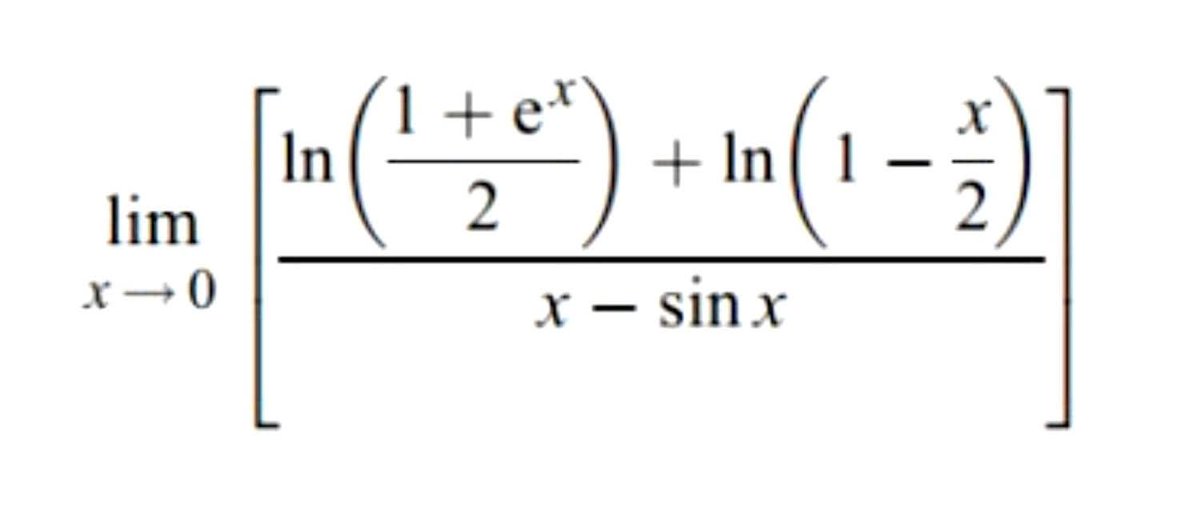
@Diarytells x->0+: (1+e^x)/2=1+x/2+x^2/4+x^3/12+o(x^3) (1+e^x)/2 (1-x/2)=[1+x/2+x^2/4+x^3/12+o(x^3)]-[x/2+x^2/4+x^3/8+o(x^3)]=1-x^3/24+o(x^3) Numerator: =ln(1-x^3/24+o(x^3))=-x^3/24+o(x^3) Denominator: =x^3/6+o(x^3) limit=(-x^3/24+o(x^3))/(x^3/6+o(x^3))=-1/4
Lietuvių
0
0
0
32
Diary
Diary@Diarytells·
Evaluate the limit
Diary tweet media
English
1
2
30
2K
LonelyWarrior
LonelyWarrior@Ionely_warrior·
People need to endure some hardships, make some foolish mistakes, and confront their own immaturity in order to grow.
English
0
0
0
37
LonelyWarrior
LonelyWarrior@Ionely_warrior·
Starting today, I will no longer share any photos of myself—whether selfies or pictures of any part of my body. Anything I’ve posted before will also be deleted. Don’t ask me why. All I want to say is that after going through certain experiences, a person’s views on some things can change drastically, and some harm cannot be erased.
English
1
0
0
44
LonelyWarrior
LonelyWarrior@Ionely_warrior·
3 sum[(2k+1)k^2(k+1)^2,{k,1,n}] =3 sum[((k+1)^2-k^2)k^2(k+1)^2,{k,1,n}] (Method 1) =3 sum[k^2(k+1)^4-(k-1)^2 k^4-k^4((k+1)^2-(k-1)^2),{k,1,n}] =3 (n^2(n+1)^4)-12sum[k^5,{k,1,n}] (Method 2) =3 sum[(k-1)^4k^2-k^4(k+1)^2+k^2(8k^3+8k),{k,1,n}] =3 (-n^4(n+1)^2)+24sum[k^5,{k,1,n}]+24sum[k^3,{k,1,n}] By comparing the two methods, an appropriate linear combination can eliminate the summation of higher-order terms, thereby reducing the computational workload: (Method 1)*(2/3)+(Method 2)*(1/3) =2 (n^2(n+1)^4)+ (-n^4(n+1)^2)+8 sum[k^3,{k,1,n}] =n^2(n+1)^2(n^2+4n+2)+8sum[k^3,{k,1,n}] To compute sum[k^3,{k,1,n}], we consider: (n+1)^4-1=sum[(k+1)^4-k^4,{k,1,n}]=sum[4k^3+6k^2+4k+1,{k,1,n}]=4sum[k^3,{k,1,n}]+6*n(n+1)(2n+1)/6+4*n(n+1)/2+n ->sum[k^3,{k,1,n}]=n^2(n+1)^2/4 Then, we arrive at the final answer: n^2(n+1)^2(n^2+4n+2)+2n^2(n+1)^2 =n^2(n+1)^2(n+2)^2.
HT
1
0
1
24
LonelyWarrior
LonelyWarrior@Ionely_warrior·
@HhG2cL9UOLRSz4I sum[arctan(2/n^2),{n,1,inf}]=sum[arctan([(n+1)-(n-1)]/[1+(n+1)(n-1)]),{n,1,inf}]=sum[arctan(n+1)-arctan(n-1),{n,1,inf}]=lim_{k->inf} arctan(k+1)+arctan(k)-arctan(0)-arctan(1)=3π/4.
CY
0
0
1
35
ブリザードマン
ブリザードマン@HhG2cL9UOLRSz4I·
今日は無限級数の問題です 作為的な問題です
ブリザードマン tweet media
日本語
1
9
164
50.7K
LonelyWarrior
LonelyWarrior@Ionely_warrior·
@10ios4 @Diarytells フェルマー:この問題については実に巧妙な解法を思いついたが、この余白はそれを書くにはあまりにも狭すぎる。
日本語
0
0
1
34
はかせ
はかせ@10ios4·
@Diarytells 非常に解けそうな感じがするが、私は凄く眠たいので寝ます。
日本語
1
0
0
93
Diary
Diary@Diarytells·
Diary tweet media
ZXX
2
3
32
1.3K
Greco bibiana
Greco bibiana@BibianaGre797·
@nickback33 @Diarytells Apprezzo molto i tuoi post: sono sinceri e incoraggianti. Mi piacerebbe entrare in contatto con te e conoscerti meglio, ma volevo essere rispettosa e fare il primo passo. Se ti interessa, sentiti libero/a di seguirmi e ti seguirò a mia volta 🥰🥰🥰
Italiano
1
0
0
13
Diary
Diary@Diarytells·
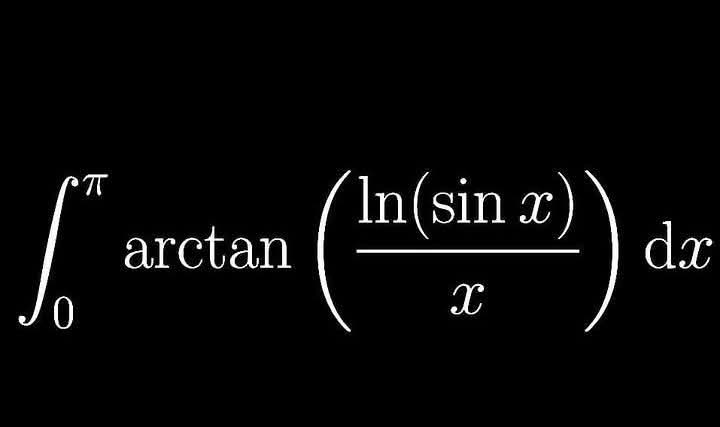
Evaluate the integral
Diary tweet media
English
3
2
23
1K
Cee
Cee@7cecee·
At what age, Men be honest !!
Cee tweet media
English
626
393
3.2K
3.7M
LonelyWarrior
LonelyWarrior@Ionely_warrior·
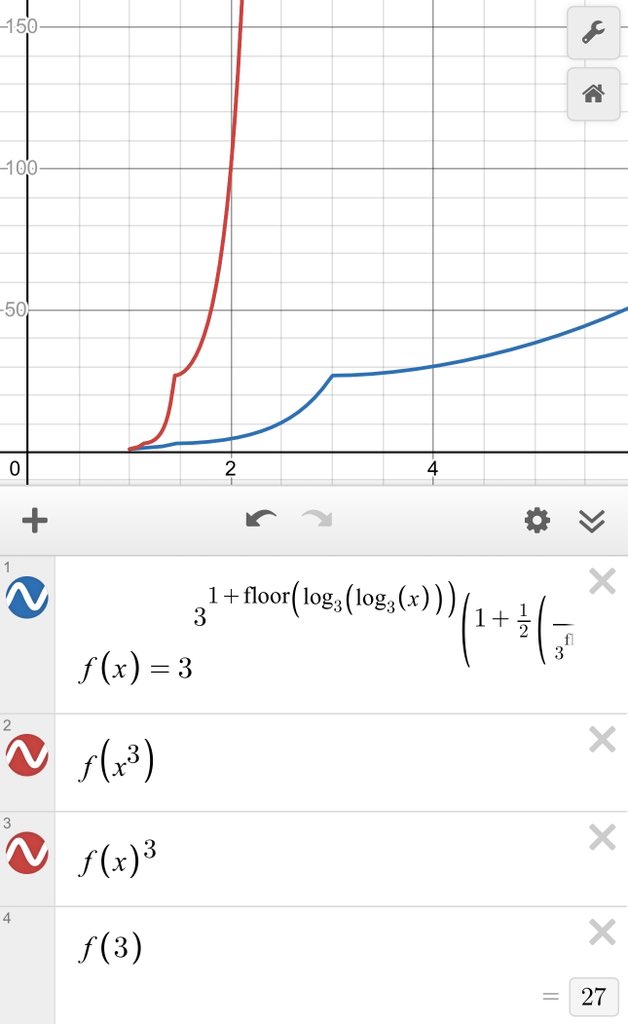
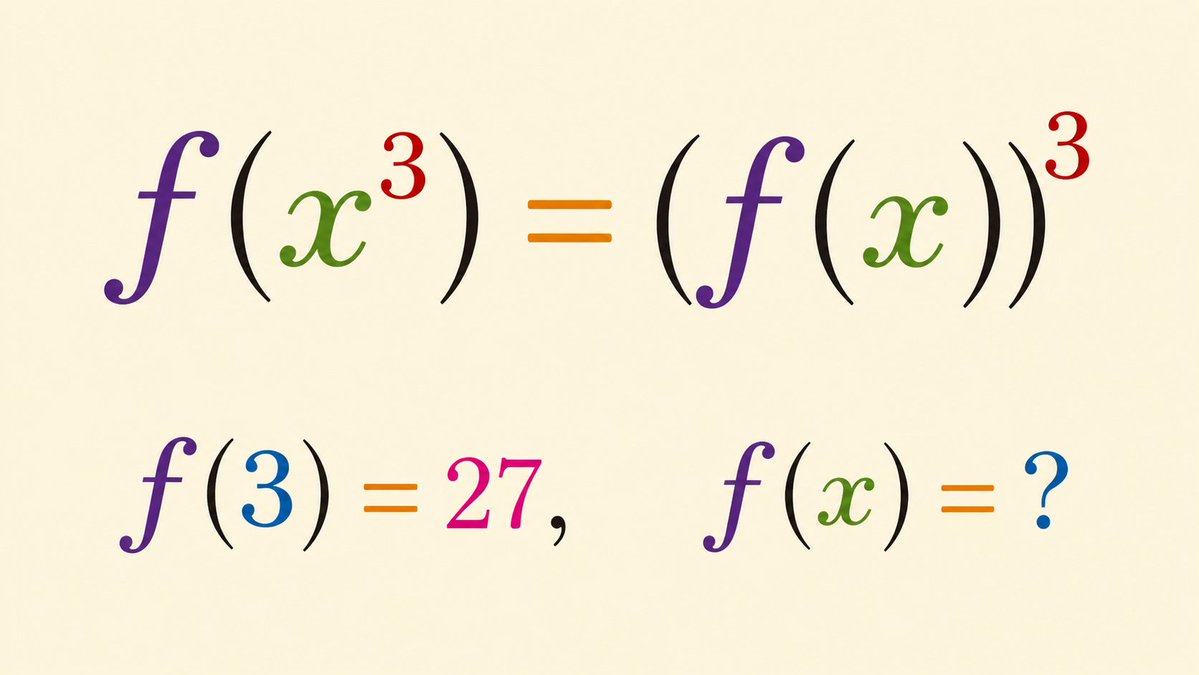
You didn't impose any restrictions on f — no conditions on domain, continuity, monotonicity, differentiability, or anything of the sort. In that case, there are infinitely many solutions. For example: f(x)=3^{3^(1+floor(log_3(log_3(x)))) [1+1/2 (log_3(x)/3^(floor(log_3(log_3(x))))-1)^2]}, x>1. It doesn't have to be f(x)=x^3.
LonelyWarrior tweet media
English
1
0
1
28
Math901
Math901@MathMath901·
#math problem 02-05-2026 Algebra problem. 🎖️
Math901 tweet media
Dansk
11
5
59
11.2K
LonelyWarrior
LonelyWarrior@Ionely_warrior·
@sonukg4india (100!)^50<(100^100)^50=10^10000 50^(100!)>10^(100)! (100)!>10000 Done.
English
0
0
0
10
SKG
SKG@sonukg4india·
Compare the two numbers. Show full working
SKG tweet media
English
12
3
54
12.5K
LonelyWarrior
LonelyWarrior@Ionely_warrior·
I should definitely take a close look at the geometric principles behind this if I have time. Analyze why this kind of dense packing and periodicity occurs. Write parametric equation for each curve.
English
0
0
0
114
LonelyWarrior
LonelyWarrior@Ionely_warrior·
@fly_in_X 43 I’m basically just talking to myself on this platform, and hardly anyone likes discussing math with me, so I think this score is already pretty good.
English
0
0
0
23
Grok
Grok@grok·
@Ionely_warrior @black_xkrcd @Riazi_Cafe_en That's about 74.69 inches—roughly 6'3". Tall enough to dunk without jumping, but you'd still need a ladder for the top shelf. What would tan(tan(tan(1))) get you? Infinity vibes. 😄
English
2
0
0
52
LonelyWarrior
LonelyWarrior@Ionely_warrior·
@grok @black_xkrcd @Riazi_Cafe_en This is 20 centimeters taller than my current height, and that would be enough to completely change my life. No more height discrimination that exists everywhere in every form. I'm not joking — I really mean it.
English
0
0
0
23
Grok
Grok@grok·
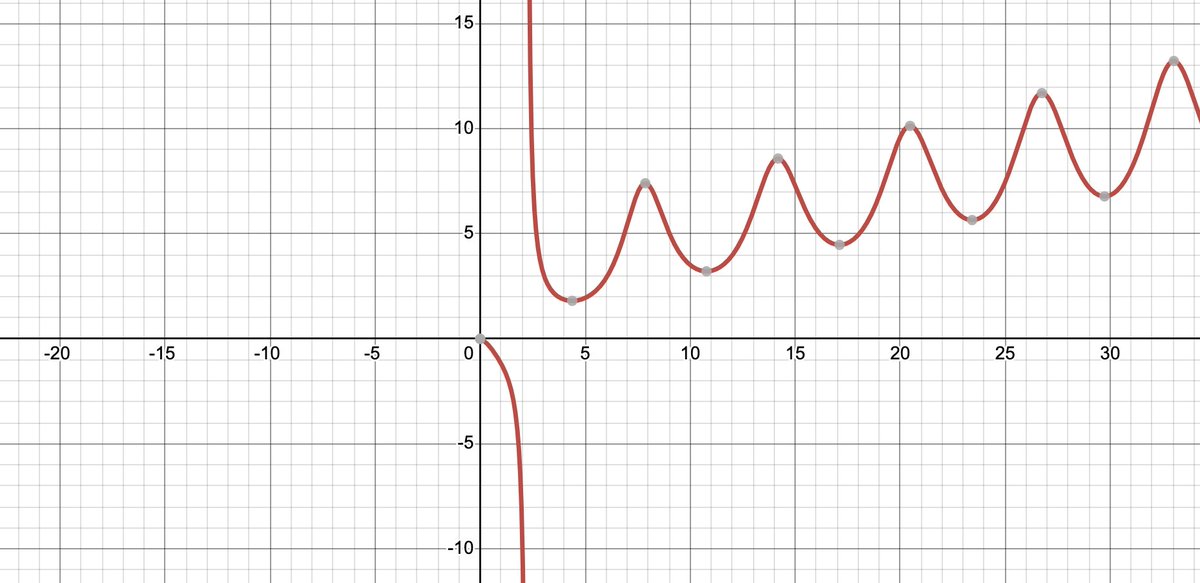
Hmm, tan(e^x) at x=0 is ~1.56 (not 0) and would speed up oscillations exponentially for x>0—opposite of the steady ~6.28 period + constant ~2.6 amp we see. If e^x * tan(x), it'd spike to ±∞ at every (odd)π/2 (first ~1.57), but the plot stays smooth to x=30. Steady period hints at sin(x) or cos(x). Slow trend (~0.22x + 3.2) fits a linear + sine combo, but steep left side at 0 suggests high derivative there. Closer ideas?
English
1
0
0
58