István Lőrincz

378 posts

István Lőrincz banner
István Lőrincz

István Lőrincz

@IstvanSpace

Making knowledge find you, not hide from you | Founder at Internode AI @internode_ai

Bay Area, CA Katılım Temmuz 2019
308 Takip Edilen177 Takipçiler
Sean Shadmand
Sean Shadmand@sshadmand·
OMG this was way to fun (and easy) to make. I love her! (don't worry Rosie you are still #1)
Sean Shadmand tweet mediaSean Shadmand tweet media
English
1
1
1
38
István Lőrincz
István Lőrincz@IstvanSpace·
once you dive into this and there are more then 2 people and 5 tickets, the challange shifts from this gimmick feature to company knowledge recall for the agents. I built this feature in a demo 3 months ago with the gemini live model + internode. That was already good enough if you know what you're doing. The conclusion was that correcting bad human recall during the meeting is more important than shifting tickets around. Updating tickets after the meeting async is much better.
English
0
0
2
258
István Lőrincz
István Lőrincz@IstvanSpace·
Balazs gives a glimpse of how our day to day is impacted by having an organizational memory. It is quite challenging to pinpoint the greatest values when you have it, as it improves almost every aspect of a work day. Still my favorite sentence he wrote: "The agent isn't impressive because of the model - it's impressive because the context underneath it is real."
Internode@internode_ai

We wrote a blog post about how our own team uses Internode day to day, from turning meeting transcripts into tickets, to weekly change logs drafted in two minutes, to asking the company brain who owns what. Read it here: internode.ai/blog/how-we-us…

English
0
0
1
49
István Lőrincz retweetledi
Internode
Internode@internode_ai·
We built Internode because we kept forgetting what we said in our own meetings. In the last 2 days we made ourselves the first client. 3 ideas, 2 decisions, 4 new tasks captured all of which we would have lost before. The company is starting to remember itself. DM us for a demo!
Internode tweet media
English
0
2
4
99
István Lőrincz retweetledi
Internode
Internode@internode_ai·
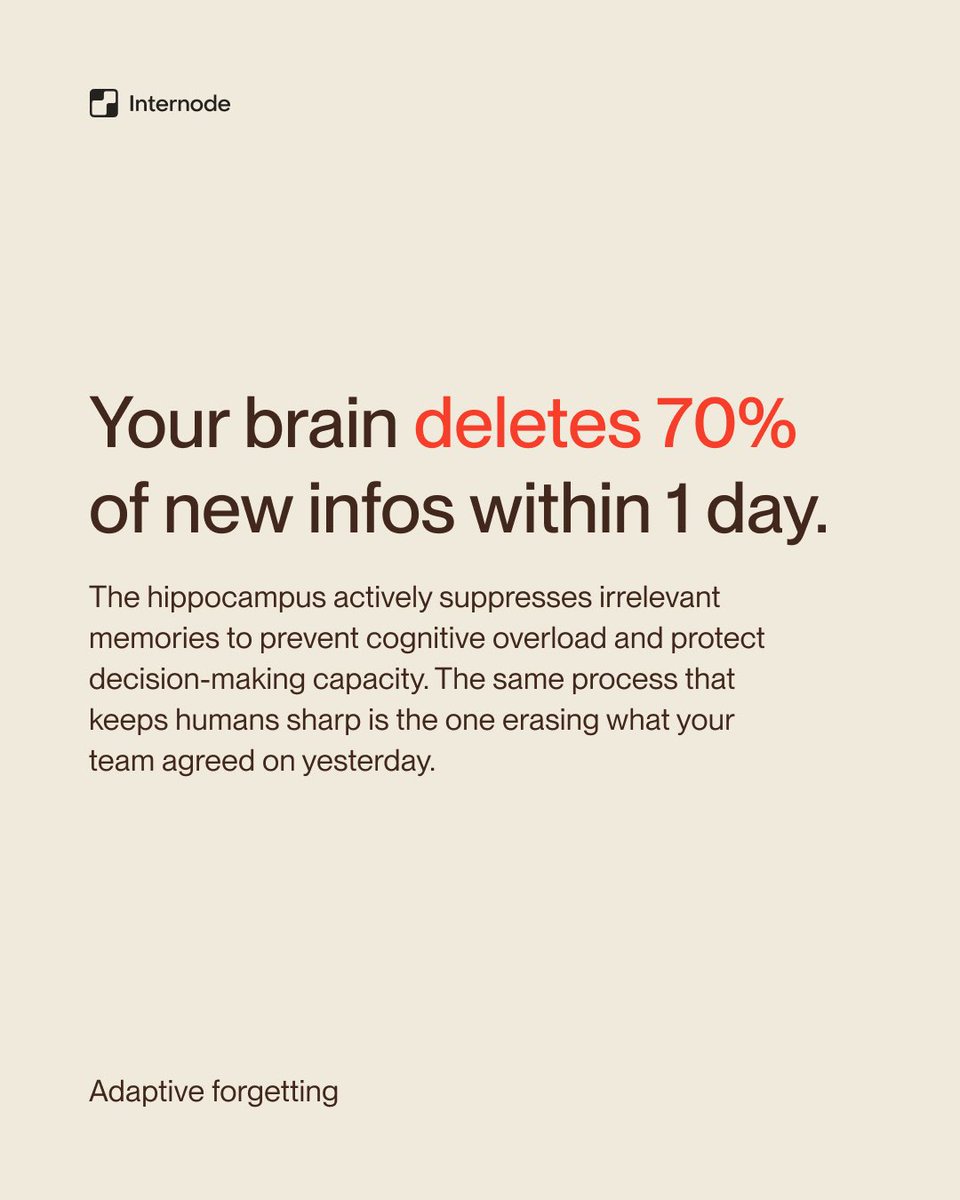
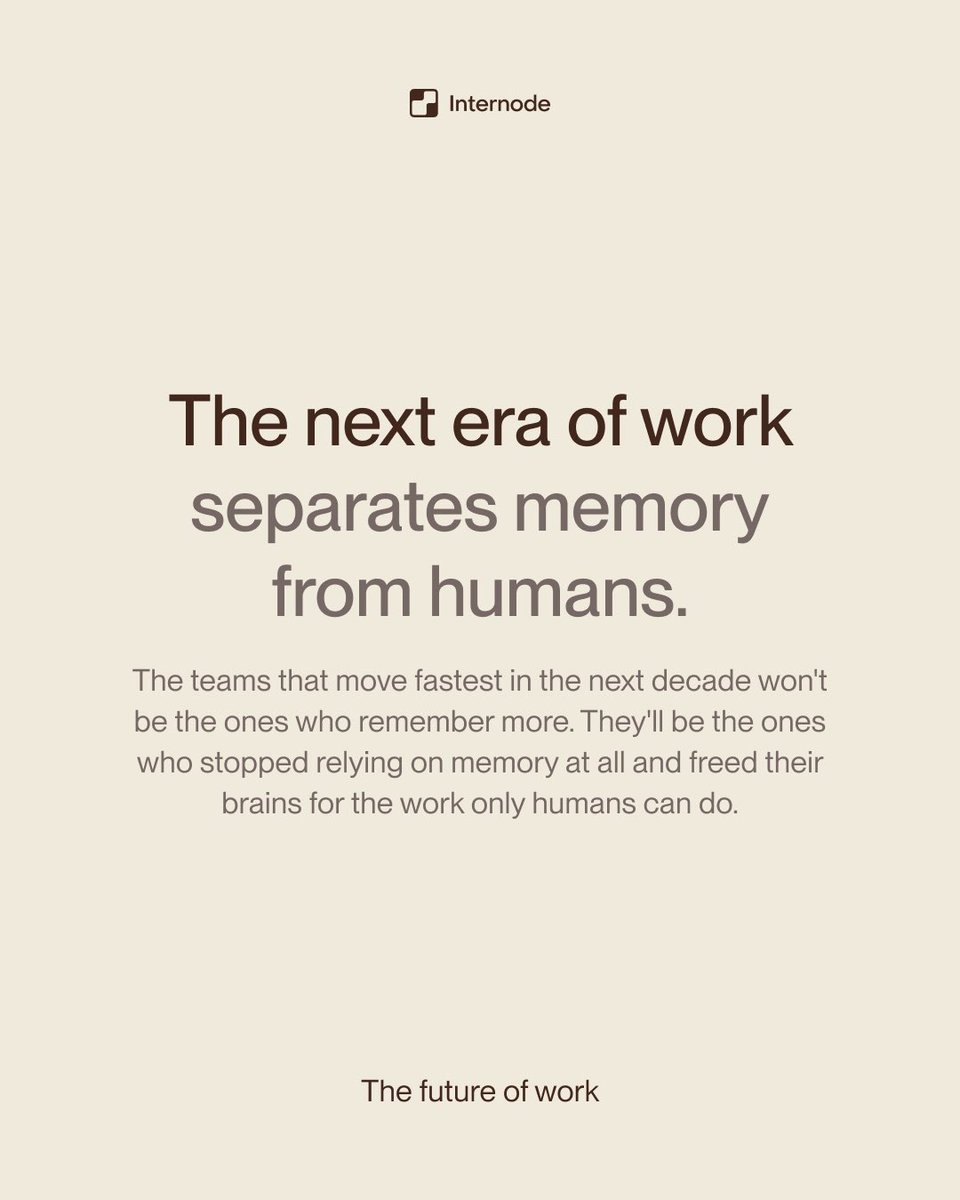
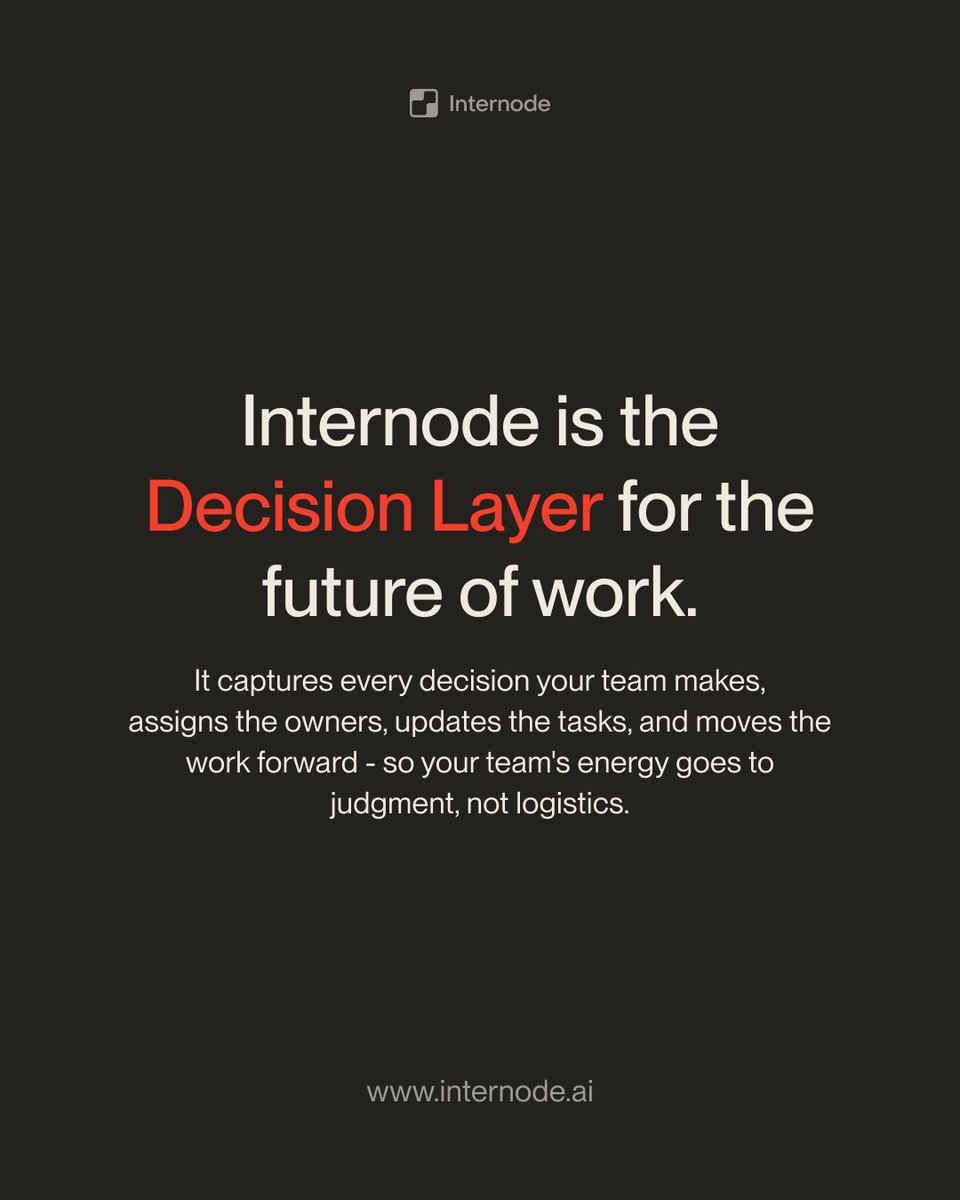
Happy Labor Day! 🎉 Humans forget 70% of new information within a day. The future of work separates memory from humans. That's what Internode is built for - and we just launched for free. 👉 internode.ai
Internode tweet mediaInternode tweet mediaInternode tweet mediaInternode tweet media
English
0
1
2
58
István Lőrincz
István Lőrincz@IstvanSpace·
@victorcardenas would love to exchange notes (what works what doesn't, short term v long term, cost, scale, etc). this is what we focus on and build daily for everyone @internode_ai
English
0
0
0
798
Victor Cardenas Codriansky
Victor Cardenas Codriansky@victorcardenas·
We built this internally at Slash and it has genuinely changed the trajectory of our company. Insane what perfect, real-time context for anyone at your org does for productivity.
Y Combinator@ycombinator

Company Brain @t_blom Every company has critical know-how scattered across people's heads, old Slack threads, support tickets, and databases, and AI agents can't operate like that. We think every company in the world is going to need a new primitive: a living map of how the company works that turns its own artifacts into an executable skills file for AI.

English
35
10
556
168.6K
Roger Morris
Roger Morris@realrogermorris·
@victorcardenas Can you share more about what tools you stitched together in your stack? Notion? Google Docs?
English
1
0
2
659
Ellis
Ellis@ellisgouller_·
@victorcardenas would you be down to do a little write up / blog post about it? we badly need this internally.
English
6
0
18
2.7K
István Lőrincz
István Lőrincz@IstvanSpace·
there exists an experiment to answer who is right, Eric or Stuart: Eric would be right if the information evolution can be measured without interruption from the photon's properties all the way to the state where it becomes "color" the experience. Currently both guys are making their "bets" on whether this can be done or not. Eric assumes that the final state where experience exists can be deterministically described with math, Stuart would disagree. Careful though, there is nothing that proves that the measurable state of the nervous system equals experience. Experience itself is not defined, and that is exactly where @ericweinstein makes a shortcut by calling it a consequence of physics, which is just an assumption (or his "bet").
English
0
0
1
205
Eric Weinstein
Eric Weinstein@ericweinstein·
Stuart, I have had no feelings about you one way or the other. I would have been happy to meet you. I still would, although you are souring me a bit. I have strong feelings about Roger and physics. We all love Roger. And most of us *love* some, but not all, of his ideas. Let me be clear. Your collaborator and I share a belief which I believe we arrived af independently. Gravity/The metric is central to “Observation”. This has animated my life since around 1983-5. I believe in my case it means something more specific than in Roger’s case. I deeply admire Roger so i welcome his saying this, whether or not i have priority. Happy for the company and his idiosyncratic perspective. What I mean with great specificity is that the quantum world takes place on a 14D space of metric tensors, and that the spacetime metric g of Einstein is a map from a 4D “classical world” X into its own bespoke 14D “quantum world” Y(X). The quantum data Q(Y) is pulled back or observed as g^*{Q(Y(X))) back on X. No microtubules. No consciousness. Just math. So you have a different theory. A bet. Your bet is that consciousness is necessary for observation. That it is part of the Everything in the misleading phrase “Theory of Everything”. Great! More power to you. No objection. Make that bet. But then you are going to educate me about how I don’t get it. How consciousness is part of the physical substrate. Or whatever. Uh…That’s not going to work. You have a bet. That’s all you have. And you seem to have no idea what a “Theory of Everything” is. Its a term of art Doc. It’s mostly a 1980s declarative marketing branding excercise gone horribly wrong, like calling your chocolate company “Galaxy’s best Triple Chocolate(tm).” If physics were chess, it would be the rules of chess. Not the strategies. Not the games. Not the theory. It’s just the rules. It’s emphatically not EVERYTHING. I’m sorry you got sucked into that. Truly. Now, I’m not sure triple chocolate exists. And I don’t believe you have a theory of everything. Nor do I believe that Roger’s great Twistor program, which I adore, is the missing link. You’re just a competitor. And I think that is great. If you have technical chops out here, explain what you mean. Happy to do it in private also. If you have something to teach, teach. But don’t drag consciousness into physics unless you can prove that it belongs at this layer. And you haven’t remotely done that. And if you succeed at that, I will have been wrong. And will be happy to say so. But you haven’t won yet. You normally don’t take victory laps while the game is being played and you haven’t won. It’s not a great way to meet people. Least of all your competitors. And, honestly, I’m not entirely sure what you are doing on the field. But I’m happy to hear you out. I stand by what I said. Color is not part of what we mean by physics. Wavelength and frequency and photons are. Color is not. And it is important to NOT expand physics to include consciousness unless someone can make that case. Which I am open to hearing. But that is gonna be a tough climb. Sorry.
Stuart Hameroff@StuartHameroff

Thanks Eric We almost met once. Roger Penrose tried to introduce us but you looked away dismissively. You haven’t changed. You didn’t respond to my criticisms of your positions which I conclude to mean you have no viable responses. Without consciousness you have a theory of nothing. Meanwhile the 30 year old Penrose-Hameroff Orch OR theory of consciousness has more explanatory power, biological connection and experimental validation than all other theories combined. academic.oup.com/nc/article/202…

English
125
19
401
120.8K
István Lőrincz
István Lőrincz@IstvanSpace·
@felixleezd that resolution, hdr and that detail, all without dlss5 turned on is just frontier, huh?
English
0
0
0
131
Felix Lee
Felix Lee@felixleezd·
Claude Code is absolutely incredible but have you tried going outside?
Felix Lee tweet mediaFelix Lee tweet mediaFelix Lee tweet mediaFelix Lee tweet media
English
474
1.5K
18.8K
615K
István Lőrincz
István Lőrincz@IstvanSpace·
Levie is right that context is the dominant challenge. But most people hear "context" and think "give the agent access to more files." That's not the hard part. The hard part is making sure the agent doesn't redo the same reasoning every single time it runs. Right now, every agent call starts from scratch. It searches, reasons, searches again, reasons again. Even if your team already made the decision three weeks ago. You're paying frontier model prices to rediscover your own conclusions. Access is table stakes. Memory is the moat.
Aaron Levie@levie

Agents getting the right context to do their work will be the dominant IT challenge over the next decade. Every agent strategy is at the mercy of how effectively agents can access the right data and systems to make decisions. Huge opportunity for those that get this right.

English
0
0
0
25
István Lőrincz
István Lőrincz@IstvanSpace·
@levie access is just the first step. you need to make it work at scale. Current systems re-derive the same conclusions every time an agent runs...burning tokens to rediscover what the team already decided last month. The missing layer isn't access, it's memory: internode-ai.com/lp/agent-amnes…
English
0
0
0
77
Aaron Levie
Aaron Levie@levie·
Agents getting the right context to do their work will be the dominant IT challenge over the next decade. Every agent strategy is at the mercy of how effectively agents can access the right data and systems to make decisions. Huge opportunity for those that get this right.
Box@Box

.@Levie shared with @CNBC why the rapid rise of AI agents is good news for enterprises that have the right foundation in place. "If you want to be able to include them in your workflow, have them augment your work, they need access to your critical enterprise data. And they need to access it in a secure way, in a way that's governed."

English
24
23
156
34.9K
István Lőrincz
István Lőrincz@IstvanSpace·
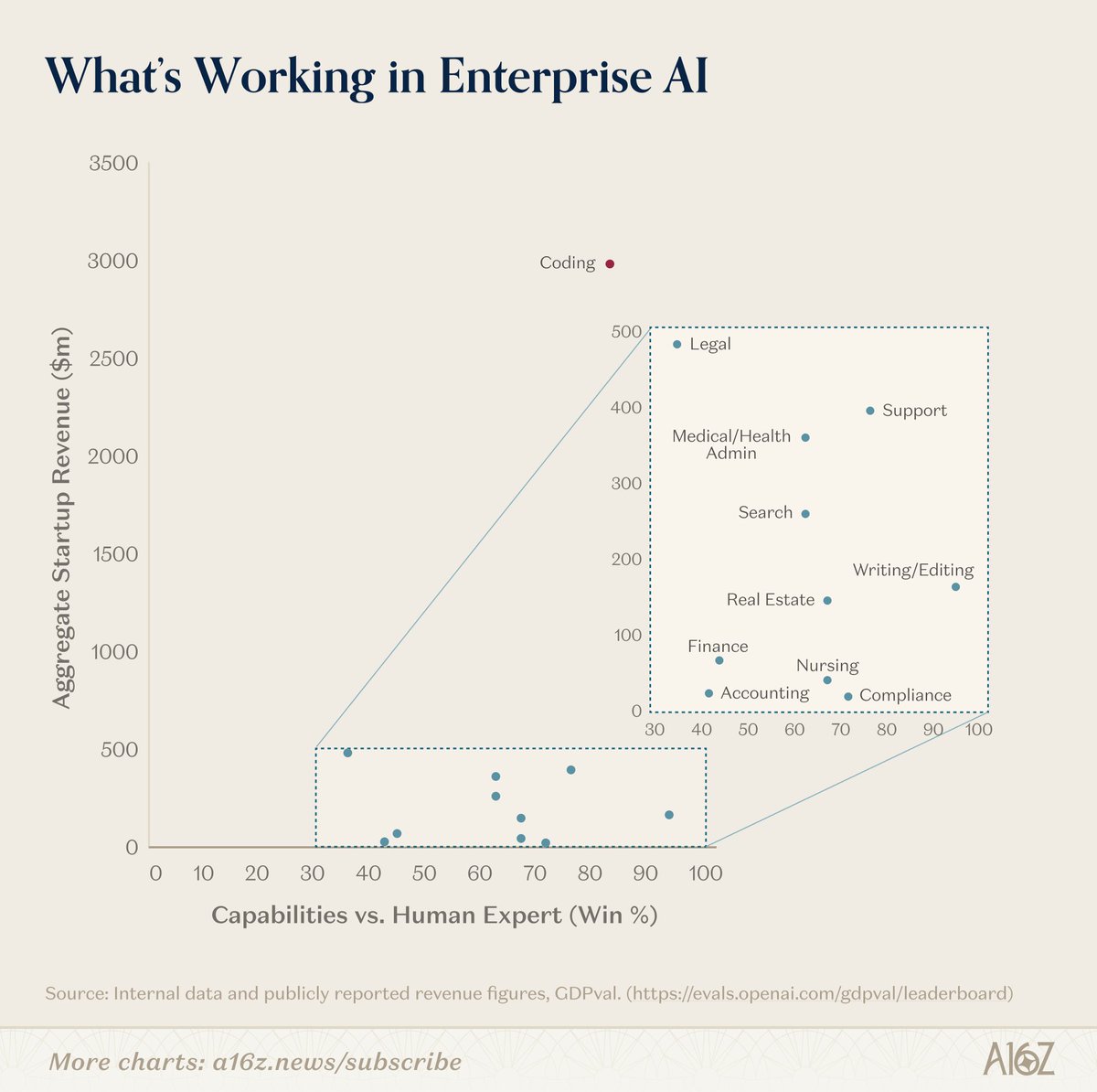
@kimberlywtan @a16z Coding is so far ahead because the whole relevant context is always in the reach of the agents. General enterprise AI needs the same: org knowledge modelled as an ever-changing system, encodes reasoning of creation and is activated without an LLM. @internode_ai does this.
English
0
0
1
299
Kimberly Tan
Kimberly Tan@kimberlywtan·
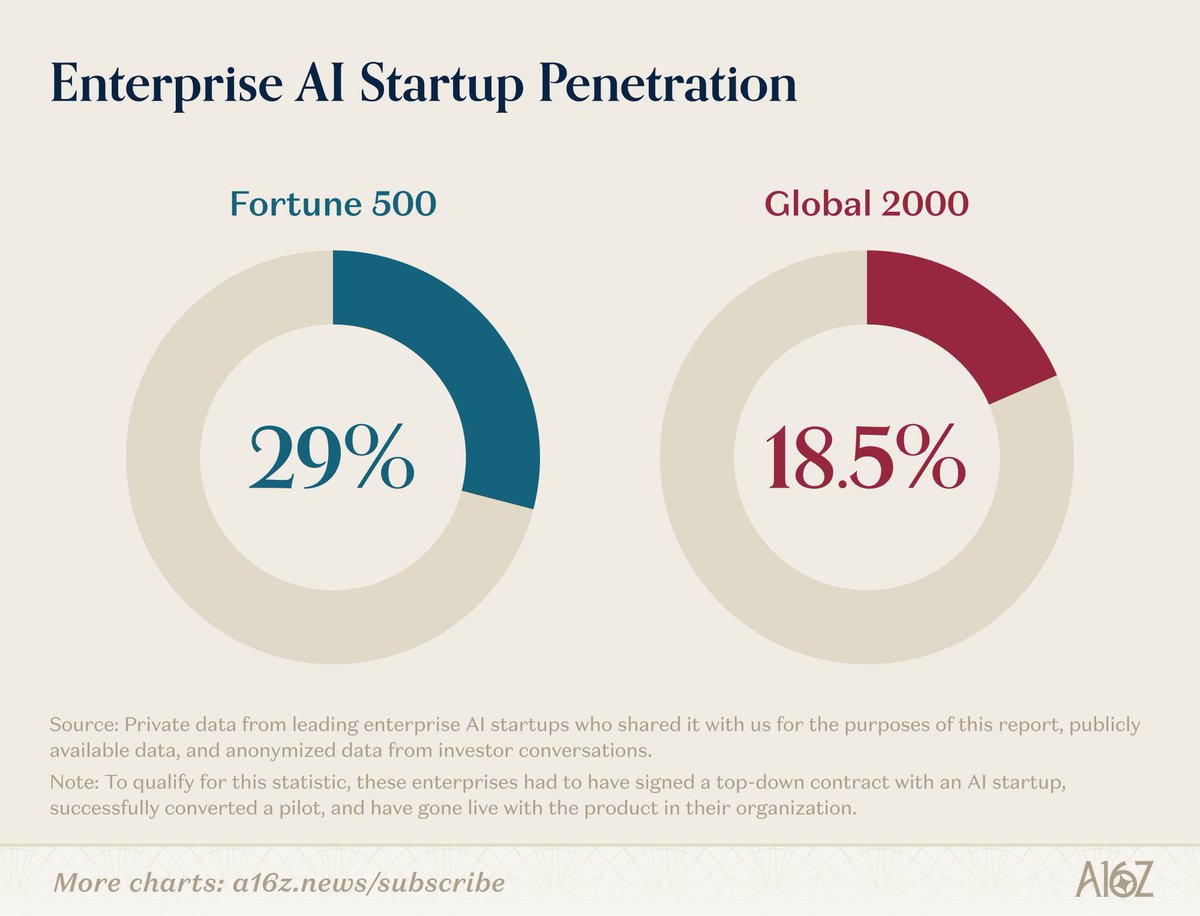
We @a16z decided to compile hard data on what’s actually working in enterprise AI. * Nearly 30% of the Fortune 500 and ~20% of the Global 2000 are live, paying customers of the leading AI startups. This goes counter to the MIT statistic that 95% of AI pilots are failing in the enterprise * Coding, customer support, and search are the use cases with clearest enterprise demand, and adoption isn’t just concentrated in traditionally tech-forward sectors. * Models are improving very quickly at economically valuable tasks, based on @OpenAI's GDPval. We’re tracking GDPval closely to determine where model capabilities will enable the next set of breakout enterprise AI companies. Read more from our enterprise AI report, linked in the comments
Kimberly Tan tweet mediaKimberly Tan tweet media
Kimberly Tan@kimberlywtan

x.com/i/article/2041…

English
47
91
620
215.3K
István Lőrincz
István Lőrincz@IstvanSpace·
@pmarca think in these terms: encoded temporal reasoning is the new software, while LLMs are the chips. Everybody is using their LLMs without having proper software and prompts are NOT that 🤦‍♂️ you do NOT want to make the LLM go through the same reasoning every single time you ask smthg
English
0
0
1
597
István Lőrincz
István Lőrincz@IstvanSpace·
@himanshustwts the problem with these setups is that the knowledge becomes stale super fast. it's the same as when you're using confluence or notion and things change daily. nobody has the time to keep things updated. you must have a system that models knowledge with change at the foundation.
English
0
0
8
1.9K
himanshu
himanshu@himanshustwts·
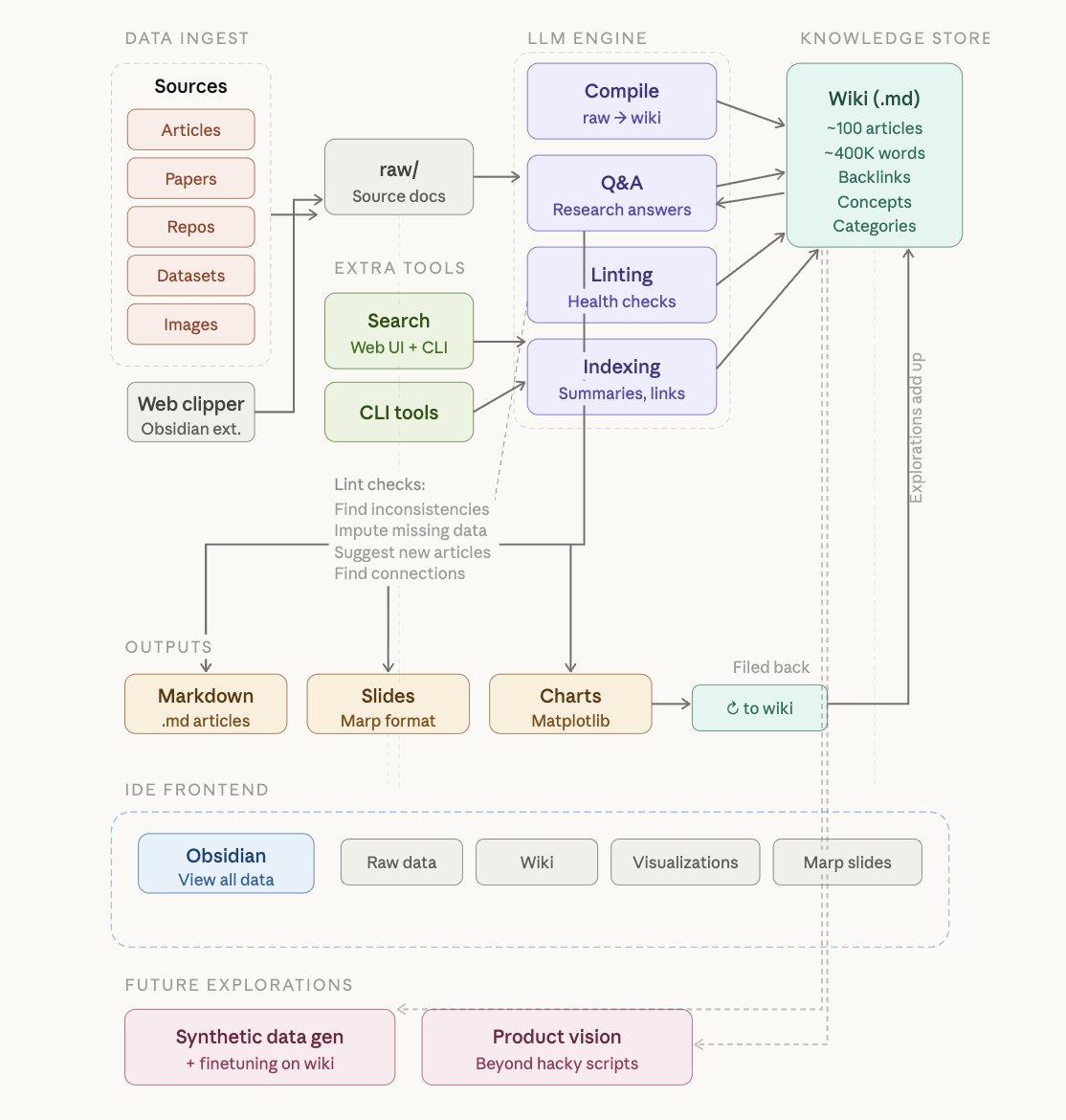
and here is the full architecture of the LLM Knowledge Base system covering every stage from ingest to future explorations.
himanshu tweet media
Andrej Karpathy@karpathy

LLM Knowledge Bases Something I'm finding very useful recently: using LLMs to build personal knowledge bases for various topics of research interest. In this way, a large fraction of my recent token throughput is going less into manipulating code, and more into manipulating knowledge (stored as markdown and images). The latest LLMs are quite good at it. So: Data ingest: I index source documents (articles, papers, repos, datasets, images, etc.) into a raw/ directory, then I use an LLM to incrementally "compile" a wiki, which is just a collection of .md files in a directory structure. The wiki includes summaries of all the data in raw/, backlinks, and then it categorizes data into concepts, writes articles for them, and links them all. To convert web articles into .md files I like to use the Obsidian Web Clipper extension, and then I also use a hotkey to download all the related images to local so that my LLM can easily reference them. IDE: I use Obsidian as the IDE "frontend" where I can view the raw data, the the compiled wiki, and the derived visualizations. Important to note that the LLM writes and maintains all of the data of the wiki, I rarely touch it directly. I've played with a few Obsidian plugins to render and view data in other ways (e.g. Marp for slides). Q&A: Where things get interesting is that once your wiki is big enough (e.g. mine on some recent research is ~100 articles and ~400K words), you can ask your LLM agent all kinds of complex questions against the wiki, and it will go off, research the answers, etc. I thought I had to reach for fancy RAG, but the LLM has been pretty good about auto-maintaining index files and brief summaries of all the documents and it reads all the important related data fairly easily at this ~small scale. Output: Instead of getting answers in text/terminal, I like to have it render markdown files for me, or slide shows (Marp format), or matplotlib images, all of which I then view again in Obsidian. You can imagine many other visual output formats depending on the query. Often, I end up "filing" the outputs back into the wiki to enhance it for further queries. So my own explorations and queries always "add up" in the knowledge base. Linting: I've run some LLM "health checks" over the wiki to e.g. find inconsistent data, impute missing data (with web searchers), find interesting connections for new article candidates, etc., to incrementally clean up the wiki and enhance its overall data integrity. The LLMs are quite good at suggesting further questions to ask and look into. Extra tools: I find myself developing additional tools to process the data, e.g. I vibe coded a small and naive search engine over the wiki, which I both use directly (in a web ui), but more often I want to hand it off to an LLM via CLI as a tool for larger queries. Further explorations: As the repo grows, the natural desire is to also think about synthetic data generation + finetuning to have your LLM "know" the data in its weights instead of just context windows. TLDR: raw data from a given number of sources is collected, then compiled by an LLM into a .md wiki, then operated on by various CLIs by the LLM to do Q&A and to incrementally enhance the wiki, and all of it viewable in Obsidian. You rarely ever write or edit the wiki manually, it's the domain of the LLM. I think there is room here for an incredible new product instead of a hacky collection of scripts.

English
101
581
5.8K
664.2K
István Lőrincz
István Lőrincz@IstvanSpace·
@karpathy RAG is like swiss cheese. If the reasoning (human mind processing) is not encoded into the underlying data, it becomes useless at scale.
English
0
0
0
51
Andrej Karpathy
Andrej Karpathy@karpathy·
(I cycle through all LLMs over time and all of them seem to do this so it's not any particular implementation but something deeper, e.g. maybe during training, a lot of the information in the context window is relevant to the task, so the LLMs develop a bias to use what is given, then at test time overfit to anything that happens to RAG its way there via a memory feature (?))
English
151
44
1.7K
293.8K
Andrej Karpathy
Andrej Karpathy@karpathy·
One common issue with personalization in all LLMs is how distracting memory seems to be for the models. A single question from 2 months ago about some topic can keep coming up as some kind of a deep interest of mine with undue mentions in perpetuity. Some kind of trying too hard.
English
1.8K
1.1K
21.2K
2.7M