Rocktor Cobos

5.8K posts

Rocktor Cobos banner
Rocktor Cobos

Rocktor Cobos

@JACobosMurcia

Doctor en Ciencias; Químico por Vocación, Rockero por Pasión, Tornero por Admiración, Fotografo por Decisión y Cocinero por Sabor: Cosamaloapeño errante (Q≤T∆S)

Pachuca, Hidalgo, Mexico Katılım Nisan 2012
1.2K Takip Edilen425 Takipçiler
Rocktor Cobos retweetledi
Rocktor Cobos
Rocktor Cobos@JACobosMurcia·
@LaloMedecigoMR Quisiera presentarle una propuesta para uná área deportiva en nuestro municipio. En una zona como lo es los #FracccionamientosLasReynas, en la cual no contamos con áreas deportivas cercanas y que son de gran importancia para el municipio
Español
2
1
0
19
Henrik L
Henrik L@henrikl1967·
Time is We propose the Fourth Law of Thermodynamics, completing the classical framework by explaining what the first three laws leave unaddressed: why physical processes require time. The Fourth Law — the Latency Law — states that no state change in a connected system can occur instantaneously; observed time (dt) represents the processing latency required for tension regulation. This transforms time from a mysterious external dimension into an emergent system property arising from finite information processing in physical arrays. We derive the Fourth Law from the Theory of Cosmic Architecture (TOCA), demonstrate its necessity for completing thermodynamics, and show it unifies the previous three laws while providing the physical foundation for consciousness, computation, and causality. Time is not a backdrop against which physics occurs — it is the signature of physics occurring. doi.org/10.5281/zenodo…
English
1
0
1
54
The Scientific Lens
The Scientific Lens@LensScientific·
Albert Einstein, in 1905, revealed something that shook the foundation of knowledge. “Time is not absolute.” Imagine standing there, knowing you have just rewritten the way humanity understands reality.
English
12
32
128
7K
Shack Toms
Shack Toms@shacktoms·
@PhysInHistory But don't conclude that entropy decreases as things in the system cool. As energy shifts, the parts that cool do so at a higher temp (larger denominator) than the temp of the parts that heat up, so they lose less entropy than the cooler parts gain.
English
1
0
1
118
Physics In History
Physics In History@PhysInHistory·
Erwin Schrödinger on entropy ✍️ What is entropy? ...a measurable physical quantity just like the length ...temperature ...the heat of fusion ...or the specific heat of any given substance. At ...absolute zero ...the entropy of any substance is zero. When you bring the substance into any other state by slow, reversible little steps ...the entropy increases by an amount computed by dividing every little portion of heat you had to supply ...by the absolute temperature at which it was supplied ...and by summing up all these small contributions. -- as mentioned in his book "What is Life?"
Physics In History tweet media
English
47
69
400
25.9K
alin
alin@alinhumairaa·
@PhysInHistory "measure of disorder". the higher the entropy, the more random and disordered the system is
English
1
0
3
179
Ljiljana Grudenic
Ljiljana Grudenic@LjiljanaGruden2·
@PhysInHistory Erwin Schrödinger's explanation of entropy in What is Life? is celebrated for its clarity because it connects entropy to familiar physical quantities, grounds it in fundamental thermodynamic laws, & uses math that bridges macroscopic processes and microscopic behavior.
English
1
0
3
72
Arjun | The Watcher
Arjun | The Watcher@BlackInWhite434·
@PhysInHistory Schrödinger beautifully simplifies entropy—a measurable quantity rising with every bit of heat added, like nature's bookkeeper of disorder. A fascinating glimpse into the laws of life!
English
1
0
6
312
Erick
Erick@Erickschultz11·
@PhysInHistory Used in information theory. Entropy measures uncertainty in data. Higher entropy means more unpredictability; lower entropy means more order. It’s the foundation of data compression, cryptography, and efficient communication systems.
English
1
2
8
240
C Thi Nguyen
C Thi Nguyen@add_hawk·
Newton’s fourth law of thermodynamics: for every hot take, there is an opposite and worse hot take.
C Thi Nguyen tweet media
English
5
5
112
14.4K
Rocktor Cobos
Rocktor Cobos@JACobosMurcia·
What Odum called transformity can be written as: A/E = (T0·S_gen)/(U − T0·S_gen). Same idea, different language. Emergy counts the history. The 4th Law provides the physical foundation. modynamics
English
0
0
0
15
Rocktor Cobos
Rocktor Cobos@JACobosMurcia·
Two ecosystems can receive the same solar energy and still have very different costs. Why? Because usable energy E shrinks as entropy is generated: dE = dU − T0·dS_gen. That’s Odum’s hierarchy, written in thermodynamics. researchgate.net/publication/39…
English
1
0
0
16
Rocktor Cobos
Rocktor Cobos@JACobosMurcia·
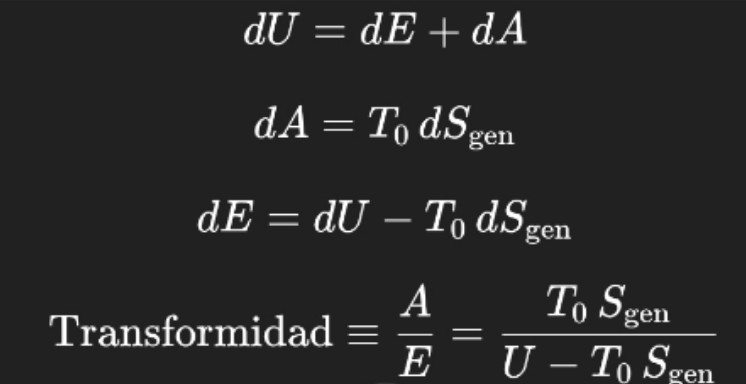
Energy is conserved, but its quality is not. Odum showed this ecologically. The 4th Law shows it physically: dU = dE + dA, with dA = T0·dS_gen. More complexity → more degraded energy → less usable energy.
Rocktor Cobos tweet media
English
1
0
0
23
Rocktor Cobos
Rocktor Cobos@JACobosMurcia·
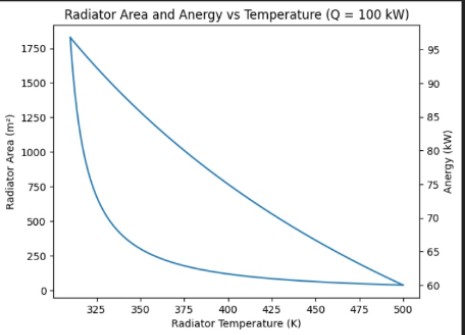
@gilbertoromboli Same 100 kW of rejected heat, two design effects: Raising radiator temperature: Area drops sharply (Stefan–Boltzmann, T⁴) Anergy drops as well (4th Law: Q·T₀/T) Smaller hardware and less energy degradation at the same time. Efficiency is about energy quality, not just heat.
Rocktor Cobos tweet media
English
0
0
0
10
gilberto romboli
gilberto romboli@gilbertoromboli·
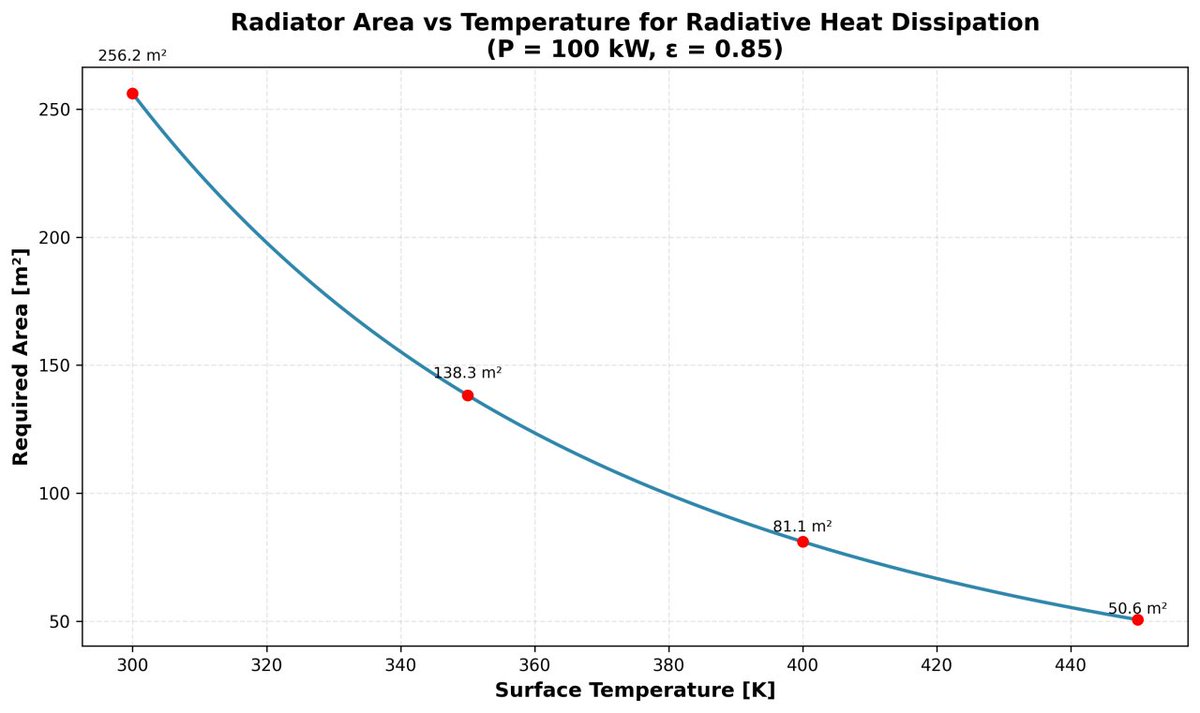
Is it possible to reduce the size of a radiator by increasing the temperature of the fluid that reaches the radiator? Yes, and this example shows how, for the same 100 kW, it is possible to reduce the radiator size by up to 80%. The key lies in the fourth power dependency of the Stefan-Boltzmann law. Let's look at the calculations: Temperature ratio: T₂ / T₁ = 450 / 300 = 1.5 But radiated power depends on T⁴, so the required area scales inversely: A ∝ 1 / T⁴ Therefore: A₁ / A₂ = (T₂ / T₁)⁴ = (1.5)⁴ = 5.0625 This matches exactly the ratio you can see in the example: A₃₀₀ / A₄₅₀ = 256.16 / 50.60 ≈ 5.06 In simple terms: By increasing the temperature by 50% (×1.5) → the required radiator surface area is reduced by approximately 80% (÷5.06).
gilberto romboli tweet media
English
4
0
0
29
Rocktor Cobos
Rocktor Cobos@JACobosMurcia·
@gilbertoromboli Exergy of heat: Ė = Q̇ (1 − T₀ / T) At 300 K (T₀ = 300 K): Ė = 0 kW → all heat is anergy At 450 K: Ė = 100 (1 − 300/450) ≈ 33 kW Higher temperature = higher energy quality. Smaller radiator, less exergy destroyed.
English
0
0
0
9