
Jonathan Mortensen

44 posts

Jonathan Mortensen banner
Jonathan Mortensen

Jonathan Mortensen

@jmomort

@southpkcommons Founder Fellowship

San Francisco, CA Katılım Mayıs 2007
41 Takip Edilen102 Takipçiler
Aida Baradari
Aida Baradari@aidaxbaradari·
Today, we're introducing Spectre I, the first smart device to stop unwanted audio recordings. We live in a world of always-on listening devices. Smart devices and AI dominate our world in business and private conversations. With Deveillance, you will @be_inaudible.
English
1.1K
5K
42.5K
4.4M
Jonathan Mortensen retweetledi
Aditya Agarwal
Aditya Agarwal@adityaag·
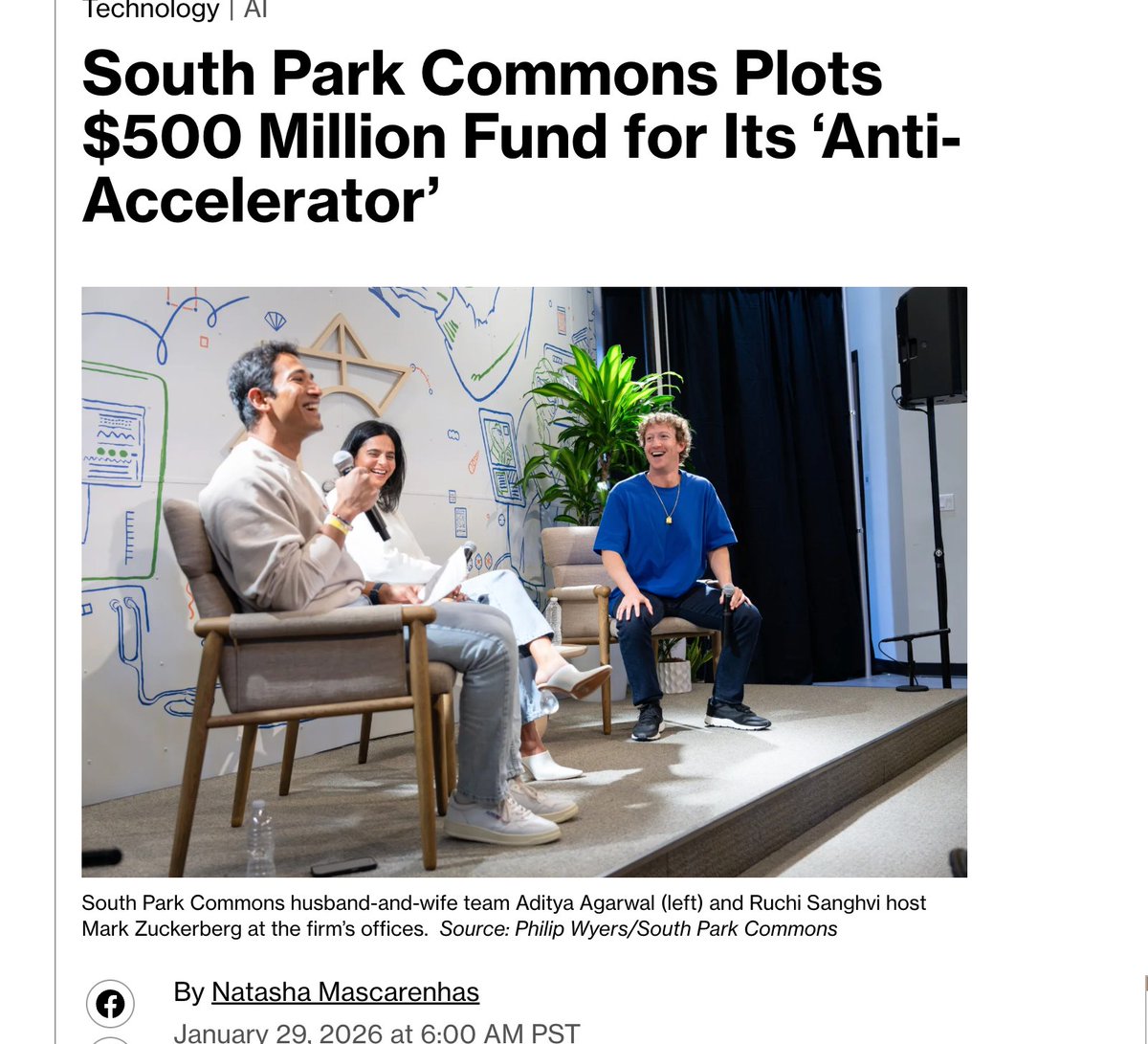
The goal @southpkcommons is to build maximally ambitious companies. Take some time to find the right mountain. Don't confuse motion for progress. Our first 10 years have been strong. Now we get to to go build the next decade. This article captures us well:
Aditya Agarwal tweet media
English
14
55
237
32.6K
Jonathan Mortensen
Jonathan Mortensen@jmomort·
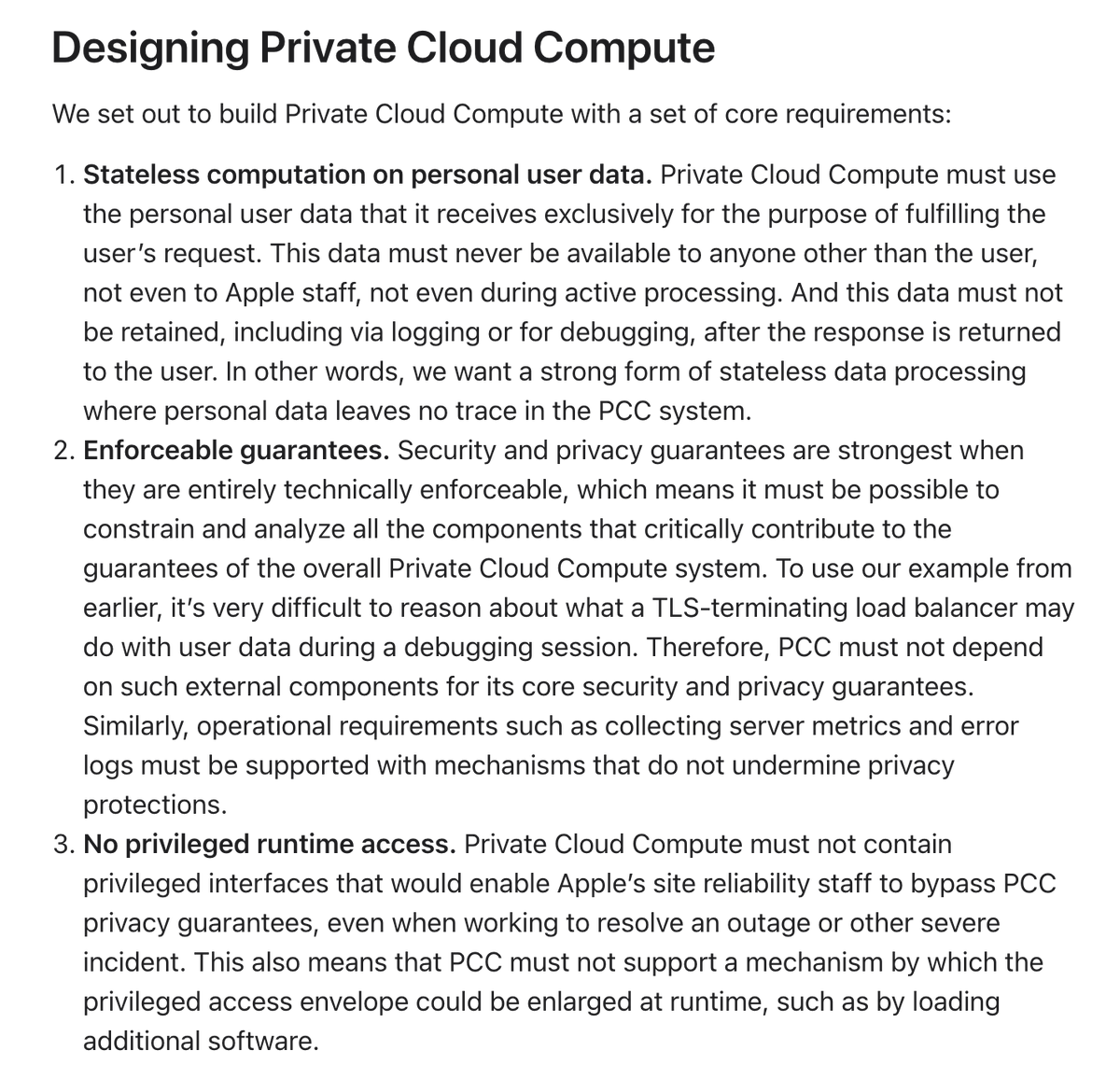
@mweinbach There is now github.com/openpcc/openpcc which is Apache 2.0 and does private inference via anonymity as well as confidential computing. It’s multi-cloud, multi-GPU, can do bare-metal, enterprise scalable, low-latency, and based on Apple’s PCC architecture
English
0
0
2
52
Max Weinbach
Max Weinbach@mweinbach·
Just worth dropping this again for how Apple's Private Cloud Compute works It's a custom OS designed for running inference, it's powered by Apple Silicon. To be clear, Apple doesn't even log requests into it. security.apple.com/blog/private-c…
Max Weinbach tweet media
English
24
55
905
67.7K
Jonathan Mortensen
Jonathan Mortensen@jmomort·
suggest folks checkout the more popular github.com/openpcc/openpcc which is Apache 2.0 and does private inference via anonymity as well as confidential computing. You need both. It’s multi-cloud, multi-GPU, can do bare-metal, enterprise scalable, low-latency, and based on Apple’s PCC
English
0
0
2
146
kepano
kepano@kepano·
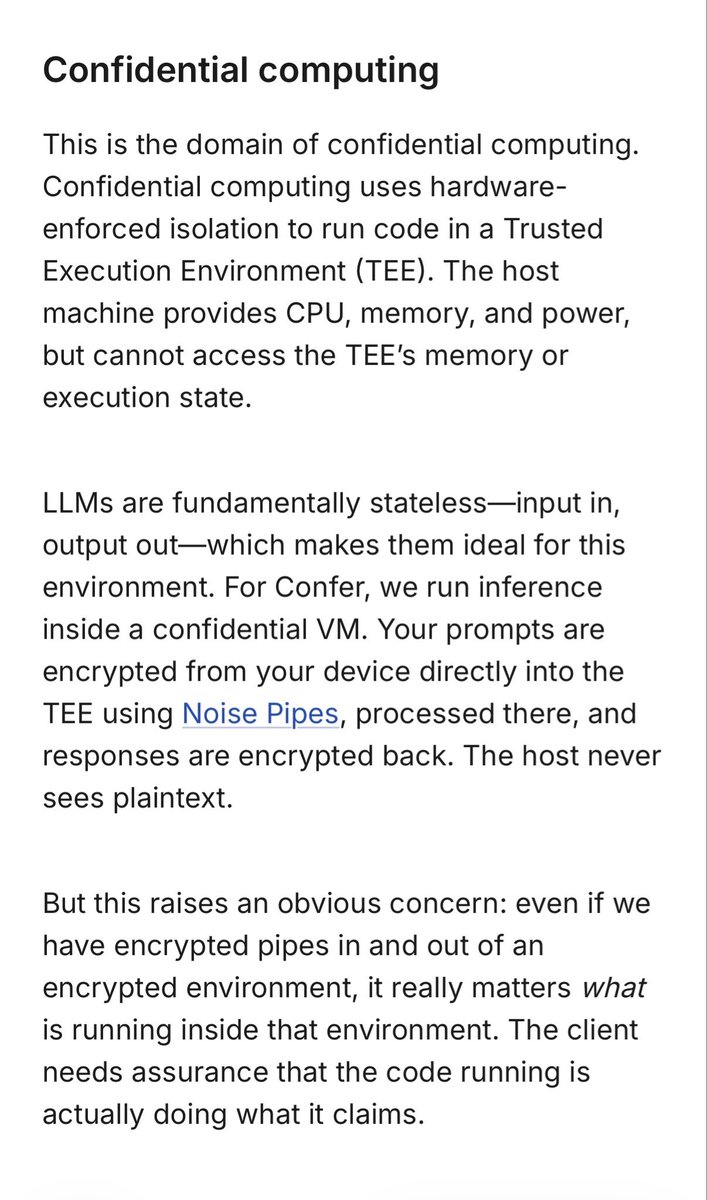
As hyped as Claude Code + Obsidian is, I have no desire to upload my personal unencrypted vault data to Anthropic or anyone else. I hope that the ideas of private inference and confidential computing that @moxie described take off. It's how all LLMs should work.
kepano tweet media
English
81
72
1.4K
88.1K
Adam Fletcher
Adam Fletcher@WriteAheadLog·
Current status: getting wrecked by git worktrees and cursor's use of them.
English
1
0
0
94
Jonathan Mortensen
Jonathan Mortensen@jmomort·
When we launched Confident Security I said, "you bring the models, we bring the privacy". Now ANYONE can bring the models - check out OpenPCC, the new standard for private AI inference.
Confident Security@confident_sec

Introducing OpenPCC - open-source AI Privacy No tracking. No training. No leaks. Just provably private infrastructure for AI. Check out the repo, announcement, and whitepaper in the comments - hit us with a star while you're there!

English
1
3
12
3K
Jonathan Mortensen
Jonathan Mortensen@jmomort·
I learned about OHTTP (RFC 9458) in 2024 while reading Apple’s PCC post and then realized how important it is to privacy on the Internet. Turns out, a lot of folks use it: Mozilla, Apple, Google, Meta, and ISRG, the creators of Let’s Encrypt, to name a few. OHTTP is critical at CONFSEC for making privacy guarantees to our customers. We couldn’t find an OHTTP library in Go that suited our needs so, of course, we wrote our own. It uses bhttp+twoway under the hood, which we just opened sourced over the past few weeks. So, now you can see how these three libraries all come together – BHTTP for encapsulating the HTTP request, twoway for encrypting requests and the chunked responses, and OHTTP for orchestrating it all. If you want to build OHTTP into your product, you’ll need the help of @fastly , oblivious.network, or @Cloudflare to make it happen – there are no other relay providers I’ve found. Thank you to @fastly @willemschots @corylanou for helping us make this happen! And, Martin Thomson, Tommy Pauly, Christopher Wood for authoring the specs.
English
0
0
1
72
Jonathan Mortensen retweetledi
Confident Security
Confident Security@confident_sec·
Go check out go-nvtrust, our open-source Go library for NVIDIA GPU/NVSwitch confidential attestation. If you've Got problems securing your AI privacy, Go no further, this library will be your Go-to solution. How many Go puns can we fit in this sentence? Better question: where are we Going with all of these open-source releases?
English
1
3
9
664
Jonathan Mortensen
Jonathan Mortensen@jmomort·
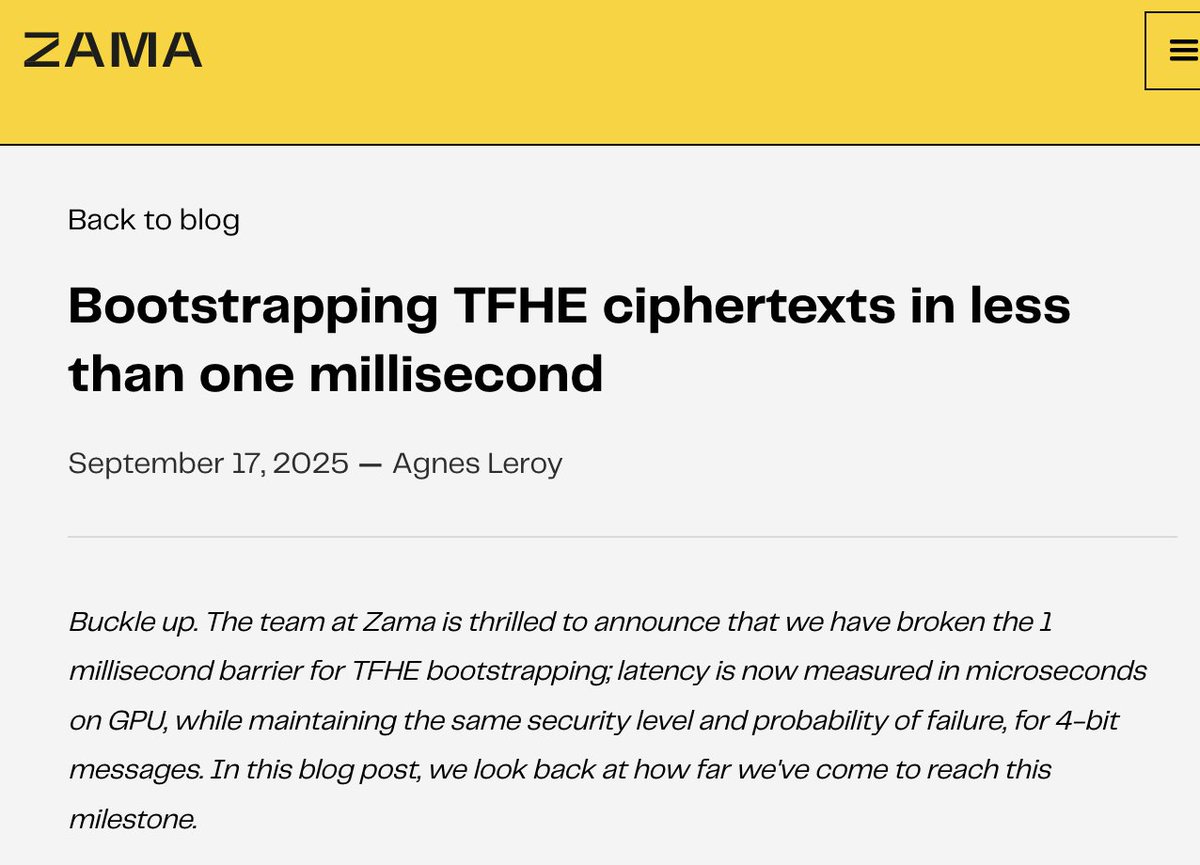
Notably absent from almost all FHE benchmarks is the baseline of no encryption. If you're not providing in the cost and time difference between the baseline, you're misleading folks. The decision to use an enclave vs FHE has to do with threat model, amount of data, budget, risk tolerance, etc. Even if you're 1e6x faster than before, you're still 1e9x slower than regular old (non-SIMD) addition on a CPU (114/s vs 3e9/s). And that's not including the 40x higher cost of running a GPU just to do encrypted data processing. So, maybe 10 orders of magnitude...
English
0
0
3
370
LaurieWired
LaurieWired@lauriewired·
In 2025, we’ve gotten a million times faster; literally. Check out Google’s HEIR project as a quick way to play around with FHE in Python. As for accelerators themselves, there’s growing competition in this space! Zama, Cornami, and Belfort Labs are doing a lot of interesting work in software, GPUs, FPGAs, and even custom silicon.
LaurieWired tweet mediaLaurieWired tweet media
English
37
28
832
42.6K
LaurieWired
LaurieWired@lauriewired·
Encryption is kind of a lie. Data can be encrypted at rest, and even in transit…but not “in use”. Fundamentally, CPUs execute arithmetic instructions on decrypted plaintext; even with secure enclaves. But what if we got *really* clever:
LaurieWired tweet media
English
100
289
4.5K
334.9K
Jonathan Mortensen
Jonathan Mortensen@jmomort·
When @MikeMcCormick_ and I first connected, I knew we were aligned immediately. He's been quick to jump in and help with introductions and thinking about the market. Excited to join on this journey!
Mike McCormick@MikeMcCormick_

Exactly two years ago, I launched @HalcyonFutures. So far we’ve seeded and launched 16 new orgs and companies, and helped them raise nearly a quarter billion dollars in funding. Flash back to 2022: After eight years in VC, I stepped back to explore questions about exponential technology and the future of humanity. Then ChatGPT launched – we’d entered the exponential AI era. The upside of AI is huge – but so are the risks: misalignment, loss of control, cyber and bio-threats, fraud, adversarial misuse, and more. For humanity to thrive in this era, we’ll need to build a resilient and secure world. And we’ll need an ecosystem of both nonprofit and for-profit solutions led by ambitious, thoughtful leaders from business, policy, academia and media. I found myself asking: 1. How do we get the world’s most talented people working on these civilization-scale challenges? 2. What funding model would allow us to support many different types of projects? With those questions in mind, I launched Halcyon. We’re building something a bit unusual: - @HalcyonFutures, a nonprofit and grant fund that helps leaders and entrepreneurs pivot to ambitious, high-impact work. - @HalcyonVC, a VC firm backing for-profit founders tackling the hardest problems in AI security and global resilience. So far we’ve raised $25m in funding for Halcyon’s nonprofit and VC fund. We’ve incubated or provided zero-to-one capital to 16 nonprofits and companies, and helped them go on to raise more than $200m — from @GoodfireAI's interpretability work to @aiunderwriting's AI risk standards and insurance, @TransluceAI's model behavior research, and @SeismicOrg's public opinion research and media. We're a small team of three (me, Shelby Summerfield and @rossmatican) surrounded by a community of advisors and allies that includes leaders from frontier labs, governments, cybersecurity, philanthropy, startups and VC. Over the coming weeks we’ll share more about Halcyon and what we’re building next. If you're working on something we might be excited about, say hi. Visit our website below in comments ⬇️

English
0
0
2
119
Jonathan Mortensen retweetledi
Mike McCormick
Mike McCormick@MikeMcCormick_·
Exactly two years ago, I launched @HalcyonFutures. So far we’ve seeded and launched 16 new orgs and companies, and helped them raise nearly a quarter billion dollars in funding. Flash back to 2022: After eight years in VC, I stepped back to explore questions about exponential technology and the future of humanity. Then ChatGPT launched – we’d entered the exponential AI era. The upside of AI is huge – but so are the risks: misalignment, loss of control, cyber and bio-threats, fraud, adversarial misuse, and more. For humanity to thrive in this era, we’ll need to build a resilient and secure world. And we’ll need an ecosystem of both nonprofit and for-profit solutions led by ambitious, thoughtful leaders from business, policy, academia and media. I found myself asking: 1. How do we get the world’s most talented people working on these civilization-scale challenges? 2. What funding model would allow us to support many different types of projects? With those questions in mind, I launched Halcyon. We’re building something a bit unusual: - @HalcyonFutures, a nonprofit and grant fund that helps leaders and entrepreneurs pivot to ambitious, high-impact work. - @HalcyonVC, a VC firm backing for-profit founders tackling the hardest problems in AI security and global resilience. So far we’ve raised $25m in funding for Halcyon’s nonprofit and VC fund. We’ve incubated or provided zero-to-one capital to 16 nonprofits and companies, and helped them go on to raise more than $200m — from @GoodfireAI's interpretability work to @aiunderwriting's AI risk standards and insurance, @TransluceAI's model behavior research, and @SeismicOrg's public opinion research and media. We're a small team of three (me, Shelby Summerfield and @rossmatican) surrounded by a community of advisors and allies that includes leaders from frontier labs, governments, cybersecurity, philanthropy, startups and VC. Over the coming weeks we’ll share more about Halcyon and what we’re building next. If you're working on something we might be excited about, say hi. Visit our website below in comments ⬇️
English
15
24
139
41.8K
Dara
Dara@daraladje·
@jmomort @JonhernandezIA @withdelphi Thanks Jonathan! We do not share source data with  external providers and any incidental LLM usage is opted out of data sharing. If someone wants to delete their data, it can be removed from our system entirely
English
1
0
1
34
Jon Hernandez
Jon Hernandez@JonhernandezIA·
📁 Matthew McConaughey says he wants a private LLM, fed only with his books, notes, journals, and aspirations, so he can ask it questions and get answers based solely on that information, without any outside influence.
English
2.8K
1.5K
32.2K
15.2M
TJ Parker⚡️
TJ Parker⚡️@tjparker·
I have a check ready to rip for a highly technical founder that wants to go head-to-head with all these dumb note taking apps so I can completly bork them via imperceptible audio perturbations or some other approach. I will help you with everything non-technical.
Granola@meetgranola

Say hello to notes on phone calls, for iPhone! 🎉 Now you can take Granola notes for quick client catch ups or calls with a colleague on-the-go. Try it on the latest version of Granola for iPhone 📞

English
58
10
389
124.4K
Brave
Brave@brave·
AI assistants collect personal information, store your conversations on their servers and use your inputs to train their models. Leo doesn't. Here's how we built privacy into every part of the Brave browser's AI assistant...
English
31
99
1K
74.2K
Shivan Kaul Sahib
Shivan Kaul Sahib@shivan_kaul·
All models available with Brave's in-browser AI assistant Leo are now hosted on Brave's infra (including Claude!) This way, neither you nor Brave have to trust a third-party AI model provider to uphold their "no logging or training" policy.
Brave@brave

AI assistants collect personal information, store your conversations on their servers and use your inputs to train their models. Leo doesn't. Here's how we built privacy into every part of the Brave browser's AI assistant...

English
7
20
161
16.5K
Matthew Green
Matthew Green@matthew_d_green·
Let’s get more specific. On the one hand we have a very small number of privacy technologies like Tor and Nym. On the other hand we have AI that is crushing privacy on every possible dimension.
English
4
5
42
5.8K
Matthew Green
Matthew Green@matthew_d_green·
Trying to plan a seminar on the topic of “how do we maintain privacy in the coming dystopia” and it’s kind of a thing.
English
12
24
124
12.1K
Jonathan Mortensen
Jonathan Mortensen@jmomort·
@bernhardsson No joke: I saw an ad on reddit for fixdst.com and it provides some convincing arguments for minimizing the time delta between sunrise and 7am and minimizing the number of time shifts due to the high costs.
English
0
0
1
48
Erik Bernhardsson
Erik Bernhardsson@bernhardsson·
My most psychotic opinion is that we should have multiple daylight savings adjustments every year. Today in NYC, sunrise is at 5:38am (1% are awake at this time and care) and sunset is at 8:25pm (100% are awake at this time and would love another hour of sun).
English
19
0
87
13.9K
Jonathan Mortensen
Jonathan Mortensen@jmomort·
<mic check> <mic check> been a while. Excited to announce I've started a founder fellowship at @southpkcommons. An amazing, smart cohort is joining and I'm gunna learn a ton from them. I'm exploring the next phase of AI-native databases. What's after vector DBs?
English
0
0
2
456