

@sandeepnailwal @levie Why do you keep shitting about ai? Nobody trusts you on that and everybody knows you are incompetent loser now. Do your job. First you need to know what your job is. Watch $POL. Pathetic indians...
English
JY
93 posts

@JYonchain
Developer worked on blockchain before | Database optimizer engineer

Another week on the road meeting with a couple dozen IT and AI leaders from large enterprises across banking, media, retail, healthcare, consulting, tech, and sports, to discuss agents in the enterprise. Some quick takeaways: * Clear that we’re moving from chat era of AI to agents that use tools, process data, and start to execute real work in the enterprise. Complementing this, enterprises are often evolving from “let a thousand flowers bloom” approach to adoption to targeted automation efforts applied to specific areas of work and workflow. * Change management still will remain one of the biggest topics for enterprises. Most workflows aren’t setup to just drop agents directly in, and enterprises will need a ton of help to drive these efforts (both internally and from partners). One company has a head of AI in every business unit that roles up to a central team, just to keep all the functions coordinated. * Tokenmaxxing! Most companies operate with very strict OpEx budgets get locked in for the year ahead, so they’re going through very real trade-off discussions right now on how to budget for tokens. One company recently had an idea for a “shark tank” style way of pitching for compute budget. Others are trying to figure out how to ration compute to the best use-cases internally through some hierarchy of needs (my words not theirs). * Fixing fragmented and legacy systems remain a huge priority right now. Most enterprises are dealing with decades of either on-prem systems or systems they moved to the cloud but that still haven’t been modernized in any meaningful way. This means agents can’t easily tap into these data sources in a unified way yet, so companies are focused on how they modernize these. * Most companies are *not* talking about replacing jobs due to agents. The major use-cases for agents are things that the company wasn’t able to do before or couldn’t prioritize. Software upgrades, automating back office processes that were constraining other workflows, processing large amounts of documents to get new business or client insights, and so on. More emphasis on ways to make money vs. cut costs. * Headless software dominated my conversations. Enterprises need to be able to ensure all of their software works across any set of agents they choose. They will kick out vendors that don’t make this technically or economically easy. * Clear sense that it can be hard to standardize on anything right now given how fast things are moving. Blessing and a curse of the innovation curve right now - no one wants to get stuck in a paradigm that locks them into the wrong architecture. One other result of this is that companies realize they’re in a multi-agent world, which means that interoperability becomes paramount across systems. * Unanimous sense that everyone is working more than ever before. AI is not causing anyone to do less work right now, and similar to Silicon Valley people feel their teams are the busiest they’ve ever been. One final meta observation not called out explicitly. It seems that despite Silicon Valley’s sense that AI has made hard things easy, the most powerful ways to use agents is more “technical” than prior eras of software. Skills, MCP, CLIs, etc. may be simple concepts for tech, but in the real world these are all esoteric concepts that will require technical people to help bring to life in the enterprise. This both means diffusion will take real work and time, but also everyone’s estimation of engineering jobs is totally off. Engineers may not be “writing” software, but they will certainly be the ones to setup and operate the systems that actually automate most work in the enterprise.



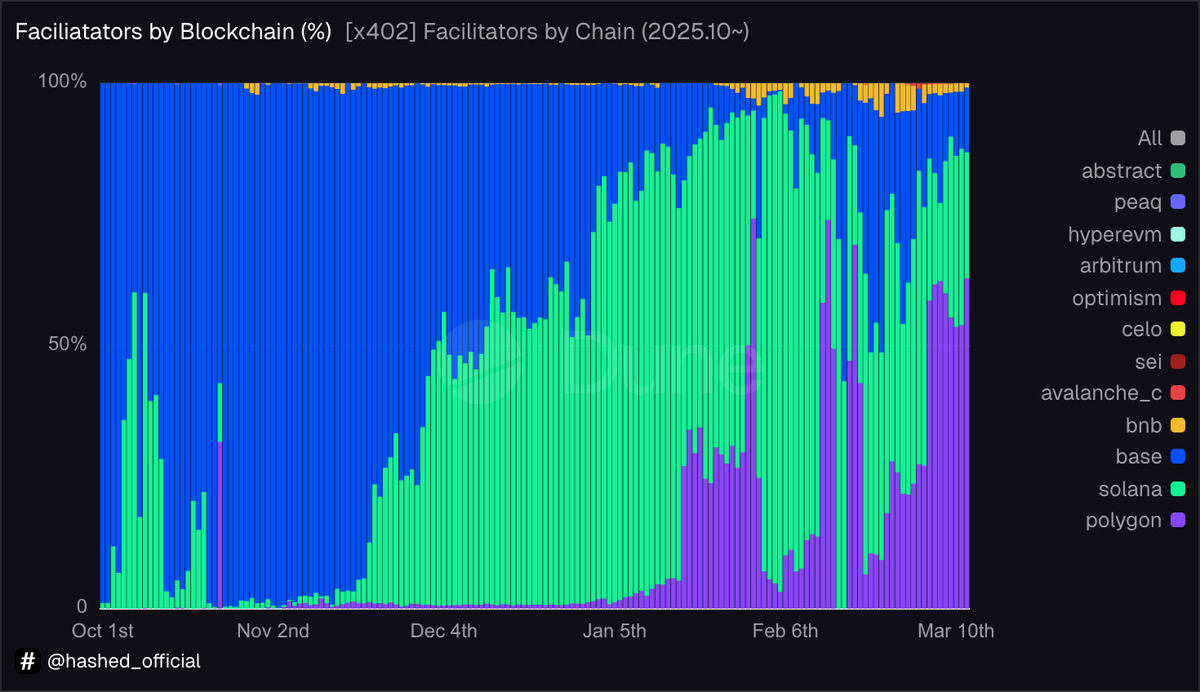
Everything an agent needs to transact onchain, in one toolkit. Wallets, payments, swaps, bridging, onchain identity, and x402. Just install + ship.
New throughput ATH for @0xPolygon PoS overtaking Base and currently leading the pack.


Base is doing things the right way: an L2 on top of Ethereum, that uses its centralized features to provide stronger UX features, while still being tied into Ethereum's decentralized base layer for security. Base does not have custody over your funds, they cannot steal funds or stop you from withdrawing funds (this is part of the L2beat stage 1 definition). You can see Base's status as an L2 on l2beat: l2beat.com/scaling/projec… I feel like many people have been confused by recent cynicism and think that things like L2beat are a weird sort of nerd-sharia compliance authority. This is NOT what is going on. The security that L2s provide, that L2beat measures, reflects concrete properties that protect you as a user from being rugged. Here is an explanation of how, if an L2 shuts down, users are automatically able to withdraw funds even without that L2's involvement: x.com/l2beat/status/… Here is an example of how L2s prevent the operator from censoring transactions, that happened on Soneium earlier this year: x.com/gauthamzzz/sta… This is what we mean when we say that L2s are non-custodial, they are extensions of ethereum, not glorified servers that happen to submit hashes. There are concrete pathways implemented in smart contract logic on Ethereum L1, that have been successfully used in the wild, that ensure that the L2 users' funds are ultimately controlled by L1, they cannot be stolen or blocked by the L2 operator.

@JamesHamps36963 @sandeepnailwal Market is rational here. That’s my whole point. Market is valuing $POL very fairly. That’s why I’m urging @sandeepnailwal for changes. Tokenomics, partnership, doubling down on prediction market and stay close with Polymarket, align marketing efforts to where it matters.