
Sabitlenmiş Tweet
Jim Roberts
19.4K posts


Jim Roberts
@JaPatRob
🇺🇸Step #1 "You shall not bear false witness against your neighbor."
Katılım Ekim 2023
634 Takip Edilen2.2K Takipçiler
Jim Roberts retweetledi

"The soldier, above all others, prays for peace, for it is the soldier who must suffer and bear the deepest wounds and scars of war."
—Gen Douglas MacArthur

English
Jim Roberts retweetledi


❤️ Who knows Pentecost ?
When was the last time you held daily prayers with your family, at home?
James Lucas@JamesLucasIT
Today at noon thousands of red rose petals will flutter down through the oculus of the Pantheon in Rome. This spectacular tradition is held each year on the feast of Pentecost.
English
🇺🇸❤️🇺🇸
💯Red White & Blue American!
Mad as hell and
IT’S TIME TO BE HEARD!!!🇺🇸
Tom Hennessy@Tomhennessey69
The Barnstable County Assembly on Cape Cod, mostly comprised of anti-White leftists, was forced to take public comments yesterday on a new measure that would hamstring ICE from enforcing immigration law in the area. A local patriot managed to show up between work shifts and delivered an incredible speech.
English

Owen, you know better.
This all about whether the British Financial System maintains control of the Middle East Oil Cartel or if Trump has his way with Britain and the world's top .5% elitist. Their skimming of Global Markets financials will be eliminated.
Tiss why NATO has not showed up.
English

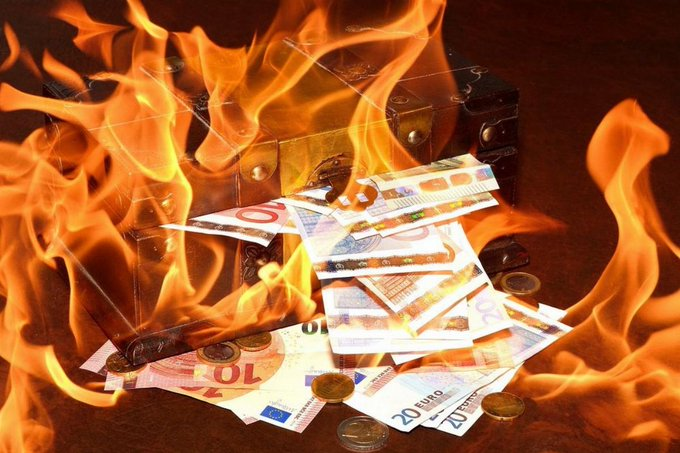
The Debt Party Nears its End | Thomas Kolbe, AmericanThinker
In the wake of the closure of the Strait of Hormuz, interest rates on global bond markets are rising rapidly. Along with yields, fears of a debt crisis are reaching a fever pitch. However, the Iran crisis may soon fade and bring calm back to energy markets.
Are we already witnessing the early signs of the next debt hurricane? One thing can be said with certainty: the surge in oil and gas prices triggered by the blockade of the Strait of Hormuz has sent a massive shockwave through global bond markets, which otherwise tend to move rather sluggishly. This shock is still propagating along the yield curves.
It almost appears as if creditworthiness concerns regarding high levels of sovereign debt are overlapping with newly rekindled inflation fears. In Germany, the benchmark yield on ten-year government bonds has risen from 2.64 percent at the start of the Iran conflict to around 3.2 percent at its peak (as of May 19). In the United States, the most important capital market in the global economy, ten-year Treasury yields have reached 4.63 percent. Should this mark a new plateau, debt servicing costs will increase.
For Germany, the interest rate effect can be roughly calculated as follows: in the first year of a 1 percentage-point increase in interest rates, government interest expenses rise by around €2.5 billion. With approximately €250 billion in debt rolled over annually, total interest costs on the entire German debt stock would increase by roughly €25 to €30 billion after several years. An unpleasant situation for the federal government. Perhaps it is dawning on some in Berlin that the bond market may one day abruptly bring an end to Germany’s debt binge.
A clear harbinger of a new regime in global bond markets is the years-long accumulation of gold at the level of central banks. Among central bankers, there is broad agreement: the world is caught in a debt spiral, and the final escape from this fiscal struggle will be the systematic debasement of currencies. It is cynical, but central banks will not be able to avoid devaluing their own product -- fiat money -- in order to escape the debt shock. Prepare, therefore, for outright propaganda contortions and monetary policy sleights of hand in the media. The narrative will be stretched to its limits in an attempt to prevent a loss of confidence in monetary stability. We know this playbook: if necessary, inflation statistics will be manipulated, or blunt instruments such as capital controls will be deployed.
This policy is executed by central banks through massive bond purchases, expanding the money supply and attempting to relieve the largest debtor -- the state -- at the expense of its creditors, taxpayers, and those unable to hedge against such policies with real assets. The rise in yields at the long end -- 20 or 30-year maturities -- represents the true tectonic shift in the system. The entire financial system -- bank balance sheets, pension funds, and insurance portfolios -- is anchored in this segment, long considered safe, offering both presumed absolute creditworthiness (always an illusion) and yield, but now entering a downward spiral.
Regardless of how the Hormuz blockade ultimately resolves, much is already in motion: a large share of blocked energy capacity is being rerouted or replaced elsewhere -- such as through a massive expansion of U.S. exports. Moreover, the immense pressure created by this bottleneck is driving further restructuring of global energy flows. Israel could emerge as a beneficiary if Saudi Arabia completes its pipeline projects and shifts parts of its distribution toward the Mediterranean.
Once this issue fades from the agenda, previously dominant forces will again shape bond markets -- such as the ongoing economic slowdown in the European Union, which continues to suppress both investment and consumer demand. This will ease inflationary pressure, possibly accompanied by an ECB rate hike, and temporarily stabilize bond markets. It is not unlikely that relief may come even sooner. The increase in crude oil prices from around $60 to peaks near $110 per barrel WTI -- occasionally reaching $115 -- when adjusted for the annual global money supply growth of 7–8 percent, is far from comparable to the energy price shock triggered by Russia’s invasion of Ukraine four years ago. Meanwhile, the business cycle -- particularly in the United States -- is picking up again. Industrial production is growing, and the global money supply continues to expand.
This is a crucial point: liquidity is the lubricant of markets and will ultimately help fiscal policy roll ever-growing debt further into the future -- for now.
This is critical, because the real danger lies within the machinery of the fiat credit system: deflation -- a contraction of the money supply leading to falling price levels -- is its true nemesis. A shrinking money supply would trigger a cascade of credit defaults, manageable only through massive central bank intervention, as seen a decade and a half ago. Such a crisis, potentially many times larger than the previous debt crisis, would be systemically relevant and could severely damage the euro system, while the U.S. dollar would once again serve as a safe haven for global capital.
The question is no longer if, but when such a credit event will ignite a broader crisis. Looking at developments in the United Kingdom, where ten-year yields have risen above five percent, it seems plausible that the City of London could become the epicenter of a new European debt crisis.
As we know, however, the list of potential crisis candidates is long: France, with public debt around 120 percent of GDP, is as vulnerable as Belgium, Spain, or Italy. The European debt construct ultimately stands and falls with Germany’s creditworthiness. Friedrich Merz and his “disaster minister” Lars Klingbeil appear to be working at full speed to set this last true firewall of the euro system ablaze in a veritable debt frenzy.
americanthinker.com/articles/2026/…
English
@OwenGregorian 🎯
Parenting is the greatest life honor and responsibility.
Owen, It's time for who yet understand to stand up and demand a nuclear family Renaissance!!!!!!
If not now, then when.
English
A better question is why you believe being a mother is not a noble, meaningful and satisfying role.
Most mothers and fathers consider having children the best thing they ever did. And once you do, life isn’t all about you.
Except for narcissists.
𝓛𝓮𝔁𝓲𝓮 💗@softpinkgiggles
We need to talk about the grief of losing your entire identity to motherhood while the man you married gets to keep his hobbies, his freedom, and his career completely uninterrupted.
English
Next on Shark Tank!!!
Jen@SweetTexanRose
The proper way to kick off this weekend. Redneck style. 🇺🇸
English

Just in the last 24 hours:
- Trump skips his own son's wedding
- JD Vance + Hegseth race back to the White House
- Chief of Staff posting videos of B-2 bombers
...something MASSIVE must be about to happen
What is going on??!!!!!
English
America MEGA needs to GROW UP!
President Donald J Trump has this!🖖
Rapid Response 47@RapidResponse47
English
Jim Roberts retweetledi

We still send $40,000,000 a week to the Taliban because the Senate won’t vote on my No Tax Dollars for Terrorists Act.

English
Jim Roberts retweetledi
Jim Roberts retweetledi

Jim Roberts retweetledi



So is life in the Democrat Socialist Party 🤣
Soulmade1@dasoulmade1
🚨 Robot vs Human Tic-Tac-Toe… and the machine just ended the debate 😂 It drew the perfect lines, blocked every move, and secured the W like a cold, calculated legend. Case closed. Just accept it. (Arguing with it is basically arguing with your wife 😉) Who else is team robot now? 🤖🏆
English
Jim Roberts retweetledi

