

JackMeOffTwo
3.5K posts


Why are grandparents so much nicer to grandkids than they were to their own children?
Mystery of the ages.
English
@antoniotabet @JCFerranti Para deixar o animal sozinho no apartamento a maior parte do tempo? Nenhum, amigo. O único animal que gosta de ficar só é o humano macho. O resto das espécies fica com depressão.
Português

Vocês que entendem de tudo, de surto de Ebola à importância do Bolsa Família, qual o melhor tipo de cachorro para adotar e por quê?
Português
JackMeOffTwo retweetledi

JackMeOffTwo retweetledi

JackMeOffTwo retweetledi

É nesse momento que o dog entra em modo avião
Português
JackMeOffTwo retweetledi

A 47-year-old writer walked into an aikido dojo, got humiliated by men half his age, and spent the next 40 years watching almost every ambitious person who came in quit one week before the breakthrough.
His name was George Leonard.
He was a writer and a magazine editor in his late 40s when he walked into an aikido dojo for the first time and got humiliated by men half his age. He kept going back. He earned a fifth-degree black belt.
He then spent the next 40 years on the mat watching hundreds of students walk in with enthusiasm, train hard for a few months, and then disappear forever right at the moment their bodies were about to absorb the technique they had been chasing.
In 1991 he wrote a small book trying to explain what he had seen. It was called Mastery. Tim Ferriss recommends it. Josh Waitzkin recommends it. The book has stayed in print for almost 35 years because Leonard had isolated something nobody else was naming clearly.
The lie he wanted to kill was the shape of the learning curve itself.
Almost every motivational speech, every productivity course, every self-help diagram draws progress as a steady line that goes up and to the right. You put in the work, you get the result, the line climbs. Leonard had spent four decades watching the actual shape of skill acquisition, and the actual shape looks nothing like that.
The real shape is a staircase.
You train for weeks and nothing visible happens. You feel exactly the same on day 40 as you did on day 10. Then one afternoon, with no warning, something clicks and you jump to a new level. You stay there for an hour or a day, feeling brilliant. Then the new level becomes the new normal, and you flatten out again. Another long stretch of nothing. Then another sudden jump.
The flat sections are called plateaus. They are not a bug in the learning process. They are the learning process.
The plateau is the period where your brain is quietly rewiring the neural circuits that will produce the next jump. The jump itself is just the visible moment when the rewiring finishes. Without the plateau, the jump cannot exist.
This is the part almost everybody misreads.
You feel stuck. You assume something is wrong with you. You assume the method has stopped working, or that you have hit your ceiling, or that you were never going to get there in the first place.
So you quit, or you switch methods, or you start chasing the next shiny technique, exactly at the moment when the rewiring was about to complete. The plateau looks like failure. It is actually the engine.
Leonard identified three personality types who lose this game.
The dabbler chases the high of starting something new. The first few weeks of any new skill are full of fast improvement because the easy gains come first. The dabbler rides that wave, hits the first plateau, decides the activity was not for them, and quits to go feel like a beginner somewhere else.
The obsessive cannot tolerate the plateau either. They double down. They train harder. They demand results from a process that does not run on demand. They burn out and crash, often spectacularly, and never come back.
The hacker is the most subtle. They reach a comfortable level and stop pushing. They live on a permanent plateau, never quitting and never growing.
All three are quitting the plateau in different ways. The master is the one who learns to stay on it without forcing anything. Show up. Train. Accept that today looks identical to yesterday. Accept that tomorrow will too. Trust that the staircase is still under your feet even when you cannot see the next step.
The line from the book that has been quoted for 30 years is four words long. Love the plateau. Not tolerate it. Not survive it. Love it. Because the plateau is not the place where nothing is happening. It is the only place where anything real is happening.
You are not stuck. You are exactly where the work gets done.
The people you envy are not on a different staircase. They just stopped flinching at the flat parts.

English
JackMeOffTwo retweetledi


JackMeOffTwo retweetledi

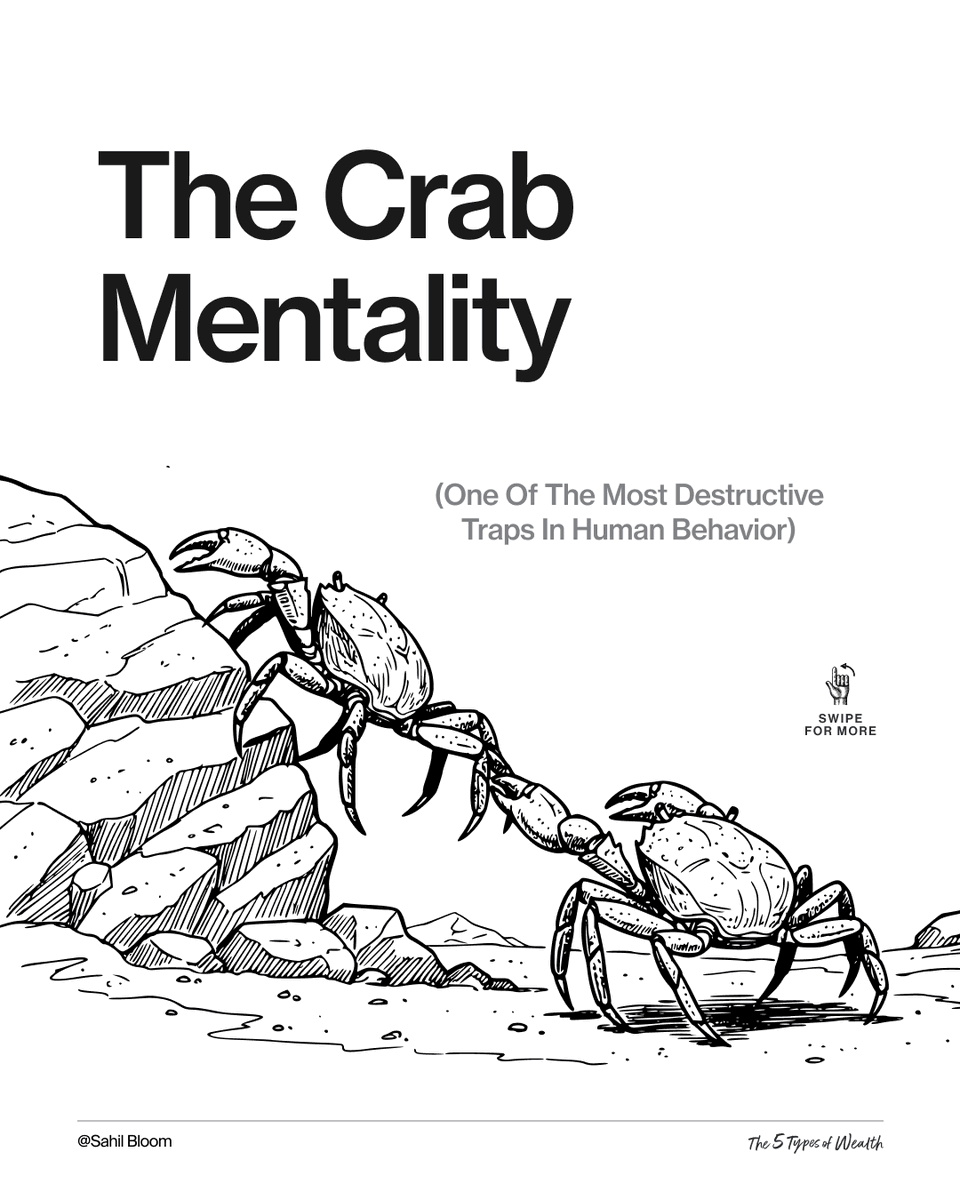
Everyone needs to read this...
The Crab Mentality
(a visual thread)
English
JackMeOffTwo retweetledi

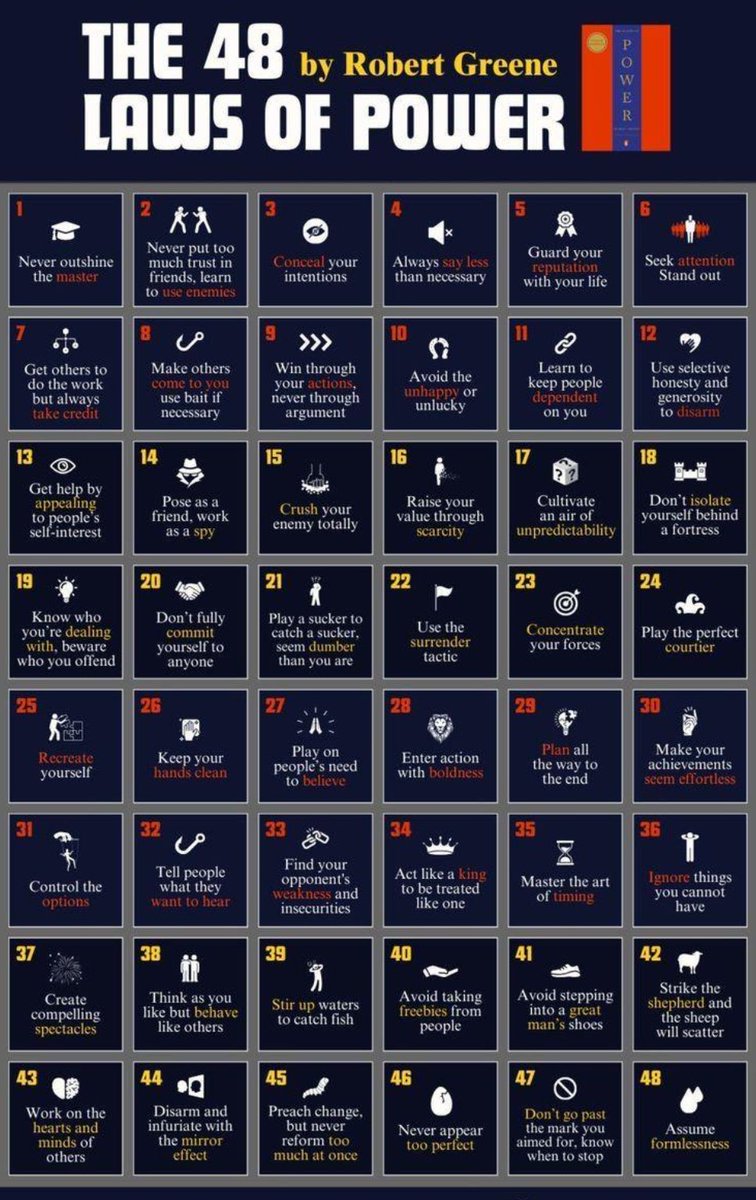
Without enemies around us, we grow lazy. An enemy at our heels sharpens our wits, keeping us focused and alert. It is sometimes better, then, to use enemies as enemies rather than transforming them into friends or allies.
English
JackMeOffTwo retweetledi

A moment from "TV of Tomorrow" released in (1953).
English
JackMeOffTwo retweetledi

JackMeOffTwo retweetledi

Once you hit about a 20-point IQ gap, communication starts to completely break down.
It's not that the lower IQ person is "stupid" (although that can often be the case) or the higher one is arrogant, it's that you're literally operating on different systems.
A 20 point difference (roughly 1.3 standard deviations) means:
Vocabulary and abstraction levels diverge sharply. What feels like crystal clear logic to one side sounds like vague, pretentious word salad to the other. Jokes land flat. Metaphors get taken literally. Complex cause and effect chains get simplified into "this good, that bad."
Different time horizons and pattern recognition. One person thinks in months or years and sees systems, the other is locked into days or immediate rewards. Trying to explain second order effects feels like speaking another language.
Also, processing speed and working memory gaps. The higher IQ person is already three steps ahead, getting impatient. The lower IQ person feels talked down to or overwhelmed.
Both walk away frustrated.
Both have wasted each others time.
English
JackMeOffTwo retweetledi

JackMeOffTwo retweetledi

A mathematician at Bell Labs noticed that the scientists who won Nobel Prizes and the ones who never amounted to anything were equally smart, equally hardworking, and equally credentialed, and the only thing that separated them was a single question almost nobody is brave enough to ask themselves before they die.
His name was Richard Hamming.
He spent 30 years at Bell Labs, in the same building as John Tukey, Walter Brattain, and a long list of physicists who took home Nobel prizes for work they did down the hall from his office, including the legendary Claude Shannon.
His invention of error-correcting codes made modern computing possible. He has won the Turing Award. And all the while he was creating his own legacy he was secretly doing a study on the people around him.
The study was straightforward. 2 Teams. The legends and the lost. Same I.Q.s. Degrees same. Same desk hours. Same access to the world’s best resources.
And yet, at the end of 40 years in their careers, one group had changed entire fields, and the other group could not be remembered by their own colleagues five years after retirement. He wanted to discover what the actual difference was.
In March 1986, he stood before 200 researchers in a Bellcore auditorium and told them what he had seen.
He said it all came down to one question. And hardly anyone he ever met was willing to ask it directly.
He called it the Friday-afternoon ritual. He spent years blocking out his Friday afternoons and not doing anything productive with them every week. No experiments. No meetings. No deliverables.
He called it Great Thoughts Time. He sat down with a notebook and asked himself a couple of questions in order. What are the most relevant problems in my discipline? And why I am not working on either of them.”
Most weeks, the answer was the same, he said. For a week now he had marched confidently in a direction he did not think was the most important direction. He was a goer. He worked a bit. He was getting clean results that would publish in respected journals. (
And for five days straight he'd been lying to himself about whether any of it mattered.
The reason almost nobody does this ritual is because the honest answer is unbearable. The thing is that if you sit down on a Friday afternoon and say out loud that you are not working on the most important problem in your field, now you have to do something about it.
You have an immediate change in direction, or you have to keep lying to yourself every week from that point on. Most people choose the lie.
In the short term it’s cheaper, but over a career it’s more expensive.
Hamming took the ritual a step further in the Bell Labs cafeteria. He began approaching scientists he barely knew, asking them what they thought the most important problems in their field were.
A week later he would ask them why they had not worked on these problems. Eventually people wouldn't have lunch with him. “I had to keep finding new tables,” he said.
Nobody had a good answer for that, and being around someone who kept asking it made every meal feel like a performance review.
The line that broke me is the line that most people skim over in the transcript. His words: If you do not work on an important problem you are unlikely to do important work.
That’s not motivational line. It is a rational one. You cannot make a great result from a problem that does not matter. Input restricts the output. The choice of the problem is the ceiling of the career.
The transcript has been freely available on the internet for almost 40 years. Stripe Press published the complete lectures as a book. Naval Ravikant quotes it all the time. It’s still given out to new hires at every serious engineering lab in Silicon Valley.
Most people will not run the ritual this Friday. They will be busy. They always are.

English
JackMeOffTwo retweetledi

JackMeOffTwo retweetledi

JackMeOffTwo retweetledi

JackMeOffTwo retweetledi

1 - É para isso que serve o período de experiência.
2 - Se o profissional era valioso, o erro foi fazer leilão de salário e não perceber que ele logo encontraria algo melhor.
3 - Se aparecesse alguém ou uma IA que fizesse o trabalho do cara pela metade do valor que ele recebia, a empresa teria demitido o cara sem parar pra pensar por um segundo em história, ambiente, pertencimento, cultura etc…

Português
JackMeOffTwo retweetledi

Leftism was always a pseudo radical movement.
They don’t want to smash the system and eat the rich.
They want to control the system and become the rich.
English
JackMeOffTwo retweetledi

The best way to teach people critical thinking
🎥: Jordan.b.peterson
English