Jackie O’Connell

5.1K posts

Jackie O’Connell banner
Jackie O’Connell

Jackie O’Connell

@JackieMeath

#PracticeManager #PracticeNurse #DisabilityAdvocate #UNCRPD #MBA #Whistleblower.

Ireland Katılım Ağustos 2019
1.6K Takip Edilen1.7K Takipçiler
Jackie O’Connell retweetledi
Gareth Noble
Gareth Noble@GarNob·
Opening up my first email of the day and it’s confirmation from the HSE that a little four year old boy who has very defined needs after assessment will be given his first OT appointment in June 2030!!!
English
95
247
596
34.3K
Jackie O’Connell retweetledi
Peter Behan (Our Lady’s Hospice Whistleblower)
I am very unhappy with the recent comments made by the Protected Disclosures Commissioner about whistleblowers using AI. Those comments are unfair to many brave and courageous Irish whistleblowers who come forward in extremely difficult circumstances, often without legal support, without union support, and at great personal cost. The reality is that many whistleblowers do not have the money for legal advice, while the people and bodies they are complaining about often have huge resources behind them. There is a clear imbalance from the very beginning. In my own case, I used AI to help structure my submission, but I did not make any legal references in it. My submission was based on the facts and concerns I was raising. Many whistleblowers are ordinary workers trying to explain serious wrongdoing as best they can. They are not lawyers. If some use AI to help structure their concerns, that should not be used to undermine the credibility of whistleblowers as a group. In my own case, after I raised concerns about the HSE, my complaint was referred back to the @HSELive I found that deeply unsatisfactory. It is very hard to have confidence in a system where a complaint about a body is sent back to that same body. The real issue is not that whistleblowers are using AI. The real issue is that too many whistleblowers are left without proper independent advice, support, or genuinely independent follow-up when making protected disclosures. I intend to write to the Protected Disclosures Commissioner and seek a meeting with him, along with a group of whistleblowers from @BlowersIreland, to discuss these concerns directly. Whistleblowers should not be portrayed as the problem. They are often the people exposing the problem. Ireland needs to support, protect and listen to whistleblowers — not discourage them. #Whistleblowers #ProtectedDisclosures #Ireland #SpeakUp #Accountability
English
1
15
25
992
Jackie O’Connell
Jackie O’Connell@JackieMeath·
Message when I click on link in text message today!!
Jackie O’Connell tweet media
English
1
0
1
99
Gareth Noble
Gareth Noble@GarNob·
I’ve said this before but it absolutely amazes me how many officials we have working for state bodies in Ireland whose every day job and function is to work out ways to restrict the voice and rights of children.
English
12
50
202
9.3K
Jackie O’Connell
Jackie O’Connell@JackieMeath·
@eircare signed up for new broadband connection in 2025. Contacted @eircare today and was told they don’t have account number even though I was logged into eir online account at the time. Still waiting for connection!
English
3
0
1
210
Jackie O’Connell retweetledi
Care Champions Ireland
Care Champions Ireland@CareChampions2·
Well done to Aoife and her parents Tony and Susan for highlighting the appalling state failure in not providing long term support adults with disabilities. Tony and Susan are the founders of #BeforeWeDie campaign
NewstalkFM@NewstalkFM

As part of our conversations with the parents of adult children with disabilities on Lunchtime Live, Andrea Gilligan paid a visit to Tony and Susan, the founders of the Before We Die campaign, and their 42-year-old daughter Aoife

English
3
14
45
829
Dublin Airport
Dublin Airport@DublinAirport·
WIN a Valentine’s getaway to Cairo 💘✈️ Flights, 4 nights hotel, museum entry and €200 Duty Free voucher. 👉 How to enter: 1️⃣ Like this post 2️⃣ Comment a ❤️ ✨ Repost for an extra chance to win
Dublin Airport tweet media
English
1.4K
1.1K
1.6K
141.6K
Jackie O’Connell retweetledi
Prof Aoife M. Foley
Prof Aoife M. Foley@AoifeMFoley·
I disagree Brigid and Cliff. I think you forget the context of @Bordbia I first encountered this issue back in 2010. I bought eggs in Ireland covered in Irish flags and carrying “Bord Bia approved” branding with the national flag. Like most consumers, I assumed they were produced in the Republic of Ireland. When I checked more closely, they weren’t. Bord Bia explained that “approved” referred to standards, not origin. That answer may have been legally correct, but it exposed a serious gap between what labels mean and what consumers reasonably understand. Fifteen years later, that confusion still exists. Food produced outside the State can meet Irish standards and still carry Irish cues, while the country of origin is technically correct but visually secondary. This undermines consumer trust and disadvantages Irish producers who meet the same standards and produce locally. This is not about banning imports, it’s about clarity and honesty. Bord Bia should introduce a standard, prominent label for imported food stating: “Meets Irish Food Standards – Produced in [Country]”. The term “Bord Bia Approved” should be reserved solely for food produced in the Republic of Ireland. Imported food can meet standards, but words like “approved” carry an implied origin that the public clearly understands in a different way. It’s also worth remembering why Bord Bia was set up in the first place. Established in the mid-1990s, in the aftermath of food scares and the Beef Tribunal era, and Larry Goodman’s massive import business, Bord Bia was designed to rebuild trust, professionalise Irish food marketing, and create clear separation between commercial power and public credibility. Systems, transparency, and independence were the whole point. That history is exactly why governance and optics matter today. Where senior figures in a State marketing body have commercial interests in importing food that benefits from Bord Bia branding, public confidence is undermined even if everything is technically compliant. Trust depends not just on rules being followed, but on independence being seen to exist. @IFAmedia and our farmers are 100% correct. This isn’t protectionism. It’s about respecting consumers, protecting Irish producers, and aligning Bord Bia’s practices with the purpose for which it was created.
English
27
117
417
31.9K
CM Haughey Solicitors
CM Haughey Solicitors@CMHaughey·
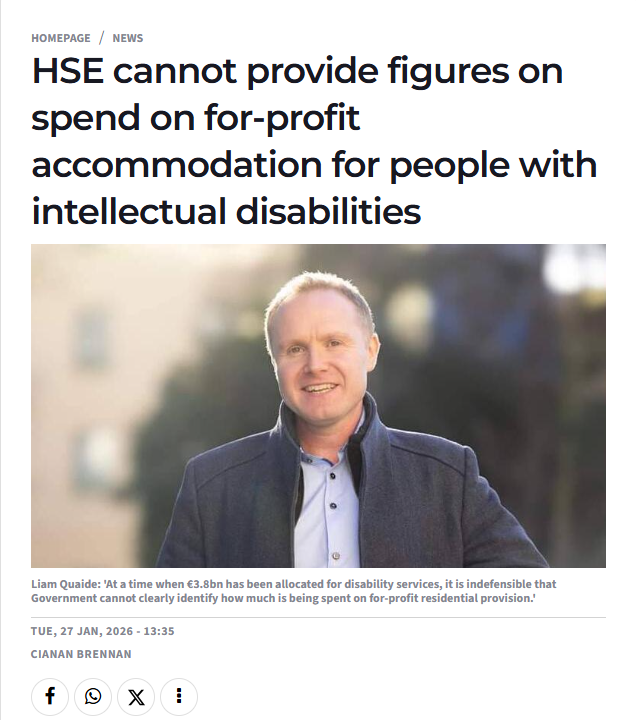
The HSE has said it cannot tell how much of its €2.2bn budget is spent on corporate for-profit accommodation for those living with intellectual disabilities, a sector which has nearly doubled in size in recent years. @ciananbrennan Liam Quaide: 'At a time when €3.8bn has been allocated for disability services, it is indefensible that Government cannot clearly identify how much is being spent on for-profit residential provision.' irishexaminer.com/news/arid-4178…
CM Haughey Solicitors tweet media
English
7
18
46
3.2K
Government of Ireland
Employers - Registration for MyFutureFund is now open. Simply: 💻Log into your account on myfuturefund.ie 📋Register by providing company details. 💳Set up a payment method MyFutureFund is the new retirement savings scheme. gov.ie/ae
Government of Ireland tweet media
English
5
2
5
1.5K
Jackie O’Connell retweetledi
AJ Leonardi, MBBS, PhD
AJ Leonardi, MBBS, PhD@fitterhappierAJ·
The Price of Denial: Early Warnings, Arrogant Dismissal, and the Lingering Cost of COVID's Immune Legacy There have been a recent number of articles framing the immune harm from Covid as a new insight. While I am pleased this has entered the mainstream, I am afraid it is too gracious to the lagging scientific consensus of how covid has been wearing away at our immune responses. Especially given how when I raised this based on T cell phenotypes, I was dismissed and attacked with extreme prejudice. Reframing Covid's immune harm as a new insight rather than a long-fought hypothesis contrary to 'immunity debt' achieves several aims: 1) It deemphasizes the role in propagating false narratives that several individuals had along with choice medical journals. For example, the BMJ extensively platformed Alasdair Munro's claims of the 'immunity debt' hypothesis. When an editor was approached with a proposal for how covid was harming immunity by individuals who had published in the BMJ before and myself, they refused to accept it. 2) It saves face for the individuals who staunchly attacked the hypothesis and dismissed it as a joke. Those people also strongly attacked me, and they would go on to claim that it is my fault such a false and ridiculous narrative of immune harm from covid even existed. These are lay people but also others. 3) it preserves a semblance of credibility for the established sources who previously denied the hypothesis and obfuscated it. 4) It shirks accountability for the duty of discernment, consideration, and equipoise that stewards of information and knowledge, like the BMJ, had to the public. They had access to the hypothesis and rationales previously and chose to trounce on it and dismiss it with extreme prejudice. To me, it highlights how many of the experts were ill-equipped to grasp early immunological changes and project them to their outcomes. This was not just an oversight, it was an editorial choice. The author of the BMJ article, Nick Tsergas, confided that the editors wanted to avoid controversy and drama. They wanted to whitewash its history. What did I do to earn such controversy? Tell the truth before other scientists could see. By the time immune harm manifests there is much damage already done. In the first half of 2020, I noted that SARS-CoV-2 had been shown in preprints to downregulate MHC Class I, overstimulate and kill CD8 T cells, and would likely accumulate harm with reinfections. I noted this even in mild cases and was dismissed by many figures, including Francois Balloux Marc Veldhoen, Zeynep Tufekci, and Antonio bertoletti. They did not dismiss kindly. Bertoletti, a senior professor at Duke NUS would reply under my posts calling me a clown and insulting me constantly. I was a medical student at the time and this behavior seemed inappropriate and offensive, especially considering how I was engaging him with genuine concern when I was discussing T cell death with him in the summer of 2020. By late 2022, I was pointing out that many people, after even mild infections, appeared to have reductions in plasmacytoid dendritic cells and other immune changes without reporting symptoms that would fit the conventional definition of Long COVID. These were not dramatic claims; they were mechanistic observations grounded in emerging data. However, the implications were stark. I had numerous media appearances discussing that immune harm was occurring. This was discussed in The Tyee by Andrew Nikiforuk. thetyee.ca/Analysis/2022/… In April 2023, FactCheck.org published a piece that characterized concerns about lasting immune effects from mild infections as exaggerated. They quoted Professor Danny Altmann, who stated there was “no phenotype” resembling immunodeficiency, only “nuanced differences” that did not translate to real-world consequences. The article framed early warnings as misinformation, implying that those raising them were overstating risks. This was not neutral correction; it was authoritative closure of debate. The message was clear: mild infection left no meaningful immune scar outside severe disease or formally diagnosed Long COVID. Discussion effectively ended there for many. factcheck.org/2023/04/sciche… Where did factcheck find the authority to promise that no such immune harm was occurring? Did they truly seek to understand what the consequences of broad t cell activation, differentiation, and death would manifest in? The dismissal was reckless and arrogant. And now proven wrong. The personal cost for telling the truth when people were actually concerned about covid was immediate and lasting. I was tagged in threads alongside senior immunologists who dismissed the ideas outright, accused (implicitly or explicitly) of fearmongering or misinterpreting preliminary data. These characterizations spread quickly on social media, embedding themselves in timelines and memories. People lied about me. Zeynep and Jeremy Kamil said that I had paid for my own PhD, when it was actually paid directly by the National Cancer Institute for my discovery of a linked mechanism of T cell death and differentiation. Years later, a search of my name still surfaces echoes of those accusations, unaccompanied by context or correction. Professional relationships cooled; invitations to collaborate quietly dried up. I lost a fellowship offer at the National Cancer Institute as Tom Misteli, the head of NCI research, wrote how, "I needed to learn what I can and can not say." The energy spent defending basic mechanistic possibilities was energy not spent on research or clinical work. It was isolating, and it was unnecessary. This manifested into something remarkably shocking and completely unprecedented in scientific literature. My two greatest and most eminent antithetical-fans teamed up and published an article mocking my twitter handle, saying that mild breakthrough infections correlated with 'fit and happy' t cells. onlinelibrary.wiley.com/doi/10.1111/im… It was shared across social media with an interpretation to mock my claim that T cells were harmed. People that mocked me cheered, like the Harvard professor Mark Davis, along with zeynep saying that it was a good rebuttal to 'looney twitter-only claims.' On Indie Sage, Christina Pagel did not disagree with the scientific content but expressed disappointment at the devolution of my interlocutors, that she was not a fan of shaming and mocking no matter how outlandish my claims were. She was wrong on both counts. Their mockery is now a testament to their ignorance and the devolution. This is not something they can retract, only deny publicly. When it occurred I reached out to the editor and he asked me if I would like to reply about the scientific content. I wanted to, but, on advice of a friend who was mortified at the conduct of the individuals and the journal itself, asked for an investigation of bullying from professors. The journal concluded the investigation saying that only my followers would know that I was the one being referenced, so were under no fault or obligation to amend the title. They retracted the offer for my response. (I included this saga and the emails to Nick and the BMJ. They chose not to include it.) I continued to watch the literature. The signals did not vanish: persistent T-cell alterations, exhausted phenotypes, subtle shifts in innate compartments. These were not the province of fringe voices; they appeared in mainstream journals, yet the narrative remained that mild infection was immunologically inconsequential for most. The possibility that repeated or even single mild infections could erode immune resilience was treated as speculative at best, irresponsible at worst. I paid a price for insisting otherwise, not in fame or notoriety, but in the quieter currency of reputation and peace of mind. Now, in early 2026, the conversation has shifted. A recent Daily Mail article discusses widespread reports of people “getting sicker more often,” with doctors noting struggling immune defences against routine bugs. The piece quotes Danny Altmann again, this time describing the hypothesis of lasting immune harm from mild COVID as “reasonable.” The idea is presented as fresh and worthy of consideration. There is no mention of the earlier certainty that no such phenotype existed, no acknowledgement that some of us were attacked for articulating precisely this possibility years ago. The system lacks both memory and foresight. The absence of reckoning is striking. Those who confidently declared “no phenotype” now entertain the same hypothesis without reference to prior denial. No correction, no apology, no credit to those who endured the backlash. This is not personal grievance alone; it reflects a broader pattern in science where consensus resists challenge until the evidence becomes overwhelming, then absorbs the insight as if it were always obvious. History is replete with such examples (Semmelweis, Warren and Marshall), yet we seem incapable of learning the lesson. The societal toll compounds the individual one. Delayed acceptance meant delayed mitigation: fewer precautions against reinfection, less urgency in studying immune reconstitution, slower recognition that population-level immune dysregulation might follow waves of mild cases. Excess respiratory illness, rising cancer concerns, unexplained reactivations. These are not abstract. They represent preventable burden born of a refusal to countenance uncomfortable possibilities when they were first raised. Vindication, when it arrives quietly and without acknowledgement, is a hollow reward. The smears linger longer than the evidence ever did. Yet the deeper failure is not personal. It is the persistent hubris that treats early, mechanistic warnings as threats rather than contributions. Until we cultivate the humility to listen when the data are still emerging, rather than demanding certainty before engagement, we will pay this price again in the next crisis. I hope the record shows that some of us tried to warn you, not for credit, but because the immune system deserved better stewardship than it received. I am glad I can look upon this period knowing that I did my very best, was ruthless, about conveying what seemed so clear to me, in very unambiguous terms. What is happening was more important than my professional standing as a fragile, early-career immunologist, because I was placed in a niche position as a specialist in T cell aging and death.
English
107
667
1.8K
83.8K
Jackie O’Connell
Jackie O’Connell@JackieMeath·
Seems that employees can only contribute to one pension plan through payroll. If an employee contributes to a PRSA through payroll they will not be able to register for My Future Fund from 1st January. Excluded or should employee be able to choose! @welfare_ie @daracalleary
Department of Social Protection@welfare_ie

On the 3rd and 4th of December, the Department of Social Protection are hosting webinars for employers on MyFutureFund. Register by clicking the below links 3rd December - eventbrite.ie/e/myfuturefund… 4th December – eventbrite.ie/e/myfuturefund…

English
0
1
0
287