James Tyler

660 posts

James Tyler

James Tyler

@JamesTyler___

Head of Merchant Success @Outsmartly (previous: @vegascom, @ea) I just want to know how it all works.

Las Vegas, NV Katılım Mayıs 2009
962 Takip Edilen403 Takipçiler
Sabitlenmiş Tweet
James Tyler
James Tyler@JamesTyler___·
I would emphasize the forecast is potentially the single most important thing for an operator to get good at and to use modern tools and infrastructure to do so. If your forecast sucks...that means you don't understand the future of your business. As an example, airlines have the most perishable, fixed inventory imaginable (seats expire at departure) and they don’t solve that by not having precise forecasting. They built revenue management: Forecast demand by flight/date/fare class, decide when to hold vs release seats vs reposition aircraft, use fences, and reprice continuously. The “raise price → CAC rises commensurately → same profit” assumption is doing a lot of work here. If CAC rises with price, you’re often reducing demand/volume, which can make ops easier, sure... but that’s shrinking on purpose because of a bad forecast. Its also by definition changing a business' ability to understand unconstrained demand. I agree dynamically pricing based on available inventory in order to maximize the yield out of that inventory is smart. Which I think is what you are describing in the increase price and monitor CAC. BUT, you want to understand latent demand so precisely that you can buy into the future optimal inventory position that you have forecasted, bottoms up, from revenue per available sku. Even if it means sacrificing some current inventory to understand future demand. Long run understanding > short run optimizations. The only thing that matters is that you don't run out of money and your future inventory position will produce more yield than your current. I don't know how you do that without a bottom's up PRECISE forecast. Then capital wants to be allocated against this bottoms up forecast. The real win in ecom will be when full blast revenue management (which definitionally requires precise forecasting and reforecasting) shows up: forecast + control price/availability/fences so you can run high utilization with low risk. As ecommerce matures I would expect to be hearing more about: Revenue Management Revenue Manager as a position Revenue per available SKU (RevPAR in travel) SKU Utilization Pace to Plan Dynamic Pricing Yield Unconstrained Demand Elasticity The equivalent terms are what built travel into being so inventory efficient that airlines can literally only make money because of credit card points. My hypothesis, broader ecom is next on this train and it will be amazing to see.
English
1
0
3
169
James Tyler
James Tyler@JamesTyler___·
@RJScaringe @Uber the two capital loss kings joining forces. beautiful. @grok what are the combined lifetime losses for Uber and Rivian, and have either of them ever generated cumulative net profit since inception?
English
1
0
9
1.7K
RJ Scaringe
RJ Scaringe@RJScaringe·
I’m excited to announce a partnership with @Uber. As part of this, Uber plans to invest up to $1.25 billion in Rivian and deploy up to 50,000 R2 robotaxis. This partnership accelerates our path to Level 4 autonomy and supports our goal of building one of the safest autonomous platforms in the world—across both shared and personally owned vehicles. The combination of Rivian’s rapidly growing data flywheel, our in-house RAP1 inference platform (800 TOPS), and our multi-modal perception stack provides a powerful foundation to scale autonomy quickly and responsibly over the next couple of years.
Rivian@Rivian

A fleet of R2 Robotaxis is coming exclusively to @Uber. ⚡🌿 Today, we announced a partnership to help both companies accelerate their autonomous vehicle plans across 25 cities in the US, Canada and Europe by the end of 2031. rivn.co/uber

English
384
356
4.9K
807.7K
James Tyler
James Tyler@JamesTyler___·
@MacCoyMerkley We love our Model Y. Got a Model X for a loaner and honestly liked the Y better. FSD is life changing. Do it.
English
0
0
3
83
MacCoy Merkley 👜
MacCoy Merkley 👜@MacCoyMerkley·
I'm not a car person - never really been interested in them. But considering leasing a Tesla Model Y with full self driving. I don't think I need the Model X because I don't really care much about the extra bells and whistles. Is there anything I'm missing?
English
9
0
6
1.6K
James Tyler
James Tyler@JamesTyler___·
Given how much you raised, and the fact that you produced “tens of millions in free cash flow,” is it fair to say the ad networks likely generated more free cash from HotelTonight than HotelTonight ultimately did? That’s why I push back on transactions as the KPI. Transactions will always correlate with ad spend. Always. If you turn the spend up, transactions go up. If you turn it down, they slow. That doesn’t necessarily tell you whether you’ve built a self-sustaining machine. From the outside, it looks like HotelTonight subsidized rate via loyalty to bring margin down for the end customer and paid heavily for acquisition. That can create transaction growth, but it also risks building a marketplace propped up by investor capital and unsustainable pricing for the user rather than organic economics. Maybe I’m wrong on the specifics. But my concern with transactions as the north star is that it can mask whether the marketplace is real or subsidized. My view is that free cash generation should be the ultimate forcing function, even early. Not because it will be positive immediately, but because if everyone is focused on that constraint, the machine has to learn to stand on its own. Every business hopes for a J-curve. The danger is building a line down and to the right and calling it traction. I appreciate your response. If you could go back, would you still choose transactions? Or would you refine it to a different leading indicator that better captured durable, self-sustaining economics?
English
0
1
3
45
Sam Shank
Sam Shank@samshank·
@JamesTyler___ Yes we did - tens of millions of free cash flow. But it took many years to build the supply and demand sides of the marketplace before we changed focus to ebitda/cash flow.
English
1
0
4
456
James Tyler
James Tyler@JamesTyler___·
I would start here: The Theory and Practice of Revenue Management by KT Talluri Pricing and Revenue Optimization by Robert Phillips Dynamic Learning for Joint Pricing, Advertising, and Inventory Management by Gurkan The Economic Analysis of Advertising by Bagwell Or come work with Outsmartly where we do this for many of the fastest growing brands on Earth (and maybe literally the fastest growing).
English
0
1
3
42
Mehtab | Karta Ventures
Mehtab | Karta Ventures@MehtabKarta·
Stop trying to nail forecasting... Forecasting for a consumer brand is very, very hard. Instead of playing a hard game, put effort into making your business easier to manage. Think every cost as being on a spectrum. Inventory is technically variable. But it’s not fast variable. You can tweak ad spend in 10 minutes. You can’t tweak inventory in 10 minutes because it has to be produced, shipped, etc... Shift your business towards FAST VARIABLE costs and AWAY from SLOW VARIABLE costs. Let's walk through an example; using pricing & customer acquisition costs... To keep things simple, let’s assume you run a business where an increase in price yields a commensurate increase in customer acquisition costs. Raising prices as much as possible until this relationship breaks is a massive win for your business because it obliterates inventory risk. Raising prices + higher CAC = same profit, but... COGS as % of revenue drops → lower inventory requirement per $ of revenue. That means you can afford to be less precise with forecasting, because the penalty for being wrong is reduced. Ad spend is extremely flexible, inventory is not so any shift in the business model that favors “more variable” levers like ad spend gives you more agility. As a fun aside, inverting this is why it's very tough to make a price decrease work. They can work, but they make the business harder to run! This Doesn’t Mean You Shouldn’t Forecast… Forecasting isn’t the problem. Relying on a forecast being perfect is. You’ll never predict every spike or slump but you can build a model that bends without breaking. 📷📷📷39
English
8
2
55
3.4K
James Tyler
James Tyler@JamesTyler___·
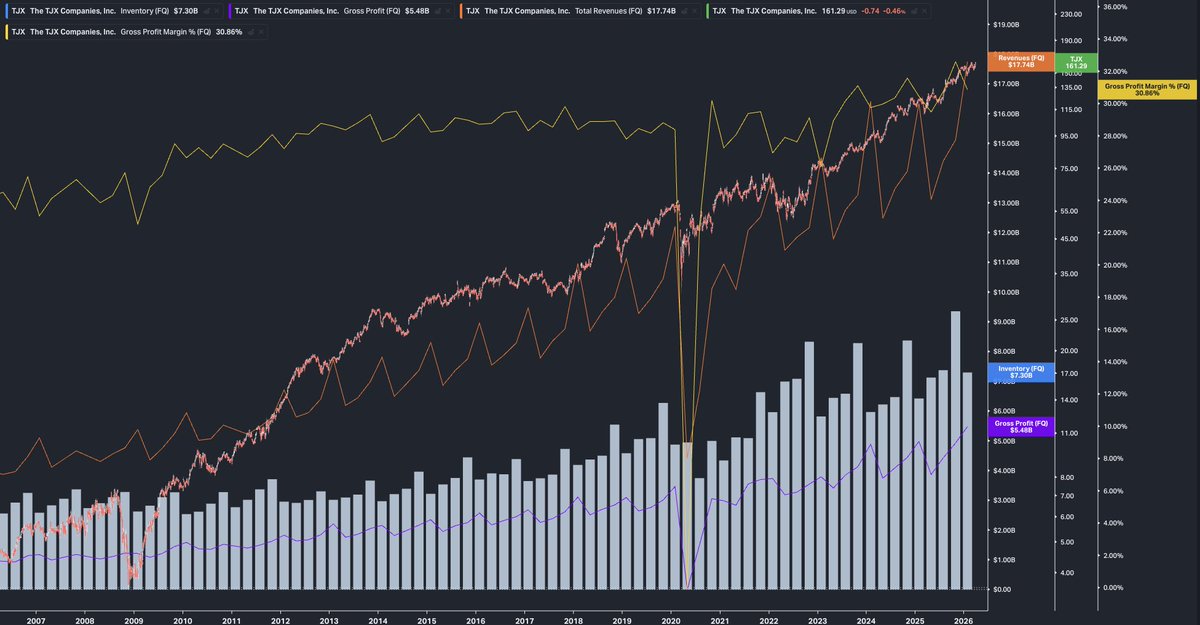
@MehtabKarta You have to grow inventory. They reliably grew inventory every quarter for 10+ years...and now they haven't meaningfully grown inventory in many quarters. They have likely reached a saturation point with the current SKU breadth vs demand. Grow inventory or die slowly.
James Tyler tweet media
English
0
0
6
274
Mehtab | Karta Ventures
Mehtab | Karta Ventures@MehtabKarta·
Apparel is a very, very tough business. What do you guys think will happen to Lululemon? It's interesting given the "lululemon for X" brands are ripping...
Mehtab | Karta Ventures tweet media
English
10
0
17
3.7K
James Tyler retweetledi
James Tyler
James Tyler@JamesTyler___·
Dynamically pricing based on available inventory is the only way to scale and manage inventory in any manner that actually maximizes total contribution. Additionally, defending against sold out variants by yielding price up is just as important as reducing prices on overstock. The last hotel room in Vegas on NYE is going to be priced a lot higher than the average daily rate. That's revenue management 101. But for some reason, this hasn't translated to retail yet. Perhaps it's because we can understand that if a room goes unsold, the hotel has lost that money but in retail a unit going unsold is still sitting in a warehouse. But actually, those two things are identical.
Taylor Holiday@TaylorHoliday

Product market fit. An idea that gets applied to broadly inside a business. Variant market fit, is a better path to cash optimization.

English
0
1
7
669
Taylor Holiday
Taylor Holiday@TaylorHoliday·
26 Predictions for Commerce (drop the e) in 2026... A manifesto on margin, machines, and the end of pretending. Personal guarantee that at least 1 will trigger you 😎
English
13
10
98
20.7K
James Tyler
James Tyler@JamesTyler___·
Appreciate the kind words but the smartest person in the world without the needed infrastructure is worth zero. I think the right question is, what systems and people are needed to run yield management across inventory, pricing, ads, location, cash and continuously optimize? Over the long run, any CPG firm not practicing yield management will ultimately lose share to one that is.
English
0
0
3
110
Will Nitze
Will Nitze@willnitze·
Who is the smartest person in the world of CPG demand forecasting?
English
25
0
39
11.4K
James Tyler retweetledi
James Tyler
James Tyler@JamesTyler___·
The best product manager at a startup is often the founder because they are the source of the vision and strategy that determine the company’s future. The same logic applies to CRO. When thinking about hiring for a conversion rate optimization (CRO) role within a smaller e-commerce business, it’s essential to understand that this function is far more than just a set of tactical tasks—it’s the very engine (or should be) that drives the business forward. The individual or team handling this function should not just be executing simple tasks like tweaking landing pages or adding trust badges on checkout pages; they should be integral to the strategic direction and growth of the company. The role of CRO within a business, especially a growing e-commerce operation, should be centered around experimentation that answers critical questions about the business’s future. It’s not just about increasing conversion rates in a vacuum; it’s about using experimentation to test hypotheses that can fundamentally alter the trajectory of the business. The best CRO programs are those that help the company understand and execute on ideas that could potentially double the business, rather than simply optimizing minor aspects like button colors or page layouts. The role, therefore, demands someone who can think strategically about the entire business, not just the website. One pitfall to avoid in hiring for this role is the temptation to offload it entirely to someone who approaches CRO from a purely tactical perspective. This is where businesses can get into trouble. Hiring someone who is focused on superficial metrics—like artificially boosting conversion rates by making some onsite funnel change that doesn’t make it back to any real profit—can distract from the more important, revenue-driving experiments that need to happen. The person you hire should have the ability to look at the big picture and prioritize experiments that have the potential to significantly impact revenue and contribution. This means they need to understand the infrastructure, people, and processes required to answer the biggest questions about the business. For these reasons, the ideal candidate for a CRO role should be someone with a deep understanding of business strategy, revenue growth, and the ability to operationalize insights across the company. They should not only be capable of running experiments but should also be able to translate the outcomes of those experiments into actionable strategies that can be scaled. This could mean finding someone with entrepreneurial experience, or at the very least, someone who has a proven track record of scaling businesses, in addition to running a sophisticated experimentation program. This person should own the revenue outcomes of their experiments, ensuring that their efforts are always aligned with the broader goals of the business. For sure it may be tempting to hire someone to simply “handle” CRO, but it’s crucial to recognize that this function is core to the business’s growth and should be treated as such. The right hire for this role will be more than just a CRO expert—they will be a strategic leader capable of driving the business forward through smart experimentation and a deep understanding of what makes the company tick. Trust badges on a checkout page might slightly increase conversion rates, but what you really need is someone who can help you double your business and operationalize the outcomes of 2x to 10x experiments. The kind of experiment that means you are SPRINTING to order more inventory. That’s the kind of CRO role you should be hiring for.
Matt@matthucius

We’ve started to build out a solid, lean team for the brand now (over £1m per year per head)- but an area I still spend SO much time on myself is general website/ecom/CRO and that whole piece - I struggle to define what a new hire could look like for this, or if actually a few is needed (probably)? Current setup is an agency to do the design and dev work, but still me to plan, manage & lead on roadmap/direction for website optimisation and design - If I want to remove myself entirely from this and have one direct report here instead, who/which role should I hire, and ideally where from? 🖥️🤔

English
4
2
16
4.3K
James Tyler
James Tyler@JamesTyler___·
James Tyler@JamesTyler___

The best product manager at a startup is often the founder because they are the source of the vision and strategy that determine the company’s future. The same logic applies to CRO. When thinking about hiring for a conversion rate optimization (CRO) role within a smaller e-commerce business, it’s essential to understand that this function is far more than just a set of tactical tasks—it’s the very engine (or should be) that drives the business forward. The individual or team handling this function should not just be executing simple tasks like tweaking landing pages or adding trust badges on checkout pages; they should be integral to the strategic direction and growth of the company. The role of CRO within a business, especially a growing e-commerce operation, should be centered around experimentation that answers critical questions about the business’s future. It’s not just about increasing conversion rates in a vacuum; it’s about using experimentation to test hypotheses that can fundamentally alter the trajectory of the business. The best CRO programs are those that help the company understand and execute on ideas that could potentially double the business, rather than simply optimizing minor aspects like button colors or page layouts. The role, therefore, demands someone who can think strategically about the entire business, not just the website. One pitfall to avoid in hiring for this role is the temptation to offload it entirely to someone who approaches CRO from a purely tactical perspective. This is where businesses can get into trouble. Hiring someone who is focused on superficial metrics—like artificially boosting conversion rates by making some onsite funnel change that doesn’t make it back to any real profit—can distract from the more important, revenue-driving experiments that need to happen. The person you hire should have the ability to look at the big picture and prioritize experiments that have the potential to significantly impact revenue and contribution. This means they need to understand the infrastructure, people, and processes required to answer the biggest questions about the business. For these reasons, the ideal candidate for a CRO role should be someone with a deep understanding of business strategy, revenue growth, and the ability to operationalize insights across the company. They should not only be capable of running experiments but should also be able to translate the outcomes of those experiments into actionable strategies that can be scaled. This could mean finding someone with entrepreneurial experience, or at the very least, someone who has a proven track record of scaling businesses, in addition to running a sophisticated experimentation program. This person should own the revenue outcomes of their experiments, ensuring that their efforts are always aligned with the broader goals of the business. For sure it may be tempting to hire someone to simply “handle” CRO, but it’s crucial to recognize that this function is core to the business’s growth and should be treated as such. The right hire for this role will be more than just a CRO expert—they will be a strategic leader capable of driving the business forward through smart experimentation and a deep understanding of what makes the company tick. Trust badges on a checkout page might slightly increase conversion rates, but what you really need is someone who can help you double your business and operationalize the outcomes of 2x to 10x experiments. The kind of experiment that means you are SPRINTING to order more inventory. That’s the kind of CRO role you should be hiring for.

QME
0
0
1
188
Barry Hott ☄️
Barry Hott ☄️@binghott·
CRO people: your job is not to increase CVR. Your job is to grow the business. Hear me out... Increasing CVR alone does not directly grow the business. If you only focus on one metric alone, it can be at the expense of other things, including scale. If you make an improvement to your site, CVR can go up... If CVR goes up, your ads will perform better... If your ads perform better, you'll increase your spend (either systematically or manually). If you increase spend, you'll send more colder traffic to your site. As more colder traffic goes to your site, your CVR will decrease. This is not a bad sign, but it might look or feel like one. Here are ways to increase CVR that don't actually scale your business: 1. Decrease spend on cold traffic. 2. Make site changes that work better for existing customers and warm visitors, but not new visitors. 3. Prioritize selling cheaper products. If you increase CVR but decrease your subscriber rate, that's bad too! Don't just try to optimize any one metric, remember how and where that metric applies to the whole business and greater goals.
English
13
3
35
7.6K
James Tyler
James Tyler@JamesTyler___·
For your ecommerce business: Best Day Ever Best Week Ever Best Month Ever Every month. Why target anything else? Achievable at every scale.
English
0
0
3
369
Ryan Hoover
Ryan Hoover@rrhoover·
Topic I've been noodling on all year: It's comforting to use logic to justify decisions, to yourself and others. But sometimes the head gets in the way of the wisdom of the heart.
English
22
3
84
7.9K
James Tyler
James Tyler@JamesTyler___·
@Smatei12 @RomanEcom Depends on the year honestly. Either better than SoCal or worse than Siberia but we do have a sphere.
English
1
0
2
95
Roman Khan - Founder of Peak 21. We acquire brands
I am thinking of spending this years BFCM week in the US. Too hard to manage it all from a Hong Kong timezone for our ad spend. What city in the US should I camp out in ? What city has the best weather late November?
English
8
0
13
4.1K
James Tyler
James Tyler@JamesTyler___·
Maybe the right question to be asking is does my customer want premium packaging? Through an experiment you could probably determine that through a test like this. Assuming you just sent all customers the premium packaging during the testing period of course. You may find out an experiment like this actually allows you to save on packaging cost and increase conversion and contribution. (Please excuse the rough mockup)
James Tyler tweet media
English
3
0
6
229
Dave Stickland
Dave Stickland@dave_stickland·
Everyone wants an amazing unboxing and branded experience, but the business runs on profit margin. What's your argument for paying more for a premium experience rather than cutting everything back to make more $?
English
19
0
16
4K
James Tyler
James Tyler@JamesTyler___·
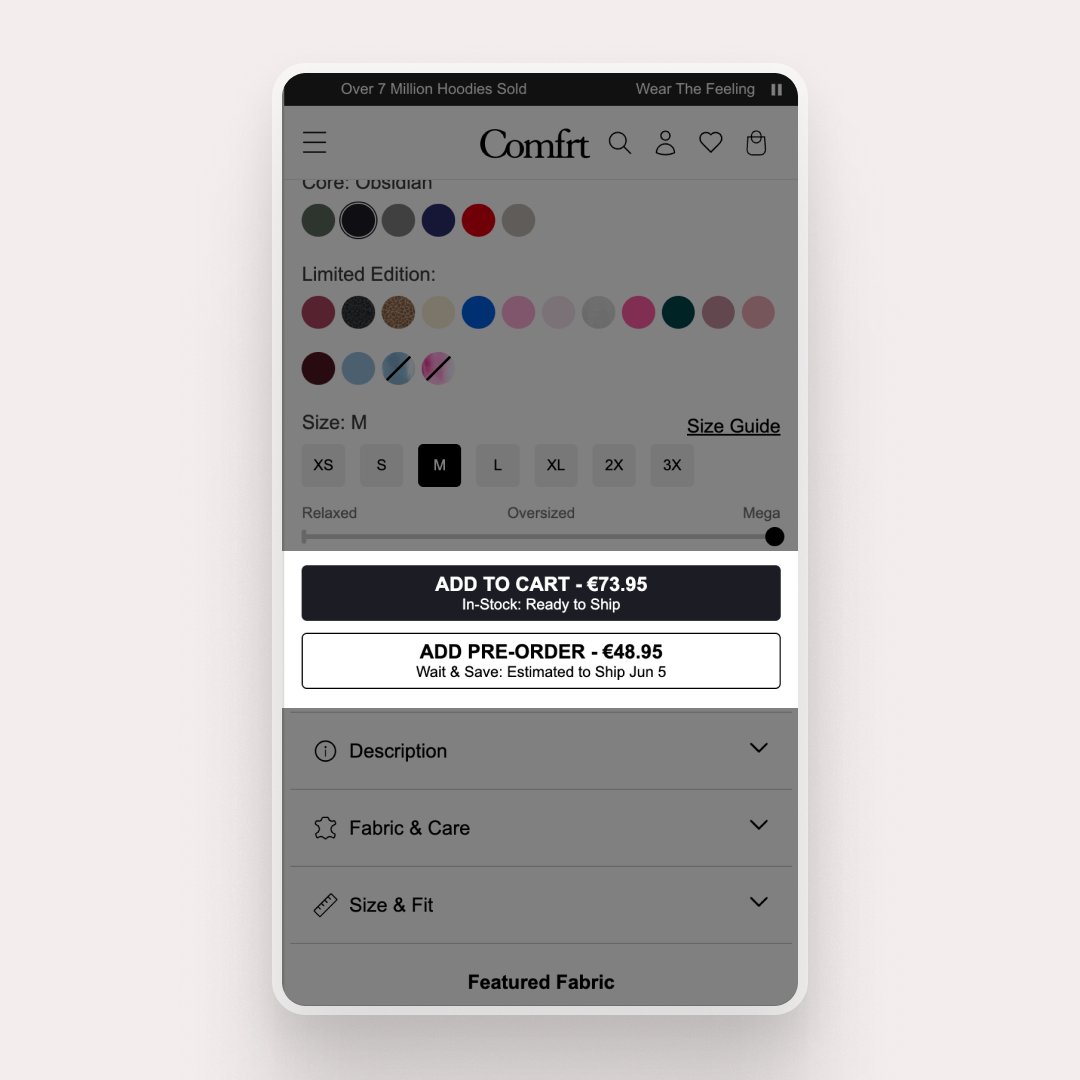
Thoughts on this potentially "inventory aware" promotion 👇
James Tyler tweet media
English
1
0
3
293
James Tyler
James Tyler@JamesTyler___·
Isn't the question you actually want to answer: "At what joint price and advertising spend maximizes the contribution from these 7k units?" As an example, just lowering price per unit could drive up units per order AND reduce CAC simultaneously, producing much more profit from the same inventory. These things are knowable and will help tremendously operationalizing future replenishment and expansion, etc.
English
0
0
6
1.2K
James Tyler
James Tyler@JamesTyler___·
How customers respond to the UX of price is a different discussion. There is probably some leverage in communicating urgency about price to the customer. I'm suggesting "promotions" should only really be used, inside of an experiment, as a vehicle to understanding at what average selling price do I maximize contribution for my store. The prices of the SKUs in my store should ALWAYS and already be at the price that maximizes the annualized return on total inventory.
English
0
0
3
148
Andrew Faris
Andrew Faris@andrewjfaris·
@JamesTyler___ So you think customers uniquely respond to time-limited promotions?
English
1
0
0
242
Andrew Faris
Andrew Faris@andrewjfaris·
So you've just run a big, successful promotion. It went great. What do you expect to happen when you go back to evergreen offers and ads after? What do you do to handle that time period best, if anything?
English
10
0
19
8.8K