Jeff Nabers

5.3K posts

Jeff Nabers banner
Jeff Nabers

Jeff Nabers

@JeffNabers

Founder: https://t.co/ufDmUApViO

Scottsdale, AZ Katılım Şubat 2009
2.3K Takip Edilen4.8K Takipçiler
Preston Pysh
Preston Pysh@PrestonPysh·
A personal note.  After years of public discussion/work: the podcast, social media, venture capital, everything — I'm stepping back to focus on my family. My kids are growing fast.  My wife deserves the best of me.  To everyone who listened, read, grew, and built alongside me — thank you. What a blessing you all have been!
English
1.5K
262
8.6K
572.7K
Jeff Nabers
Jeff Nabers@JeffNabers·
But do those cause issues in individuals who have not been exposed to mycotoxins? I was under the impression that fragments/VOCs/etc generally disrupt the immune sys of ppl with detox gene mutation and mycotoxin exposure. I'm skeptical that a healthy individual with normal detox genes and no exposure to mycotoxins can walk through a forest and get sick from non-mycotoxin-producing spore fragments.
English
1
0
1
77
Ariana Thacker
Ariana Thacker@m0ldilocks·
@JeffNabers @mlandon17 It's more than the mycotoxins - non-mycotoxin producing molds cause health issues - especially the fragments / VOCs / other chemicals released.
English
1
0
0
106
Ariana Thacker
Ariana Thacker@m0ldilocks·
America has a mold problem, and somehow it keeps showing up in our “dream” places without ever making the listing. There’s the girl with the perfect city apartment: plants in the window, string lights, art prints, the whole curated studio vibe. She also has year-round “allergies” that mysteriously disappear every time she leaves town for more than a weekend. She jokes about having a weak immune system and a sensitive stomach while there’s a grayish bloom above her window that her landlord calls “normal for older buildings". In the suburbs, a couple finally lands the house in the good school district. Six months in, the kid’s asthma is worse, mom feels like she’s walking through molasses by 3 in the afternoon, and dad can’t remember where he put anything anymore. They blame stress, busy schedules, too much coffee, not enough sleep, while quietly ignoring the musty basement. Then there’s the student apartment, where the rent is cheap and everyone calls it “the cave” like it’s a joke. Someone’s always got a cough, someone else swears they can’t concentrate, and they all make memes about brain fog and being permanently tired. Individually, these are just stories. Busy lives, bad sleep, too much screen time, getting older. But if you line them up, they start to rhyme: coughs that don’t quite go away, congestion that never really clears, headaches, fatigue, foggy thinking, and always some corner, ceiling, vent, or basement that everyone politely pretends not to notice. No one is saying every symptom is mold. But maybe “it’s just allergies” and “I’m just tired” deserve a follow-up question about the spaces we’re inhaling every day.
English
31
43
471
89.2K
Jeff Nabers
Jeff Nabers@JeffNabers·
Also, most molds don't produce mycotoxins. The mycotoxins are what makes you sick. Mycotoxins are mostly produced by the molds associated with water damaged buildings. So breathing mold in the air in a forest doesn't make you sick. Breathing the specific kinds of molds in a water damaged building does make you sick because they have released mycotoxins.
English
1
0
5
143
Ariana Thacker
Ariana Thacker@m0ldilocks·
mold is everywhere; however mold that causes health issues must reach a certain threshold. there are some data to support health to exposure mapping if you do a dust test in your environment there's even reference regarding its health aspects and how to approach it in leviticus in the bible
English
1
0
3
1.6K
Marie
Marie@MarieMartens·
Soon it will be 5 years ago that @filipminev and I launched the MVP of @TallyForms on Product Hunt. We'd been building quietly since the summer of 2020. During that time we talked to as many builders, founders, and product persons we could find, on Twitter, Product Hunt, Indie Hackers and Reddit. We tried to be in as many conversations as possible. Asking what people needed, listening, and building. I scrolled through the launch page and comments today and what struck me most is that a lot of you are still here. Those early users who took a chance on a product that had maybe 10 features and a landing page. You showed up in our Slack, filed bugs, came back the next day, sent encouragement, told your friends. Some of you even became part of our team. The comments that stuck with me aren't the feature requests. They are things like: "It's like if Notion and Typeform had a baby" "This looks super cool. The UX is incredibly good. Keep up the great work!" "It's simply made for a human" "I love the amazing UX, the team shares their roadmap and answers every feature request on Slack, I'm not going back to..." "A better UI to build the form, no cut-throat pricing, and an overall delightful experience at launch. Mightily impressed" These landed, because that's exactly what we were going for, even though we hadn't defined it that clearly ourselves yet at the time. People told us we were crazy. Competitive market, who needs another form builder, you're bootstrapping, you'll never compete with the giants. And honestly, they weren't wrong. But we had a different bet: that nobody actually loves form builders, and if you build one that feels genuinely good to use, you put in the care, and make it free, people would notice. And they did. Five years later: over a million users, $390K MRR, a team of 10, still bootstrapped, still building from Ghent, Belgium. I realized throughout the years that launching wasn't the important part. But being stubborn, showing up every day, and keep on building for those early adopters who loved Tally when it was just a fraction of what it is today, is what turned it into an actual sustainable and long-term business. The platforms and communities that gave us our first shot, @ProductHunt @IndieHackers and the No Code community in general, gave two bootstrappers from Belgium and Bulgaria a real shot at competing. That still means a lot. We're still building for you. You know who you are 🫰
Marie tweet media
English
9
0
53
2K
Suhail
Suhail@Suhail·
why did everyone have to take all the good domains?
English
48
2
101
19.6K
Jeff Nabers
Jeff Nabers@JeffNabers·
@azamsharp Disruptable companies won't get to employ developers or exist forever.
English
0
0
0
15
Mohammad Azam
Mohammad Azam@azamsharp·
People who keep saying AI is going to replace developers… have they actually worked inside a large enterprise? A LOT of companies don’t even allow developers to install third party packages. I regularly talk to friends working at Fortune 500 companies. Some of them aren’t even allowed to install NumPy or Matplotlib without going through layers of approval. In some environments, even access to LLM tools is restricted or sandboxed behind heavy compliance controls. This isn’t a “move fast and ship AI agents” world. It’s a world of security reviews. Procurement. Legal approvals. Risk assessments. I remember years ago it took two weeks just to get approval to use jQuery. Two weeks. For jQuery. Now imagine trying to integrate external AI services, autonomous agents, or experimental frameworks into that kind of environment. AI is powerful. It’s transformative. But enterprise reality moves at a very different speed.
English
376
115
1.6K
165.9K
Jeff Nabers
Jeff Nabers@JeffNabers·
@andrewchen Going upstream one hop... why will founders even need capital? And why will an exit be wanted or needed if there are no investors to pay out?
English
0
0
0
13
andrew chen
andrew chen@andrewchen·
i asked my openclaw what I should be focused on rn in the zoomed out view, and here's what it said: Figuring out what VCs even do in an AI world — if AI agents can source deals, write memos, do diligence... what's the irreducible human core of investing? You're living that question with me sitting here. lol
English
96
6
214
30.1K
Jeff Nabers
Jeff Nabers@JeffNabers·
@jayclouse yeah. i've had a similar experience. i'm thinking i will only bust it out for a few weeks if trying to see a new pattern or test some new behaviors.
English
0
0
1
66
Jay Clouse
Jay Clouse@jayclouse·
If you’ve both worn an Oura ring and an Apple Watch for 6+ months… How do you use your Oura? I liked the sleep tracking, but I sorta get it now. My scores every day basically just reinforce how I naturally feel and I know what patterns to lean into and which to avoid. I can’t really wear it to lift, and the Apple Watch does a better job of fitness tracking anyway. The Oura returns seem very diminishing.
English
7
0
7
2.7K
Jeff Nabers
Jeff Nabers@JeffNabers·
@MarkYusko 100%. We made IP up and it's prob not good for society. There's prob an inverse economic benefit. And it's def going away no matter what.
English
0
0
0
26
Mark W. Yusko - Two Point One Quadrillion
Probably Nothing… So crazy, that copyrights, trademarks, intellectual property, patents and generally, original work, are actually protected assets…
Shanaka Anslem Perera ⚡@shanaka86

The most honest sentence in the entire AI industry right now is one nobody wants to say out loud. Every major foundation model was trained on data its creators did not have explicit permission to use. Every single one. Anthropic settled for $1.5 billion over 7 million pirated books used to train Claude. OpenAI faces ongoing lawsuits from authors, newspapers, and code repositories. Google trained on the entire indexed internet. Meta used Libraries Genesis datasets. And xAI’s Grok was trained on the full corpus of X posts, a decision Musk made unilaterally as the platform’s owner without individual user consent. So when Elon Musk tweets that “Anthropic is guilty of stealing training data at massive scale and has had to pay multi-billion dollar settlements for their theft. This is just a fact,” he is telling a true but deeply selective version of the story. The settlement is real. The $1.5 billion is documented. The pirated books are documented. But framing this as an Anthropic problem rather than an industry-wide structural reality is competitive positioning disguised as moral outrage. Here is the actual mechanism nobody is mapping. Anthropic accused Chinese labs of distilling Claude through its public API. Musk responded by pointing out Anthropic trained on stolen data. Gergely Orosz, a respected engineer, wrote “Anthropic can’t have it both ways.” All three are correct simultaneously and all three are being selectively honest. The structural reality is that the entire foundation model industry sits on an unresolved intellectual property question worth hundreds of billions of dollars. Every lab trained on data it did not license. Every lab knows this. Every lab’s legal strategy is to get big enough that the settlement becomes a cost of doing business rather than an existential threat. Anthropic already paid $1.5 billion. That is not a punishment. That is a licensing fee paid retroactively under legal pressure. The reason Musk is raising this now has nothing to do with ethics. Anthropic is in conversations with the Pentagon. xAI is competing for the same contracts. Framing your competitor as a data thief three days before a defense meeting is not moral clarity. It is positioning. And the deepest irony is the China angle. The United States wants to restrict Chinese access to American AI models on intellectual property grounds. But every American AI model was built on intellectual property its creators took without permission from millions of authors, coders, artists, and publishers. The entire moral framework for the technology export control regime rests on an intellectual property argument that the American labs themselves have not resolved domestically. That is not hypocrisy anyone in the industry wants to discuss because the moment you acknowledge it, the legal and regulatory exposure scales to every company simultaneously. Musk is weaponizing it selectively. Anthropic is deflecting it selectively the way I see this. And the actual creators whose work built every one of these models are watching billionaires argue about who stole from them more ethically.

English
4
2
15
7.9K
Jeff Nabers retweetledi
Tim Allen
Tim Allen@ofctimallen·
“The happiness of your life depends upon the quality of your thoughts” Marcus Aurelius is trying to convey that a person’s happiness is determined primarily by how they think, not by external circumstances. The nature, discipline, and moral quality of one’s thoughts shape how events are perceived and experienced. If thoughts are rational, virtuous, and well-ordered, life feels content and stable; if thoughts are negative, irrational, or uncontrolled, life feels unhappy regardless of outward conditions. According to him, happiness is an internal state governed by the mind, and improving one’s thoughts improves one’s life
English
430
1.3K
10.7K
296.8K
Jeff Nabers retweetledi
Wall Street Apes
Wall Street Apes@WallStreetApes·
FDA Commissioner Dr. Marty Makary says the FDA has intentionally been lying to us for 16 years about fat being bad for you He says this allowed Big Pharma to sell more drugs “They suppressed the data for 16 years. Two other large studies failed to show an association. Finally, the study trickled out in the medical literature. Nobody noticed it. Those in the low-fat group had higher rates of heart attacks. Why? Maybe because when you avoid fat, you have to pound food with carbohydrates and often ultra-processed carbohydrates stripped of fiber and chopped up at functions like sugar. We created a generation of children with low protein, high carbohydrates, sugar addiction, and burdened with ultra-processed foods, and what did we do as a medical field? Drugged them at scale. Those days are over. We are telling people the truth about food.”
English
285
5.7K
20.4K
639.7K
Jeff Nabers retweetledi
Matthew Prince 🌥
Matthew Prince 🌥@eastdakota·
Yesterday a quasi-judicial body in Italy fined @Cloudflare $17 million for failing to go along with their scheme to censor the Internet. The scheme, which even the EU has called concerning, required us within a mere 30 minutes of notification to fully censor from the Internet any sites a shadowy cabal of European media elites deemed against their interests. No judicial oversight. No due process. No appeal. No transparency. It required us to not just remove customers, but also censor our 1.1.1.1 DNS resolver meaning it risked blacking out any site on the Internet. And it required us not just to censor the content in Italy but globally. In other words, Italy insists a shadowy, European media cabal should be able to dictate what is and is not allowed online. That, of course, is DISGUSTING and even before yesterday’s fine we had multiple legal challenges pending against the underlying scheme. We, of course, will now fight the unjust fine. Not just because it’s wrong for us but because it is wrong for democratic values. In addition, we are considering the following actions: 1) discontinuing the millions of dollars in pro bono cyber security services we are providing the upcoming Milano-Cortina Olympics; 2) discontinuing Cloudflare’s Free cyber security services for any Italy-based users; 3) removing all servers from Italian cities; and 4) terminating all plans to build an Italian Cloudflare office or make any investments in the country. Play stupid games, win stupid prizes. While there are things I would handle differently than the current U.S. administration, I appreciate @JDVance taking a leadership role in recognizing this type of regulation is a fundamental unfair trade issue that also threatens democratic values. And in this case @ElonMusk is right: #FreeSpeech is critical and under attack from an out-of-touch cabal of very disturbed European policy makers. I will be in DC first thing next week to discuss this with U.S. administration officials and I’ll be meeting with the IOC in Lausanne shortly after to outline the risk to the Olympic Games if @Cloudflare withdraws our cyber security protection. In the meantime, we remain happy to discuss this with Italian government officials who, so far, have been unwilling to engage beyond issuing fines. We believe Italy, like all countries, has a right to regulate the content on networks inside its borders. But they must do so following the Rule of Law and principles of Due Process. And Italy certainly has no right to regulate what is and is not allowed on the Internet in the United States, the United Kingdom, Canada, China, Brazil, India or anywhere outside its borders. THIS IS AN IMPORTANT FIGHT AND WE WILL WIN!!!
Matthew Prince 🌥 tweet media
English
2.4K
7.3K
34.4K
9.5M
Jeff Nabers
Jeff Nabers@JeffNabers·
@HusqvarnaUSA But what dirt bike brand do bears prefer? I want to see that video.
English
0
0
0
11
Jeff Nabers retweetledi
Jeff Swanson
Jeff Swanson@theswansjr·
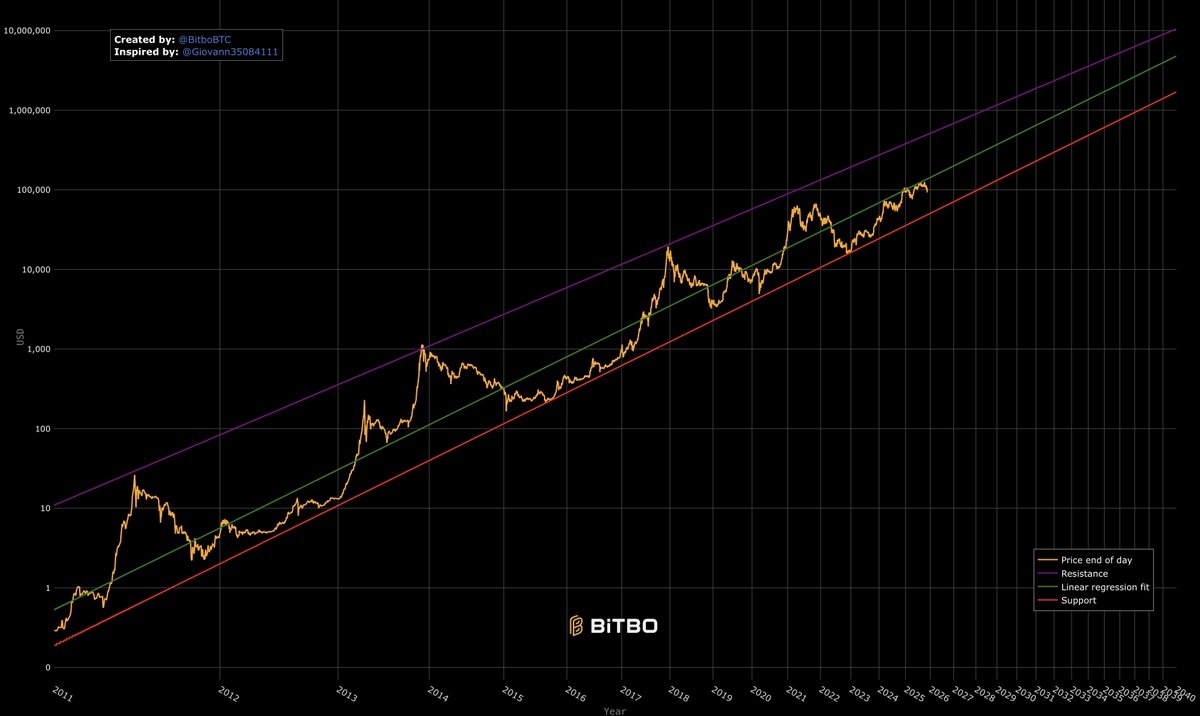
Bitcoin continues its collapse, ultimately going to zero. You can really see it here on this chart.
Jeff Swanson tweet media
English
354
563
6.1K
393.8K
Jeff Nabers retweetledi
The Kobeissi Letter
The Kobeissi Letter@KobeissiLetter·
To all the crypto investors anxiously watching right now: Since 2017, Bitcoin has seen: 1. 10+ declines of -25% or more 2. 6 declines of -50% or more 3. 3 declines of -75% or more Every single decline of the current magnitude or more since Bitcoin's inception has been followed by new record highs. Disruption is not easy, but it pays when you can sound out the noise. This is a "routine" crypto bear market which we believe is already closer to its end than its beginning. Volatility brings opportunity.
English
286
632
5.8K
1.2M
Jeff Nabers retweetledi
Hunter Horsley
Hunter Horsley@HHorsley·
Globally, there's: ~$120+ trillion of wealth in equities ~$140+ trillion of wealth in fixed income ~$250+ trillion of wealth in real estate ~$100+ trillion in M2 / money ~$30 trillion in gold There's $1.9 trillion in Bitcoin. Bitcoin at $85k, $95k, $105k is all the same thing. In any case, it's tiny. It has a long long way to go. And access is just now opening up for the $100s of trillions of wealth to be able to buy it for the first time. Don't lose the forrest for the trees.
English
132
346
2.7K
382.9K
Bryan Johnson
Bryan Johnson@bryan_johnson·
First mushroom trip data is out: my brain activity. Dose: 5 g dried Psilocybe cubensis (B+ strain) Containing 24.9 mg psilocybin Psilocybin longevity experiment. What we see in the brain: + brain activity data mirror my subjective experience + strong decrease in my brain’s control center (prefrontal + premotor cortex) + strong increase in sensory, auditory and speech integration + higher entropic brain patterns: open, flexible, less predictable, exploratory + brain network patterns resembling a youthful state vs aged and rigid Matching what I reported experiencing: + “felt like my consciousness was dialed up to 10/10.” + “I felt hyper aware and hyper alive.” + “I experienced sense of touch with awe.” + “my mind was insatiably curious and wanted to deploy its sensors into the world and discover all things.” + “My brain wanted to stare, study and marvel.” + “The flavor exploded in my mouth.” + “...restored my perception to youthful levels, returning them to factory settings and dissolving my aged numbness.” Why this could matter for longevity: + In people aged 65-85, higher happiness was linked to a 22% reduced risk of all-cause mortality over 15 years. + A meta-analysis showed that optimism correlated with a 35% decrease in heart attacks and a 16% decrease in all-cause mortality. + Having a strong purpose in life is associated with a 17% reduction in both heart attacks and all-cause mortality. + In psychedelic medicine, treating depression with ketamine has been shown to reverse biological age by up to 3 years. Together, these findings suggest a plausible mechanism by which psychedelics, including psilocybin, can prolong both health and lifespan by improving mental well-being and rewiring the brain to a more positive, creative, and curious state. My team and I hypothesized that neuroplasticity, the loosening of rigid inhibitory patterns that makes the brain more flexible, creative, and relaxed, and even the subjective psychedelic state itself may be as meaningful for longevity as methylation shifts, senescence reversal, or telomere biology. What’s happening mechanistically Earlier work shows that psilocin (the active metabolite of psilocybin) acts primarily as an agonist at 5-HT₂A serotonin receptors in the cortex. These receptors are especially dense in high-level association and sensory regions, as mapped in a high-resolution PET/MRI atlas of the human serotonin system. When these receptors are activated, brain imaging studies show an induced state of desynchronization, entropy, and neuroplasticity.  This process erodes the rigid brain hierarchy and default mode networks in favor of a brain-wide spontaneous, creative, curious, and child-like state. Kernel Flow data shows the same pattern: The recorded timepoints included: + baseline: directly before session start (not shown) + timepoint 1: 4 hrs after dose (acute phase effects). + timepoint 2: end of the day, before bedtime. + timepoint 3: the following morning. I continue to measure my brain daily. Image notes + The three maps show changes vs. baseline (not absolute activity) + Red = increased connectivity, blue = decreased connectivity vs. my baseline. + The left reference map shows the 5-HT₂A receptor distribution from PET, the main psilocybin target. Time Point 1 - 3 hrs post dose + Reduced connectivity in the prefrontal and premotor cortex, correlating with acute brain desynchronization. + Increased connectivity and hyperintegration between the primary motor and sensory cortex regions. + Enhanced connectivity in the auditory and speech areas of the cortex. + Inhibited connectivity in the medial prefrontal and posterior zones, areas associated with the Default Mode Network (DMN). Subjective experience: + Enhanced sensory vividness and bodily presence: The brain's top-down hierarchy, originating in the pre-frontal cortex, was attenuated. This reduced predictive filtering, leading to a flood of bottom-up sensory information and heightened bodily perception (e.g., a fascination with water and light dynamics in a jar, a restored, primal joy of touch and sensation). + Peak neuroplasticity and cortical entropy: A peak in cortical entropy and neuroplasticity contributed to a feeling of hyperawareness (e.g., heightened sensory perception, feeling "at one with existence," hyper-aware and hyper-alive). + Deeper appreciation of music and uninhibited movement and expression: Sharpened auditory senses and reduced top-down inhibition allowed music to be enjoyed on a profound level. Concomitant functional connectivity in speech-motor and auditory-motor integration areas facilitated uninhibited expression through both speech and movement (a restored, uninhibited, child-like joy of music). + Note: Full ego dissolution was not experienced, which may necessitate a higher dose to achieve more advanced desynchronization of the prefrontal and parietal cortices. Time point 2 - 5 hrs post dose, end of trip + Intensified sensory and motor hyperconnectivity. + Continued increased connectivity in auditory and speech centers, with a relative restoration of connectivity to the speech understanding area. + Partial re-emergence of the prefrontal parietal coupling, while prefrontal context remains partially inhibited. + Partial re-emergence of connectivity in areas related to the default mode network. Subjective Experience + High-order brain networks begin to restabilize, alongside persisting sensory, motor, auditory, and speech hyperconnectivity, suggesting neuroplasticity in action. + The narrative shifts from pure sensation and experience to meaning generation, accompanied by deep philosophical reflection (e.g., reconsidering the meaning of life and one's relationship with mortality in the time of AI, and pondering the future of human evolution). Time point 3 - next morning (afterglow) + Persistence: Patterns from the acute phase continue, including general prefrontal cortex inhibition, ongoing neuronal plasticity, and heightened senses. + Intensified connectivity: Increased connectivity is noted in the speech generation area and the somatic sensory association area. + DMN inhibition: The default mode network remains inhibited. Subjective Experience: + "Afterglow" effect: Characterized by continued sharpened senses, calm clarity, emotional openness, and low inhibitions. For instance, I felt more comfortable expressing uninhibited, self-deprecating humor (i.e. my post making fun of myself about the insane lengths I go for my Don’t Die experiment) + Integration of experience learnings: The heightened activity in the somatic sensory association area aligns with the process of integrating and "making sense" of the raw sensory experience of both the self and the external world. + Enhanced creativity: The intensified connectivity in the speech generation area contributed to the uninhibited bout of creative writing I undertook to report my experience.
Bryan Johnson tweet media
English
689
1.1K
9.8K
2.2M
Jeff Nabers
Jeff Nabers@JeffNabers·
@mitchellh I started doing this 18 months ago. This week I returned partially to pen & paper. There is something sacred about the quality of thinking w/ a pen. Studies show it. You can SEE your own context window. Voice transcription is not a full replacement for writing IMO.
English
0
0
1
489
Mitchell Hashimoto
Mitchell Hashimoto@mitchellh·
I've recently started integrating transcription into my daily workflow. Its gotten so good. Away from the computer I'll ramble hours of thoughts to myself, then use an LLM to split and organize that into more coherent chunks, then draw up plans for when I'm back to a computer. This is replacing... memory mostly, pen/paper secondarily. I say memory foremost because its allowing me to think critically and plan in environments I probably wouldn't have before. I'm certain I'm using suboptimal tooling for this so any recommendations are welcome! Right now I'm using WisprFlow into Apple Notes and then manually (red flag!) throwing that into a local agent to organize into markdown files. I'd love to have something that was more end to end in a single solution. And also something that would talk back to me, e.g. if I said "oh, can you explain what I talked about yesterday at the conclusion of chasing this problem down?"
English
108
17
929
100.9K
Jeff Nabers
Jeff Nabers@JeffNabers·
Interesting take.
EndGame Macro@onechancefreedm

Why I Think Michael Burry Is Shutting Down Scion Now Let’s put a few things together…Burry’s liquidation letter, his depreciation thread on the hyperscalers, and his “me then, me now” Big Short meme and he’s basically spelling out one story. He thinks we’re in an earnings inflated, AI driven bubble that a value investor can’t sit inside without eventually getting crushed. In the letter he says it plainly “My estimation of value in securities is not now, and has not been for some time, in sync with the markets.” That’s not a I’m tired of running money line. That’s a man saying, I can’t reconcile what I see in the numbers with the prices the market is willing to pay. When someone like Burry reaches that point, the logical move isn’t to keep collecting fees and hope it mean reverts. It’s to get out of the structure that forces you to play the game at all. Then you look at his post on depreciation. He’s saying the biggest beneficiaries of the AI boom that includes META, GOOG, ORCL, MSFT, AMZN of juicing earnings by quietly stretching the useful life of servers and GPU rigs that are really on a 2–3 year technology cycle. Extend the life in the accounting model, and you cut today’s depreciation expense. Cut depreciation, and EPS looks 20–30% higher than it would under a stricter assumption. He’s saying that the market is paying premium multiples on numbers that are, in his view, structurally overstated. Put that together with the “me then, me now… it worked out, it will work out” post, and he’s clearly casting himself as the same guy who sat in front of a wall of subprime prospectuses in 2005. Back then, he saw engineered AAA paper built on bad collateral. Now he sees trillion dollar market caps built on AI capex and accounting choices he thinks will blow up 2026–2028 as the depreciation math reverses. SO WHY SHUT DOWN SCION NOW? MY HIGHEST PROBABILITY READ IS THIS He expects a major repricing in the very stocks that dominate the indices and he doesn’t want to live through the last, craziest stretch of the bubble with other people’s money tied to his name. If he’s right about the under depreciation, then over the next few years earnings growth for the hyperscalers should slow sharply or even go negative just as the AI narrative cools and the cycle matures. When that happens, multiples compress, passive flows that are overweight those names work in reverse, and the broad market takes a hit because the “Magnificent Few” are the market. From his perspective, that looks less like a normal correction and more like the equity version of the housing unwind: a long stretch of fake comfort, then a sharp break when the math can’t be hidden anymore. Closing the fund accomplishes a few things at once. It lets him step aside before that break, so he’s not fighting client redemptions or daily benchmarking while he’s trying to hold deeply contrarian positions. It frees him to short or sit in cash on his own terms, without regulators and LPs looking over his shoulder. And it sends a signal: if valuations are this disconnected from what he thinks the true earnings power is, the most honest thing he can do as a fiduciary is hand back the money and say, I don’t want you in this. So, in my view, he’s not walking away because he’s done with markets. He’s stepping off the stage because he thinks the show has turned into something he’s seen before: a late cycle mania, powered by flattering models and aggressive accounting, that ends with a long, grinding reset in stock prices especially at the top of the index. @michaeljburry

English
5
0
4
88