Jeff Steele

16K posts

Jeff Steele banner
Jeff Steele

Jeff Steele

@Jeff__Steele

NatSec/Foreign Affairs | Government Affairs | Political Philosophy “I know that I do not know.” ~Socrates

Fairfax, VA Katılım Nisan 2009
3.1K Takip Edilen1.6K Takipçiler
Jeff Steele retweetledi
Alex Priou
Alex Priou@alexpriou·
Die große Politik ist angekommen.
Deutsch
2
2
13
1.1K
Jeff Steele
Jeff Steele@Jeff__Steele·
@EKaretny @marzhanel @big_simp Ok, @EKaretny, this is quite the rabbit hole I’m about to follow you down. I started with the tweet below this morning, then found your new Thiel essay, which I’m about to read. Time for another cup of coffee. ☕️
Jozef Andrew K. 🌐@jozefandrew1

Enjoyed this essay by @alex_usyd. Some thoughts: 1. The liberal v postliberal v illiberal framing really misses the point on “civilizational states.” The central defect of Anglo American liberal thought is assuming everyone is or secretly wishes to be a liberal (whereas in fact it is one normative position, competing with others). There is little consideration of the realities of different Lebenswelt by the Western commentariat. 2. This leads to poor geopolitical analysis and decisions. America abandoned ideological framing along Kennan’s lines (in favour of game theory, balance of power, utilitarian economic analysis, etc) and has been poorer for it. Consider the regime change attempt in Iran; did anyone stop to think that much of their ‘command and control’ are true believers in Mahdism, etc? When Russia invaded Ukraine, only a handful of analysts (myself included) pointed out that this was an ideological endeavour to rebuild the Russkiy Mir. Same paucity of thought on India, China, etc. 3. If liberals like Prof. Lefebvre wish to tackle the postliberals on their own terms, they have to go to the core of the argument and present a normative spiritual defence of the liberal project. Arguments from ‘social cohesion’ and ‘justice’ (Rawls, etc) are talking at cross-purposes. 4. The deeper question is whether liberals in the West are content with defending their project in their own backyards, or seek to present their Lebenswelt as a universalist suppersessionism applied to other “civilizational states.” Few (apart from Niall Ferguson, Bill Kristol, etc) wish to point out the obvious implications of the latter view. And yet, much of the new discourse on ‘multipolarity’ is just a rehashed take on this age-old debate.

English
1
0
2
78
Eli Karetny
Eli Karetny@EKaretny·
I think some know but are forced to keep quiet about these things. I can tell you that among academics, any mention of NHI will trigger public snickering. In private, the reactions are very different. Smart people wear masks when talking about these things. Their writing is masked all-the-more. Thus, the esoteric traditions.
English
2
0
2
45
Eli Karetny
Eli Karetny@EKaretny·
Thanks to the team at Frontiers of American Reaction for publishing my article on how Peter Thiel's idea about the Antichrist and a potential alien threat impact US foreign policy. illiberalism.org/against-world-…
English
1
3
5
440
Jeff Steele retweetledi
Marcus House
Marcus House@MarcusHouse·
Yes! GO GO GO!
English
8
65
1.1K
13.1K
Jeff Steele retweetledi
Zena Hitz
Zena Hitz@zenahitz·
The habit of asking fearless questions, with confidence that one can learn something by asking them, should not be underestimated. That habit and the zeal for it are simply the basic structure of the life of the mind, ANY life of the mind. 13/x
English
2
1
9
340
Giovanni Ghizbari
Giovanni Ghizbari@JoePaulGians·
In this time of great change, confusion, and conflict, I want to share what tools I have come upon which afford me clarity and ability to engage with the world successfully. I will likely miss many things, so this is not to be taken as a definitive or exhaustive case, and I would welcome criticisms and challenges. (Especially as my mode of thinking and expressing those thoughts runs into practical limitations in this medium, further exacerbated by the needs of real life, so this is also an ‘isolation exercise’ for me as well.) These tools are born out of my experience in engineering and the military, as well as elsewhere in my life, becoming a broad system of correlating and interpreting data principles of varying complexity and across disciplines and domains. It is as much a memory palace as it is a predictive and inductive system. A linear sequence of events and a Gordion knot of intertwined complexities. Its advantage is in its power to handle very complex sums of data, but this is also its weakness. I have far fewer GPUs running in my skull, and far more children running amok (both my actual and work ‘children’), which makes this broader model unwieldly in some situations. But as I have found that repeated use strengthens and quickens the mind, I’m hoping that this exercise will further this as well. So, to the problem statement which the model answers: If man is to find his way in the world, he must know where he stands in relation to his environment if he is to plot a course from his current point to some destination. All men do this in every intelligent act, though it may not be obvious due to the unconscious systems and models we have in our minds and bodies, and in many cases the various models we each use have been tailored to our particular life needs and desires. This basic process holds for all exercises, whether terrestrial navigation or philosophical musings: we filter out much of the ambient data around us through simplifying heuristics to enable rapid reactions to stimuli. The potency or efficacy (thus the value) of such a system of modeling problems and resolving answers, naturally varies in direct correlation to how accurate that model reflects actual reality about us, and the results thereof. The myriad models we use in different spheres, however effective they may be at large, are showing their limitations in the current day. In most cases, it seems we view the world through either a bell-curve or a bi-modal distribution, which provides a fairly accurate ‘2-D’ representation of things about us, but when the variables we use to describe the world about us become innumerable and increasingly complex, this two dimensional system breaks down. This is no clearer than in the current environment where talk of “5GW” and “Information Warfare” abound. The current ‘2-D’ model of “Operational” (or physical) and “Information” (or non-physical) is one such model that, while fairly robust, overly simplifies key non-physical variables and how they interact with the physical. It is robust primarily because of its efficacy in capturing almost all variables in life for most ‘problem sets’, but as life becomes more and more complex, the tools we use generate ‘higher order’ signals that do not well conform to the simple “2-D” framework. It is my thesis that, where possible, a third dimension is required to allow the proper correlation between different fields, and to maintain the integrity of the variables at play. This will also facilitate the conceptual movement within the broader space, as this additional dimension allows us to clearly see great movement along one plane or another, while from another vantage point we see a single collapsed point. That third proposed dimension would be best described as “spiritual”, representing those phenomena that are not specifically tied to the ‘mechanical’ operation of the mind (however interrelated) or body. Therefore, the 2-D format of “Operational/Information” or “Physical / Non-Physical” becomes more akin to the “Mind-Body-Spirit” conceptual breakdown. I do not believe one has to hold to a particular faith to recognize that spiritual phenomena are real and have characteristics separate from simple biochemical or mental effects (however related). One can not believe in Christianity, say, but it is impossible to say that Christianity does not exist and operates as much as an independent organism or phenomenon as do the individual adherents (so too, Islam and other faiths). As I am most familiar with the current theories and concepts on this subject from within the US, I will start from those terms and try to work this thesis outwards to account for other concepts and views such that the model I posit is both sufficiently detailed to actually be able to provide utility, but also flexible enough to avoid overspecialization. 1/x
English
5
0
22
5.6K
Richard Hanania
Richard Hanania@RichardHanania·
Levels of horseshoe theory confirmation that shouldn’t be possible.
English
11
9
179
26K
Jeff Steele
Jeff Steele@Jeff__Steele·
Brings to mind this essay which differentiates the 2nd century version from the modern. It argues that the modern version, as interpreted by Voegelin and Hans Jonas, produces two seemingly opposite but actually related responses to reality. Jonas highlights the “hermit” posture, withdrawal from a world seen as meaningless or hostile, while Voegelin emphasizes the “revolutionary” impulse to remake the world into a perfected order. Both, however, stem from the same rejection of reality as it is, revealing a deeper modern loss of faith in the cosmos’s inherent meaning. southey.com/writing/revolu…
English
0
0
1
37
Paul R. DeHart
Paul R. DeHart@PaulRDeHart·
@millerman I like Voegelin. Not a huge fan of the word Gnostic, which is untethered to the historic, 2nd century meaning of the term.
English
1
0
2
76
Michael Millerman
Michael Millerman@millerman·
In The New Science of Politics (1952), Eric Voegelin identified six criteria that characterize gnostic political movements from Marxism to National Socialism. This diagnostic measures the degree to which your thinking follows that pattern. voegelin.millermanschool.com
Michael Millerman tweet media
English
3
1
21
2.4K
Jeff Steele retweetledi
Ryan Fedasiuk
Ryan Fedasiuk@RyanFedasiuk·
It’s finally here — the world’s most advanced, realtime China intelligence dashboard. A side project 2 years in the making. I’m calling it “Digital Embassy.” Now it’s yours, for free. Here’s how it works: 🧵 1/10 digitalembassy.net
English
81
311
1.9K
265.6K
Jeff Steele
Jeff Steele@Jeff__Steele·
The “CIA did it” myth just won’t die. Reality: Mossadegh was appointed by the Shah, not elected by the people. His government collapsed amid authoritarian moves, economic crisis & domestic opposition. CIA helped finish it; didn’t create the failure. History isn’t a comic book.👇🏻
Bruce Gilley@BruceDGilley

The U.S. did NOT overthrow a democratically-elected government in Iran in 1953. Stop allowing this false narrative to go unchallenged. 🧵1/11
English
0
0
2
126
john milbank
john milbank@johnmilbank3·
‘it is no more absurd to say that God creates himself and all other things than [it is to say that] God sees himself and all other things.’ (Nicholas of Cusa) In the lineage of Plotinus, Victorinus, Eriugena and Eckhart (but not Augustine), Cusanus affirms God as causa sui.
English
4
2
19
2.5K
Lisa Desjardins
Lisa Desjardins@LisaDNews·
BREAKING. The Senate just passed funding for most of DHS for the rest of the fiscal year. The bill funds all but ICE and *Border Patrol* This was by unanimous voice vote. It now goes to the House, which is still in town and can vote later today. The bill contains no reforms. It comes after POTUS pledged to fund TSA, removing a key pressure point.
English
61
192
1.2K
498.4K
Jeff Steele retweetledi
John Ʌ Konrad V
John Ʌ Konrad V@johnkonrad·
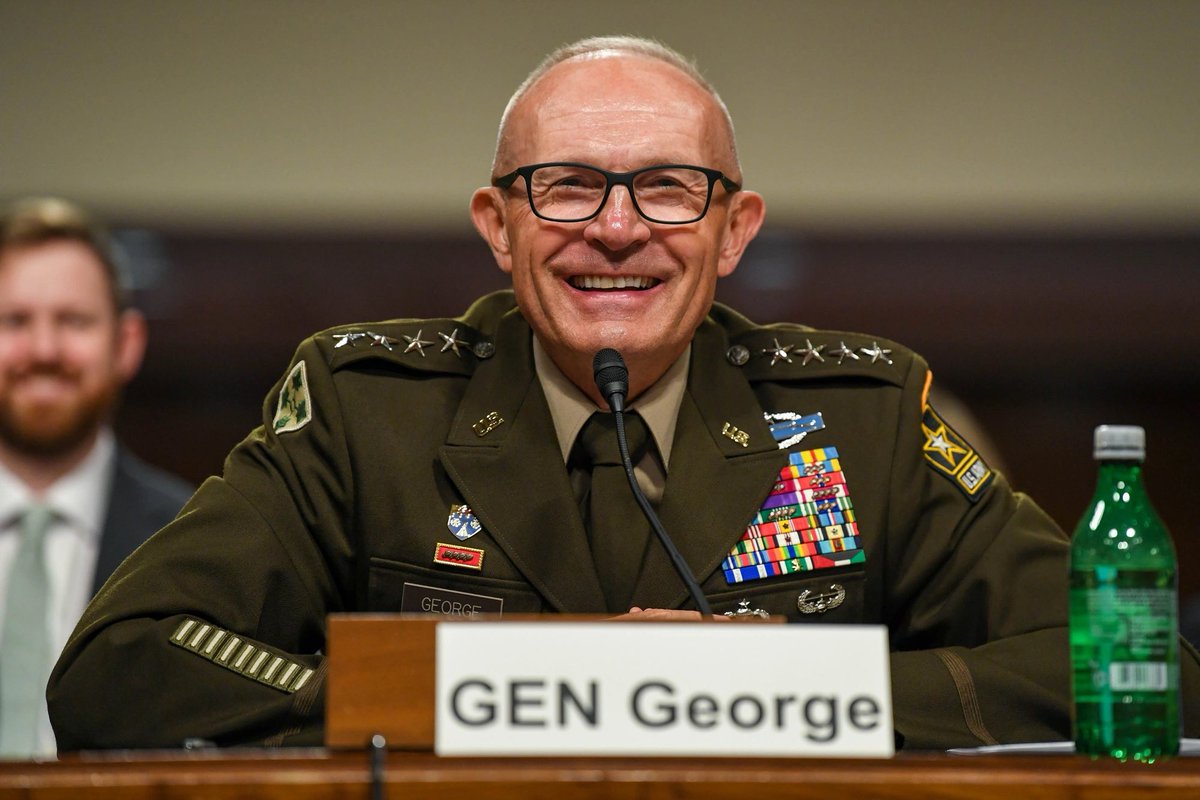
The comments calling me a traitor for revealing Army deployment secrets are absurd. You cannot load dozens of massive US Merchant Marine cargo ships and still maintain OPSEC. It is impossible. That is exactly why, from WW2 until 2025, the US Army relied on preloaded ships packed with tanks, munitions, and heavy equipment, prepositioned around the world and ready to go. Ships fully manned, loaded and ready to slip anchor and disappear in the night. I don’t think anyone deserves to hang but… General Randy A. George, US Army Chief of Staff, was the man who signed off on cancelling those prepo ship contracts last year. So if you want to arrest someone for treason, start here 👇👇👇
John Ʌ Konrad V tweet media
John Ʌ Konrad V@johnkonrad

Trump is NOT escalating this into a major ground war. Let me spell this out with crayons. I’m a US Merchant Marine Captain, O6 (not O3) equivalent. We are a tiny forgotten service with one MF overarching specialty: moving escalatory armies overseas. It’s true a general like McChrystal has far more knowledge about what to do AFTER his tanks roll off our ships. But BEFORE those tanks roll off? They are OUR cargo. We are the specialists. We climb all around those tanks. We secure them, move them, deliver them. Our Commandant, who I talk to every single week, is in charge of that lift. Not whatever general is waiting on the pier. Right now we are in the BEFORE stage. I absolutely 💯 know more about this than any general because I have spent decades training and living the life for THIS MOMENT. When generals want to move escalatory army divisions overseas, they call us. We don’t specialize in every branch. Naval, Air Force, USMC, Special Forces movements have their own lift pipelines. We can help, but that’s not our core mission. But if you want to escalate a war with heavy ground forces? I get a call. The Air Force has already called us to move more bombs into theater. So yes, the air campaign can escalate. But there are ZERO plans to escalate this into a large scale ground invasion. ZERO. This cannot be done by airlift. The USAF can’t even get their own bombs overseas right now, let alone divisions of army units. And if I do get the call, it will be months before we are landing tanks.​​​​​​​​​​​​​​​​ So I repeat… this CAN NOT turn into a major war without my phone ringing. You can send Marines and air assault units without tanks to do raids but a major landing force like McChrystal is talking about just is not happening. Not yet. Not for months, if ever. And when it does happen I will tell you because you can’t move Army divisions in secret. Not since the Army, in a moment of idiocy, sold off its Merchant Marine preposition fleet last year.

English
138
707
3.9K
304.7K
Jeff Steele retweetledi
Claremont Institute
Claremont Institute@ClaremontInst·
On April 7, at the Harvard Kennedy School, Michael Anton, Former Director of the State Department's Office of Policy Planning, will join former National Security Advisor Jake Sullivan for a debate on American foreign policy. Learn more here hks.harvard.edu/events/foreign…
English
27
38
228
45.8K
Fingolfin
Fingolfin@Fingolfin200·
@Old_But_Gold50s What symphony? There are two singers and an orchestra. No symphony.
English
1
0
1
107
Jeff Steele
Jeff Steele@Jeff__Steele·
Thank god for nuclear weapons. Ofc they don't make war impossible. They don't eliminate proxy conflicts, cyberattacks, economic coercion, gray-zone campaigns, or dangerous accidents/escalation ladders in a Taiwan crisis or South China Sea incident. But they do make unlimited, direct, existential great-power war between the two superpowers the least rational outcome imaginable.
GIF
English
1
0
1
43
The Myth of Sisyphus
The Myth of Sisyphus@MythDeSisyphus·
Prisoners' dilemma predicts war. Thucydides' trap predicts war. All human history predicts war. So, how does it really end?
English
1
0
0
18
The Myth of Sisyphus
The Myth of Sisyphus@MythDeSisyphus·
For the first time in human history, the world is dominated by two powers in true deadlock. Neither can defeat the other. Neither can exist without the other. Neither can afford to fall to second place. You blink, you lose.
English
1
0
0
33
Jeff Steele
Jeff Steele@Jeff__Steele·
Deneen's early peak oil phase (2007–2010 blog posts) presaged his postliberal turn by diagnosing liberalism's core flaw: its denial of limits (anthropological individualism, faith in endless progress/growth) depletes moral, cultural, and ecological foundations, thriving only on temporary abundance (fossil fuels then; later abstracted to broader depletion). This set up the unsustainability critique central to “Why Liberalism Failed” (2018), initially with a regretful, localist focus on bottom-up moral renewal. Mark Lilla, in his June 2024 NYRB essay on the postliberals "The Tower and the Sewer", describes Deneen’s evolution to “Regime Change” (2023) as a sharp shift: from mournful diagnosis to more radical, revolutionary tone, explicitly calling to "overthrow the liberal ideology of progress" via "aristopopulism," with elite "class traitors" guiding the demos through Machiavellian means for Aristotelian ends. Lilla attributes this radicalization to Vermeule's 2018 review ("Integration from Within," American Affairs), which praised the book but critiqued its quietism/localism and urged aggressive institutional capture to defeat liberalism outright, pushing Deneen toward top-down power assertion over patient percolation. archive.ph/Nkq0I
English
0
0
0
17
Phil Magness
Phil Magness@PhilWMagness·
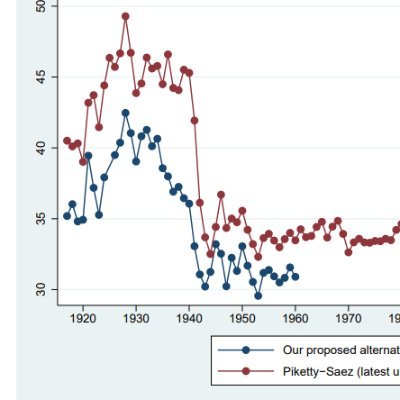
🧵When did the Postliberals start using the word "postliberalism" to refer to themselves?🧵 Turns out it was surprisingly recent.
English
2
8
56
6.2K
Jeff Steele
Jeff Steele@Jeff__Steele·
The first usage by Deneen I’m aware of is an influential 2012 First Things essay where he says: “Thus the liberal experiment contradicts itself, and a liberal society will inevitably become “postliberal.” The postliberal condition can retain many aspects that are regarded as liberalism’s triumphs…” firstthings.com/unsustainable-…
English
1
0
1
62
Phil Magness
Phil Magness@PhilWMagness·
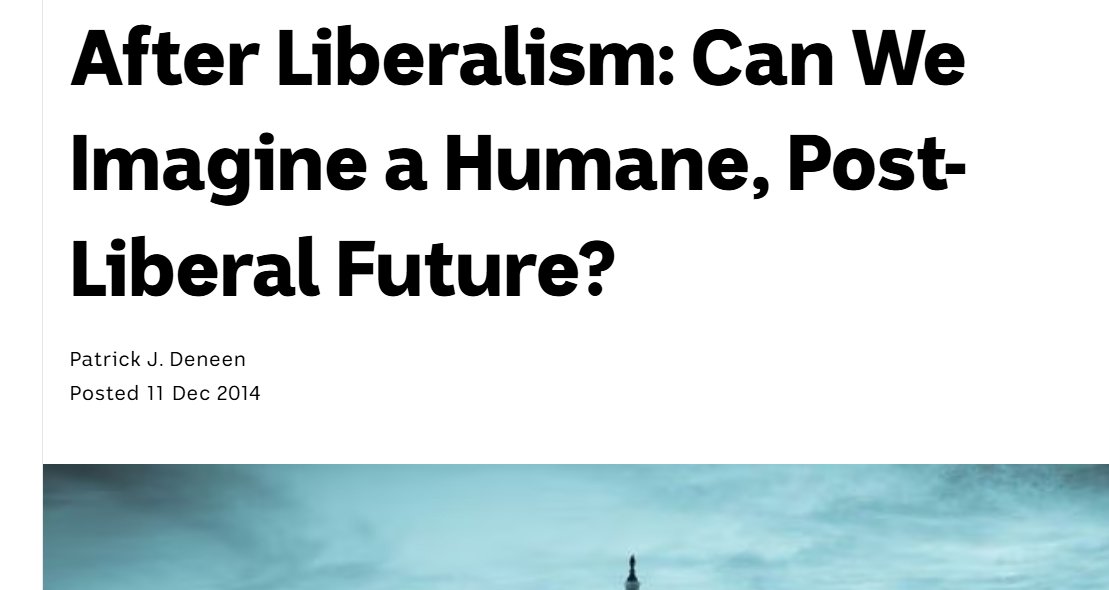
Patrick Deneen was the next adopter. He picked up the term no later than October 2014 in a lecture that he reprinted a few months later as a blog post. abc.net.au/religion/after…
Phil Magness tweet media
English
2
0
13
285