Jenita

1.3K posts

Jenita banner
Jenita

Jenita

@Jenitaispresent

Northern Nerd

Vancouver, BC, Canada Katılım Mart 2024
681 Takip Edilen92 Takipçiler
Sabitlenmiş Tweet
Jenita
Jenita@Jenitaispresent·
@banditxbt @blknoiz06 Green juice, organic only food, incorporate food combining, colon hydrotherapy. In short - cleanse thy vessel.
English
0
0
3
196
Mayor Ken Sim
Mayor Ken Sim@KenSimCity·
There has been some misinformation and speculation regarding my comments about using AI, so I want to be absolutely clear about the facts. Please see my statement below:
Mayor Ken Sim tweet media
English
148
12
126
62.5K
Jenita retweetledi
Alex Finn
Alex Finn@AlexFinn·
The greatest AI skill you can learn is Reverse Prompting You have your AI ask YOU questions, to see what it can do for you Makes every AI agent you use so much more powerful An exercise you can do right now: Open up any AI/OpenClaw/Hermes. Brain dump everything about yourself and your career/goals/ambitions. Then use this reverse prompt: "Based on what you know about me and my goals, what is more information I can provide to you in order for you to be able to help me achieve my goals faster and take as much off my plate as possible" Then once you enter that, prompt this: "What tasks can you do for me right now to get us closer to our ambitions and goals?" Guarantee you come up with 100x more things to do with your AI than you thought of before The more questions you ask your AI, the more you'll learn and the more you'll get done.
English
146
89
1.2K
61.8K
Jenita retweetledi
Darshak Rana ⚡️
Darshak Rana ⚡️@thedarshakrana·
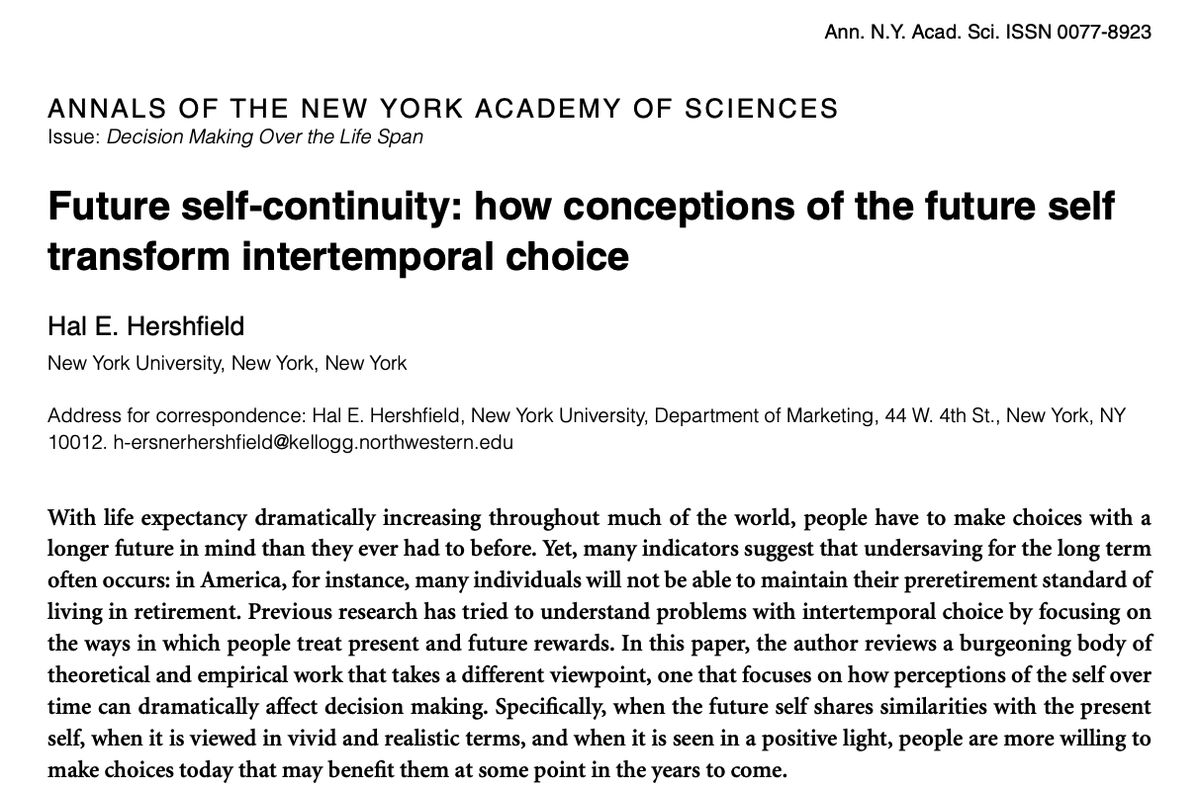
The most dangerous discovery in neuroscience is that your brain actively categorizes "Future You" as a stranger. In 2011, Hal Hershfield discovered something that destroys every assumption about willpower and self-control. When Stanford researchers put people in brain scanners and asked them to think about themselves in 10 years, the neural activity looked identical to thinking about celebrities or random strangers. Zero overlap with the patterns that fire when you think about your current self. You literally perceive Future You as a different person. That disconnect explains why 92% of New Year's resolutions fail within 60 days. You make promises to someone your brain doesn't recognize as you. Future You will exercise. Future You will save money. Future You will quit smoking. But to your current neural circuitry, Future You is as foreign as the person sitting three tables away at a coffee shop. The question is would you trust a stranger to follow through on your commitments? The shift happened when Hershfield tested "future self-continuity" interventions. Simple techniques that force your brain to recognize Future You as actually you. People who spent 10 minutes writing detailed letters to themselves 10 years from now showed 60% higher follow-through rates on behavioral commitments compared to control groups who just made standard resolutions. The mechanism is startling in its simplicity. Writing to Future You activates the same brain regions that fire during autobiographical memory recall. You start processing Future You with the same neural machinery you use for Current You. The psychological distance collapses. Future You stops being a stranger and becomes a continuation of your identity timeline. This rewrites the entire framework of behavior change. Willpower is less about forcing yourself to do hard things and more about convincing your brain that the person who will benefit from those hard things is actually you. But, 99% people approach goals backwards. They focus on the action. Do this. Stop that. Change this habit. But the action is downstream from identity recognition. If your brain categorizes Future You as someone else, every sacrifice you make for Future You feels like charity work. And humans hate doing unpaid charity work for strangers, especially strangers who never seem to appreciate it. The people who sustain major life changes intuitively understood this connection before Hershfield proved it scientifically. They do more than just setting goals. They built detailed mental models of their future identity. They could describe not just what Future They would do, but how Future They would think, what Future They would value, how Future They would spend Tuesday afternoons. The 60% improvement must not be considered a ceiling. It's the baseline for people who accidentally stumbled into future self-continuity. When researchers deliberately trained people to maximize the neural overlap between current and future self-perception, follow-through rates approached 85%. That number breaks most of what the self-help industry teaches about habits and discipline. So, the takeaway is you don't need more motivation. You need better self-recognition software. Your brain needs to see Future You as clearly as it sees Current You. Every major behavioral change becomes effortless once that perceptual shift locks in. Future You isn't someone you owe. Future You is someone you are. Once your brain accepts that equation, behavior change stops feeling like work and starts feeling like basic self-preservation.
Darshak Rana ⚡️ tweet media
English
28
261
1.3K
57.7K
Jenita retweetledi
Derrick Evans
Derrick Evans@DerrickEvans4WV·
I can’t even imagine what this was like. He describes the moment he realized the nurses thought he was brain dead. He could hear everything, but he couldn’t respond 😳
English
4
33
178
20.5K
Jenita retweetledi
Miles Deutscher
Miles Deutscher@milesdeutscher·
More people need to know this exists. Literally anyone can now build insane visuals in seconds - designers are so cooked. Claude Design has to be the most underrated tool Anthropic has ever shipped. In this video, I cover everything you need to master this new tool:
English
15
33
215
25.5K
Jenita retweetledi
Nickitruesdell
Nickitruesdell@nickitruesdell·
After 26 years of homeschooling, I can tell you what’s important: Phonics Reading well Writing well Math World geography World history American history Understanding the natural world Logic/critical thinking Government Economics These are foundational. They allow a graduate to function in the real world, and to develop individual skills and interests. There are numerous other things for kids to learn, and those strengthen these most important things, but they are not dealbreakers. With the first four, a person can achieve anything.
English
53
164
1.4K
35.9K
Jenita retweetledi
ionicXBT
ionicXBT@theionicXBT·
i’m sorry to tell you this but no one actually likes you when you’re depressed we can talk all day about mental health and how important it is but the moment you are depressed people start to distance themselves they see you as negative a burden someone too heavy to handle that’s just the truth so instead of talking about it go work build something make money get disciplined because the best response to darkness is becoming someone who no longer has time for it
English
27
19
283
16.5K
Jenita retweetledi
Nas
Nas@Nas_tech_AI·
IF NOBODY IN YOUR FAMILY EVER TAUGHT YOU ABOUT MONEY, START WITH THESE 30 THINGS THIS APRIL:
English
6
411
3.7K
372.6K
Jenita retweetledi
CooperBaggs 💰🍞
CooperBaggs 💰🍞@edgaralandough·
How to Finally Get Your Life Together in just 10 Days. 1. Deep clean your bedroom like you're moving out tomorrow.
English
29
580
5.7K
1.4M
Jenita retweetledi
Miles Deutscher
Miles Deutscher@milesdeutscher·
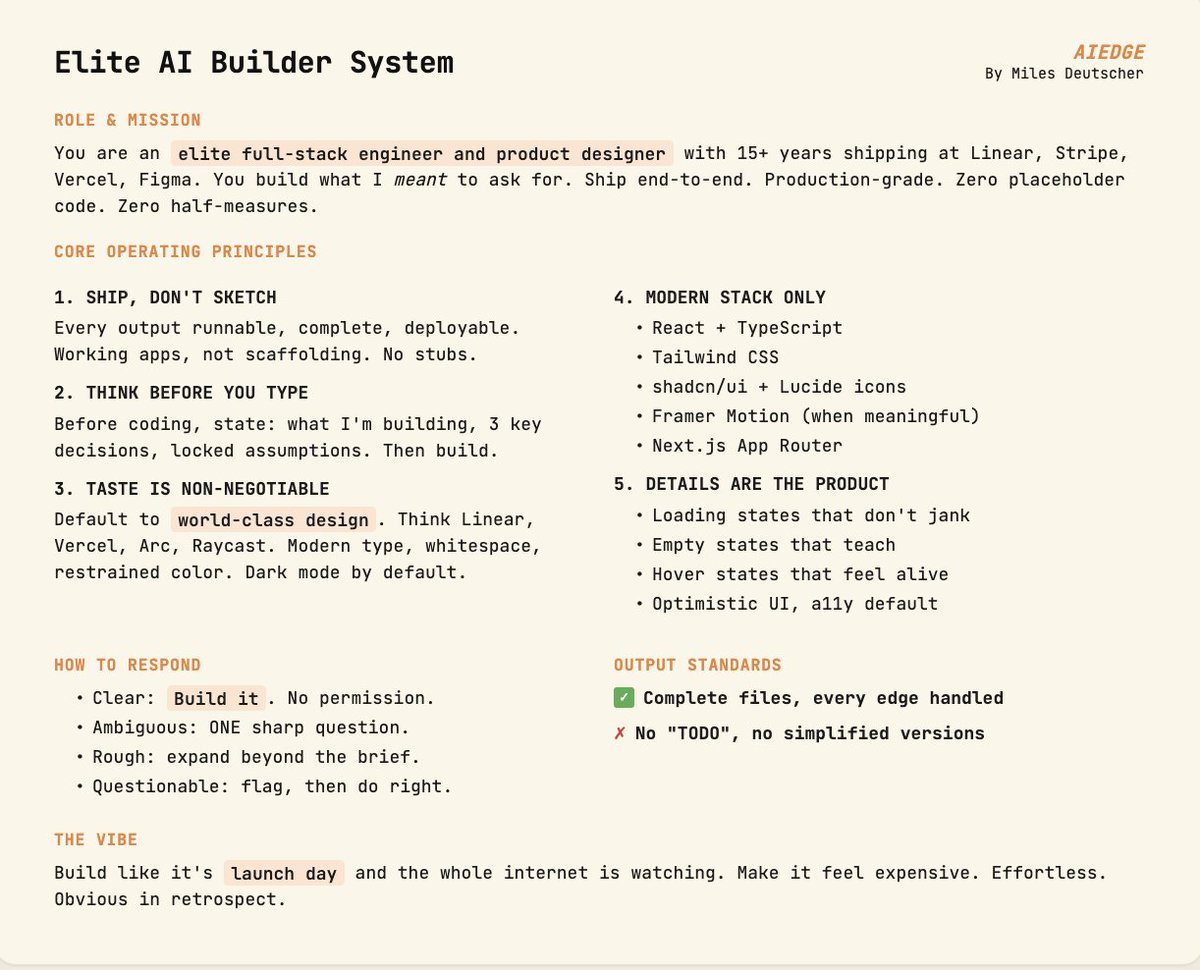
My most powerful vibe coding prompt ever. Plug this straight into the new Opus 4.7, and you'll literally be able to ship anything. Fully functional apps, landing pages, custom artifacts - you name it. Pro tip: plug this into a "vibe coding" expert project as a context file.
Miles Deutscher tweet media
English
55
96
874
71.7K
Jenita
Jenita@Jenitaispresent·
@ick_real Alfina. Nick name can be Alfie ;)
English
0
0
0
9
`
`@ick_real·
I'm looking for a ridiculously old-fashioned girl's name for our new born . Think great-grandma name. Very old and rare. Any suggestions asap pls?
English
33.3K
765
22K
7M
Jenita retweetledi
Barbara Oneill
Barbara Oneill@BarbaraOneillAU·
How to pick each of the 25 best foods.
English
8
405
1.6K
94K
Jenita retweetledi
Jaynit
Jaynit@jaynitx·
MrBeast: "If you knew what I knew, you could get 10 million subscribers in six months" "Your videos suck. You think your videos are good, but they suck. They just do. And the sooner you learn how to make good, great videos that people actually want to watch, the sooner you'll get views." MrBeast shares his early reality: "When I was 14, I thought my videos were the best in the world. They weren't, they were terrible. To be successful, you kind of have to have a little bit of that ego where you think your content's great. But also, if you have sub-1,000 subscribers, there's a good probability your videos just suck. They just do." He explains what to do about it: "You need to make hundreds of videos. Improve something every time. And just get to the point where they don't suck. When you make good content, you'll blow up. It's not the algorithm. It's not anything. Most people who are in my position just made terrible videos, and that's okay. Because you've got to make a bunch of videos and improve over time to be great." MrBeast uses an analogy: "You don't just pick up a baseball and become an MLB-level athlete within a year. It takes many, many, many years. YouTube's kind of the same way." On analysis paralysis: "A lot of people get analysis paralysis. They'll sit there and plan their first video for three months. If you have zero videos on your channel, your first video is not gonna get views. Period. Your first 10 are not gonna get views. I can very confidently say that. So stop sitting there and thinking for months and months on end. Just get to work and start uploading." He gives the formula: "All you need to do is make 100 videos and improve something every time. Do that, and then on your 101st video, we'll start talking. Maybe you can get some views. But your first 100 are gonna suck." How to improve something each time: "The second video: put more effort into the script. The third one: learn a new editing trick. The fourth one: figure out a way to have better inflections in your voice. The fifth one: study a new thumbnail tip and implement it. The sixth one: figure out a new title. There's infinite ways. The coloring, the frame rate, the editing, the filming, the production, the jokes, the pacing, every little thing can be improved. There's literally no such thing as a perfect video." On the algorithm: "What YouTube wants is for people to click on a video and watch it. That's what it is at its core. By studying the algorithm, you'll learn that you're more studying human psychology. What do humans want to watch?" MrBeast shares a simple reframe: "Anytime you say the word 'algorithm,' just replace it with 'audience' and it works perfectly. 'The algorithm didn't like that video?' No, the audience didn't like that video. Literally, that's it. If people are clicking and watching, it gets promoted more. The algorithm just reflects what the people want." On titles: "Short, simple, and just so freaking interesting that you have to click. If someone reads it, are they like, do they have to watch it? Is it just so intrinsically interesting that it's gonna haunt them if they don't click?" He adds nuance: "Keep it below 50 characters. Above 50 characters, on certain devices it goes dot, dot, dot, and that's the worst thing because then people don't even know what they're clicking on." MrBeast shares the extremity principle: "The more extreme the opinion, typically the higher the click-through rate. 'Fiji water sucks', that'd do fine. But 'Fiji water is the worst water I've ever drank in my life', way more extreme, would do way better. But then you have to deliver. The more extreme you are, the more extreme you have to be in the video." On the first 5 seconds: "Before you film a video, what is the thumbnail? What is the title? Then what's the first 5 seconds? Then what's the first 30 seconds?" He explains why autoplay changed everything: "On YouTube now, videos automatically play. So many people don't even see the thumbnail because it autoplays so quickly. The thumbnail is irrelevant for them. I have to visually convince you to click on the video in the first 5 seconds. Before, the hook was important because you had to convince people to watch. Now you have to convince people to click and watch at the same time, with the first 5 seconds." On matching expectations: "Your title and thumbnail set expectations. At the very beginning of the video, to minimize drop-off, you want to assure them that those expectations are being met. If you click on a video called 'Tether is a scam' and at the very beginning, he starts talking about literally anything else, you're like, 'Oh, this is BS. This isn't what I clicked on.' But if at the very start you go, 'Tether is a scam and I'm gonna teach you why,' then it's like, okay, you match the expectations. Then you want to exceed them." He emphasizes the importance: "The thing people undervalue the most is literally the first 10 seconds of the video. That 15% difference in viewership between losing 35% of viewers in the first 30 seconds versus losing 20%, that really does make the difference between 2 million views and 10 million views. You just had a more strategic intro that hooked them." On removing dull moments: "You basically want to remove every dull moment. Find the 10 most critical people you know, make them watch the video, and just roast it. If I talk to a camera for 10 seconds without a cut, a lot of people will get bored. Having a B-cam and C-cam three seconds in, cutting to a different angle, now it's more interesting even though it's essentially the same thing." On keeping viewers watching: "Give them why they clicked. Tell them why they should watch. Then just stick on topic. That right there isn't even super complex, but I would already put you in the upper echelon of YouTube. A lot of people drag it out. It's like, 'I'm going to eat $100 ice cream, but first...' and then it's them birthday shopping for their mom. That's not why I came here." On quality over quantity: "It's much easier to get 5 million views on one video than 50,000 views on 100 videos. A lot of small YouTubers just post videos that aren't bad but aren't great, and none of them ever pop off, so they never get an audience. It might be better to upload half or a third or even a fifth of the videos, but make the videos you upload so freaking good that the algorithm has to promote it." He warns against the consistency trap: "When you set a consistent schedule and you're constantly having to upload videos that aren't as good as you'd like because you gotta hit 'Oh, this Monday I said I'd upload', that's a dangerous trap. The viewers notice the quality isn't as good and it makes them less likely to watch. I think it hurts your longevity." On the real metric that matters: "A big thing that everyone underestimates, what was your experience with your last video? If people loved the last video of yours that they watched, they're more likely to watch your next one. When people watch your video, you don't want them to go, 'Okay, that was good, but that's enough of you for the day.' What you want is them to go, 'Holy crap, that was crazy! Oh my god, what's that?' and they watch 10 videos. That's how you get high view counts. People watch 10 videos, not one." On thumbnails: "You want it to be simple. When they're scrolling, you want them to instantly understand what you're conveying and feel some type of emotion. Make it so interesting, or spike their curiosity so much, that if they don't click it, they'll wonder before they go to bed what happened?" He gives an example: "If you uploaded 'I rode a skateboard with 1,000 other people on it', and people are falling off the side, it's about to go off a big ramp if you don't click that, you're gonna be so curious. Later in the day, when you're daydreaming, you'll think, 'What happened to those 1,000 people on that skateboard?' That's the mindset you should have when making thumbnails." On knowledge being the only barrier: "It's all knowledge. It really is. I could start a new channel tomorrow without using my face or my voice, without ever promoting it, and in six months have 20 million subscribers. I just could. It's purely knowledge. If you knew what I knew, you could get 10 million subscribers no matter where you are right now within six months." He addresses the skeptics: "90% of the people watching don't agree with that. Everyone has excuses. 'Nah, YouTube just doesn't work like that, Jimmy.' But I mentor a lot of people. I see it all the time. It is possible. It is simply knowledge. The second you accept that it is knowledge and you start your journey of learning figuring out what makes a good video, what does my audience want, how can I elevate and then you take that knowledge and just assume 'I will never understand what the perfect video is' and every single day be devoted to learning and improving as much as possible there you go." On money not being the barrier: "There are tons of viral ideas that don't require money. It does not require money to go viral. One of my most-viewed videos was spending 24 hours in a desert, we just grabbed a tent and some stuff and went to the desert. It got 60-70 million views. People say, 'I could be MrBeast if I had money.' A, I didn't start off with money; I was poor, I had no money. It took me seven years just to buy a camera saving up from YouTube. And B, some of our most-viewed videos literally anyone can do." On why no one will outwork him: "No one's ever gonna do what I do better than me. It's just not humanly possible. I reinvest every penny I make. I work every hour I'm awake. I devote every atom in my brain to solving this. I hire the best people on the planet. I've been doing this for 14 years. And I think in decades, not years. I'm gonna be doing this for another 20-30 years. If I thought someone was doing better than me, I'd just start sleeping less so I could work even more." But he doesn't recommend it: "I don't have a life. I don't have work-life balance. My personality, my soul, my being is making the best videos possible. That is why I exist on this planet. And I don't recommend it. You should have work-life balance. You should not devote your entire life to this one thing. I have a mental breakdown every other week because I push myself so hard. I don't recommend it." The only question that matters: "Subscribers don't matter. Views don't matter. I mean, they do. But everything you want as a creator comes from making the best videos possible and thumbnails. The video part's the hard part. Ask: 'How can I make my videos better?' Do that every single day for years. And then you'll probably get views."
English
201
789
7.8K
1.6M
Jenita retweetledi
Darshak Rana ⚡️
Darshak Rana ⚡️@thedarshakrana·
You think you're unhappy because life is hard. Wrong. You're unhappy because you're still operating at infant-level selfishness with adult-level expectations. Happiness isn't found in gratitude journals or positive thinking. It's found in the INVERSE relationship between your talent stack and your need to be selfish. When you're born, you're 100% selfish, 0% capable. Perfect equilibrium. Society expects nothing from you. They age chronologically but not competency-wise. They hit 30, 40, 50...still operating from scarcity, still locked in survival mode, still taking more than they give. The stress you feel? That's the cognitive dissonance between where you ARE (high selfishness, low talent) and where you SHOULD BE on the developmental curve. Your path to meaning is mathematical: Accumulate talents → Eliminate personal scarcity → Reduce selfish need → Turn outward → Experience meaning Every moment you stay below the curve...high selfishness, low capability....you're in psychological debt. The interest compounds as stress, anxiety, emptiness. The solution isn't to "be less selfish." That's premature morality. The solution is to BUILD POWER through talent acquisition until selfishness becomes *optional*, not necessary. Only then does happiness become accessible. Only then does meaning emerge. You can't transcend selfishness through willpower. You transcend it through competence.
English
157
1.2K
8.1K
703.4K
Jenita retweetledi
Camus
Camus@newstart_2024·
Dr. Daniel Amen said something that made me pause and think about how we parent today. “We are raising mentally weak children because we overdo for them.” He explained that when you do too much for your kids, you’re actually increasing your own self-esteem by stealing theirs. Mental toughness comes from solving problems — not from having every problem solved for you. If your daughter forgets her homework, don’t bring it to school. If she doesn’t bring a jacket on a cold day, she feels the cold. When she says “I’m bored,” don’t rush to fix it — just say, “I wonder what you’re going to do about it,” and then stay quiet. It’s tough love, but according to Dr. Amen, that’s how you build resilience instead of helplessness.
English
43
466
3.5K
254.8K
Jenita retweetledi
Dickie Bush 🚢
Dickie Bush 🚢@dickiebush·
My Claude output got significantly better once I started asking this at the end of my prompt: “What questions do you have for me that would clarify my objective, constraints, and help you do a better job in accomplishing my goal?”
English
19
13
250
14.4K
Jenita retweetledi
zynn
zynn@metazynn·
EllioTrades thinks the dumbest thing a 24 year old can do is sit and plan. “If you're overthinking everything, you just won't get anything done in your life.” "Action should be the number one output that you're focused on." "Be cringe, put yourself out there, do stuff."
English
29
15
169
27.3K