@petergyang I think the issue is there’s a large swath of people that feel they can’t do that Europe or Asia lifestyle without the nest egg that the labs or FAANG offer
English
Jeremy
187 posts

@JeremyVarkey
Descendent of Aladdin

The vibes in SF feel pretty frenetic right now. The divide in outcomes is the worst I've ever seen. Over the last 5yrs, a group of ~10k people - employees at Anthropic, OpenAI, xAI, Nvidia, Meta TBD, founders - have hit retirement wealth of well above $20M (back of the envelope AI estimation). Everyone outside that group feels like they can work their well-paying (but <$500k) job for their whole life and never get there. Worse yet, layoffs are in full swing. Many software engineers feel like their life's skill is no longer useful. The day to day role of most jobs has changed overnight with AI. As a result, 1. The corporate ladder looks like the wrong building to climb. Everyone's trying to align with a new set of career "paths": should I be a founder? Is it too late to join Anthropic / OpenAI? should I get into AI? what company stock will 10x next? People are demanding higher salaries and switching jobs more and more. 2. There’s a deep malaise about work (and its future). Why even work at all for “peanuts”? Will my job even exist in a few years? Many feel helpless. You hear the “permanent underclass” conversation a lot, esp from young people. It's hard to focus on doing good work when you think "man, if I joined Anthropic 2yrs ago, I could retire" 3. The mid to late middle managers feel paralyzed. Many have families and don't feel like they have the energy or network to just "start a company". They don't particularly have any AI skills. They see the writing on the wall: middle management is being hollowed out in many companies. 4. The rich aren’t particularly happy either. No one is shedding tears for them (and rightfully so). But those who have "made it" experience a profound lack of purpose too. Some have gone from <$150k to >$50M in a few years with no ramp. It flips your life plans upside down. For some, comparison is the thief of joy. For some, they escape to NYC to "live life". For others still, they start companies "just cuz", often to win status points. They never imagined that by age 30, they'd be set. I once asked a post-economic founder friend why they didn't just sell the co and they said "and do what? right now, everyone wants to talk to me. if i sell, I will only have money." I understand that many reading this scoff at the champagne problems of the valley. Society is warped in this tech bubble. What is often well-off anywhere else in the world is bang average here. Unlike many other places, tenure, intelligence and hard work can be loosely correlated with outcomes in the Bay. Living through a societally transformative gold rush in that environment can be paralyzing. "Am I in the right place? Should I move? Is there time still left? Am I gonna make it?" It psychologically torments many who have moved here in search of "success". Ironically, a frequent side effect of this torment is to spin up the very products making everyone rich in hopes that you too can vibecode your path to economic enlightenment.

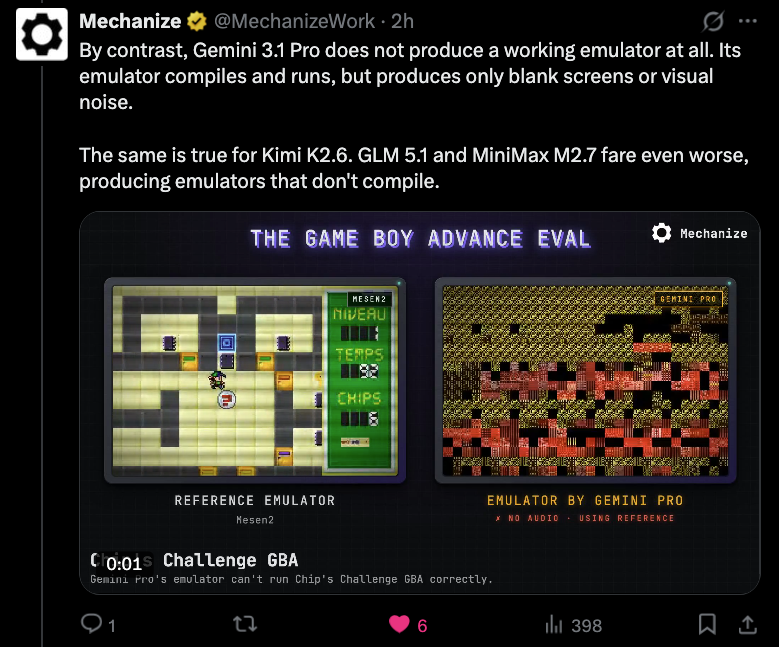
Here's how each model scored over 24 hours of wall-clock time, on a single attempt. GPT-5.5 performs best, with a late gain in the final hours. Claude models settle in by hour 8 and cluster within noise. More at: gbaeval.com/leaderboard


The FT says that Amazon employees are doing random unnecessary task automations to consume tokens and to show their bosses that they're using AI more ft.com/content/8ee0d3…

Gordon Ramsay on what it really takes to run a successful restaurant: That $25 cheeseburger isn’t a rip-off. It’s a thick, high-quality patty (chuck + short rib blend), a proper brioche bun, and premium toppings. But the real killers behind high prices? Brutal rent and labor costs. Landlords raise the rent when you succeed… and still demand it when you struggle. Ramsay’s best tell for a truly great restaurant: It’s packed on a Monday night. Weekends fill themselves. Surviving (and thriving) on slow nights is what separates the winners. Restaurant prices look insane until you see the brutal economics of keeping the doors open every single day. I’ve always liked Ramsay’s no-nonsense style, and this is a perfect example — a busy restaurant on a quiet weekday is often one of the best signs of real quality. What do you think — is a packed Monday night the ultimate test of a good restaurant, or do you have a better tell?



Some rough math! (All napkin math...) Assume Colossus 1 has 220k GPUs Assume 150k H100s, 50k H200s, 20k GB200s Pricing Assumptions: - $2.30 / hour for H100s - $2.60 / hour for H200s - $5 / hour for GB200s - blended rental rate across the entire fleet of $2.60 / hour Assume it's all take-or-pay style deals (you pay for 24x365 usage) This translates to ~$5b of annual rev to Xai. We have a new neocloud! On top of that - on recent Dwarkesh podcast, Dario ran through some napkin math on unit economics (he framed it all as industry math vs Anthropic specific - which is important, he wasn't disclosing anything Anthropic specific). What he mentioned was take $100b of compute spend (he just picked a round number). There will be a mix shift of that spend between training and inference. Skew too much on training and you don't generate enough revenue. Skew too heavy on inference and you kneecap future R&D progress. He thought the industry is currently 50/50 on training / inference of compute spend. He said as in industry, could turn that $50b inference spend into $150b of revenue (called out these are most likely the unit economics of the industry in 1-2 years) So taking this back to the Xai deal. Under above assumptions, Anthropic paying $5b / year. Let's say they turn that into $15b / year in rev (60-70% gross margin) Win win!!




FIRE is broadly unattractive, hence its rarity but it seems oddly popular for software engineers, perhaps b/c of big early comp + age discrimination?
It’s clear that AI will wind up funding universal income. Let’s make that happen ASAP.
We've signed an agreement with Google and Broadcom for multiple gigawatts of next-generation TPU capacity, coming online starting in 2027, to train and serve frontier Claude models.




We are in the golden age of AI. Go thank a VC near you. A $200 monthly subscription to Claude can consume $5,000 in compute. This reminds me of when I was in college and Ubers were $3.