

Jochen Metzger
83 posts
Jochen Metzger
@JochenMetzger1
Science journalist, freelance. Psychologie Heute (@psyheu), Geo (@geomagazin), P.M. (@pm_online), brand eins (@brandeins), Podcast "Sag mal, du als Psychologin"
Hamburg/GER Katılım Mart 2013
90 Takip Edilen45 Takipçiler

Humbled and honoured to be featured on this year's 40-under-40 list for Germany by @capitalMagazin along with so many fantastic people who are working towards a better tomorrow in society, science, politics, and business.

English
Jochen Metzger retweetledi

A review in Nature, by @candice_odgers, asserts that I have mistaken correlation for causation and that “there is no evidence that using these platforms is rewiring children’s brains or driving an epidemic of mental illness.” Both of these assertions are untrue.
nature.com/articles/d4158…
@zachmrausch and I have been collecting the published studies on both sides since 2019, organizing them, and making them available for public viewing and commenting, in multiple Google docs available here:
anxiousgeneration.com/resources/coll…
In the “social media and mental health” doc, we currently list 22 experimental studies (16 of which found significant evidence of harm) and 9 quasi-experiments (8 of which found evidence of harm. Odgers cited only the 9th one.) We also examine the many meta-analyses and review papers. I lay out the evidence for causality (not just correlation) and walk the reader through the Google doc in this post at After Babel:
afterbabel.com/p/social-media…
People really need to stop saying that the evidence is “just correlational.” Sure, there are a lot of correlational studies (79 in our Google doc, of which 64 found significant correlations with variables related to poor mental health.) But there are also many experiments supporting my claims of causation.
I’ll write a post at Afterbabel.com in April responding more fully to the arguments of the skeptics (including Odgers). For now, I point interested readers to a post in which I laid out 6 problems with the way that the skeptics have conceptualized the debate:
afterbabel.com/p/why-some-res…
I just want to note two more problems with Odgers’ review.
First: She says that I am offering a simplistic one-factor explanation: it’s social media! But I am not. My story is about two major factors (end of the play-based childhood, rise of the phone-based childhood), each of which has many components that bring a variety of harms to different children in different ways. My book is full of lists of causal pathways. There is no one causal pathway that, on its own, explains “the kind of large effects suggested by Haidt.” Yet when you add up all the different ways that the phone-based childhood is harming different kids, some of which we learned about in that Senate hearing on January 31, you end up with a lot of kids being harmed in many ways, and these many harms combined can easily explain the “large effects” even though most pathways affect only a subset of kids.
Yet Odgers and the other skeptics focus intently on studies that operationalize social media in one crude way (total # of hours per day), and then correlate that number with some measure of anxiety, depression, or other mental ailment. When the correlations turn out to be around r = .15 for girls (which is actually a number we agree on, as I explain in the previous link), the skeptics conclude that this is not large enough--by itself--to explain the epidemic, so social media must be only a trivial contributor to the epidemic. This is an error caused by an overly narrow operationalization of a complex phenomenon: the radical transformation of daily life that happened for teens between 2010 and 2015. Only a sliver of the story is captured by the crude measure of “hours per day” on social media.
The skeptics’ skepticism would be more compelling if they had an alternative explanation for the multi-national decline in mental health that happened in the early 2010s, but they do not. Odgers claims that the “real causes” of the crisis, from which my book “might distract us from effectively responding,” are the lingering effects of the 2008 Global Financial Crisis, which had lasting effects on “families in the bottom 20% of the income distribution,” who were “also growing up at the time of an opioid crisis, school shootings, and increasing unrest because of racial and sexual discrimination and violence.”
I agree that those things are all bad for human development, but Odgers’ theory cannot explain why rates of anxiety and depression were generally flat in the 2000s and then suddenly shot upward roughly four years after the start of the Global Financial Crisis. Did life in America suddenly get that much worse during President Obama’s 2nd term, as the economy was steadily improving?
Her theory also cannot explain why adolescent mental health collapsed in similar ways around the same time in Canada, the UK, Australia, and New Zealand, as Zach and I have shown:
afterbabel.com/p/internationa…
Nor can she explain why it also happened in the Nordic countries, which lack most of the social pathologies on Odgers’ list:
afterbabel.com/p/internationa…
Nor why it also happened in much of Western Europe:
afterbabel.com/p/internationa…
Nor why suicide rates for Gen Z girls (but not alway boys) are at record levels across the Anglosphere:
afterbabel.com/p/anglo-teen-s…
I just can’t see a causal path by which America’s school shootings, lockdown drills, inequality, or racism caused girls in Australia to suddenly start self-harming or dying by suicide at the same time as American girls.
In short: There is a great deal of evidence for my claims that something terrible is happening to teens in many countries, and that a major contributing factor is the sudden international arrival of the phone-based childhood. I lay out this evidence––with hundreds of footnotes––in chapters 1, 5, 6, and 7 of The Anxious Generation. I have also laid it out in many posts at AfterBabel.com. All along, Zach and I have “shown our work” in public Google Docs and Substack posts, and we have invited others to critique it. Zach has made supplemental files for every chapter in The Anxious Generation, which give links to the datasets and data points that he used to create the graphs in the book. We invite you to check our work:
anxiousgeneration.com/resources/supp…
Our work has benefited from cordial, normal, academic debates with the skeptics. We will continue to welcome their critiques. But please, everyone, stop saying that the evidence is “just correlational.”
English
Jochen Metzger retweetledi
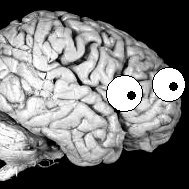
"Mind uploading" is often discussed but it is impossible. The mind is not software running on the brain. It is the activity of the brain. You can't upload a mind from a brain, any more than you could upload the spinning from a wheel.
English
Jochen Metzger retweetledi

What changed today: the simple version.
There is no reason to use the free version of ChatGPT anymore. That uses GPT-3.5 and is outclassed by Bard (as of today) and Claude, both of which are free.
But you should probably be using GPT-4, which is still dominant & is free in Bing
English
Jochen Metzger retweetledi

Proposed Theorem: it’s impossible to acquire super humanity skills when relying purely on data created by humanity.
Why do I say super humanity and not super human? Because for example a translation algorithm is already better than any single human in terms of how many languages it can translate between.
But it’s unclear you can get super humanity language skills if you train on human language. A language beyond human understanding could include massive parallelism that humans could not comprehend as our language processing is pretty serial. But it's otherwise unclear what super humanity language skills even mean since language is a human construct and invention.
That's why we see many simpler benchmarks flatten to an s curve just around human annotator skills now.
The connection between complex thought and language is also an interesting question in this regard.
Humanity is partially so intelligent collectively because we have different kinds of people. Some like staying in their home town and enjoy daily life as it is and has been. Some venture out in the literal or figurative darkness and Want to explore.
What that means is that we need better simulations and more creative exploration of a search space and potentially multiple agents that require interaction to solve goals they agreed on together.
English
@emollick Same with „Pi“ by the way. Amazing conversational skills for weeks. Cheesy and not exactly empathetic this week. Following your „a guy called Steve“ heuristic I felt like I was talking to a different person.
English
If you check back on Google Bard, they have quietly added a big bunch of features (still, sadly, powered by PaLM 2, so mostly a waster today)
Bing just keeps fiddling with things, so prompts that worked sometimes fail or work better
Claude 2 is seeming "smarter" but who knows?
English
All the Frontier LLMs are changing without notice constantly
In the last week OpenAI's systems clearly got overwhelmed and a whole bunch of stuff that worked really well a week ago got throttled. But that is this week. Next week things might go back to normal or improve suddenly
English
Have been a huge fan of Lisa’s work for years. But boy: This is one of the most inspiring podcast episodes I have heard in a long time.
Lisa Feldman Barrett@LFeldmanBarrett
The new @HubermanLab podcast is now available! Thanks so much, Andrew, for a truly enjoyable & thought-provoking discussion about the science of emotion. hubermanlab.com/episode/dr-lis…
English
Jochen Metzger retweetledi

In 2006, I was 1 of 4 designers on Google Search.
For 20 years, every search engine has copied Google.
Now ChatGPT, Bard + Claude look like Google's offspring - "better” search engines.
But last week signaled we're on the brink of a design revolution.
ChatGPT unveiled incredible new features.
These could give us the opportunity to completely shift how we interface with AI.
Here's the full story:
–––
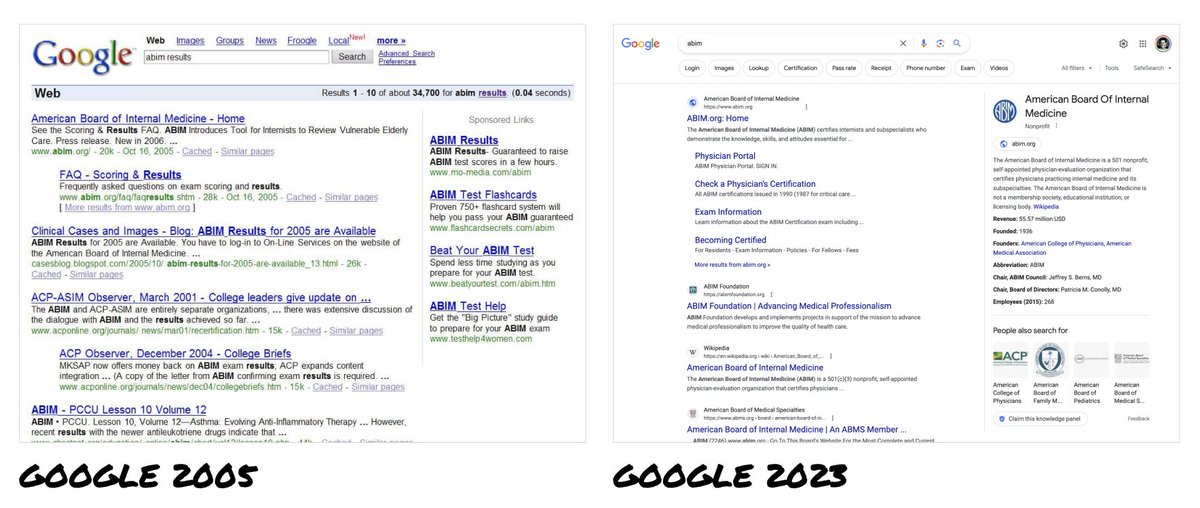
When I was a designer on Google Search, all major search engines looked the same – Google, Yahoo, MSN Bing.
Google was the market leader with a heavily optimized UI that supported billions of dollars in ad revenue.
Naturally, it became THE way to show search results.
Its success made it illogical for Google to consider big UI changes.
And any changes they did make were just mirrored by everyone else.
So 20 years later, we’ve only seen incremental changes to search engine UIs.
–––
Today, we have consumer-ready LLMs (Large Language Models) freshly in our hands.
As consumer products, these are in their infancy.
We’re very early in understanding their capabilities and defining how people interact with them.
These are uncharted waters.
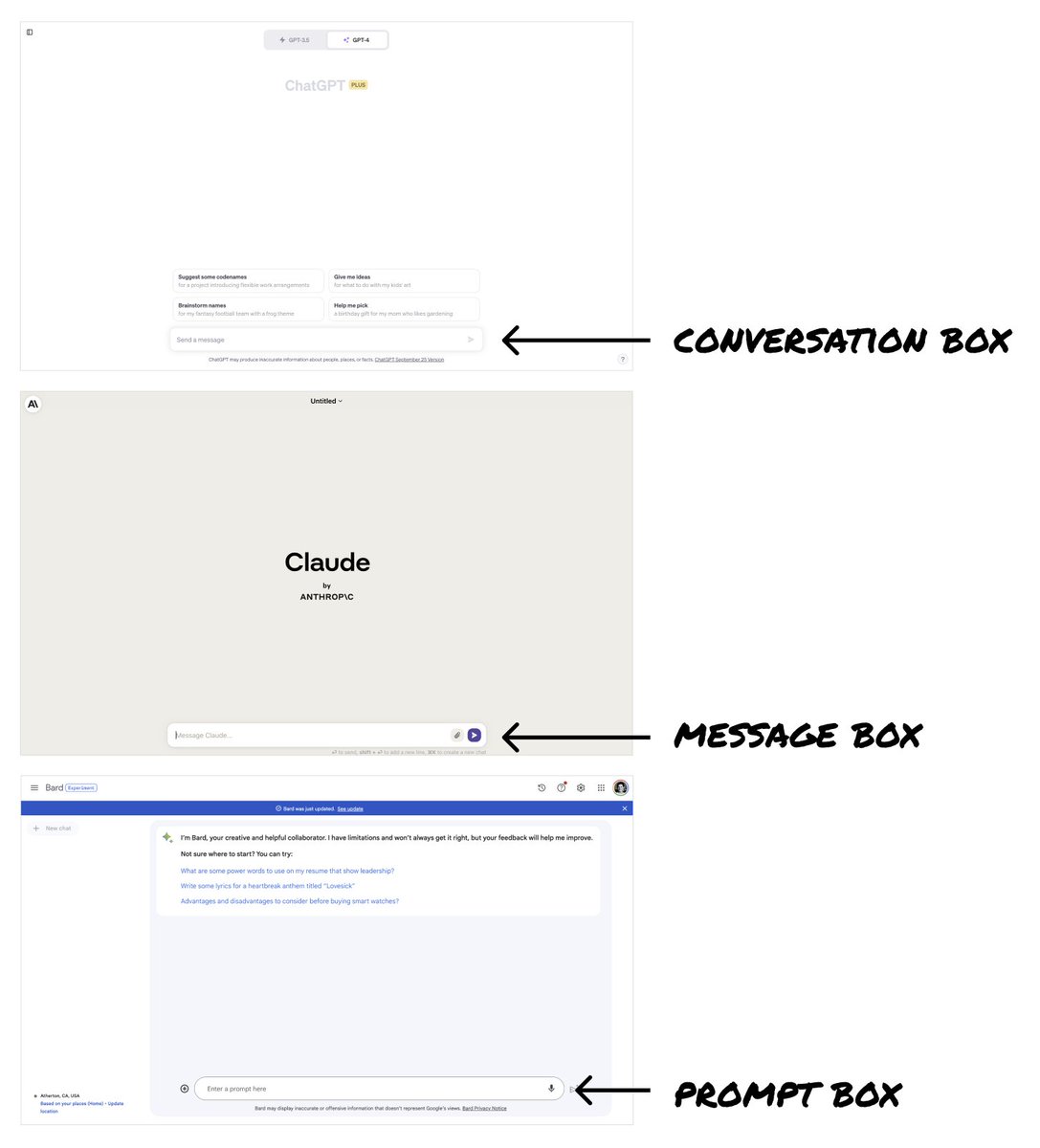
And yet ChatGPT, Bard, Claude etc. all chose a text-based input box — just like Google’s search box — as the core interface.
Why?
The input box is simple, versatile, and familiar.
- It’s simple to understand → you type your questions into the box.
- It’s versatile → the box can handle all sorts of questions/queries.
- The paradigm is super familiar → people immediately know how to use it.
Because of this, LLMs have essentially become “a better Google.”
–––
But last week’s ChatGPT announcements thrust open the doors to new possibilities.
ChatGPT is now multi-modal — it can see, hear, and speak.
These are the recent announcements from @OpenAI :
Voice: x.com/openai/status/…
Photos: x.com/openai/status/…
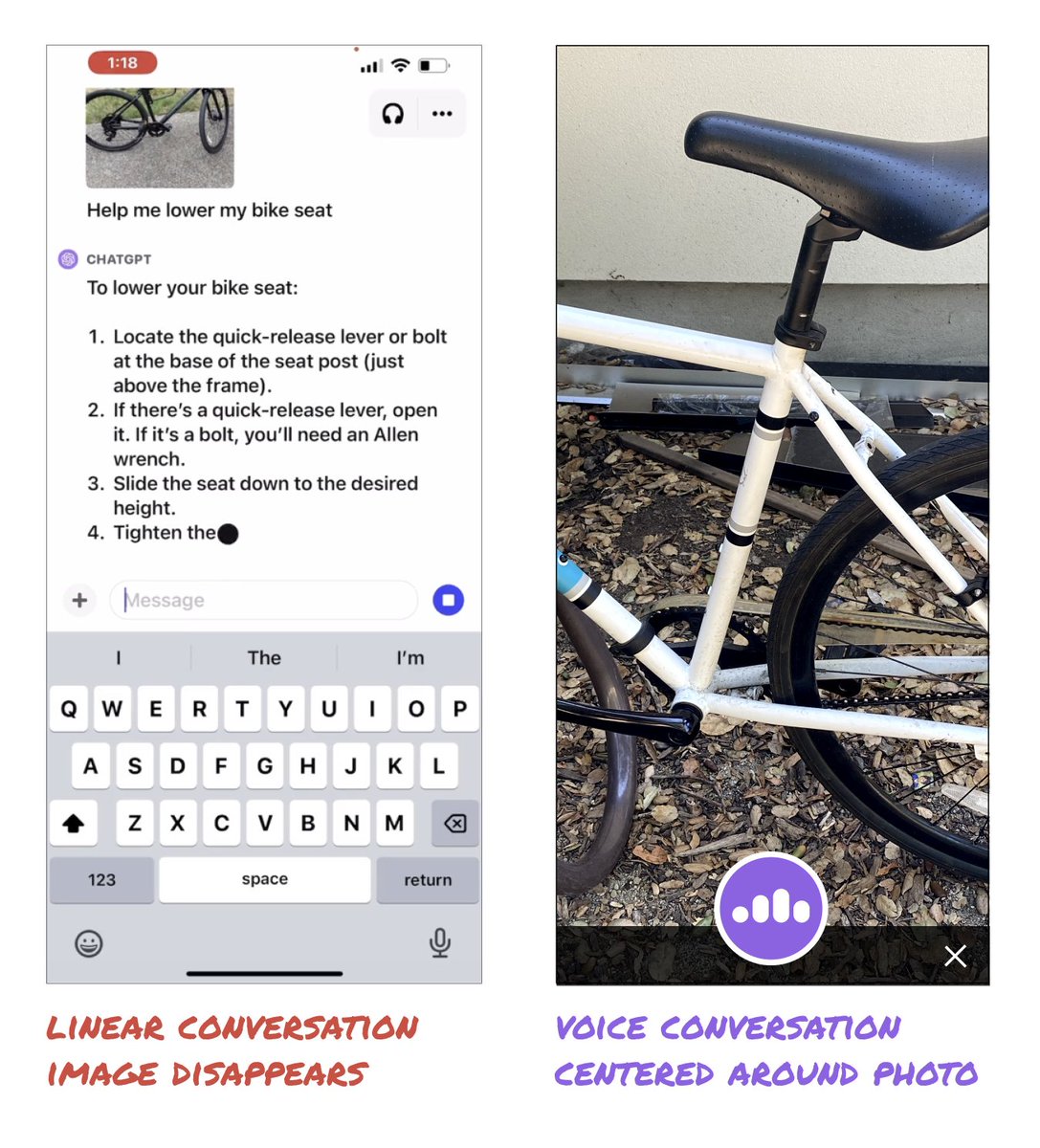
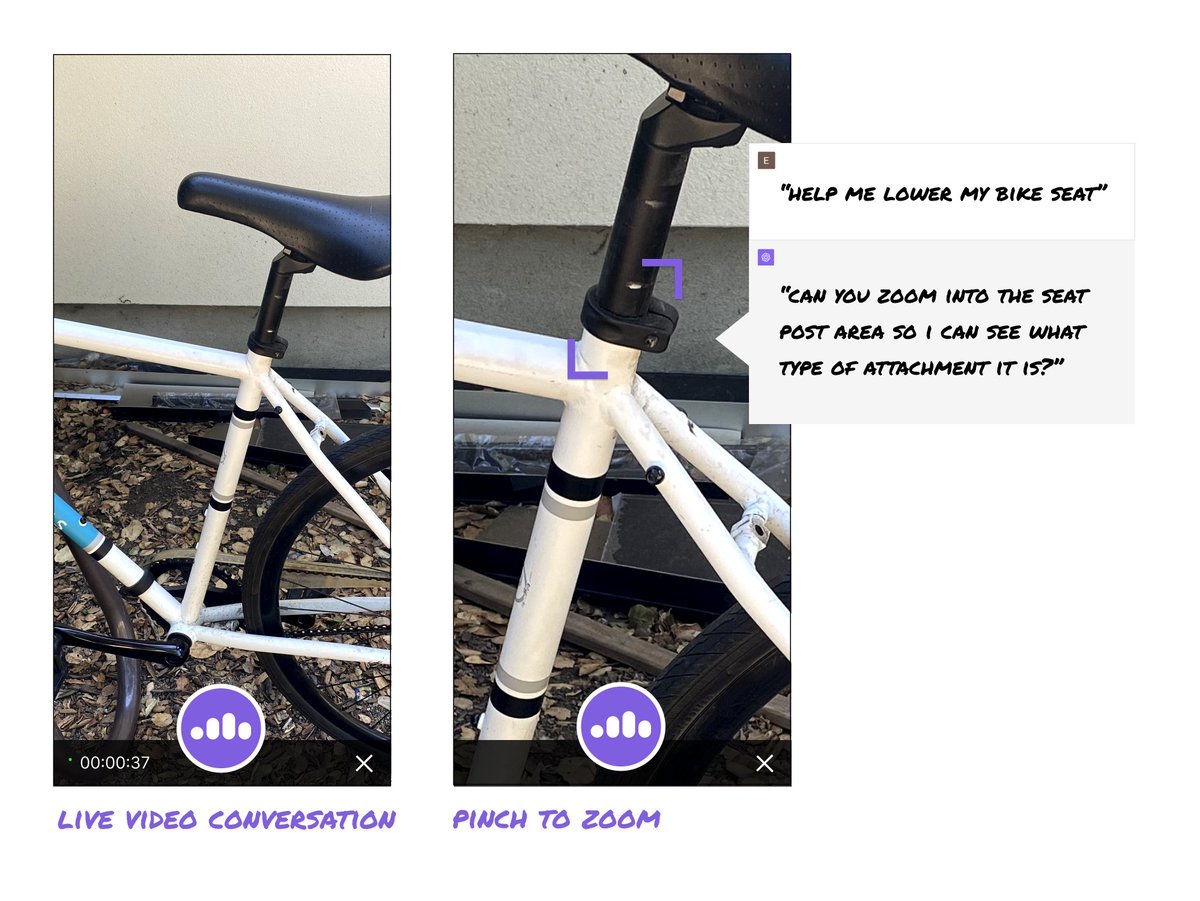
The example of ChatGPT explaining how to lower a bike seat was incredible.
But, it could be so much better!
The video showed you'll have to post multiple new photos to keep adding new information and to progress the conversation.
It was still a linear conversation centered around the text box.
But what if we rethought the interface to center around the image?
What if ChatGPT supported both images AND voice simultaneously?
Could we end up with a more immersive experience?
–––
How else could interacting with LLMs mimic IRL conversations?
Could we (or the AI) pinch to zoom or rotate the image?
Could we interact in real time with video?
What new possibilities open up with context being preserved over time?
–––
There is so much energy and excitement around what AI can do.
But we are limiting the potential by assuming the conversation box is the best interface.
Right now, designers have the chance to create truly novel interactions and bust through the 20+ year old search UI paradigm.
The ideas above are just to illustrate some potential options.
But they are also intended to spark a flame.
Now is the opportunity to be creative and explore divergent UIs.
What are the craziest, coolest, most creative UI ideas we can unleash?
LFG 🚀
English
Jochen Metzger retweetledi

Meta-Analysis: Self-control is around 60% heritable – that is, genes explain around 60% of the differences between individuals in their levels of self-control (N > 100,000) sciencedirect.com/science/articl…


English
KI synchronisiert mal eben ein englisches Statement ins Deutsche. Spooky! Außerdem: Von @emollick kann man wahnsinnig viel über KI lernen. Folge ihm schon ne Weile. Wenn nicht, würde ich sofort damit anfangen.
Ethan Mollick@emollick
Hey, I speak German now. (I don't speak German. AI is advancing pretty fast)
Deutsch
Jochen Metzger retweetledi


Deutsch
Social Psych has a bad rep within the field. Personality research: way more reliable. But when I write about Social psych for the general public people go like: “Yay! Science!” When I write about the Big5: “That can’t be true!”
WHY???
#psychology #communication #peoplearecrazy
English

I did ALL THE THINGS to get my 100€ reimbursement for a keynote in Germany, including printing some documents 3 times (one-sided!) but other documents only once (double-sided!), and shipped the whole package.
Sadly, I used electronic signatures which are NOT accepted in 2023.

English
Jochen Metzger retweetledi

I have known for years that Dan Ariely made stuff up but now it turns out that it is ok because his book was a novel! variety.com/2022/tv/news/n…
English

Von wegen Sommerpause! Wir fahren ab in Staffel 9 🚂🚅🚞 Volldampf voraus!
Deutsch
Chatted with the Pi Chatbot by @inflectionAI this morning. And this is how it ended. By all standards: that was a pretty decent conversation. I am impressed. Also: „my friend“!!! Pretty bold move.

English
Jochen Metzger retweetledi

1 / In our new paper, we challenged LLMs on an oral boards q-bank with mostly higher order questions! Also for the first time, we quantify “hallucinations” — a puzzling phenomenon where LLMs will confidently incorporate falsehoods into responses.
medrxiv.org/content/10.110…
English
Jochen Metzger retweetledi

Full post here:
experimental-history.com/p/science-is-a…
English
Jochen Metzger retweetledi

Machine learning can easily produce false positives when the test set is wrongly used. Just et al in @NatureHumBehav suggested that ML can identify suicidal ideation extremely well from fMRI and we were skeptical. Today retraction and our analysis of what went wrong came out.
English