Excited to see these two papers out in #JACC: Heart Failure demonstrating cardiovascular effects of dietary medium-chain fatty acids.
Elegantly spearheaded by Josephine. Thanks to all collaborators and the vital funding: #DFF, #DDRF, #NNF, #DCA.
Links below.
Just a few conditions being pursued for secondary prevention or treatment by GLP-1/GIP/Glucagon drugs in a new and comprehensive review @NatRevDrugDisc
The evolving landscape of obesity pharmacotherapy
nature.com/articles/s4157…rdcu.be/fiw7g
This new Review covers the evolution of obesity therapy from GLP1s to multi-receptor agonists, oral formulations, weight-loss quality approaches and tissue-specific drug targeting
New review from the lab discussing the therapeutic potential of LEAP2 mimetics as an emerging strategy for treating obesity and related cardiometabolic disorders.
@Metabolcenterlink.springer.com/article/10.100…
New paper out in Aging Cell! We show how NMDA receptor modulation shapes metabolic control. Using memantine in C. elegans, we uncover effects on stress resilience, lifespan and energy metabolism. Led by @VaidaJuozaityte from @Metabolcenter
Open accees: onlinelibrary.wiley.com/doi/10.1111/ac…
If our environment promotes obesity, why do some people stay thin? 🤔
This new popular scientific article by Ute Eberle in @KnowableMag delves into this question 👇1/8
knowablemagazine.org/content/articl…
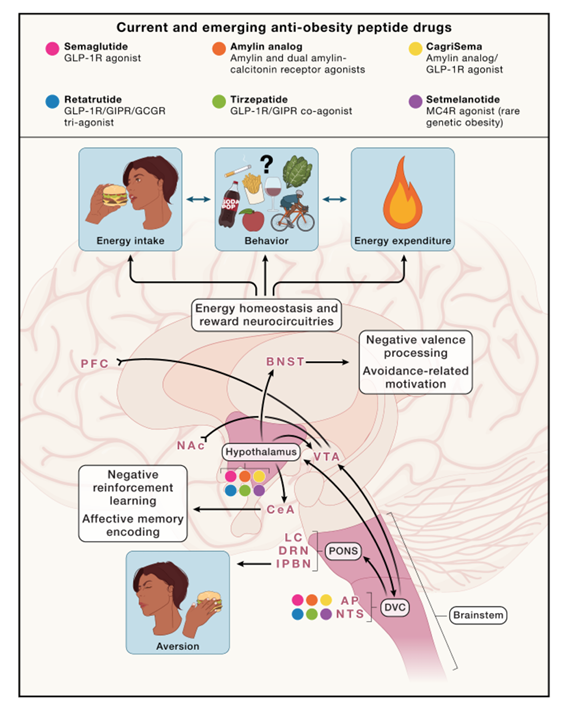
Excellent review article on the brain control of energy homeostasis and implications for anti-obesity pharmacotherapy. New peptide-based drugs directly target brain pathways to deliver safe, sustained weight loss. The CNS and gut-brain axis are key to next-gen obesity treatments and cardiometabolic health.
cell.com/cell/fulltext/…
New paper from the lab with @andrewlutas. Work of the amazing Claire Gao. Important read exploring mechanistic insights as to why semaglutide may work better for some versus others. Building on all the amazing research that has been done over the years. biorxiv.org/content/10.110…
New brain-targeting anti-obesity peptides (GLP-1, GIP, and dual agonists) access brain sites, such as the area postrema and arcuate nucleus, where they engage neurons controlling appetite, energy use, and reward response. By tapping into these circuits, they help suppress hunger and drive weight loss.
cell.com/cell/fulltext/…
The brain is the master regulator of food intake and energy balance. A brilliant new @CellCellPress review, including the mechanism of GLP-1 drugs, by @ClemmensenC and colleagues, open-access
cell.com/cell/fulltext/…
1/8
🧠 New review from the lab in @CellCellPress: Brain Control of Energy Homeostasis
We explore how central nervous system circuits regulate energy balance, and how this informs the development of next-generation obesity pharmacotherapies.
🔗 cell.com/cell/fulltext/…
Just out in @NatureNeuro We have identified a brain circuit that drives safety-seeking behavior, overriding essential needs like feeding. Amazing collaboration with @KiehnLab, brilliantly led by the now Twitterless Nathalie Krauth. nature.com/articles/s4159…
Is increased hunger really a primary driver of obesity?
In this Letter to the Editor in @NEJM, Thorkild Sørensen, Mark Friedman and I question the widespread idea that many people develop obesity because they overeat 👇 1/5
nejm.org/doi/full/10.10…@Metabolcenter@MonellSc
After 21 years at my dream job, I’m very sad to announce my early retirement from the National Institutes of Health. My life’s work has been to scientifically study how our food environment affects what we eat, and how what we eat affects our physiology. Lately, I’ve focused on unravelling the reasons why diets high in ultra-processed food are linked to epidemic proportions of chronic diseases such as diabetes and obesity. Our research leads the world on this topic.
Given recent bipartisan goals to prevent diet-related chronic diseases, and new agency leadership professing to prioritize scientific investigation of ultra-processed foods, I had hoped to expand our research program with ambitious plans to more rapidly and efficiently determine how our food is likely making Americans chronically sick.
Unfortunately, recent events have made me question whether NIH continues to be a place where I can freely conduct unbiased science. Specifically, I experienced censorship in the reporting of our research because of agency concerns that it did not appear to fully support preconceived narratives of my agency’s leadership about ultra-processed food addiction.
I was hoping this was an aberration. So, weeks ago I wrote to my agency’s leadership expressing my concerns and requested time to discuss these issues, but I never received a response. Without any reassurance there wouldn’t be continued censorship or meddling in our research, I felt compelled to accept early retirement to preserve health insurance for my family. (Resigning later in protest of any future meddling or censorship would result in losing that benefit.) Due to very tight deadlines to make this decision, I don’t yet have plans for my future career.
The NIH has been a wonderful place because it allows scientists to take risks, form unique collaborations, and do studies difficult to conduct elsewhere. I’m proud of what we’ve accomplished and I’m fortunate to have had such wonderful colleagues and scientific collaborators. I hope to someday return to government service and lead a research program that will continue to provide gold-standard science to make Americans healthy.