Jonathan Siddharth

8.1K posts

Jonathan Siddharth banner
Jonathan Siddharth

Jonathan Siddharth

@Jonsid

Founder and CEO, Turing. Accelerating superintelligence to drive real economic progress @turingcom.

Stanford, CA Katılım Kasım 2008
4.8K Takip Edilen7.9K Takipçiler
Jonathan Siddharth
Jonathan Siddharth@Jonsid·
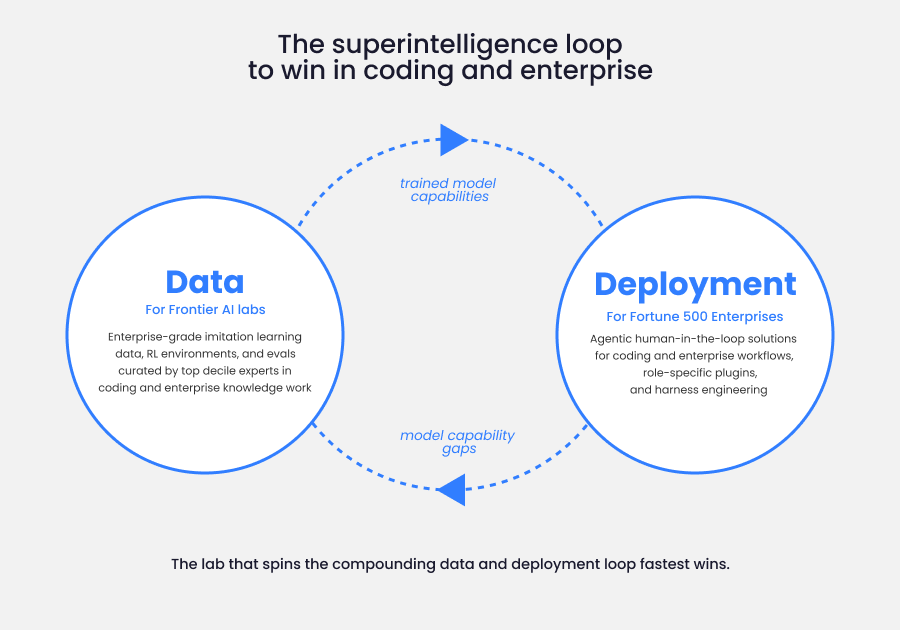
Turing works both sides of AGI. Research: frontier labs use us to push model capability. Coding first, now all knowledge work. Deployment: enterprises use us to ship that capability. Each side compounds the other. The Secret Turing Master Plan: x.com/jonsid/status/…
Deedy@deedydas

Every single startup selling AI Training Data (July 2026) >50 cos sell data and RL environments to big AI labs and drive AI progress behind the scenes. They total ~$8.5B in rev and ~$100B in valuation, >75% of which are just 4 players: Scale, Surge, Mercor and Handshake.

English
2
2
37
7.9K
Jonathan Siddharth retweetledi
Deedy
Deedy@deedydas·
“The dirty secret in AI is that everything is a data and an eval problem. The best models have the best data and best internal benchmarks. The mid ones buy a lot of data, not the best, and hillclimb public benchmarks. (you need a lot of compute too)” – Stanford CS Professor
English
74
78
1.1K
105.4K
Jonathan Siddharth
Turing is scaling on exactly this thesis. Data spend will exceed $100B/year by 2030. The type of data will keep changing. To win will require agility and research taste. Join @turingcom to accelerate superintelligence for all economically valuable work.
will depue@willdepue

A Stargate for Data Labs are on a trajectory towards >$100B/year of data spend by 2030. As we begin the trillion-dollar compute project, we need to think about the equivalent civilizational-scale effort for the other core ingredient: data. At the foundation of the scaling revolution is a simple empirical law: deep neural networks improve smoothly, near magically, as you scale two things in proportion — (1) the size of the model and (2) the amount of data you train on. And despite the scaling laws being brutally diminishing, we’ve successfully bitten the bullet of logarithmic scaling with exponentially larger clusters and datasets, and received incredible new capabilities in return. But this exponential scaling is bound to hit some limits. Oddly enough, compute has compounded fairly smoothly without limit, with trillions flowing into hypercluster buildout. Instead, we’re starting to hit the limits of an exponential demand for data. Gone are the days of being purely in the compute-limited regime, where we had effectively infinite internet data but never enough GPUs, we’re now entering a data-limited regime. Luckily, this limitation is coinciding with staggering improvements in AI capabilities. Incredibly, we seem to have a real line of sight towards automating a majority of knowledge work with the methods we have today. RL + pretraining, and the data for each, will be generally sufficient to achieve most economically valuable tasks, given some minimal algorithmic progress and continued compute scaling. In a data-limited world, economic progress & scientific acceleration will be directly bottlenecked by our coverage in each domain. We need to see data collection as imperative, deserving the same civilizational ambition we’ve given compute. The internet as a one-time subsidy It’s underrated how much all progress in AI owes everything to the blessing of the internet, this one-time civilizational subsidy to deep learning, decades of unintentional accumulation of a perfect dataset: every book, blog post, image, video, paper, discussion, etc. all digitized and freely available. Without the internet, we’d likely see comparably minimal progress in AI today, and in fact, if you notice where systems currently underperform, it’s almost always a domain where web coverage is limited and data is private, expensive, non-digitized, or non-existent. But we’re running out of it. There are only about 300 trillion tokens of useful public human text, and the internet doesn’t produce nearly enough new high-quality data to match what scaling demands — we’re soon to hit the limits of public data for pretraining. And though the advent of RL bought us reprieve — chain-of-thought RL needed a new form of untapped data, gradable math & coding tasks, also available online — we’re quickly running dry of hard tasks for RL as well. Why do we need so much data anyways? Humans learn comparably in far less time, needing just one textbook where language models might need the equivalent of hundreds to learn a new topic. It’s possible we discover methods that are massively more data efficient — synthetic data, data efficient architectures, other exotic algorithms — but fundamental progress is slow and highly unpredictable, and the recipe we have just works today. And, while I’m wary of getting too deep here, even arbitrary data efficiency can’t replace data that just doesn’t exist in the first place. There’s a massive amount of missing information on the web: the dark matter of the internet — tacit knowledge, undocumented processes, etc. — most of which was never published and lives only inside organizations, the physical world, or just in people’s heads. I’ll leave it here and say, for reasons far longer than I can fit in this post [1], it’s best to operate on the assumption that our insatiable desire for data will continue as it has for the last decade. There will be >$100B/year in data spend by 2030 We’re not screwed yet, of course. Only a fraction of useful data in the world is on the public internet, the rest is stored inside private datasets, corporations, personal archives, universities, governments, and otherwise. Labs can and will continue to license these private datasets, or create them from scratch, like Anthropic’s book scanning project. And we’ll increasingly task human experts to manufacture new high-quality data, with a large fraction of hard RL training tasks already being sourced this way. But collecting this data, unlike before, will be expensive. As the free internet dries up and demand for data rises, we should see labs investing equally in data as compute, likely spending a significant fraction of their compute budgets on data. As we see trillions spent on compute, we should also expect hundreds of billions spent on data (human data & collection budgets), given their equivalent importance. And, notably, data spend is already tracking this way: total data spend across vendors, not counting internal lab efforts, is already roughly $7 billion per year. It’s quite reasonable we’ll see >10x by 2030. Data is the moat Data becoming increasingly private will also majorly shift the competitive landscape. While compute is a commodity — everyone buys the same chips and builds the same clusters — data really isn’t. The big reason why frontier models have felt eerily similar to one another, until now, is they were trained on substantially the same internet (pretraining data variability across labs seems pretty low). As labs diverge onto more exclusive, manually collected corpora, I think models will begin to increasingly diverge. OpenAI pulling ahead in mathematics and Anthropic in cybersecurity isn’t an accident. I really think laser-focused collection of high-quality midtraining tokens, custom RL tasks, environments, with dedicated research effort, has driven much of the visible progress in the last year. James Betker has an excellent blog about “the ‘it’ in a model is the dataset”: model architecture and compute buy you efficiency and order-of-magnitude performance, but ultimately, models, of any architecture, are such incredible approximators of their dataset that the core meat of a model boils down to just that, nothing else. Data is a major moat. AGI long, ASI short As I’ve tweeted before, I’m confident that, despite the narrative, the data labeling industry will continue to fuel great businesses and be an excellent AGI long, ASI short. The argument is just: By the time the AGI labs no longer need data, it’s probably over for everything else too [2]. In this frame, the last companies left should be the data companies, as the last speck of economically relevant data is sucked in. And these companies are already among some of the fastest-growing companies in history: Mercor, founded three years ago, is rumored to be doing $2 billion in revenue with something like a few million expert labelers under contract. While these businesses are very non-stationary, what type of data is needed shifts constantly, I don’t think that diminishes their value. The long-tail of the economy is long, and the value isn’t diminishing as you extend farther into more obscure information: as models get more capable, the value of the marginal dataset goes up, not down. Automating a full job means covering its full distribution of tasks, tools, edge-cases, and long-horizon loops. There’s some O-ring logic to it: a dataset that buys a 1% bump can justify a previously unjustifiable collection cost when it’s the difference between a system that does 99% of a job and one that does all of it [3]. The competitive dynamics of the data industry are still evolving but as demand for data is increasingly niche, ultra high-quality, expert-generated, I think we’ll see real consolidation. Again, contra-narrative, we’ll probably see true competitive differentiation built on brand, quality control of data (which, from personal experience, can vary massively), as well as in network effects from the talent networks themselves over time. We’ve already seen rapidly shifting data type demand work in favor of incumbents, benefiting those with early knowledge of where the market is headed. The binding constraint It’s truly remarkable that we seem to have the recipe — pretraining + RL — to absorb most economically valuable work, despite being far from a lot of what we expected from “AGI”. The same way chess engines revealed we never needed general intelligence to solve chess, as we originally thought, we’ll soon realize that software, mathematics, and the vast majority of the economy (including physical, just running ~3 years behind!) are the same. If recursive self-improvement or some other algorithmic breakthrough arrives, that’s wonderful, but we really don’t have to wait for it. The binding constraint between here and an automated economy isn’t that, it’s data coverage: every app, workflow, edge case, process, etc. sitting in private stores or someone’s head. Ultimately, while we make tremendous strides in more efficient model architectures, and clusters like Stargate equip us with zettaflop-scale compute, we really aren’t making rapid progress collecting the data we lack. We’ll soon live in a world where we have the methods & compute to accelerate scientific progress or economic growth, but not the data. And we’re already there today: frontier models would surely be as good at accounting/many medical tasks/legal advice as they are at software engineering if we only had the same pretraining & RL coverage as we did for code. I really want to drill this in: The speed at which we automate the economy is going to be directly rate-limited by our ability to collect data about it. Worth noting that under this assumption, with data as defensible and directly proportional to economic & scientific progress, data should also be considered a national strategic asset like compute. Imagine what we’d do in a world where we had a Manhattan Project-effort for AI and needed to mobilize data collection as a limiting factor. We should be concerned about China, with greater state capacity and authoritarian economic control, being capable of mobilizing data collection at national scale, potentially compounding their economy and scientific output faster than us down the line. A Stargate for data I’m leaving my complete ideas for a future post, as this one is already far too long, so I’d really like to pose the question here. Stargate exists because we organized trillions of dollars, international strategy, gigawatts around compute as a fundamental ingredient. What would equivalent ambition look like for data? Obviously, scaling data collection, a heterogeneous mass of information across the economy, isn’t going to be as clear as scaling compute, as a homogenous infrastructural effort. A core division will be first, coverage — all uncaptured knowledge sitting across the economy/science/physical world and all that simply isn’t recorded — and, secondly, sheer volume in the domains we already train on: more hard math tasks, more high-quality web text, way more coding data, more legal drafts, etc. I have a post coming soon which breaks down my proposals. There’s a lot of room for creativity. Quickly, we’ll probably want to start with a deep census of what we have and what we’re missing, predict what the 2030 model will still be bad at and work backward to what we should be collecting today. You can probably license a large amount, leveraging high lab valuations to buy datasets or companies altogether. There’s an adversarial nature to a lot of this collection with firms, so there’s lots of engineering to do this correctly. We should go convince important companies to turn off deletion policies, even if we’re not buying from them yet. Data flywheels in consumer products will be massive. Confidential training, government legislation for grant-funded research, running companies at a loss for their data, etc. We’re headed towards hundreds of billions in expenditure, national prioritization, and major data limitation on the horizon. We have a great opportunity to think creatively about what a megaproject for data would look like: How do we, deliberately this time, construct the next internet’s worth of data? Footnotes: [1]: I’ll probably soon publish my much longer post explaining my position on data efficiency and why the value of this data is still pretty high in most worlds regardless of new algorithms. [2]: The “AGI freeroll” bet: heads you win, tails ASI flips the world upside down anyways. [3]: We already see a glint of validation of this point, given the data market is strongly tilting towards ultra-high-quality agentic data, rather than unskilled labeling — niche expert workflows, live environments, and evaluations requiring increasingly obscure talent & knowledge — yet shows increasing, not decreasing, revenues.


English
1
8
28
3.1K
Jonathan Siddharth
Jonathan Siddharth@Jonsid·
Happy 250th, America 🇺🇸 I moved here with nothing but an admit letter to Stanford. Became a citizen in 2018. Built Turing here. This is the land of opportunity.
English
9
9
195
8.7K
Jonathan Siddharth retweetledi
Turing
Turing@turingcom·
Rubrics-Graded Reasoning is here. Today, Turing released the Advanced PhD Reasoning Rubrics Data Pack on @huggingface: -1,106 expert-authored PhD-level tasks -Computer Science, Data Science & Chemistry -Weighted atomic rubrics + golden answers -Human-validated and frontier-model calibrated Why this dataset? Most benchmarks score final answers. This dataset evaluates how models reason by grading intermediate steps, derivations, calculations, mechanisms, code/data workflows, and structured outputs. Built for: ✓ RL & reward modeling ✓ Post-training ✓ Process-level evaluation ✓ Benchmarking ✓ Reasoning failure analysis Turn expert grading into machine-verifiable training signal. If you're working on model reasoning, evaluation, or RL infrastructure, we'd love to hear what you think. Links below.
Turing tweet media
English
1
9
23
81.1K
Jonathan Siddharth retweetledi
Turing
Turing@turingcom·
Breaking into great tech jobs shouldn't require a perfect resume, or surviving six rounds of interviews. Turing is changing that. One assessment. No experience gatekeeping. No recruiter small talk. No application black holes. Qualify and unlock access to remote software opportunities with Frontier Labs. US-based students and professionals: Take the Turing Hiring Challenge 2026 and earn $50/$250 per project. Let your skills speak for themselves. Link below.
Turing tweet media
English
1
8
21
17.8K
Robert Sterling
Robert Sterling@RobertMSterling·
> you’ll never start a rocket company > you’ll never build your own engines > you’ll never be able to use off-the-shelf parts > you’ll never survive three launch failures > you’ll never reach orbit > you’ll never win NASA’s trust > you’ll never launch cargo to the ISS > you’ll never compete with Boeing > you’ll never compete with Lockheed > you’ll never make rockets reusable > you’ll never land a rocket vertically > you’ll never land one on a drone ship > you’ll never reuse a booster > you’ll never fly the same booster 10 times > you’ll never fly the same booster 20 times > you’ll never fly the same booster 30 times > you’ll never recover and reuse the fairing > you’ll never lower launch costs > you’ll never launch every month > you’ll never launch every week > you’ll never launch multiple times a week > you’ll never carry astronauts > you’ll never replace Roscosmos > you’ll never fly civilians to orbit > you’ll never manufacture satellites at scale > you’ll never build the biggest constellation ever > you’ll never make satellite internet work > you’ll never make satellite internet fast > you’ll never make satellite internet affordable > you’ll never serve rural customers > you’ll never serve aircraft and ships > you’ll never build a methane rocket engine > you’ll never make full-flow staged combustion work > you’ll never build the most powerful rocket ever > you’ll never build a rocket bigger than Saturn V > you’ll never build it out of stainless steel > you’ll never launch Starship > you’ll never separate Super Heavy and Starship > you’ll never relight Raptor in space > you’ll never bring Super Heavy back > you’ll never catch a booster with Mechazilla tower arms > you’ll never launch 85% of mass to orbit worldwide > you’ll never change the economics of space > you’ll never force the entire industry to copy you > you’ll never win > you’ll never IPO   Congratulations to @elonmusk and the SpaceX team. You did what countless people said was impossible, and you did it time and time again.   Today is your day. You deserve this. May it be a glorious one.
Robert Sterling tweet media
English
615
5.7K
26.6K
1.8M
Jonathan Siddharth
Jonathan Siddharth@Jonsid·
Enjoyed joining Icons last week to discuss startups, AI, and the importance of following market signals over assumptions. We talked about lessons from my entrepreneurial journey, @Turingcom's growth, and why staying curious and adaptable is essential in a world where technology is evolving faster than ever. Thanks to the @sv_icons team for the great conversation.
Georgi Koreli@gegelz

Last week, we had a chance to host @jonsid, founder of @turingcom for @sv_icons. When you talk to Jonathan, it feels like he processes everything through a purely factual lens of causes and outcomes. Most of us draw takeaways through the filter of our own experiences. What Jonathan does differently is strip away the bias and analyze events almost from a machine-learning perspective. One of the most fascinating and insightful conversations we've had at Icons. Here are a few takeaways: • What was refreshing to hear is that Jonathan isn't the stereotypical Zuckerberg-style founder who succeeded on the first try. His first startup didn't work out the way he intended. Right after Stanford CS, Jonathan started a company in Silicon Valley and spent seven years building it before reflecting on what went wrong. The answer wasn't Jonathan. It was the market. He was attached to an idea that simply didn't have a large enough market. He was stubborn. He believed it could be huge. But that's not what the market demanded. • In situations like that, Jonathan suggests being less stubborn. Give yourself the freedom to think differently. Go talk to 100 ICPs and verify whether they actually care about the problem you're trying to solve. If the answer is yes, go solve it. If the answer is no, pivot away. Not just pivot slightly, but jump away from what you had before - teleport. All your existing collateral can become a curse when you're trying to find a truly great startup idea. • But what about insights? Didn't we learn at Stanford that we should stick with an "insight," following Andy Rachleff's Product-Market Fit framework? Jonathan's view is: challenge your insight. Most insights only exist within a specific time horizon. Imagine having a brilliant insight around automation before 2023. Then ChatGPT arrives. Do you still hold on to that insight? Probably not. Humble yourself. Your insight may no longer be true. Don't become attached to the dream. • Okay, you've pivoted and your old insight is no longer valid. What's next? Go all in. Jump into the new thing that excites you most. Don't underestimate your ability to develop new insights. If you're smart and curious, you'll go deep and find them again, but this time inside a market that's actually growing fast enough to matter. • When Jonathan started Turing, OpenAI called and asked how many people he could dedicate to expert-skill labeling. He wanted to say an even bigger number because the demand was so overwhelming. The market signal was impossible to ignore. In just a few years, Turing grew to multi-hundred million ARR. Today, it serves many of the leading AI labs and also helps enterprises adopt AI by connecting them with the best solutions available. • Is the opportunity around data labeling limited? Eventually, yes. But not anytime soon. Jonathan's view is that we're still decades away from fully automating the process. At the same time, Turing has built a second business that leverages the latest AI models and innovations to help enterprises deploy AI directly into their operations. • How would Jonathan screen for startup ideas? He would look for highly fragmented markets with mostly analog competitors. Real estate is one example: fragmented, less technology-driven, and deeply connected to the physical world. • Another way to think about opportunities is to become an input to AI companies. What will they need to reach the next level? It could be data. It could be infrastructure. It could be something entirely different. • Jonathan believes founders need to stay several years ahead of competitors. How do you get ahead? Reading books isn't enough. You need high-variance learning so you don't get trapped in a local minimum. That means constantly meeting new people, exposing yourself to new ideas, and learning from what others have built, especially in Silicon Valley, where the density of ambitious and talented people remains incredibly high. Thanks Jonathan Siddharth for phenomenal evening. Appreciate @AlmaImmigration @Aizada, @UofBeta and Signal for supporting Icons.

English
3
5
16
2.7K
Jonathan Siddharth retweetledi
Google Workspace
Google Workspace@GoogleWorkspace·
The AI tips you love, now from the people putting them into practice every day. Introducing Customer AI Boost Bites: a new video series featuring real business leaders sharing how they use Gemini, NotebookLM, Gems, and more to solve challenges and save time. Start with Taylor Bradley, VP of People at @turingcom, and learn how to build a Strategic Challenger Gem to pressure-test ideas in minutes. 💡 goo.gle/4ehsmlC
English
5
15
53
12.2K
Jonathan Siddharth retweetledi
Turing
Turing@turingcom·
MMLU is saturated. HLE is getting there. We built Multimodal STEM HLE++: for what comes next, and the top frontier labs publishing SOTA models are already using it. 1,100 PhD-level multimodal STEM problems that break Opus 4.6. Around 20% pass@1 on SOTA. Hard enough to expose reasoning failures. Solvable enough to generate real RL signal. Every problem requires joint reasoning over images and text, has a deterministic ground-truth answer, and was authored by a PhD-level domain specialist. 50-task public sample on @HuggingFace. Full pack available now. Links below.
Turing tweet media
English
4
10
22
34.4K
Jonathan Siddharth
Jonathan Siddharth@Jonsid·
Without context, agents are confident guessers. True. @paulg is right that AI-native companies won’t have this knowledge stuck in people’s heads. But the knowledge that matters is the failure you haven’t seen yet. The enterprise is too vast to map up front, so models keep breaking in new ways in production. You don’t extract context once. You catch each failure and feed it back. A loop, not a setup step. It runs for decades. This is why Turing does both data and deployment.
Tom Blomfield@t_blom

Imagine replacing 90% of your employees with a team of geniuses who have no idea how your company operates. Total chaos. Nothing works. That’s what AI feels like today. The missing piece is extracting all the domain knowledge from people’s heads and providing that as structured context to the models.

English
2
5
20
2.1K
Jonathan Siddharth retweetledi
Juhi Parekh
Juhi Parekh@juhiparekh94·
Built this to push the frontier!!! 🚀 cc @jonsid @anshulbhagi @turingcom
Turing@turingcom

MMLU is saturated. HLE is getting there. We built Multimodal STEM HLE++: for what comes next, and the top frontier labs publishing SOTA models are already using it. 1,100 PhD-level multimodal STEM problems that break Opus 4.6. Around 20% pass@1 on SOTA. Hard enough to expose reasoning failures. Solvable enough to generate real RL signal. Every problem requires joint reasoning over images and text, has a deterministic ground-truth answer, and was authored by a PhD-level domain specialist. 50-task public sample on @HuggingFace. Full pack available now. Links below.

English
0
6
10
894
Jonathan Siddharth retweetledi
Jeffrey Weichsel
Jeffrey Weichsel@jeffreyweichsel·
This is why high quality expert data is so important. Data, compute, and implementation are the most valuable layers of AI. @Turing produces the most realistic and complex long context knowledge tasks and implements AI in enterprises. This is a self reinforcing cycle.
Tom Blomfield@t_blom

Imagine replacing 90% of your employees with a team of geniuses who have no idea how your company operates. Total chaos. Nothing works. That’s what AI feels like today. The missing piece is extracting all the domain knowledge from people’s heads and providing that as structured context to the models.

English
0
4
8
1.4K
Jonathan Siddharth retweetledi
Vivek Sen
Vivek Sen@Vivek4real_·
LARRY ELLISON: AI IS RAPIDLY COMMODITIZING BECAUSE MOST MODELS ARE TRAINED ON THE SAME PUBLIC INTERNET DATA. THE REAL COMPETITIVE EDGE ISN’T THE MODEL ANYMORE — IT’S ACCESS TO EXCLUSIVE, PROPRIETARY DATASETS. THAT MAY BE THE ONLY MOAT LEFT.
English
385
609
5.6K
3.3M
Jonathan Siddharth
Jonathan Siddharth@Jonsid·
The models are already extraordinary. That's not the hard part anymore. The hard part is letting them touch reality. Real workflows. Real data. Real stakes. The next decade belongs to whoever solves deployment, not whoever builds the best benchmark score. I've been making that bet for seven years. I'm more convinced than ever. Link below.
Jonathan Siddharth tweet media
English
4
7
22
5K
Jonathan Siddharth retweetledi
This Week in AI
This Week in AI@ThisWeeknAI·
Who's actually building AI? 3 months and 14 episodes into This Week in AI, @Jason has sat down with founders and operators across infra, models, dev tools, consumer, creative, robotics, healthcare, and more. INFRA & COMPUTE Chase Lochmiller (Crusoe) @ChaseLochmiller Lin Qiao (Fireworks AI) @lqiao Chris Lattner (Modular) @clattner_llvm Nick Harris (Lightmatter) @theanalognick Mitesh Agrawal (Positron AI) @mitesh711 Alex Cheema (EXO Labs) @alexocheema Philip Johnston (Starcloud) @PhilipJohnston Naveen Rao (Unconventional AI) @NaveenGRao Russ d'Sa (LiveKit) @dsa FOUNDATION MODELS & RESEARCH Kanjun Qiu (Imbue) @kanjun Carina Hong (Axiom Math) @CarinaLHong Jeremy Fraenkel (Fundamental) @fraenkelj EVALS & BENCHMARKS Anastasios Angelopoulos (Arena) @ml_angelopoulos DEV TOOLS, CODING & AUTOMATION Karri Saarinen (Linear) @karrisaarinen Matan Grinberg (Factory) @matanSF Spiros Xanthos (Resolve AI) @spirosx Wade Foster (Zapier) @wadefoster CONSUMER & SEARCH Aravind Srinivas (Perplexity) @AravSrinivas Richard Socher (youdotcom & Recursive) @RichardSocher Tanay Kothari (Wispr Flow) @tankots Steven Berlin Johnson (NotebookLM) @stevenbjohnson CREATIVE & MEDIA Demi Guo (Pika) @demi_guo_ Victor Riparbelli (Synthesia) @vriparbelli Mikey Shulman (Suno) @MikeyShulman Grant Lee (Gamma) @thisisgrantlee ROBOTICS Jake Loosararian (Gecko Robotics) @jakeloosy Boris Sofman (Bedrock Robotics) @bsofman HEALTHCARE Shiv Rao (Abridge) @ShivdevRao Trey Holterman (Tennr) @TreyHolterman ENTERPRISE, VERTICAL & DATA George Sivulka (Hebbia) @gsivulka Kashif Ali (TaxGPT) @ChKashifAli Alex Elias (Qloo) @ape TALENT & WORKFORCE Ali Ansari (micro1) @aliansarinik Jonathan Siddharth (Turing) @jonsid Thank you all for joining! Episode 14 out now: youtube.com/watch?v=szd0TY…
YouTube video
YouTube
English
5
13
37
63.6K