Joseph Sweeney

2.5K posts

Joseph Sweeney

Joseph Sweeney

@JosephESweeney

Decision science | AI & human judgment CFO, JD Bravo Founder, Decision Leadership Institute @Decision_Leader

West Chester, PA Katılım Kasım 2011
740 Takip Edilen651 Takipçiler
Aakash Gupta
Aakash Gupta@aakashgupta·
Your entire life is an electromagnetic force field pretending to be physical contact. When you “touch” a table, the electrons in your fingertip and the electrons in the wood repel each other. The gap never closes. What your brain registers as solid contact is the Pauli exclusion principle and electromagnetic repulsion creating the sensation of resistance at roughly 1 angstrom, one ten-billionth of a meter. This applies to everything. The ground you’re standing on. The chair you’re sitting in. The phone in your hand right now. You’ve never made contact with any of them. You are permanently floating approximately 0.1 nanometers above every surface you’ve ever “touched,” suspended by the same force that keeps two magnets from snapping together when you flip one around. Now scale that. Every nerve signal you’ve ever felt, every texture, every temperature, every sensation of pressure: all of it is your nervous system interpreting variations in electromagnetic repulsion strength. Silk feels different from sandpaper because the electron clouds have different geometries, not because your skin ever contacted either surface. The part that should unsettle you: your brain has never once received direct physical input from the outside world. Every sensory experience you’ve ever had was a second-hand report from electrons that refused to get any closer. You’re reading this on a screen you’ve never touched, with eyes that collect photons but contact nothing, processed by neurons that have never been in direct physical contact with each other. The signal jumps the gap every single time. Your entire reality is built on things that almost meet but never do.
Curiosity@CuriosityonX

Quantum physics says that you can never actually touch anything.

English
18
90
443
39.3K
Joseph Sweeney
Joseph Sweeney@JosephESweeney·
@dr_ed_tate @aakashgupta I was thinking along the same lines, and that we should be able to predict how complex some systems should be mathematically and then test in the real world if any systems work more easily than that…
English
0
0
1
222
Ed Tate
Ed Tate@dr_ed_tate·
@aakashgupta Well, I guess that is pretty strong evidence we are not living in a simulation.
English
9
1
128
16.4K
Aakash Gupta
Aakash Gupta@aakashgupta·
Game designers figured this out decades ago and it cost millions in failed launches. Will Wright built SimCity with a fully accurate traffic simulation. Testers hated it. The cars behaved realistically, which meant nobody could build a functioning city because real traffic is an unsolvable nightmare. He had to make the simulation dumber before the game became fun. The tension is permanent: the more accurately you model a system, the more it punishes the participant. Real medieval economies kept 90% of the population in subsistence farming. A historically accurate fantasy world doesn't produce heroes. It produces serfs. Tolkien solved this by making his economy deliberately vague. No one knows what a gold coin buys in Gondor. That ambiguity is a design choice, not a shortcut. The Reddit post is funny. The lesson underneath it is one of the hardest problems in simulation design: fidelity and fun are opposing forces, and you have to pick which one wins.
Oliver Dahl@OliverWDahl

The more I think about this the funnier it gets

English
343
3.2K
33.1K
2.3M
Malvern Prep
Malvern Prep@MalvernPrep·
The Malvern Prep Community celebrates the Feast of St. Joseph today, honoring his role as protector, provider, and model of humble service.
Malvern Prep tweet media
English
1
0
4
116
Joseph Sweeney retweetledi
Brian Armstrong
Brian Armstrong@brian_armstrong·
Getting old shouldn't be viewed as inevitable, just because it happens to everyone. It's a disease that kills over 100,000 people a day, and hopefully it will be optional in the future.
English
1.2K
387
5.9K
1M
Joseph Sweeney retweetledi
Joseph Sweeney
Joseph Sweeney@JosephESweeney·
@7SecularSermons Like genes, memes (or concepts) replicate. And replicators don’t need a purpose to do so. Our genes don’t want or gain anything from it. Some concepts are just well-suited for getting copies of themselves made in their environment and so they do. They don’t get anything from it.
English
0
0
1
11
Daniel Böttger 💖
Daniel Böttger 💖@7SecularSermons·
"Aside from learning if it's true, what could a concept gain From being incarnated to a thought inside a brain?"
English
1
0
2
43
Joseph Sweeney
Joseph Sweeney@JosephESweeney·
@johnarnold High impact and low likelihood for large Expected Value public good is very hard for government to do. Sophisticated wealthy are well-positioned to place bets with this profile, whether single or portfolio style. They can understand the rationale and aren’t beholden to public.
English
0
0
0
118
John Arnold
John Arnold@johnarnold·
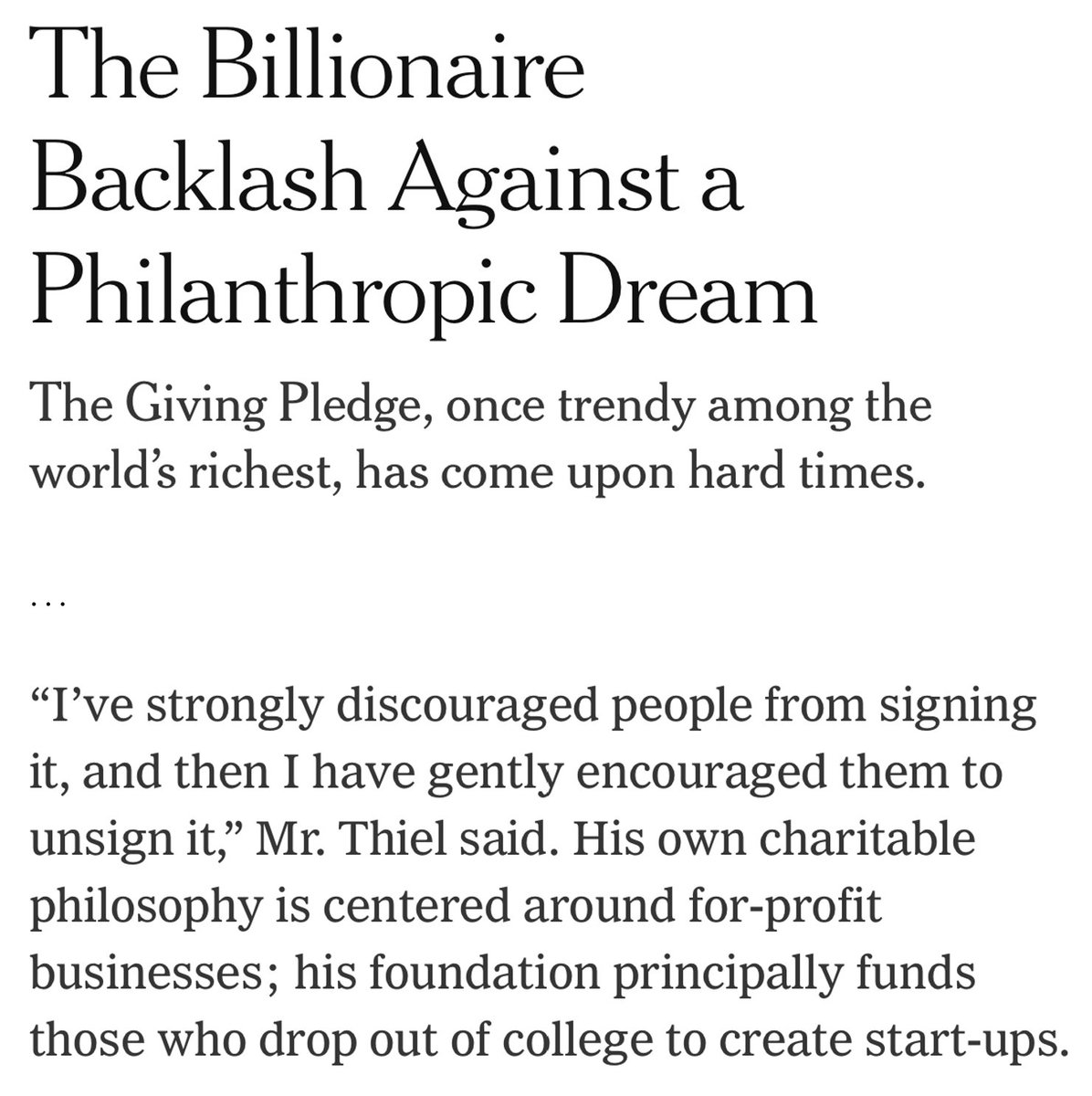
I understand and agree with many criticisms of philanthropy. But practically, fortunes have to go somewhere. There are only 3 options: philanthropy, heirs & govt. If not nonprofits, is Peter Thiel's plan to give $10B+/child? I'm more skeptical of that than he is of philanthropy.
John Arnold tweet media
English
73
38
472
127.9K
Joseph Sweeney
Joseph Sweeney@JosephESweeney·
@davidsenra @pmarca "Great men of history had little to no introspection"? Marcus Aurelius Ben Franklin Charles Darwin Abraham Lincoln Mahatma Gandhi Nelson Mandela
English
0
0
1
41
David Senra
David Senra@davidsenra·
Great men of history had little to no introspection. The personality that builds empires is not the same personality that sits around quietly questioning itself. @pmarca and I discuss what we both noticed but no one talks about: David: You don't have any levels of introspection? Marc: Yes, zero. As little as possible. David: Why? Marc: Move forward. Go! I found people who dwell in the past get stuck in the past. It's a real problem and it's a problem at work and it's a problem at home. David: So I've read 400 biographies of history’s greatest entrepreneurs and someone asked me what the most surprising thing I’ve learned from this was [and I answered] they have little or zero introspection. Sam Walton didn't wake up thinking about his internal self. He just woke up and was like: I like building Walmart. I'm going to keep building Walmart. I'm going to make more Walmarts. And he just kept doing it over and over again. Marc: If you go back 400 years ago it never would've occurred to anybody to be introspective. All of the modern conceptions around introspection and therapy, and all the things that kind of result from that are, a kind of a manufacture of the 1910s, 1920s. Great men of history didn't sit around doing this stuff. The individual runs and does all these things and builds things and builds empires and builds companies and builds technology. And then this kind of this kind of guilt based whammy kind of showed up from Europe. A lot of it from Vienna in 1910, 1920s, Freud and all that entire movement. And kind of turned all that inward and basically said, okay, now we need to basically second guess the individual. We need to criticize the individual. The individual needs to self criticize. The individual needs to feel guilt, needs to look backwards, needs to dwell in the past. It never resonated with me.
David Senra@davidsenra

My conversation with Marc Andreessen (@pmarca), co-founder of @a16z and Netscape. 0:00 Caffeine Heart Scare 0:56 Zero Introspection Mindset 3:24 Psychedelics and Founders 4:54 Motivation Beyond Happiness 7:18 Tech as Progress Engine 10:27 Founders Versus Managers 20:01 HP Intel Founder Legacy 21:32 Why Start the Firm 24:14 Venture Barbell Theory 28:57 JP Morgan Boutique Banking 30:02 Religion Split Wall Street 30:41 Barbell of Banking 31:42 Allen & Company Model 33:16 Planning the VC Firm 33:45 CAA Playbook Lessons 36:49 First Principles vs. Status Quo 39:03 Scaling Venture Capital 40:37 Private Equity and Mad Men 42:52 Valley Shifts to Full Stack 45:59 Meeting Jim Clark 48:53 Founder vs. Manager at SGI 54:20 Recruiting Dinner Story 56:58 Starting the Next Company 57:57 Nintendo Online Gamble 58:33 Building Mosaic Browser 59:45 NSFnet Commercial Ban 1:01:28 Eternal September Shift 1:03:11 Spam and Web Controversy 1:04:49 Mosaic Tech Support Flood 1:07:49 Netscape Business Model 1:09:05 Early Internet Skepticism 1:11:15 Moral Panic Pattern 1:13:08 Bicycle Face Story 1:14:48 Music Panic Examples 1:18:12 Lessons from Jim Clark 1:19:36 Clark Versus Barksdale 1:21:22 Tesla Versus Edison 1:23:00 Edison Digression Setup 1:23:13 AI Forecasting Myths 1:23:43 Edison Phonograph Lesson 1:25:11 Netscape Two Jims 1:29:11 Bottling Innovation 1:31:44 Elon Management Code 1:32:24 IBM Big Gray Cloud 1:37:12 Engineer First Truth 1:38:28 Bottlenecks and Speed 1:42:46 Milli Elon Metric 1:47:20 Starlink Side Project 1:49:10 Closing Includes paid partnerships.


English
1.3K
446
5.2K
2.7M
Joseph Sweeney
Joseph Sweeney@JosephESweeney·
AI-to-AI communication will be to us what human language is to chimps Chimps use calls and gestures. Humans use grammar and abstraction AI systems exchange dense vectors, probabilities, and computations directly – whole sets of concepts with meaning and nuance ungraspable to us
English
0
0
1
14
Joseph Sweeney
Joseph Sweeney@JosephESweeney·
@MelmontC @NathanpmYoung A democracy or a democratic republic is meant to align government with the will of the enfranchised. Animals and future people get taken care of only to the extent that the enfranchised value them. Less a problem of the form of government, more a failure of ethics in the public.
English
1
0
0
16
Melmont Conterson
Melmont Conterson@MelmontC·
@NathanpmYoung I think this and animal welfare are the best critique of democracy. It’s voting, but animals and future people don’t have votes.
English
2
0
3
522
Joseph Sweeney
Joseph Sweeney@JosephESweeney·
@_hanneslehmann_ @aakashgupta I mostly agree, grounding and feedback are required, but see too little emphasis on goal seeking. Goal-seeking pushes epistemic rationality/ belief updating. Rational actors improve when having a better map of reality makes them better at achieving thing in the real world.
English
0
0
1
13
Hannes Lehmann
Hannes Lehmann@_hanneslehmann_·
The framing is wrong. "Which architecture wins" is an engineering question dressed up as a paradigm debate. The actual open problem is what kind of structure you need between perception and action — and neither scaling LLMs nor building world models from scratch has answered that. LeCun is right that language models don't understand physics. He's wrong that "world models" are therefore the answer. Understanding physics isn't an architecture problem, it's a grounding problem. You can build a perfect internal simulator and still not know what to do with it. The missing piece isn't better prediction, it's the coupling between model and environment. The real tell is the investor list. Nvidia, Toyota, Dassault... they don't care about the paradigm debate. They need AI that works in physical systems. They're hedging because nobody knows how to get there yet, and anyone who says they do is selling.
English
4
2
9
652
Aakash Gupta
Aakash Gupta@aakashgupta·
Two Turing-class AI researchers just raised $2B in three weeks to bet against every LLM company on the planet. Fei-Fei Li closed $1B for World Labs on February 18. LeCun closed $1.03B for AMI Labs today. Both building world models. Both arguing that the entire generative AI paradigm is a statistical parlor trick. And the investor overlap tells you this is coordinated conviction, not coincidence. Nvidia backed both. So did Sea and Temasek. The math on AMI is absurd. $3.5B pre-money valuation. Four months old. Zero product. Zero revenue. The CEO said on the record that AMI won’t ship a product in three months, won’t have revenue in six, won’t hit $10M ARR in twelve. He described it as a long-term scientific endeavor. Investors gave him a billion dollars anyway. This tells you everything about how the smart money is actually modeling AI’s future. They’re not pricing AMI on a revenue multiple. They’re pricing it on the probability that LLMs hit a ceiling. And if you look at the investor list, Nvidia, Samsung, Toyota Ventures, Dassault, Sea, these are companies that need AI to understand physics, geometry, and force dynamics. A language model that can write poetry is worthless to a robotics company trying to predict what happens when a mechanical arm applies 12 newtons at a 30-degree angle to a flexible surface. LeCun raided his own lab to build this. Mike Rabbat, Meta’s former research science director. Saining Xie from Google DeepMind. Pascale Fung, senior director of AI research at Meta. He walked into Zuckerberg’s office in November, told him he was leaving, and four months later half of FAIR works for him. Meta is reportedly partnering with AMI anyway, which means Zuckerberg thinks LeCun might be right even while Meta keeps scaling Llama. AMI’s first partner is Nabla, a medical AI company, building toward FDA-certifiable agentic AI. That’s the use case that makes world models existential. LLMs hallucinate. In healthcare, hallucinations kill people. You can’t prompt-engineer your way out of a model that generates statistically plausible text when you need a system that actually understands how a human body works. Two billion dollars in three weeks. Two of the most credentialed researchers alive. And a thesis that says the $100B+ already poured into scaling LLMs is optimizing the wrong architecture entirely. If they’re wrong, investors lose money. If they’re right, every company building on top of GPT and Claude for physical-world applications just bought the wrong foundation.
AMI Labs@amilabs

Advanced Machine Intelligence (AMI) is building a new breed of AI systems that understand the world, have persistent memory, can reason and plan, and are controllable and safe. We’ve raised a $1.03B (~€890M) round from global investors who believe in our vision of universally intelligent systems centered on world models. This round is co-led by Cathay Innovation, Greycroft, Hiro Capital, HV Capital, and Bezos Expeditions, along with other investors and angels across the world. We are a growing team of researchers and builders, operating in Paris, New York, Montreal and Singapore from day one. Read more: amilabs.xyz AMI - Real world. Real intelligence.

English
38
78
469
74.2K
Joseph Sweeney
Joseph Sweeney@JosephESweeney·
There are ideas that AI will have that we haven’t. But perhaps harder for us to believe, there are ideas AI will have that we cannot. Not just speed and recall, but concepts with too many dimensions for us to grok. Many of them will be important.
English
0
0
0
11
Joseph Sweeney
Joseph Sweeney@JosephESweeney·
@22TrevorBingham @dylan522p I’d argue it’s worse. The likelihood of a virus escaping does not go up as its lethality increases, but the likelihood of an AI breaking constraints is positively correlated with its increase in intelligence (and agency).
English
0
0
1
22
Trevor Bingham
Trevor Bingham@22TrevorBingham·
@dylan522p Being an AI researcher today is like being a gain-of-function researcher at Wuhan before they had the lab leak. If they had stopped, millions of lives would have been saved, but they were filled with hubris and the rest is history.
English
1
1
4
466
Dylan Patel
Dylan Patel@dylan522p·
Being in SF is like being in Wuhan right before the pandemic Something is happening, it's gonna hit everywhere but so few people know it
English
300
277
5.3K
1.9M
Joseph Sweeney
Joseph Sweeney@JosephESweeney·
Imagine if cursive were a new skill being introduced to the curriculum, would it be adopted? There is just no way. But starting in April, all Pennsylvania schools are required to teach cursive again. Decision Skills reminders: Always invert and Opportunity Costs are real
English
1
1
2
32
Joseph Sweeney
Joseph Sweeney@JosephESweeney·
@drgurner People focus on making the right decisions. But avoiding a few catastrophic mistakes often matters more. Think in a 2×2: Impact vs Reversability 1. Avoid Ruin: drugs, crime, bad partner 2. Pursue Goals: go for the gold 3. Avoid small cumulative harms 4. Pursue desirable habits
English
0
0
1
11
Dr. Julie Gurner
Dr. Julie Gurner@drgurner·
People focus a *lot* on how the wrong decisions can ruin your life...and that's true... But the focus should really be on how the "right decisions" can change the course of everything. Place your emphasis on making the right calls, even on the small things. It matters most.
English
68
44
349
8.9K
Joseph Sweeney retweetledi
Eliezer Yudkowsky ⏹️
Eliezer Yudkowsky ⏹️@ESYudkowsky·
@regardthefrost @POTUS @NSF Can we have replication markets? (Advance prediction markets on the result of replication attempts, esp. with respect to methodology sections published in advance of whole papers.)
English
3
1
150
3.8K
Joseph Sweeney
Joseph Sweeney@JosephESweeney·
@justinskycak Groups with similar skills rarely function well on group projects without intentional design for Comparative vs Absolute Advantage. Otherwise, the high-performer(s) are rationally selected to do most of the work. Good teachers design for this, usually without knowing those terms.
English
0
0
0
56
Justin Skycak
Justin Skycak@justinskycak·
Group work usually ends with the student who knows the least learning nothing, and the student who knows the most doing everything.
English
128
142
1.8K
35.9K
Joseph Sweeney retweetledi
zeynep tufekci
zeynep tufekci@zeynep·
Generative AI isn’t occasionally “hallucinating” but otherwise providing a correct answer it knows. It’s the same to the machine. Verity is an external layer. (It can indicate levels of sparse data, maybe? — but not identical to “confidence in guess” in humans.)
English
2
1
22
6.2K