Judith Lewis

70.7K posts

Judith Lewis banner
Judith Lewis

Judith Lewis

@JudithLewis

🎤Speaker; MC; Trainer; 👩🏻‍💼NED; ThinkTank lead; Search Awards judge; 🍫🍷 chocolate, & wine expert judge; WSET3; 🪶First Nations; Email: [email protected]

London, Toronto & Didcot Katılım Ekim 2008
2K Takip Edilen11.4K Takipçiler
Judith Lewis retweetledi
Search ‘n Stuff
Search ‘n Stuff@searchandstuff·
25 years in digital. Global Search Awards judge. WBA think tank member on AI and wine. Academy of Chocolate board member. @JudithLewis contains multitudes and she's speaking at Search 'n Stuff Antalya 2026. October 1–4. searchnstuff.co.uk/search-n-stuff…
Search ‘n Stuff tweet media
English
0
1
2
113
Harpreet
Harpreet@harpreetchatha_·
Our AEO traffic converts way better than SEO traffic. Of course it does. We are comparing apples to oreos here. People are gaslighting you into thinking AEO / GEO has some magic attribution to it. Might as well say AI converts better than a billboard ad on highway 99. It’s true, but what’s the takeaway? What they really mean is “AI traffic converts better than non-branded informational SEO traffic.” A lot traditional SEO traffic was never designed to convert. The pages were built to get traffic (cause some tech companies have an obsession with growth and bs metrics, doesn’t matter what the growth is or impact on business, they just want to see numbers go up and to the right). Traffic was really easy to game and achieve growth. - “what is” - “topic x explained” - “how to do y” - “10 examples of x” AI systems reduce clicks, they strip out the bullshit so you’re getting less clicks to the content types above. By the time traffic gets to you, naturally it’s of a higher intent. Lower traffic + higher intent traffic = better conversion rates. A more nuanced comparison would be AI conversions vs organic BOFU or branded conversions. We don’t see this cause most marketers haven’t built out their attribution models. They don’t want to either, because the data will go against the popular narrative around how AI is an amazing growth channel (more on this later in ep. 2).
English
7
6
41
9.8K
Judith Lewis retweetledi
Aleyda Solis 🕊️
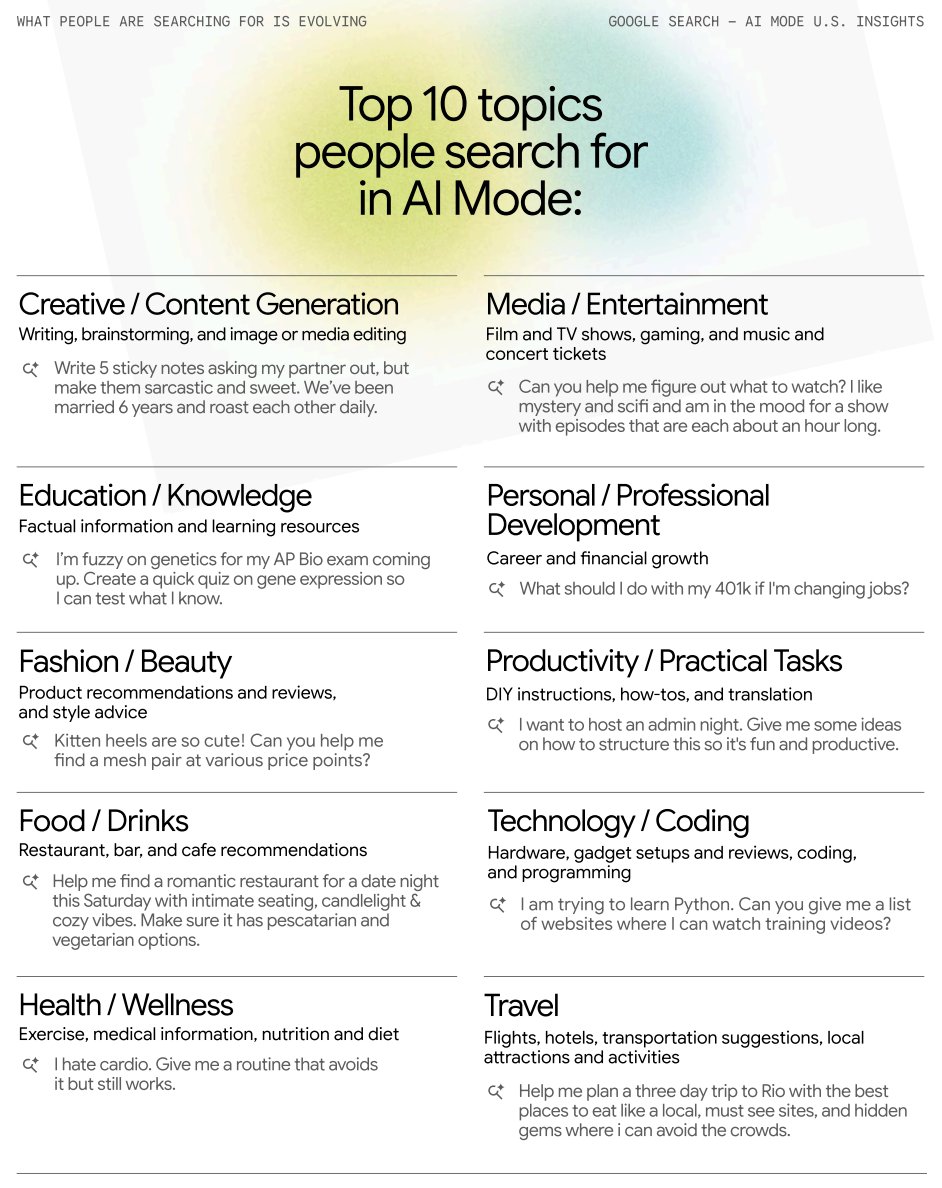
📊 Google just shared a new report on how people are using AI Mode in the US. 👇 Useful directional insights, yes. Complete market picture, no: The keyword data comes from sampled Google Trends data for AI Mode. With that in mind, a few patterns worth paying attention to: 🔎 Searches are longer and more conversational. The average AI Mode query is 3x the length of a traditional Search query. Keyword research now needs to be complemented with prompt, task, constraint and scenario research. 💬 Follow-up behavior matters. Follow-up queries grew 40%+ on average per month. Brand visibility can't be analyzed only at the first prompt anymore: a brand might be mentioned, dropped, compared, misrepresented or never cited across the journey. This means the unit of analysis is the journey, not the query. 🛍️ AI Mode is being used to decide, not only to discover. * Which" queries grew 40% faster than AI Mode queries overall in the past six months. * The top retail attributes people look for: price, location, color, brand, availability, size, material, style, type, quality. This means Ecommerce AI Search optimization shouldn't be only about "more product content": it's accurate, complete, fresh and consistent product data across pages, structured data, feeds, variants, reviews and attributes. 📍 Local and availability intent is very visible. Follow-up store queries include "near me", "in stock", "replacement parts", "car dealerships with financing". AI systems need to understand location, inventory, services and constraints to satisfy these. 🧭 AI Mode is becoming a task layer, not only an answer layer. Planning queries grew 80% faster than AI Mode queries overall. The opportunity is to be included in plans, shortlists, comparisons and workflows, not only ranked for individual queries. 👀 My takeaway: Don't confuse Google's usage narrative with independent performance data. There's a behavioral shift and Google has every incentive to frame it favorably for its own ecosystem. For SEOs and marketers, the practical next step isn't to replace SEO fundamentals. It's to expand how we research, optimize and measure: ✅ From keywords to prompts, tasks and constraints ✅ From rankings to presence, citations and representation accuracy ✅ From single queries to follow-up journeys ✅ From content-only optimization to entity, product, local and feed-level readiness ✅ From observed traffic to a more nuanced view of visibility and influence AI Mode makes it increasingly risky to measure search visibility only through traditional rankings and clicks. Read the full report in: storage.googleapis.com/gweb-uniblog-p…
Aleyda Solis 🕊️ tweet media
English
9
40
121
6.1K
Judith Lewis
Judith Lewis@JudithLewis·
@Dixon_Jones @Ryanair That is really crazy… it’s because they have a better, right? It’s the craziest, B-road-strikes rule ever…
English
1
0
0
69
Dixon Jones
Dixon Jones@Dixon_Jones·
Hey @Ryanair apparently I cannot put these in the overhead locker! Isn’t that a violation as I am in an emergency seat? :) Looking forward to your usual considered response.
Dixon Jones tweet media
English
6
0
5
484
Judith Lewis
Judith Lewis@JudithLewis·
Hey @athenseo people! Tomorrow it is CHOCOLATE FOR QUESTIONS for my talk at 16:00 so make sure you stick around - plus you will want to be here for the afterparty anyway so make sure your Saturday is EPIC and stick around to the end!
Judith Lewis tweet media
English
0
0
0
38
Judith Lewis
Judith Lewis@JudithLewis·
@pedrodias Lunch… it’s lunch… the team has been cooking lunch…
English
0
0
1
36
Judith Lewis retweetledi
Cyrus Maxx
Cyrus Maxx@CyrusShepard·
Google: Don't "chunk" your content - that's a myth! Also Google: Organize your content into chunk-like sections plz
Cyrus Maxx tweet media
English
27
18
115
8.9K
Judith Lewis retweetledi
Count Binface
Count Binface@CountBinface·
Repost if you’d like me to represent the UK at #Eurovision 2027.
Count Binface tweet media
English
130
1.8K
6.8K
166.3K
Judith Lewis retweetledi
Aleyda Solis 🕊️
Aleyda Solis 🕊️@aleyda·
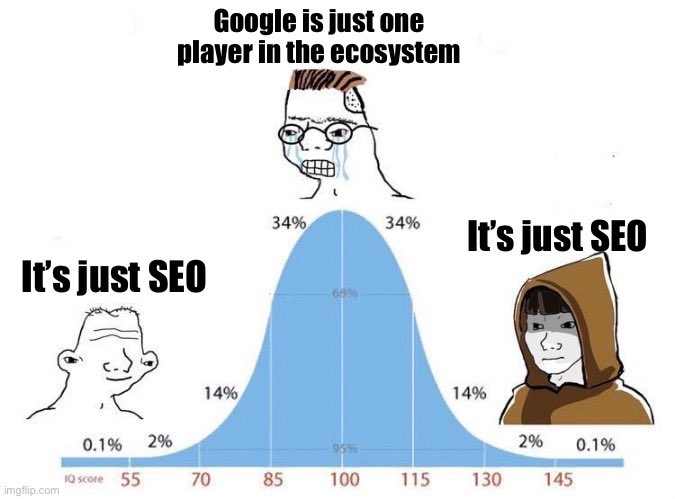
In practice, I don’t really care what optimizing for AI Search is called: SEO, AI Search Optimization, AEO, GEO, or whatever the new acronym ends up being. I’m the first one to adapt to the terminology clients use if it helps them understand the opportunity, get internal buy-in, and move faster. However, the problem comes when a new label makes AI Search Optimization look like something completely separate from SEO. Because this can backfire in two important ways: First, it makes it less obvious to decision makers that SEO specialists are the best placed to own and grow this area. And let’s be crystal clear: SEOs already understand how search systems discover, crawl, render, interpret, evaluate, rank, cite, and drive demand through content, links, entities, authority, technical accessibility, and brand signals. Second, it makes it easier for tactics to be sold as “new” AI visibility solutions while being disconnected from SEO processes, quality standards, and search fundamentals… and this is where the risk becomes very real. Google’s new guidance for optimizing for AI experiences makes it clear: SEO principles still apply in AI Search and has also clarified that its existing spam policies apply to AI Overviews and AI Mode. Lily Ray’s recent analysis shows what can happen when AI-generated content is used as a scale shortcut to manipulate AI search visibility: it can backfire across both traditional search and the AI search experiences many sites are trying to win. So yes, use the terminology that helps your stakeholders understand the opportunity, but don’t let the terminology make you forget what actually matters: * AI Search doesn’t replace SEO, it expands where SEO needs to operate. * Sustainable AI Search visibility won’t come from ignoring SEO best practices. It will come from applying them better across your own site and the wider ecosystem where AI systems learn, cite, validate, and recommend information. PS: if you want to keep updated with the latest in SEO & AI search optimization without the fluff, subscribe to the free weekly #SEOFOMO newsletter and join almost 45K subscribers : seofomo(.)co
Aleyda Solis 🕊️ tweet media
English
29
30
131
7.1K
Judith Lewis retweetledi
Aleyda Solis 🕊️
Aleyda Solis 🕊️@aleyda·
🤖 It Works Until It Doesn't: AI Content Strategies That Backfire - A must read guide by @lilyraynyc 👇 There are very specific scenarios for which content at scale is needed due to nature/reach of the site (eg. marketplaces), but it needs to be generated by going through a careful integration and validation to ensure quality via an editorial workflow and review, while adding useful and relevant, meaningful, unique insights, proprietary data, expert / user advice that really fulfill a need of users... however, most of sites out there, don't really fall into this scenario. In this guide, Lily shows what happens when AI is leveraged in ways that don’t fulfill the criteria above, and it works… until it doesn’t. She analyzed +220 sites publicly associated with AI content creation, automation, and scaling platforms, and the findings are a reminder of what happens when scale is prioritized over substance: * 54% lost +30% of their peak organic traffic * 39% lost +50% * 22% lost +75% The pattern is certainly familiar for anybody that has been in SEO for a while: rapid content growth, traffic increase, then significant visibility drops a few months later, caused by: * Programmatic “what is” glossaries. * Comparison pages at scale. * “Best X for Y” listicles. * Competitor alternative pages. * Thin location or language pages. * Self-serving listicles. * Off-topic content scaled mainly for visibility. AI didn’t created these tactics but made them much easier, faster, and cheaper to scale. The issue isn't using AI for content but using AI to publish large volumes of formulaic, undifferentiated content created mainly to rank, get cited, or influence AI search systems, without enough originality, expertise, topical focus, or human validation. This matters for both traditional SEO as well as AI search. If your AI search strategy damages your organic search visibility, credibility, and topical authority, it can also end up hurting your AI search visibility via grounding. Remember: Don’t use AI to scale like this, because as we’ve seen in SEO many times before, scale without substance might work temporarily, but it doesn't usually end well. Read it here: lilyraynyc.substack.com/p/it-works-unt…
Aleyda Solis 🕊️ tweet media
English
10
12
64
11K
Judith Lewis retweetledi
Pedro Dias
Pedro Dias@pedrodias·
Pedro Dias tweet media
ZXX
4
2
16
1.1K
Judith Lewis retweetledi
Aleyda Solis 🕊️
Aleyda Solis 🕊️@aleyda·
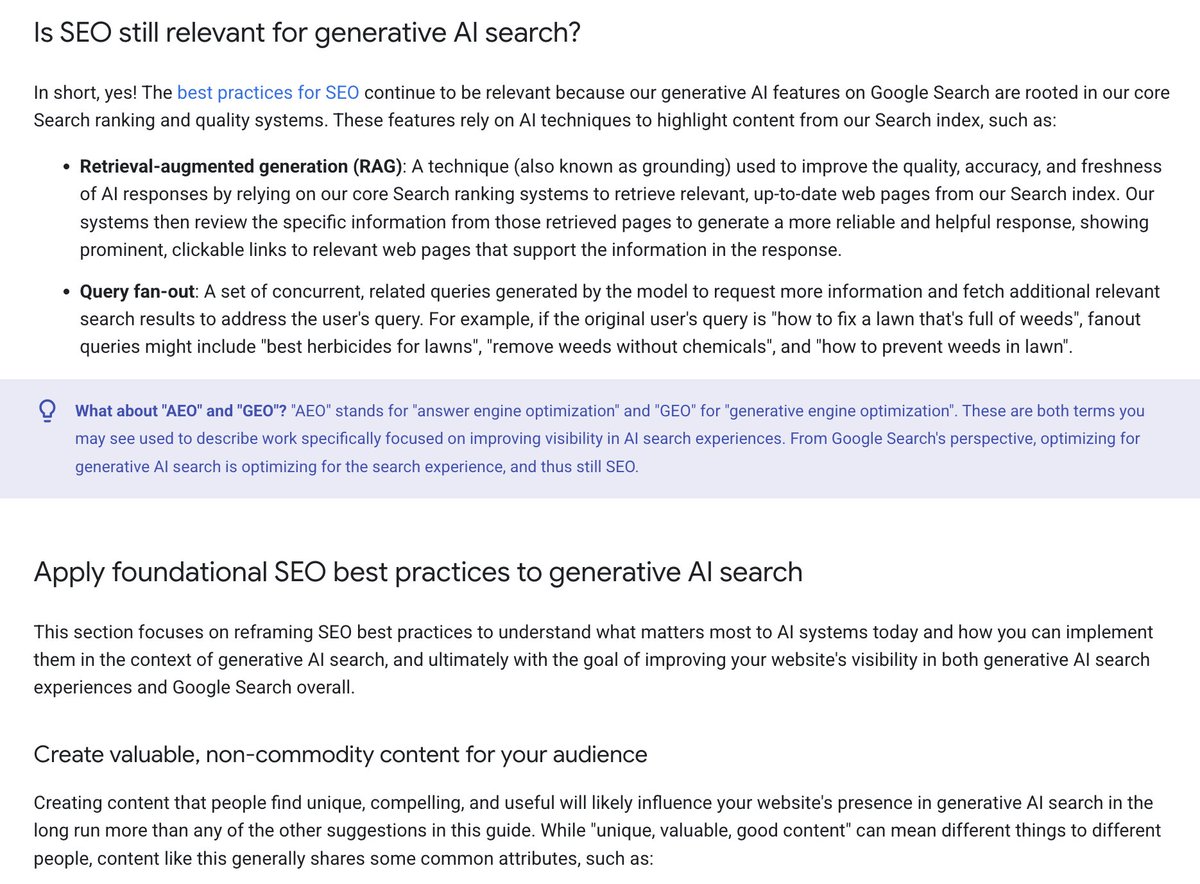
🚨 Google has published its official guidance on optimizing for generative AI experiences in Search, including AI Overviews and AI Mode 👇 Going through: 1. How SEO is still relevant for generative AI search: The best practices for SEO continue to be relevant because their generative AI features on Google Search are rooted in our core Search ranking and quality systems. 2. How to Apply foundational SEO best practices to generative AI search: ** Creating valuable, non-commodity content for your audience: Providing a unique point of view, Creating non-commodity content that's helpful, reliable, and people-first, Organizing content in a way that helps your readers, adding high-quality images and video, focusing on what your users want, and avoid overdoing it. ** If you're using generative AI tools to assist in content creation, be sure that your work meets the standards of the Search Essentials and our spam policies. ** Building and maintain a clear technical structure: meeting the Search technical requirements, following crawling best practices, focusing on human readability and don't worry about perfect HTML code, if you're using JavaScript, be sure to follow JavaScript SEO best practices, providing a good page experience, reducing duplicate content. 3. Mythbusting generative AI search: what you don't need to do Things you can ignore for Google Search: ** LLMS.txt files and other "special" markup ** "Chunking" content: ** Rewriting content just for AI systems ** Seeking inauthentic "mentions" ** Overfocusing on structured data 4. Explore agentic experiences AI agents are autonomous systems that can perform tasks on behalf of people, such as booking a reservation or comparing product specifications, they can take many forms; for example, browser agents may access your website to gather the data they need to complete these tasks, such as analyzing visual renderings (like screenshots), inspecting the DOM structure, and interpreting the accessibility tree. Check out the available agentic experiences and review the guide to agent-friendly website best practices recently published here: web(.)dev/articles/ai-agent-site-ux Read the full Google guide here: developers(.)google(.)com/search/docs/fundamentals/ai-optimization-guide PS: This is by far the most in-depth, actionable guide that Google has published so far for AI search, tackling some of the major misunderstandings and myths SEOs face in the day to day... thank you @googlesearchc team 🙌
Aleyda Solis 🕊️ tweet media
English
14
42
165
14.7K
Judith Lewis retweetledi
Aleyda Solis 🕊️
Aleyda Solis 🕊️@aleyda·
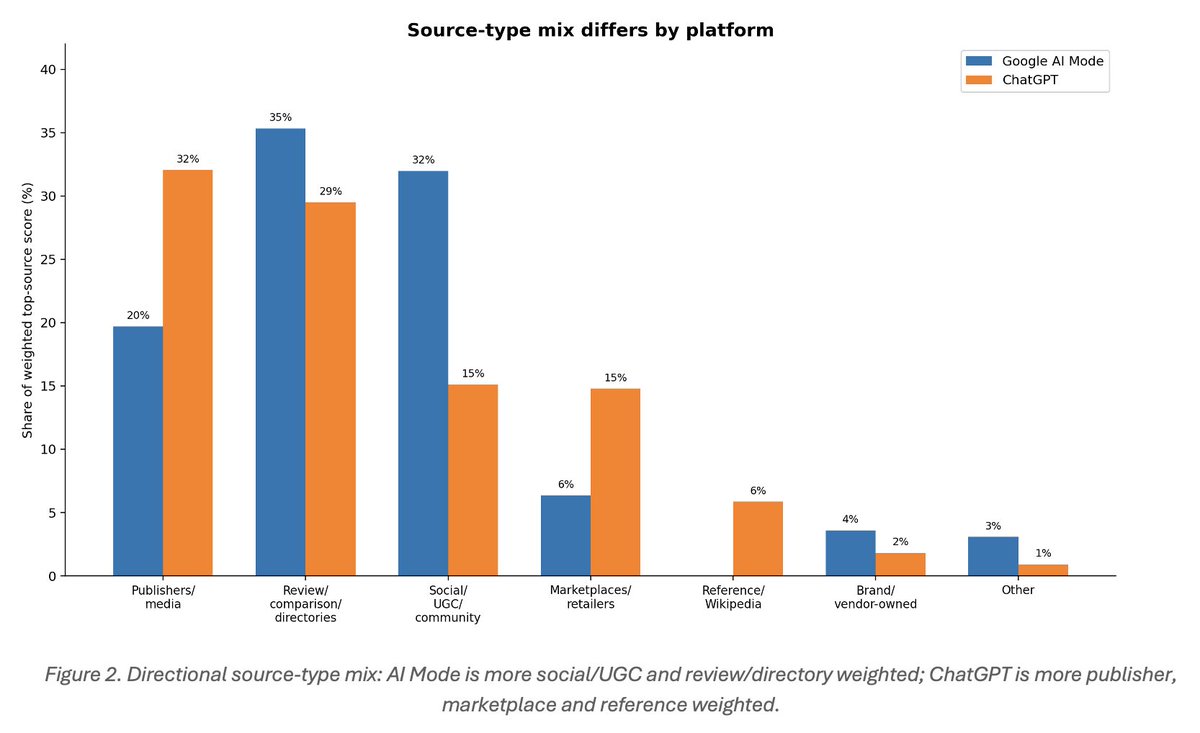
👀 I went through 9 months of @semrush AI Visibility Index source data comparing ChatGPT and Google AI Mode across Business Services, Consumer Electronics, Software, Fashion and Finance: The top outcome isn't just that the two platforms rely on different source ecosystems, but that they're constantly moving. A few patterns stood out: 1. ChatGPT is much more diverse. In April 2026, ChatGPT needed 1,621 brands to reach 80% share of voice Overall. Google AI Mode needed 299. That is a 5.4x gap. 2. YouTube is far more prominent in Google AI Mode (what a surprise!). It became AI Mode’s #1 Overall source in April, jumping from 16.0 to 46.9 in Semrush’s source score from March to April. 3. Wikipedia has been a major ChatGPT source, but April changed the story. It was ChatGPT’s #1 or #2 Overall source from Aug 2025 to Mar 2026, then dropped to #5 in April. 4. Alibaba is one of the most interesting new entrants: It has zero Google AI Mode top-10 appearances in this dataset, but became ChatGPT’s #4 Overall source in April and #1 in Consumer Electronics. 5. The platforms overlap, but not enough to treat them the same. April top-10 source overlap ranges from 4/10 to 6/10 by vertical. Reddit is the strongest April cross-platform constant, appearing in the top 10 for every analysed vertical in both platforms. Forbes is also highly consistent Overall, appearing in both platforms’ Overall top 10 in 7 of 9 months. The takeaway: AI search visibility shouldn't be only about optimizing your own site, but about understanding which external sources each platform repeatedly surfaces as evidence in your vertical, and tracking how that source layer changes over time. This data doesn't prove which sources cause visibility, but it does show where brands should prioritize third-party visibility, reviews, community presence, video, marketplace representation, digital PR, and entity corroboration by platform and vertical... and one AI visibility strategy for every platform is not enough. If you haven't yet, check Semrush AI Visibility Index: ai-visibility-index.semrush.com 👀 Thanks for the data 💪
Aleyda Solis 🕊️ tweet mediaAleyda Solis 🕊️ tweet media
English
2
5
29
3.7K
Judith Lewis retweetledi
Martin MacDonald
Martin MacDonald@searchmartin·
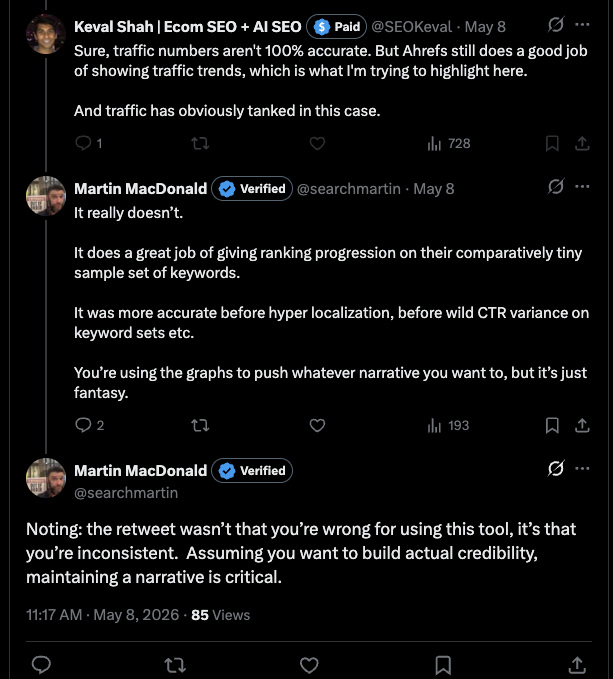
I told this guy that posting entirely opposite takes on the same data impacts his credibility with professional SEO's. Seems the audience he wants to attract are amateur SEOs that dont understand nuance, and just eat up his crap blindly. #DontBeLikeSEOKeval
Martin MacDonald tweet mediaMartin MacDonald tweet media
English
7
1
21
3.2K
Ryan Jones
Ryan Jones@RyanJones·
Hey @google I have 5 different Google accounts tied to this phone number (work email, personal, business, etc) I didn’t request this code. But I have no way of knowing what account it was for. Why can’t you add that to the text?
Ryan Jones tweet media
English
1
0
2
319
Judith Lewis retweetledi
Martin MacDonald
Martin MacDonald@searchmartin·
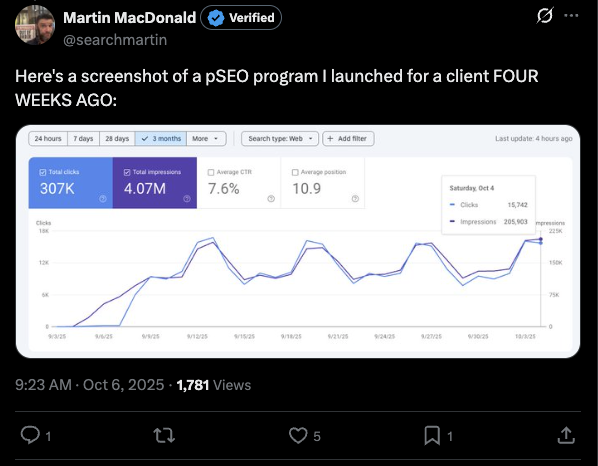
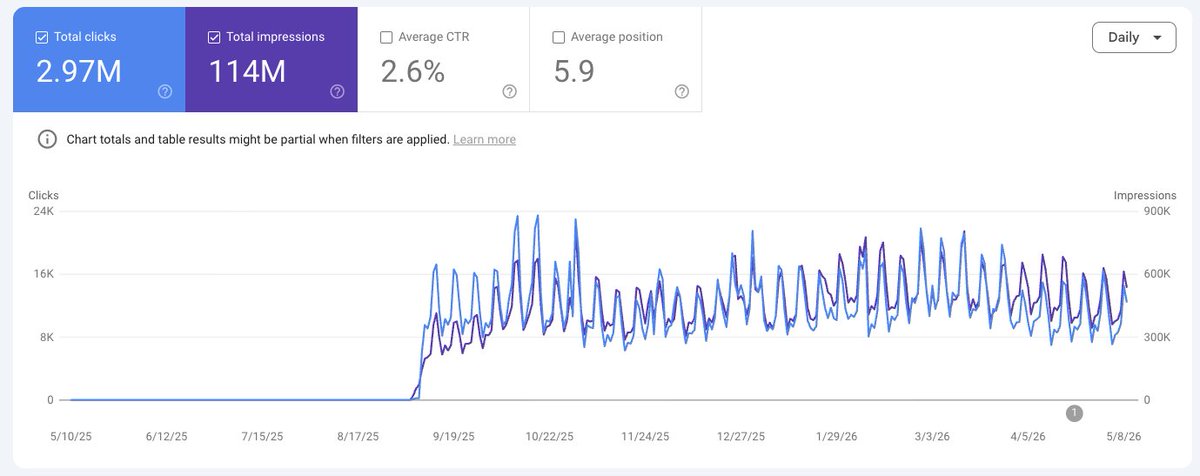
PSEO DONE RIGHT. How it started (oct '25), vs how its going (May '26): Programmatic SEO doesn't need to be spam, but 100% of other threads here, are just that. Sorry not sorry.
Martin MacDonald tweet mediaMartin MacDonald tweet media
English
24
3
65
8K
Judith Lewis retweetledi
Fumu !!
Fumu !!@huu_xiie·
Fumu !! tweet media
ZXX
288
56K
216.1K
1.9M