One Man Opinion

1K posts
One Man Opinion

One Man Opinion

@K46213K

Katılım Ocak 2024
105 Takip Edilen0 Takipçiler
Sahil Kapoor
Sahil Kapoor@SahilKapoor·
There is a new trend of questioning whether SIPs are useful at all. That is not surprising. People are wired to overweight recent experience. When recent SIP returns are weak, commentators quickly appear to declare that SIPs do not work. Most offer no real alternative. So here is a brief history of the idea. It is not exhaustive. It is a mix of global and Indian milestones. 1924 SIP did not begin as a product. It began as an idea. In 1924, Edgar Lawrence Smith published Common Stocks as Long Term Investments and broke the old belief that bonds were always superior to equities. His back-testing proved that long-term, periodic equity investments yielded superior capital appreciation due to the compounding of retained earnings, providing the fundamental intellectual rationale for why systematic equity accumulation is a sound, wealth-generating practice. 1928 Pioneer Fund was established in the US. One of the earliest mutual funds, it created the structure that made regular fixed-amount investing practical for ordinary investors through pooled capital and fractional ownership. 1947 Lucile Tomlinson published Successful Investing Formulas and delivered the first rigorous back-test of regular investing across 23 overlapping 10-year periods. She showed how average cost can fall below average price and gave one of the earliest formal validations of what became Dollar Cost Averaging. Utilizing the Dow Jones Industrial Average across 23 overlapping ten-year periods (1929–1952). She definitively proved the mechanics of average cost falling below average price, formally affirming that "No one has yet discovered any other formula for investing which can be used with so much confidence of ultimate success... as Dollar Cost Averaging". 1949 This is a big one which brought the concept to limelight. Benjamin Graham published The Intelligent Investor and formally coined the term “dollar-cost averaging.” He affirmed DCA as the ultimate psychological mechanism to prevent the fatal behavioural error of concentrating purchases during market euphoria, establishing mechanical accumulation as a core tenet of value investing. 1954 The New York Stock Exchange launched the “Monthly Purchase Plan.” This turned theory into a retail mechanism. Investors could now commit fixed sums every month into selected stocks in a structured, repeatable way. 1963 The Government of India passed the UTI Act and created the Unit Trust of India. This marked the beginning of India’s mutual fund industry and laid the regulatory and structural base on which the future SIP market would stand. 1975 John Bogle founded the Vanguard 500 Index Fund. Bogle became one of the most influential champions of disciplined, low-cost investing and strengthened the case for regular investing into broad market indices without trying to time the market. 1979 George Constantinides published a major academic critique of DCA. He showed that in a perfectly efficient market, DCA is theoretically inferior to optimal sequential investing because cash held back has an opportunity cost. This sparked the long debate between mathematical optimality and behavioural practicality. Today, it is well known that EMH is a phony concept. 1987 SBI launched SBI Mutual Fund and ended UTI’s 24-year monopoly. This was a major moment for India because it widened distribution and brought large public sector participation into the mutual fund ecosystem. 1992 SEBI was established as a statutory regulator. This changed everything for Indian capital markets by bringing stronger rules, better transparency, investor protection and a framework that allowed private sector mutual fund innovation to grow. 1993 Vivek Reddy, Shyam Kothari and John Cogan Jr. formed Kothari Pioneer, India’s first private asset management company. It also helped improve market transparency by introducing daily NAV disclosures to Indian investors. Also in 1993, Kothari Pioneer later taken over by FT launched the first Systematic Investment Plan in Indian capital markets. This was the true birth of SIP in India: a disciplined, automated way for retail investors to invest through volatility using rupee-cost averaging. 1995 Meir Statman published A Behavioural Framework for Dollar-Cost Averaging. He defended DCA not on pure return maximization, but on human behaviour. His work showed that DCA helps reduce regret aversion, loss aversion and self-control failures. 2005 Robert Dubil used Monte Carlo simulations to show that while lump sum investing often delivers higher returns, DCA lowers volatility and can be rational for investors who value smoother outcomes, downside comfort and behavioural discipline. 2017 AMFI launched the “Mutual Fund Sahi Hai” campaign. This was a turning point in India. SIP moved from being a niche investing concept to a mass household habit, accelerating domestic retail participation in Indian equities. 2023 Vanguard Group research reaffirmed that lump sum investing beats DCA roughly 68% to 76% of the time across global asset classes because of the equity risk premium. But it also reinforced the older truth: for investors with high loss aversion, DCA remains the more usable and sustainable strategy. 2025 In the Jan 2025 edition of DSPNetra we showed how SIP has worked in creating long term wealth in all major equity markets across the world. SIP is not a return-maximization strategy. It is an antidote to emotional responses to market cycles of greed and fear. It is an acceptance of decent average returns over an indecently long period. That is because, in the compounding formula, the exponent is t for time, not r for return.
English
6
15
139
22.4K
One Man Opinion
One Man Opinion@K46213K·
@tejas0281 @ipo_agarwal Already bought Wipro in some accounts. Will do the rest for other accounts after tomorrow. As you mentioned it’s long time before Buyback tendering happens, try to stagger purchase and see if I I have reasonable average cost. Cyient added some shares today before run up.
English
0
0
0
123
Tejas Pandya
Tejas Pandya@tejas0281·
@K46213K @ipo_agarwal Loaded with wipro.. cyient plan pending..what's ur strategy?? only problem is funds get blocked for 1.5 to 2 months in each buyback..but when there are no ipos in pipeline buyback would be a good strategy..
English
1
0
0
117
G K AGARWAL
G K AGARWAL@ipo_agarwal·
TCS may announce buyback very soon to divert attention from the Nashik case But before punishing all the culprits, everyone should not forget about it
English
34
143
933
31.1K
One Man Opinion
One Man Opinion@K46213K·
@tejas0281 @ipo_agarwal Tejasbhai what’s the plan for Wipro and cyient buyback. You generally buy before announcement of Buyback price or after. In absence of ipo, planning to apply in Buyback
English
1
0
0
135
Prashant Nair
Prashant Nair@_prashantnair·
Akash Prakash with the question of our times !
Prashant Nair tweet media
English
16
37
218
16.9K
Vikas Vij
Vikas Vij@TheClubJunto·
Negative Wealth Effects of a Prolonged Bear Market 1. Housing sales lowest in 18 quarters 2. 2026: Retail lost ₹11 lakh cr in equity wealth 3. Participation: Crash hurts 4X more households today than 2018 4. Housing & Equity: Combined slowdown hits consumer sentiment DATA: Positive vs. Negative Wealth Effect a. When stock portfolios and property values go up, consumers feel confident due to their rising net worth. They take auto loans, home loans, consumer loans, and indulge in high-ticket spending. Animal spirits boom. b. The exact opposite happens when net worth falls. Consumer sentiment gets depressed. There is risk-aversion and future looks insecure. Consumption and investment slows down, creating a negative loop, damaging asset prices further. c. IMF Paper on “Marginal Propensity to Consume” (MPC): 10% fall in asset prices leads to a decline in aggregate consumption of about 1 to 1.4% in the overall economy. Indian Real Estate: Jan-Mar 2026 a. Housing sales fell below 1 lakh units for the first time in 18 quarters (after Covid) with 13% YoY decline. b. New Launches declined 19% YoY, indicating a sharp fall in builder confidence. c. Real Estate contributes 8% to India’s GDP and supports core industries (energy, steel, cement, paint, construction). Core Sector growth in India slowed sharply to 2.3% in Feb 2026, down from 4.7% in Jan. d. Property is the primary collateral for lending by banks and NBFCs. With a continued slowdown in housing, the credit cycle may be affected. Plus, the risk of low quality builder loan defaults rises if the slowdown worsens. When the Music Stops: The Aftermath of Euphoria a. Economic Survey 2025-26: Share of equity in household savings jumped 7.5X from 2% in FY12 to 15% in FY25. Monthly SIP inflows increased 7X from FY17 to FY25. b. Household equity wealth expanded from ₹31 lakh cr in April 2020 to ₹84 lakh cr in Sept 2025, representing an increase of ₹53 lakh cr in just 5 years. c. In 2018, there were 3.1 cr unique registered equity/MF investors in India. This number jumped 4X to 12.2 cr in 2026. So, now when the market crashes, it hurts 4X more households than it would have in 2018. d. On Jan 1, 2026, NSE market cap was ₹479 lakh cr. Retail investors’ share in this market cap was ₹91 lakh cr, including direct investors & MF investors. By Mar 31, 2026 retail investors had lost ₹11 lakh cr, with their market cap down to ₹80 lakh cr (12% decline). e. “Average” retail wealth erosion was 12% in Jan-Mar 2026. But 51% of retail investors are direct investors according to NSE Pulse Report 2026, while 49% are MF investors. Direct investors have a concentration in midcaps and smallcaps, which have suffered much deeper value destruction than “average” 12%. For Investors & Policymakers: Recessionary Risks of a Prolonged Bear Market Falling Asset Prices → Weaker Household Balance Sheets → Lower Bank Collateral Values → Borrowing Capacity Falls → Less Spending & Investment → Economy Weakens → Asset Prices Fall Further ENDQUOTE: “You can't predict the future, but you can prepare for it.” – Howard Marks, Legendary Investor (“The Most Important Thing”) @arabicatrader
English
15
34
199
28.4K
One Man Opinion
One Man Opinion@K46213K·
@AmolPlanRupee This report suggest hybrid and Multi asset. And post suggest equity. Many foreign brokerages downgrade India as well. Seems ful picture hide to misguide investor. I am in favour of complete info for informed decision
English
0
0
0
17
Amol Joshi
Amol Joshi@AmolPlanRupee·
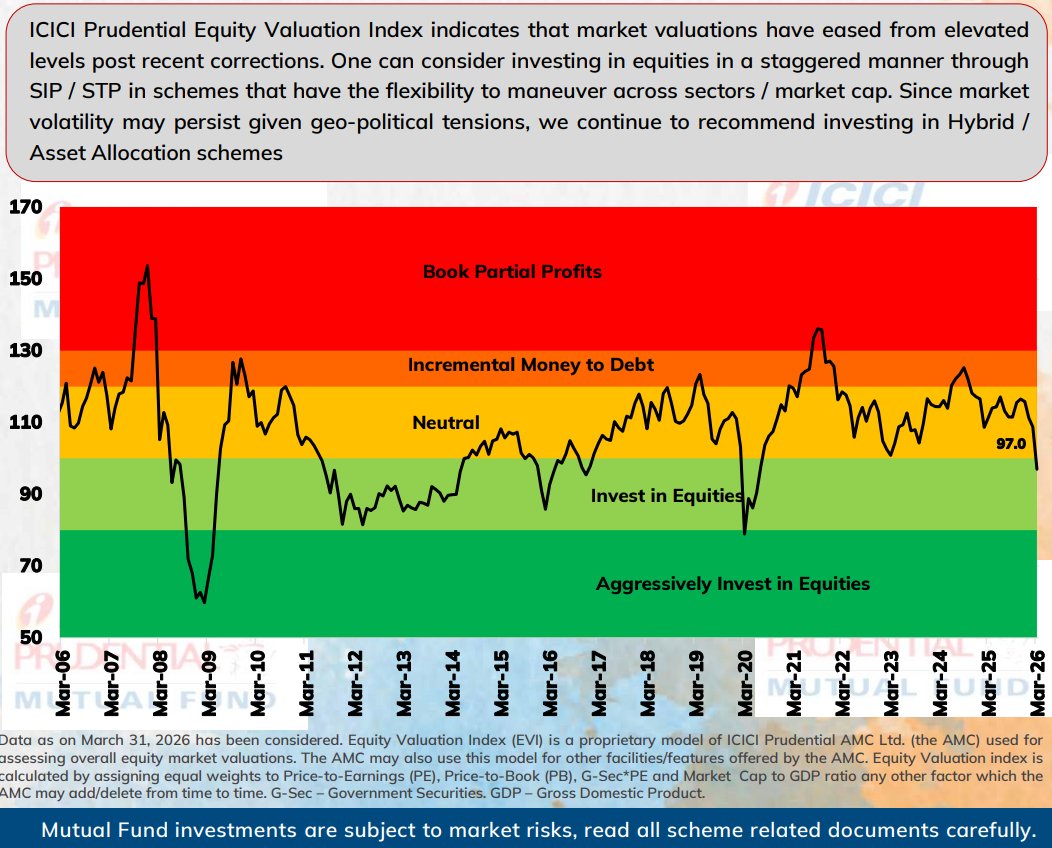
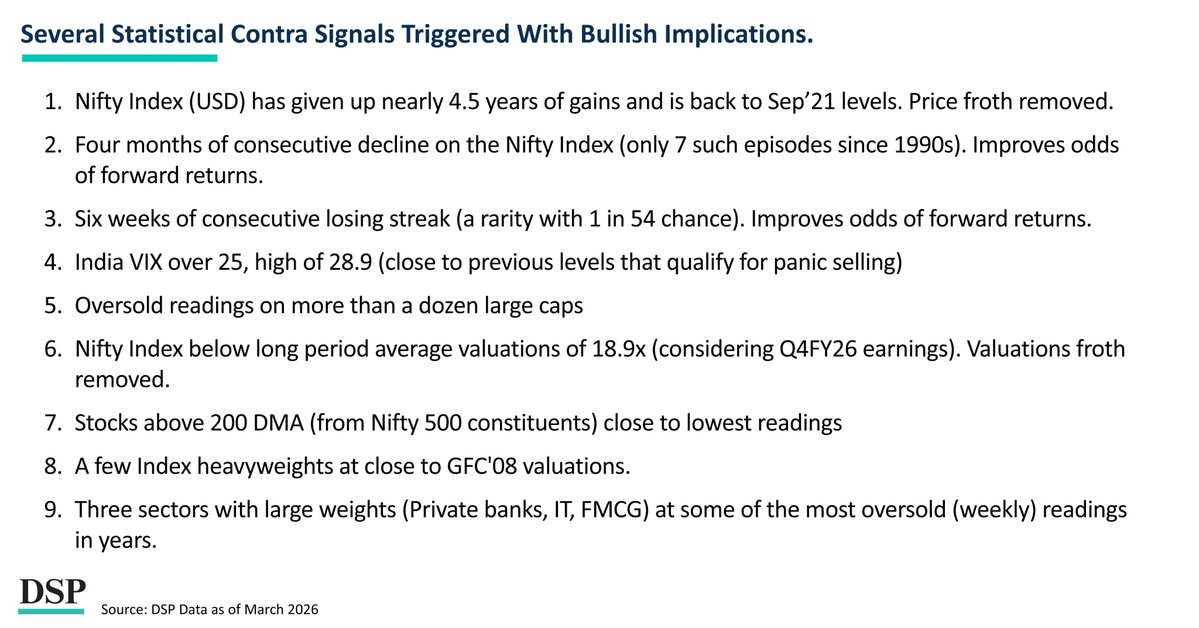
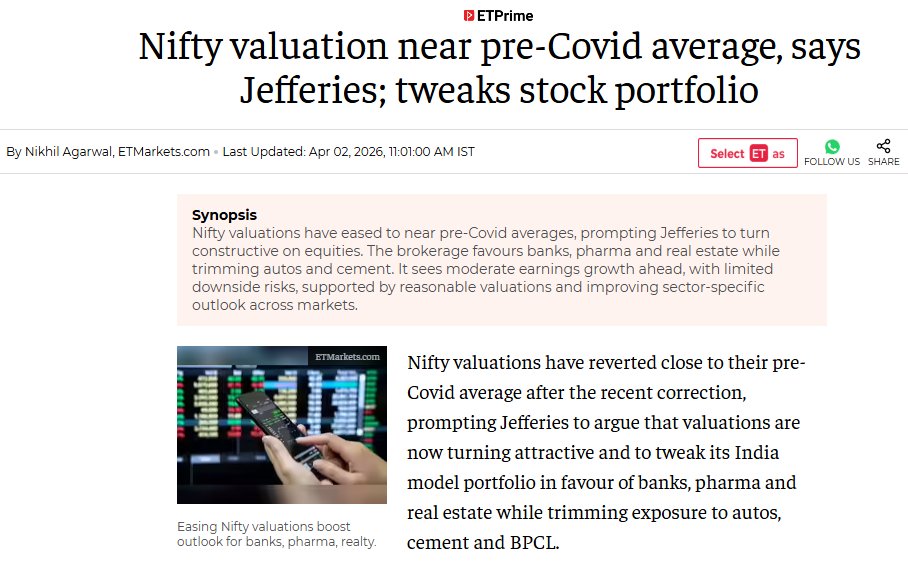
Wished you had invested in Mar-2020❓ Believe the Buffet saying "Buy when there's blood in the streets" - One can consider investing in equities in a staggered manner... S Naren - ICICI Pru MF - Investors should in line with their risk profile evaluate increasing exposure to equities, preferably in phases over the next few weeks. Prashant Jain - Nifty Index (USD) is back to Sep’21 levels. Four months of consecutive decline on Nifty...improves odds of forward returns. DSP MF - Nifty valuation near pre-Covid average, Jefferies Not a reco. DYOR
Amol Joshi tweet mediaAmol Joshi tweet mediaAmol Joshi tweet mediaAmol Joshi tweet media
English
7
21
123
10.3K
One Man Opinion
One Man Opinion@K46213K·
@gurjota Interesting data point. Looks like FD return is better for time period you mentioned.
English
0
0
0
871
Gurjot Ahluwalia
Gurjot Ahluwalia@gurjota·
Do not let oldies of the stock market misguide and misinform you. The golden period of stock market returns from 1980s and Harshad Mehta bull run are not something you will ever experience Sensex itself multiplied by 33x from 1980 to 1994, you will not see this in your lifetime. Returns go down over time as countries move from developing to developed nations. For the same Unluckiest Investor example, I took the last 20 years Sensex data. And the CAGR is around 7.7%. For the next 20 years it maybe 6% or lower if you end up being a fool to buy at the top everytime. Don't even ask for the last 10 and last 5 years.
Gurjot Ahluwalia tweet mediaGurjot Ahluwalia tweet media
Monika Halan 🇮🇳@monikahalan

What took me hours of work earlier, @claudeai helped me do in minutes. So, this is India's unluckiest investor's story. He buys the Sensex every year at the 52-week high. And keeps buying for 35 years. He is persistent. He is the unluckiest investor in India. Because each time he invests the market falls (that year). But long-term compounding of the market turns Rs 35 lakh into just over Rs 3 crore. That's a 10.5% return. For the worst-timed investment.


English
32
23
355
66.5K
Ritesh Jain
Ritesh Jain@riteshmjn·
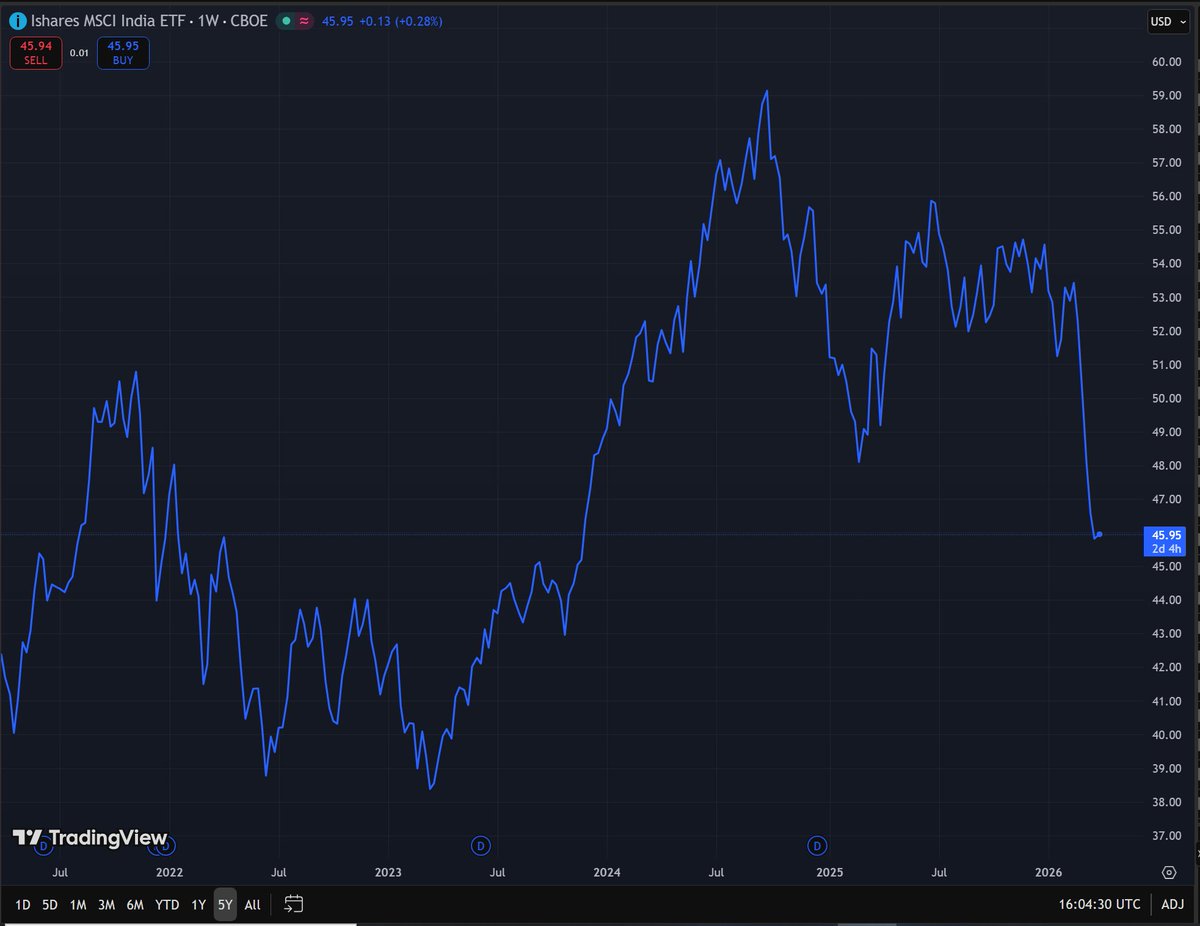
5 years of zero returns for INDA
Ritesh Jain tweet media
English
19
25
298
25.9K
One Man Opinion
One Man Opinion@K46213K·
@SahilKapoor @1shankarsharma Sahil - Isn’t it the duty of fund manager to advise client on booking profit when market is over valued? Mid 24 market was over valued and promoter , FI exiting at the expense of SIP money. Not sure whether explicit advise like this passed onto client directly or indirectly
English
0
0
0
30
Sahil Kapoor
Sahil Kapoor@SahilKapoor·
The market that should mean revert for the right reasons. Bear market: lose fat Bull market: gain muscle Repeat, until you get close to 12% to 14% body fat. For 100% naturals, it can take a few years, like below.
Sahil Kapoor tweet media
English
4
0
72
12.6K
One Man Opinion
One Man Opinion@K46213K·
@gurjota Loss is loss at the end of the day and part of the game. Although agree it can be set off against profit and resultant tax benefit.
English
2
0
2
767
Gurjot Ahluwalia
Gurjot Ahluwalia@gurjota·
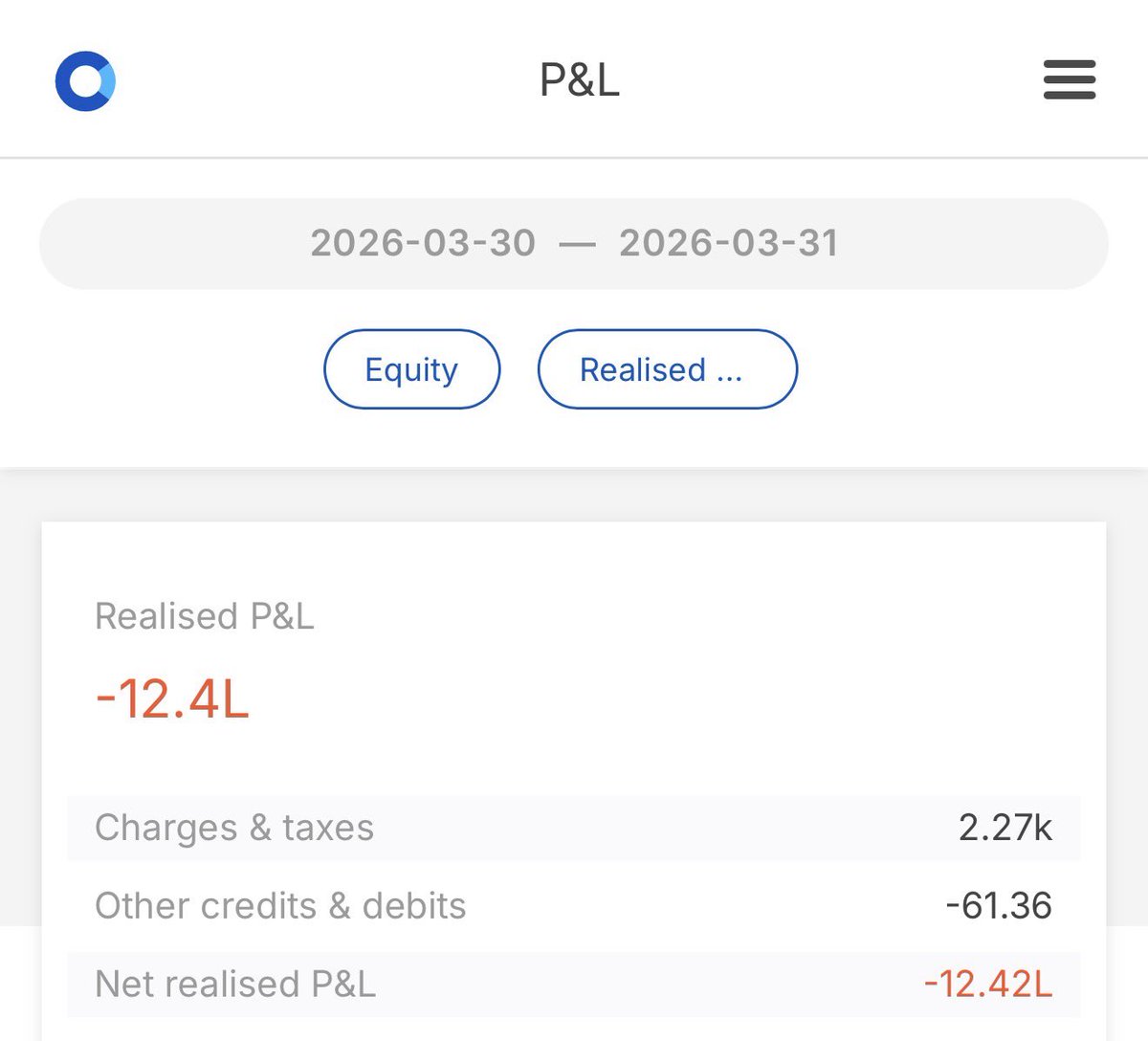
My contribution in yesterday's selling 😬
Gurjot Ahluwalia tweet media
English
26
1
276
74.5K
Sekhar
Sekhar@LearningEleven·
So many decent quality micro cap stocks at throw away prices due to market conditions and liquidity crunch. Few examples: RBZ Jewellers - market cap might soon be touching their revenues from their retail store! Two more stores coming up in next few months! AVP Infra - If DMK wins, there is no stopping SJ Logistics - just not logistics anymore! Please do share the quality names you are tracking!
English
52
98
790
88.9K
Vineet Bhatia
Vineet Bhatia@investor_vineet·
@LearningEleven Start nibbling financials, many at superb valuations My go to names are equitas and IDFC
English
4
0
14
3.5K
Rajendra B. Aklekar
Rajendra B. Aklekar@rajtoday·
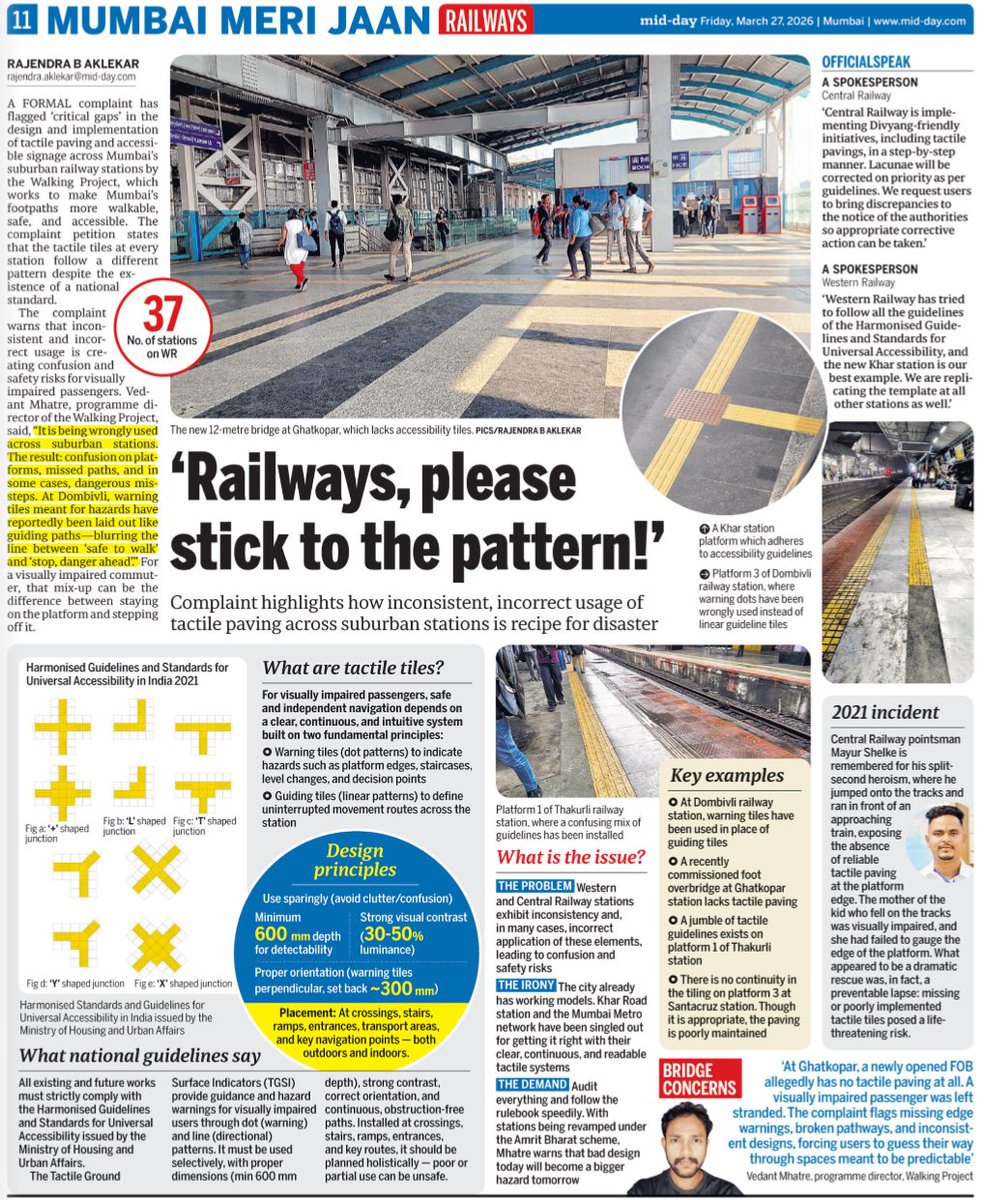
Mind the Gap, but where's the guide? A formal complaint has flagged 'critical gaps' in the design and implementation of tactile paving and accessible signage across Mumbai’s suburban railway stations by the @walkingproject team. Tactile tiles at every station follow a different pattern despite a national standard being in place.
Rajendra B. Aklekar tweet media
English
2
37
136
6.1K
Samir Arora
Samir Arora@Iamsamirarora·
Elon Musk is not the richest man in the world for he mostly owns equity in different companies- we should only count actual US$ in his bank accounts to calculate his networth. 🤣
Ira Dugal@dugalira

Bernstein makes a point on India's FX reserves that I have been debating with Reuters FX experts @kalrajs23 and Nimesh Vora: Should India's true FX cover be measured as foreign currency assets, adjusted for forward position and not total reserves given the higher share of gold? That would take usable reserves to about $480 billion or so? (Last reported FCA at $555 billion and forward book last reported at $68 billion) Bernstein makes that point today. Views welcome!

English
17
12
177
47.1K