
Kara Calvert 🛡️
400 posts

Kara Calvert 🛡️
@karacalvert
Mom to 4 amazing kids! Wyoming native and proud @UWYO alum. Thrilled to be working for @coinbase. Longtime tech and crypto advocate in DC.


🚨NEW: Since last Friday, @ABABankers members have sent more than 8,000 letters to Senate offices urging lawmakers to fix the stablecoin yield compromise, per a source familiar with the effort. It apparently does not include a separate phone call campaign.

🚨 The banking cartel is in full panic mode. 🚨 While Americans were celebrating Mother’s Day with their families, the CEO of the American Bankers Association sent a frantic alert to every bank CEO in the country, demanding “immediate engagement” to lobby Senators and kill stablecoins that would finally let everyday Americans earn real yields on their own money. This line in the letter sticks out: “we believe committee members may not be fully aware of the risks to the economy by the stablecoin loophole.” That’s both intellectually dishonest and simultaneously demeaning. First, there is no “loophole.” This entire issue was litigated during the GENIUS Act debate. @BillHagertyTN worked tirelessly on this issue and this statement is an insult to his and others work. For decades, these banks have treated your deposits like their personal piggy bank, paying you next to nothing while lending YOUR money out for massive profits and executive bonuses. During the Biden era, these same banks worked hand-in-glove with @SenWarren and her allies to debank Americans, including President Trump’s own family. They shut down accounts of conservatives, patriots, and anyone who dared challenge the regime, all while regulators applied pressure under schemes like Operation Choke Point 2.0. It wasn’t about risk. It was about political control. Now that innovative stablecoins threaten to break their monopoly and give you actual financial freedom? They’re running to Congress again, screaming about “threats to economic growth and financial stability.” Translation: Protect the racket at all costs. The Senate Banking Committee votes on landmark crypto legislation this Thursday. As a member of that committee, my message is clear: Hands off the people’s money. Let Americans choose real competition and better returns. No more shielding Wall Street from the future. The banking elite’s days of rigging the system and debanking their political enemies are over. Innovation, freedom, and the American people will win. I’m voting to break the cartel.

American Bankers Association CEO Rob Nichols sent the following letter on Sunday to every other bank CEO in the country, asking bankers for “immediate engagement” on stablecoin yield policy. Senate Banking Committee is slated to mark up landmark crypto bill Thursday

Big step forward. Appreciate @SenatorTimScott and the Senate Banking Committee moving toward markup of the CLARITY Act on May 14. Clear market structure rules are essential for protecting consumers, supporting innovation, and ensuring this technology develops in the United States rather than offshore.

The final rewards text in the CLARITY Act is now public. We’ve been clear throughout this process: much of this debate was based on imagined risks, not real evidence, nor was it based on a real understanding of how crypto actually works. Nevertheless, the crypto industry showed up to engage. Through months of meetings, the @WhiteHouse, @USTreasury, @BankingGOP, @SenThomTillis and @Sen_Alsobrooks finally arrived at a compromise. In the end, the banks were able to get more restrictions on rewards, but we protected what matters – the ability for Americans to earn rewards, based on real usage of crypto platforms and networks. We also ensured the US can be at the forefront of the financial system – which in this competitive geopolitical era is paramount. That’s important for innovation, consumers and America's national security. Now that this issue is behind us, it’s time to focus on the broader bill. While this debate has been underway, lots of progress has been made on other areas like token classification, defi, and tokenization. We’re excited to review the full, final text, and for the bill to move forward. It’s time to get CLARITY done.


🚨NEW: As the clock ticks down to a markup of the Clarity Act in the Senate Banking Committee, the North Carolina Bankers Association (a state trade group) has been urging member banks to call into @SenThomTillis’s office to weigh in on the stablecoin yield debate. Per an email shared with me by an employee at a small Wilmington-based bank, circulated by leadership this week on behalf of @NCBankers, the current compromise stablecoin yield text “does not accomplish the goal” of mitigating deposit flight to stablecoins. It then encourages employees to call Tillis’s office using the following pre-written message: “The CLARITY (sic) Act must include an airtight prohibition on payments for stablecoins acting as a store of value by clearly barring any interest or yield-like payments tied to the holding, retention, or balance of payment stablecoins — without carve-outs that can be met through nominal activity or loyalty programs.” The email adds that employees don’t need to answer questions or defend their positions. “Simply state your message and you’ll be thanked for your call. It’s that easy.” The development tracks with recent reports that banks are growing increasingly restless with the current stablecoin yield compromise and are making a last-minute push for changes.

Get your house and keep your crypto. Crypto-backed mortgages are here - increasing access to homeownership for millions of Americans. Buy a home without converting your portfolio by using BTC or USDC as collateral for your down payment. Offered by Better, powered by Coinbase.


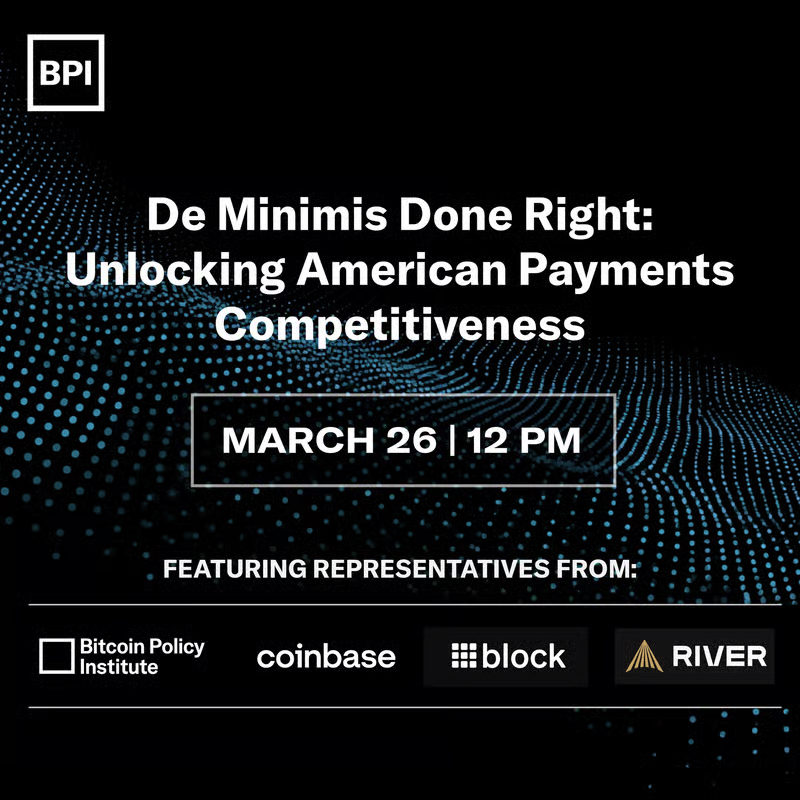
This is extremely concerning if true. I can confirm that over the past three months there’s been a strong shift on the Hill to limiting the de minimis exemption to stablecoins only. BPI continues to meet with lawmakers to explain what a strategic blunder this would be for the U.S. We’ve spent years on this issue—we can’t let it slip at the last minute.

Coinbase is quietly lobbying to kill Bitcoin's de minimis tax exemption. The company reportedly told legislators that "no one is using Bitcoin as money" and that a Bitcoin de minimis exemption would be "DOA." Meanwhile, they're pushing for the exemption to apply only to stablecoins, specifically regulated, dollar-pegged stablecoins like USDC. Coinbase made $1.35 billion in stablecoin revenue in 2025, up 48% year over year, almost entirely from interest earned on U.S. Treasuries held in USDC reserves. Bloomberg estimates that number could surge 7x under the GENIUS Act. Every person who uses USDC for payments instead of Bitcoin is a person whose dollars are sitting in Coinbase's reserve pool generating risk-free yield for Coinbase. A de minimis exemption for Bitcoin would let people spend it freely for everyday purchases without triggering a taxable event. That makes Bitcoin a direct competitor to USDC as a payment method. Coinbase doesn't want that competition. They want you locked into their centralized stablecoin ecosystem where they clip yield on every dollar you park there. The irony is that a de minimis exemption doesn't even make sense for stablecoins. They're pegged to the dollar. They don't fluctuate in value. There's no capital gain to exempt. The exemption matters for Bitcoin precisely because it does fluctuate, and without it, every coffee purchase becomes a taxable event. Senator Lummis proposed a $300 de minimis exemption that would cover Bitcoin. The House framework only covers stablecoins under $200. The Bitcoin Policy Institute has already warned that Bitcoin is being deliberately excluded from these talks. A de minimis exemption that covers stablecoins but not Bitcoin isn't a tax framework. It's a subsidy for Coinbase's treasury management business disguised as consumer protection.

Can someone please explain to me the logic here? No compromise on CLARITY means no restrictions on intermediaries offering stablecoin rewards. If you believe the banks’ argument about deposit flight, this would be catastrophic. Feels like I’m watching an arsonist threaten to burn down their own home.