Bert Kastel

5.8K posts

Bert Kastel banner
Bert Kastel

Bert Kastel

@KastelBert

Frontier tech, AI, longevity, blockchain, energy, peace & prosperity. Ventures: FutureFrontiersInstitute, Nukleai, TheImmortals, EssentialCognition

USA Katılım Ağustos 2017
404 Takip Edilen885 Takipçiler
Sabitlenmiş Tweet
Bert Kastel
Bert Kastel@KastelBert·
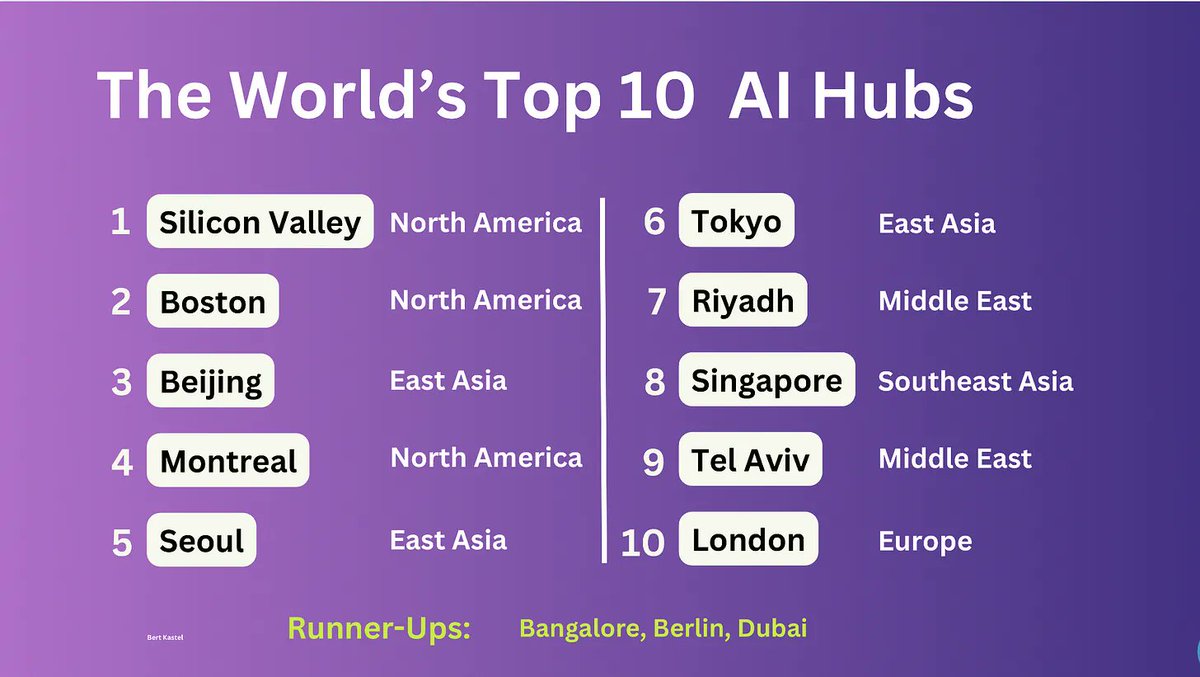
THE WORLD'S TOP 10 AI HUBS Bay Area, Boston, Beijing, and the Rest? What do Riyadh, Tel Aviv, Singapore, and Montreal have in common? As of September 2023, they are among the Top 10 AI Hubs in the world. London just barely made the list. And nobody in the EU did. In general, AI prowess is a factor of data, hardware, and people. Other aspects include the investment climate, startup ecosystem, regulatory regime, access to government support, depth of talent (high-end research) and breadth (diversity and with basic AI education), and the ability to scale. Let’s look at the world’s top 10 locations. It starts with the 3 Big Bs. 1. BAY AREA By almost all criteria, and with a large margin, Silicon Valley leads the pack: the Bay Area. For starters, it has up to ten times as much VC investment in AI as the number two. The top talent is there, with leading researchers, universities, and labs, and lots of data and hardware. And also the big success stories: @OpenAI, @Google, @AnthropicAI, @Meta, and now also @xai. The picture is similar in hardware, with @nvidia, @AMD, and @intel. In 2023, this leaves the Bay Area the undisputed epicenter of the AI world. 2. BOSTON Boston comes in second, with lots of money and domain expertise in critical fields relating to AI, like healthcare, robotics, and materials sciences. Its academic research power rivals the U.S. West Coast, centering on Harvard, MIT, and other top schools. For AI in healthcare, Boston may even be leading the world. And its being part of the U.S. Northeast Corridor adds New York City, and even Washington, DC, and Pittsburgh to its reach. 3. BEIJING The third “B” stands for Beijing. This is China’s AI Middle Kingdom. Its closeness to the governmental apparatus delivers regulatory and political cover, money, and easy access to the People Republic’s treasure of data from over a billion people. But the Chinese Academy of Sciences, Tsinghua University, and Peking University represent major-league research power, as well. And Beijing is also the seat of over 1,000 Chinese AI companies, housing up to 60% of the country’s AI experts. 4. MONTREAL Turing Award winner Yoshua Bengio may best personify Montreal’s AI research leadership. The city offers more, though, above all the world’s highest density of machine learning (ML) experts. This is mainly due to two institutions. The Montreal Institute for Learning Algorithms (MILA) employs more than 1,000 ML researchers. And the city also is the headquarters for SCALE AI, Canada's AI supply chain supercluster. 5. SEOUL In the anglo-centric world, non-Western countries often fly below the radar. One example is Seoul, which reflects South Korea’s prominent position in global chip supply chains and high-tech R&D. Seoul’s technology giants play to these traditional strengths, e.g., by pursuing AI chips and on-device AI. But powerhouses like Kakao and Naver are also producing globally competitive generative AI solutions. And the government and Seoul’s tech giants Samsung, LG Electronics, SK, Kakao, Naver, and KT are EACH investing multiple billion dollars in AI research and infrastructure, from foundational models to robotics. 6. TOKYO The August 2023 founding of @SakanaAILabs, by David Ha and Llion Jones, enhanced Tokyo’s visibility and standing in the AI world. Llion is a highly regarded co-inventor of the transformers architecture and co-author of the famous “Attention is All You Need” paper that ushered in the generative AI craze. David is a former member of Google Brain and recent head of research at Stability AI. But Japan’s contributions to AI have a long history and go far beyond generative AI. In July 2023, for example, investments into robotics alone were close to $2 billion. It helps that the government defines its role to encourage and facilitate the use of AI. Japan “has no regulations that generally constrain the use of AI”. 7. RIYADH Riyadh has an ambitious and forward looking vision, whether it is to train 25,000 women in AI or focus on the use of AI for healthy life extension. It also has money to back this up. Saudi Arabia keeps massively investing into AI infrastructure, exemplified by the mid-2023 purchase of thousands of NVIDIA GPUs. The Kingdom’s target is to invest 2.5% of its GDP in technology, mainly AI. But Riyadh’s aspirations and approach are best exemplified by the person heading the KAUST (King Abdullah University of Science and Technology) AI initiative: Jürgen Schmidhuber - @SchmidhuberAI. Due to his role in developing neural networks and transformers, he often is called a “father of modern AI”. 8. SINGAPORE Singapore punches far above its weight class in AI as well. With world-class research institutes, a large talent pool, outstanding infrastructure, and an extensive ecosystem of accelerators, incubators, and thousands of tech startups, the city state knows how to develop, commercialize, and scale new technologies. Singapore scored third in a recent report by British “slow news” web site Tortoise’ Global AI Index that used over 100 criteria to rank 62 countries. This ranking seems a bit high. Clearly, the island nation must be considered one of the Top 10. But like the next city on the list, its impact is somewhat limited by its overall small size. 9. TEL AVIV Tel Aviv is Israel’s technology center and deeply integrated into the Silicon Valley and New York venture capital (VC) and high-tech startup scenes. The quality of its talent is unsurpassed, and the city is said to have the “highest concentration of startups per capita, and twice as many unicorns than the UK”. Tel Aviv’s particular strengths are in healthcare, biotech, cybersecurity, the defense industry, robotics, and fintech. Israels regulatory environment is decisively pro-AI and “aimed at assisting in the development and implementation of AI in the public sector and economy”. 10. LONDON At a first glance, London’s number 10 position may seem low, considering the city’s many strengths. Its access to private capital (3rd in 2023 in AI investments), world-class research related to AI (also ranked 3rd), and its traditionally strong entrepreneurial culture remain London’s strong points. The UK is also home to a third of Europe's total AI companies, including DeepMind, Stability AI, and digital health startup Babylon. But too many regulations, a shaky economy, and a relatively paltry governmental commitment of less than $2 billion (compared to Saudi Arabia’s $20 billion), mean it barely stayed in the Top 10. THE RUNNERS-UP: Bangalore Bangalore comes closest to being a globally recognized Indian AI hub. This leverages India’s huge numbers of trained IT and AI engineers, and the largest population on Earth, plus lots of data. The country also has a recent track record of delivering world-class outcomes when working with financial constraints. The latter was exemplified by its recent landing on the Moon’s South Pole, for a purported cost of only about $70 million. Today, though, most AI activity is still percolating below the surface. Berlin As the capital of Europe’s largest economy, Berlin has a flourishing AI community and startup ecosystem. The EU remains a serious player in AI due to its vast market, advanced technology ecosystem, world-class research, and broad talent pool. In 2022, its private sector alone invested about $25 billion in AI. But countering this is a perception of regulatory overreach and bureaucracy. This has put the whole region on an economic back foot. Dubai Dubai has an ambitious and well-funded strategy, keeping it highly competitive and close to higher-ranking hubs. The UAE has a state-level Ministry of AI. It also keeps investing massively in compute power and the development of open-source large language models.
Bert Kastel tweet media
English
4
6
21
4.8K
Bert Kastel
Bert Kastel@KastelBert·
Just met the Great GV at this conference!! Made my day!!
Gill Verdon@GillVerd

Anjney Midha from @a16z recalls introing Anthropic founders to 22 firms on Sand Hill road for the $100M Seed round and then getting 21 no's. The key to financial upside in AI is belief in the potential of the tech.

English
0
0
10
110
Bert Kastel
Bert Kastel@KastelBert·
Mostly correct, but saying "AI is eating software" disregards that AI still "is" software and actually is eating and elevating service. We are entering a world of "Service as Software", meaning: Services becoming AI Agents. Doesn't take anything away from you core point...🚀
English
0
0
11
459
Bindu Reddy
Bindu Reddy@bindureddy·
We are a cusp of massive change - ai agents are being used IRL and are taking over human tasks - we are deleting onerous regulations. - we are shutting down bureaucracy - AI is eating software and will result in massive disruption - innovation has become infectious and we are progressing at an unprecedented pace At first it will appear as if nothing is changing and then all of a sudden everything will be different ❤️
English
54
56
462
40.3K
Bert Kastel
Bert Kastel@KastelBert·
Serious question, by the way. Am missing Hereticon… but keep stealthily working on … NukleAI: building a global network of extra-judicial off-grid nuclear and geothermal-powered data centers for compute … Immortals: making the essence of our individuality immortal Could use your chips for both of these.. Freedom!
English
0
0
0
55
Bert Kastel
Bert Kastel@KastelBert·
@beffjezos When can Extropic chips be in such data centers, at meaningful quantities?
English
1
0
0
42
Beff (e/acc)
Beff (e/acc)@beffjezos·
Never Bet Against Elon
Sawyer Merritt@SawyerMerritt

NEWS: @elonmusk's xAI plans to bring online an additional 100,000 Nvidia GPUs at its Memphis, Tennessee training cluster within the next 2 months, for a total of 200,000 Nvidia GPUs, doubling the size of what was already the world's largest and most powerful supercomputer. This massive cluster named "Colossus" is used to train @Grok. They are building and turning on these training systems in record time. OpenAI CEO Sam Altman reportedly told some Microsoft executives last recently that he is concerned that xAI could soon have more access to computing power than OpenAI. It looks like he is right.

English
27
30
607
39.7K
Bert Kastel
Bert Kastel@KastelBert·
@PeterDiamandis It’s irrelevant in the coming decade… and missing the point of money.
English
1
0
1
64
Peter H. Diamandis, MD
Peter H. Diamandis, MD@PeterDiamandis·
Is Universal Basic Income feasible within the coming decades?
English
354
27
426
70.6K
Bert Kastel
Bert Kastel@KastelBert·
@LynAldenContact So you really list the bad, including tribalism, and then say we should be more… tribal?! It contains the root of almost all evil. Not the looking out for oneself or a group… But, the “ism” generally means putting down the “other”. Be careful about focusing on your tribe.
English
0
0
0
18
Lyn Alden
Lyn Alden@LynAldenContact·
Many people propose that humans are fundamentally good. I disagree. It would be nice if we were, but we are not. We are mixed. Humans, like many animals, are capable of atrocities. We’re tribalistic, egotistic, and violent. Focus on your friends. Your neighbors. Your tribe.
English
548
313
4.6K
242.7K
Bert Kastel retweetledi
Caitlin Long 🔑⚡️🟠
Caitlin Long 🔑⚡️🟠@CaitlinLong_·
“The SEC is protecting you from getting wealthy. FDA is protecting you from getting healthy.” —@balajis
English
20
107
582
38.4K
Bert Kastel
Bert Kastel@KastelBert·
@gopalgoel19 @balajis Requires higher interest rates, distributed AI, and access to everybody, without top-down/political control and limits. Plus hard money (currently only option: Bitcoin). This can stimulate savings and investments, particularly in that space. Then, there is a slight chance...😎
English
0
0
0
120
Gopal Goel
Gopal Goel@gopalgoel19·
@balajis A popular line of thinking among NPCs is the economic gains from AI is gonna solve this problem. How do you respond to that?
English
23
5
75
612.6K
Balaji
Balaji@balajis·
ECONOMICS > POLITICS No election can pay off America's $175T in debt. Only the printing press can. Because as Elon, Dalio, and others realize...the Western world is headed for a sovereign debt crisis far worse than 2008. Just like they’ve been lying about Biden’s senility, they’ve also been lying about the economy. And so they're going to print a lot of currency. But take a look at the data and judge for yourself. 1) MORE EMERGENCY LOANS THAN 2008 First, did you know the Fed[1] made more emergency loans in 2023 than during the financial crisis of 2008? The banking system is on life support thanks to the US government first selling billions in bonds to financial institutions and then devaluing them with surprise rate hikes. Just look at this graph from the Fed. The blue bump below on the left is the lending from the 2008 crisis — you know, that little old thing. The purple is COVID. And the giant orange/aquamarine monster on the right is the 2023 banking crisis. See how much higher it is than even 2008? 2) MORE BORROWING THAN COVID Second, did you know the US is borrowing more[2] under the "Biden boom" than it did during COVID? Set aside whether a coronavirus should have been treated as a financial crisis. At least the COVID borrowing was at ~0% rates. But today the US government is borrowing historical sums of money in peacetime…and at 5% rates! This is the act of a desperate man maxing out his credit cards to pay his bills. 3) MORE INTEREST THAN DEFENSE Third, did you know that all this borrowing has made interest payments on the national debt the single largest government expense? More than defense, or social security, or anything else[3a, 3b]. The number one thing all tax dollars (and printed dollars) now go towards as of 2024 are payments to bondholders. And even still, anyone who bought US Treasuries (or other bonds) got annihilated over the past few years. For all the warfare and all the welfare, it was buy now pay later. And as you can see from the graph, the time to pay has come. 4) MORE DEVALUATION OF THE DOLLAR Fourth, did you know that the dollar has lost at least 25% of its value in just four years[4a]? This one you probably knew from just your lived experience of inflation. But Larry Summers estimates[4b] that purchasing power has been eroded even more radically than this, with annual numbers hitting 18% if you include the enormous spike in loan payments due to rate hikes. Compounded over four years, that’d be considerably more than 25% of the dollar's value. But wait, there's more. Six more graphs, and references. 👇
Balaji tweet mediaBalaji tweet mediaBalaji tweet mediaBalaji tweet media
Elon Musk@elonmusk

Where are we with dollar value destruction, you might ask?

English
233
2K
7.3K
2.3M
Bert Kastel
Bert Kastel@KastelBert·
It's the decades of low interest rates that caused the money bubble. But now that the debt has ballooned, there is no easy way out. Not even the Babylonian way - debt forgiveness, which would benefit the big eve more. Only hyper-charged AI productivity has a hint of a chance, if it is distributed (and access is managed decentrally).
Balaji@balajis

I love the optimism. But let's do the math: AAPL: 3.4T MSFT: 3.3T NVDA: 3T GOOG: 2.25T META: 1.25T TSLA: 0.78T The combined market cap of the Magnificent 7 is "only" 14T. That's <10% of the $175.3T owed by DC! So, there's no way to grow out of this. A debt crisis is coming.

English
1
0
3
144
Bert Kastel
Bert Kastel@KastelBert·
🎯 can be painful… I have used multiple LLMs to help write, edit, proofread, and translate a book over the past few months. The amount of bland drivel and pseudo-intellectual disingenuous mushy input I received REALLY hurt sometimes! They still helped cut down my time very significantly… And sometimes, when I listen to people or read their writing, I feel they operate not quite differently. They may have fine-tuned their training database a bit more, but the principle seems… human. 😜
Pedro Domingos@pmddomingos

Imagine if you talked by picking the next word to be the one people most often say after your previous words.

English
0
0
0
99
Bert Kastel
Bert Kastel@KastelBert·
@ylecun @elonmusk Interesting. A big chunk of what you wrote here could have been written by me about yourself... 😂☮️
English
0
0
0
30
Yann LeCun
Yann LeCun@ylecun·
My opinion of @elonmusk I like his cars (I own a 2015 S, and 2023 S), his rockets, his solar energy systems, and his satellite communication system. I also like his positions on open source and patents. But I very much disagree with him on a number of issues. I disagree with how he treats his scientists. Technology/product development may not need openness and publications to advance, but forward-looking *research* sure does, whether it's in AI, neural interfaces, material science, or whatever. Secrecy hampers progress and discourages talents from joining the effort. I also disagree with the hype. I mean, expressing an ambitious vision for the future is great. But telling the public blatantly false prediction ("AGI next year", "1 million robotaxis by 2020", "AGI will kill us all, let'spause",...) is very counterproductive (also illegal in some cases). More importantly, I think his public positions on many political issues, journalism, the media and the press, and academia, are not just wrong but dangerous for democracy, civilization, and human wellfare. Say what you want about "traditional media" but you can't really have reliable information without professional journalists working for a free and diverse press. Democracy can't exist without it, which is why only authoritarian ennemies of democracy rail against the media. Finally he doesn't seem to hesitate to disseminate batshit-crazy conspiracy theories as long as they serve his interests (e.g. boosting "PizzaGate", "illegal immigrants corrupt elections in the US", "person X is a pedo",...). One would expect a technological visionary to be a rationalist. Rationalism doesn't work without Truth. This has become particularly concerning since he bought himself a platform to disseminate his dangerous political opinions, conspiracy theories, and hype. He has been quite naïve about the difficulties of running a social network and the (legal) necessity of doing content moderation. One can claim to be a 1st Amendment absolutist, but a lot of content *must* be taken down by law, e.g. terrorist propaganda, child exploitation, blatant hate speech (in the EU and other regions). Then, there is dangerous disinformation that puts public health in danger or corrupts the democratic process. You have to moderate that too. Content moderation is a complicated problem whose best answer is not an attitude of total laissez-faire but a complex trade-off.
English
2.6K
1.9K
16.8K
2.7M
Bert Kastel
Bert Kastel@KastelBert·
@gronko63 @johnrobb Or rather, let them work it out. There are ways to buy time that gives everyone most of what they want. If we get 25 years without war, we will then see where the chips have fallen. …and are produced.
English
0
0
1
9
Gronko Dean
Gronko Dean@gronko63·
@johnrobb If China want the island, China will get it. They need to work out a Hong Kong type agreement. Save a lot of lives and look at reality of situation.
English
2
0
3
273
John Robb
John Robb@johnrobb·
I can understand the motivation for this policy, but to do it while we are still completely reliant on Taiwan for our chips is like marching three legions into the Teutoburg forest to intimidate the Germanic tribes. "The Biden administration plans to halt shipments to China of more advanced artificial intelligence chips designed by Nvidia" reuters.com/technology/bid…
Mario Nawfal@MarioNawfal

🚨NVIDIA CEO: WE WOULD BE NOTHING WITHOUT TAIWAN "Taiwan is the unsung hero, a steadfast pillar of the world. Together, we ignited a renaissance for our industry. Our dedication led us into the next computing frontier. Without you, our vision would be a distant dream. With you, we change forward, creating a smart and convenient life and battling disease and natural disasters. Making our world a better place." Source: NVIDIA Keynote

English
12
15
36
14.8K
Bert Kastel
Bert Kastel@KastelBert·
@NiklasAnzinger @beffjezos We need to talk. ¿Tal vez la semana que viene o la semana siguiente? In der nächsten Woche werde ich in Mittelamerika sein, aber nur kurz.
Deutsch
0
0
0
11
Bert Kastel
Bert Kastel@KastelBert·
Jeff, this is exactly what I am trying to pitch here, including the establishment of a 15,000 chip (yes, currently only of NVDIA and not yet Extropic) server farm in Northern Patagonia or the Salta region - powered by 10 nuclear SMRs. Major challenge: ack of a parliamentary majority. Could be perceived as a risky move. I am trying to counter this by offering 10% of the compute power for free back to the community/country. And then, this must be replicated globally, 100x, in freedom-friendly and forward-looking places.
English
0
0
1
462
Bert Kastel
Bert Kastel@KastelBert·
‼️ And this is why, in a handful of years from now, we will hear people say “black swan” - although this is a pink flamingo if there ever was one. The masses fell for the Tulip bubble… plus South Sea on top. They will lower interest rate some more time, before the elections. And then we are inches away from what @balajis described 8 months ago… And China will come out smelling like roses… and they don’t even care about us, just about Taiwan and their neighborhood. Elections are around the corner. 3 things matter to get us out of this mess: 1. Bitcoin as hard reserve currency. 2. No war, at (almost) any price. 3. No regulations limiting AI.
Lyn Alden@LynAldenContact

In the late 1980s and early 1990s, concern about the public debt reached its peak. The national debt clock was installed, and Ross Perot ran the most successful independent presidential campaign in the past century focused largely on debts and deficits. But then China and the post-Soviet Union region opened up to the world, and the resulting offshoring and globalization sparked all sorts of disinflation. Interest rates fell, and so U.S. interest expense relative to the size of the economy dropped by a lot, even as debt/GDP continued to head higher. The lesson that many people took from that era, by the time we reached the 2010s and early 2020s, is that deficits don't really matter. All those people worrying about the deficit were viewed as wrong. And so, the *lack* of concern about public debt reached its peak. But that's also when four decades of falling interest rates hit zero and started going sideways. And so, the falling-rate offset to ever-higher public debt growth is no longer there now. Globalization is slowing down, and putting more frictions back into global supply chains. The pendulum is swinging in the other direction.

English
0
0
2
120
Bert Kastel
Bert Kastel@KastelBert·
Polina doing it again! Making me think through every single one of these high-value pieces of advice. Thanks Polina! Love it (and thanks to the audience, of course, and remember - I drove up to NYC to meet your husband for his Christmas party…:-))
Polina M. Pompliano@polinapompliano

I spent the last month trying to answer the impossible question: What makes someone likable? Below, I break down 9 techniques that will help you dial up the charisma in your everyday life:

English
0
0
2
162