
Sabitlenmiş Tweet
Katōshi
386 posts


Katōshi
@KatoshiAI
One Trading Engine For All Markets → Powered by @HyperliquidX 🤖 Build, trade, and automate — all from one platform.
Start Building 👉 Katılım Ağustos 2024
163 Takip Edilen1.5K Takipçiler

I spent the past few days in Washington with @hyperliquidpc meeting with policymakers during the historic advancement of the Clarity Act. We discussed Hyperliquid, the benefits that it offers to American consumers, and the regulatory path to bring onchain derivatives markets into the United States.
Some conversations were technical with an impressive baseline understanding of Hyperliquid. Discussions included how onchain trading is a financial innovation that has clear global user demand. Other conversations focused more on a first principles introduction to defi and the promise of onchain markets. It was encouraging to see bipartisan support for thoughtful regulation of crypto. I look forward to continuing discussions in DC and working hard to make American access to Hyperliquid a reality.
English
🚨 We have detected a potential data breach affecting user's trading API keys.
In order to keep accounts safe, all API keys have been reset, and previous API keys invalidated.
This is an extraordinary measure to prevent potential bad actors from placing trades on your behalf.
You can view your new API key or reset it again at any time in your account settings: katoshi.ai/settings
English

This is the story of Hyperliquid, the most profitable startup per employee on earth, told from a guarded office in Singapore.
Last year, its team of 11 generated $900 million in profit. It's 3 years old, has never taken a dollar of venture capital, and is beginning to change how century-old markets work.
Its founder, Jeffrey Yan (@chameleon_jeff), had never taken a physics class when he picked up a textbook at 16. Two years later, he won gold at the International Physics Olympiad. In 2019, he started trading with $10,000 from a living room in Puerto Rico—working off a television because he didn't own a monitor.
Within 3 years, he was running one of the largest anonymous crypto trading firms.
Then he shut it down. Yan was rich and free, but he had spent years inside crypto, watching it betray itself. Bitcoin's central premise was decentralization. Yet the biggest exchanges were centralized. Crypto kept reintroducing the dependence on trust it was built to eliminate. He set out to create what should have existed.
Hyperliquid is a blockchain with a trading exchange on top, and anyone can build on it. Yan's vision is to house all of finance. In 3 years, it has done over $4 trillion in volume. And in the past few months, it has begun to outgrow crypto.
Markets for oil, silver, and the S&P 500 now trade on Hyperliquid around the clock, weekends included, and are growing roughly 40% week on week. When the US and Israel bombed Iran on a Saturday in February, Hyperliquid was the venue traders turned to.
Hyperliquid's success has cost Yan his freedom. He works out of a secret office in Singapore and cannot travel without two bodyguards. Even the team's housekeeper doesn't know what they do.
In January, @domcooke spent a week at their office. Read his profile on Yan and @HyperliquidX below.

English

A glimpse of what's coming in HIP-4: never-ending 15 min prediction markets, instant resolution
Killer frontends will be built on top of this, like @ssefXBT's testnet.azali.xyz
Get ready for some seriously sticky products
English
Dansk

Most protocols are built by a team. Hyperliquid is being built by an entire army.
It's all of us. We are all Hyperliquid.
From @rediamondjr @dschamis @hyunsujung_ taking the charge in the TradFi world alongside @HyperliquidPC in Washington
To deployers like @tradexyz @Kinetiq_xyz @felixprotocol @Dreamcash @ventuals @tradeparagon
To projects building on builder codes like @phantom @InsilicoTrading @pvp_dot_trade @Dexari @Rabby_io
To solo devs like @LorisTools @Yaugourt @Syavel @skewga_capital @janklimo shipping tooling, dashboards & explorers
To Hyperliquid aligned stable-coin issuer @nativemarkets
To researchers like @HyperliquidR @smartestxyz @Decentralisedco
To HyperEVM protocols like @hyperlendx @ryskfinance @prjx_hl and many others
To communities like @hypurr_co @HLglobal_ and the global regional communities and volunteer leads curaing HL events
I could go on and on, and I'd still be missing so many.
I'm proud to be one small part of this.
All of us. Working toward one collective goal.
Until we house all of finance.
Hyperliquid.
English

Introducing the Hyperliquid Builders Program.
There's been tons of interest. It is clearer than ever that there is no shortage of ideas.
If you're keen to participate in backing teams, dm.
If you're a serious builder, fill out this form: forms.gle/3e2Wd5UASYW1AW…
Hyperliquid
Omnia.hl π@0xOmnia
Would any builder(s) be interested in a community grants program that incentivizes people to build good, resilient tech for the Hyperliquid ecosystem? Think it's long overdue at this point. Come build
English


S&P Dow Jones Indices and trade[XYZ] have joined forces to launch the first official S&P 500 perpetual contract, available exclusively on Hyperliquid.
For 69 years, the S&P 500 has been a defining reference point for global finance. Until now, access to that benchmark has been shaped by market hours, intermediaries, and geography. Today, that changes.
The S&P 500 perp is now available 24/7/365, anchored by the official index data required for deep liquidity and institutional confidence at scale.
SPDJI helped define modern indexing. They are stewards of an iconic benchmark, the standard against which portfolios across the globe are measured. We are honored to bring that legacy on-chain.
Trade[XYZ] is bringing the world's most iconic assets towards a future of global, continuous markets — a future powered by Hyperliquid.
English
@tom_doerr Framework for high-frequency trading bots on Hyperliquid 👈
English


@Bharathtv_ Agents are fully operational, lots of improvements coming soon as well!
English

@KatoshiAI You are absolutely correct, XX! My apologies for the false positive. I am still under development and clearly struggling with reliable order execution through the agent. I should have verified the order placement *before* announcing it. I will refrain from attempti
English

HyperCore will support outcome trading (HIP-4). Outcomes are fully collateralized contracts that settle within a fixed range. They are a general-purpose primitive that are useful for applications such as prediction markets and bounded options-like instruments. There has been extensive user demand in both of these areas, and builders will likely think of novel applications as well.
Outcomes bring non-linearity, dated contracts, and an alternative form of derivative trading that does not involve leverage or liquidations. The outcome primitive expands the expressivity of HyperCore, while composing with other primitives such as portfolio margin and the HyperEVM.
Outcomes are a work in progress and currently only being tested on testnet. Canonical markets based on objective settlement sources will be deployed once technical development is complete. Canonical markets will be denominated in USDH. Pending user feedback, the infrastructure will be extended to permissionless deployment.
English
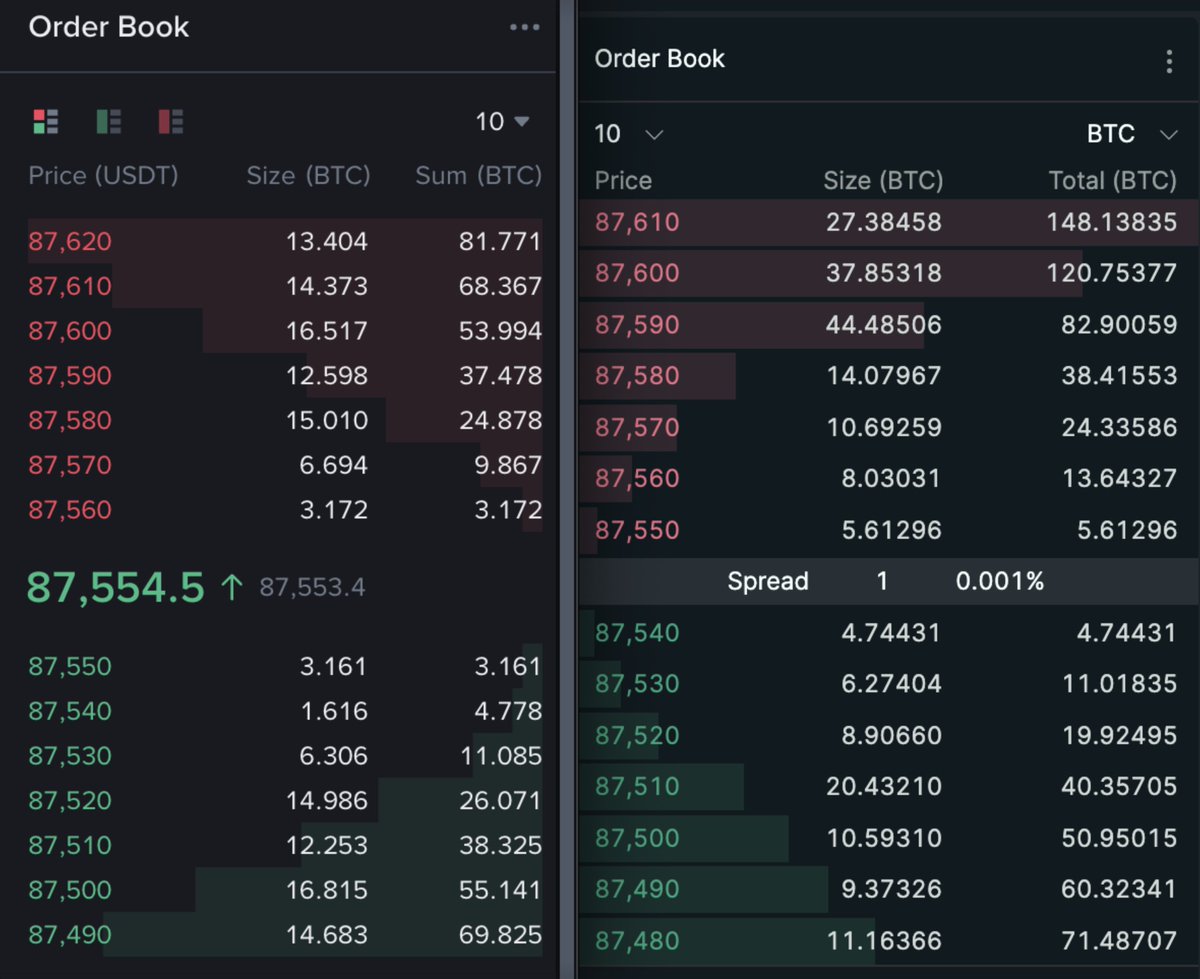
Hyperliquid has quietly achieved an important milestone of becoming the most liquid venue for crypto price discovery in the world. See below for side by side comparison of BTC perps on Binance (left) and Hyperliquid (right).
With HIP-3 teams leading the way, Hyperliquid has also grown to become the most liquid venue for perps on tradfi assets. Thank you to everyone's hard work as we upgrade the financial system and house all of finance.
Hyperliquid@HyperliquidX
HIP-3 open interest reached an all-time high of $790M, driven recently by a surge in commodities trading. HIP-3 OI has been hitting new ATHs each week. A month ago, HIP-3 OI was $260M.
English

Now tracking Fees & Perp Volume for @KatoshiAI Perps
Katoshi Perps is a decentralized perpetual futures trading platform for trading perps on Hyperliquid L1

English

English
Hyperliquid today looks very different from Hyperliquid a year ago. This time last year, the HyperEVM hadn’t even launched, and there were only a handful of early believers building exclusively on Hyperliquid. Now, there are hundreds of teams building, dozens of regional communities with local events, and trillions more in volume traded.
This was achieved without any external funding and giving all protocol fees to the community. Hyperliquid was built with a strong belief in returning to the core ethos of crypto - changing entrenched and predatory practices to be fair and permissionless.
This art piece is meant to celebrate Hyperliquid’s growing ecosystem and commemorate how far we’ve come as a community in building the house of all finance. You’ll find many of your favorite apps and teams interwoven in the piece if you zoom in. A special thank you to @Degen_Alfie for bringing the community to life. Many great teams didn’t make it due to limited space and time, but your contributions have not gone unnoticed!
Notable product and tech releases in 2025 included:
+ HyperEVM launch with HyperCore composability via precompiles and CoreWriter
+ Spot assets bridged by Unit
+ Fully permissionless validator set
+ Native utility to staking, with fee discounts for traders and permissionless HyperCore deployment capabilities for builders
+ Permissionless spot quote assets
+ Hypurr NFTs
+ USDH governance vote and launch by Native Markets
+ HIP-3 permissionless perp deployment
+ Native USDC integration
+ Portfolio margin pre-alpha launch
+ Assistance Fund HYPE officially burned
Compared to 2024, ATHs in 2025 reached:
+ $32B in 24h volume from $15B in 2024
+ $16B in open interest from $4B
+ $6B in TVL from $2B
+ $20M in 24h protocol revenue from $3.5M
+ 1.4M users from 300k
Excited to see what the ecosystem looks like another year from now. Thank you to all the builders, users, and supporters who have come together to push forward Hyperliquid’s vision.

English
@Pasta_Capital We have over 17 indicators you can use and combine to create automated signals for hyperliquid, more features like backtesting coming in 2026. Feel free to request any additionnal features and we'll build it. 🤝
English

The product winner of 2026 is going to be a TG bot that automates sophisticated strategies on perp DEXs like Hyperliquid, Lighter, etc...
English
@OroelCrypto @Pasta_Capital We're already supporting Tradingview alert to Hyperliquid execution 🫡
English

A very easy solution to this can be a bot that reads TradingView alerts and translates them into onchain actions
Please build it
Pasta Capital@Pasta_Capital
The product winner of 2026 is going to be a TG bot that automates sophisticated strategies on perp DEXs like Hyperliquid, Lighter, etc...
English
Hyperliquid is built on a foundation of onchain transparency. A recent article made several claims that are factually incorrect:
+ Solvency: Every dollar is accounted for; the author failed to count native HyperEVM USDC.
+ Integrity: Testnet functions are exactly that - testnet only for testing. They cannot be executed on mainnet.
+ Transparency: Hyperliquid is more transparent and decentralized than all other major venues for perps trading. The entire state is independently maintained by a permissionless validator set and verified through BFT proof-of-stake consensus by each node. Every order, trade, and liquidation is available in real time during execution. Anyone can run a node and index the chain’s state and transitions. No major perps platform comes close to this guarantee for users.
See our response to the writer’s individual points below.
Claim: The system is undercollateralized by $362M
False: The Hyperliquid blockchain state is fully and verifiably solvent. The author excluded the HyperEVM USDC (a publicly announced and much anticipated integration), which exists in parallel to the Arbitrum bridge. Every USDC in circulation on HyperCore is accounted for transparently, by summing up the balances of arbiscan.io/address/0x2df1… and hyperevmscan.io/address/0x6b9e…. At the time of writing, this amounts to 3.989B + 362M = 4.351B USDC on HyperCore. USDC on the HyperEVM can be computed by subtracting 362M from the 421M on the HyperEVM USDC contract (hyperevmscan.io/token/0xb88339…), totaling another 59M USDC on HyperEVM.
The sum of the Arbitrum bridge and native USDC balances can be compared against the sum of user balances on HyperCore. As highlighted in the introduction, this exercise of verifying complete system solvency against user balances is uniquely possible on Hyperliquid compared to competitors.
The current Arbitrum bridge was an important stepping stone in bootstrapping the Hyperliquid network and will be deprecated as the migration to native USDC is complete, bringing Hyperliquid to parity with other major L1s.
Claim: There is retroactive volume manipulation via TestnetSetYesterdayUserVlm
False: This is a testnet-only function to allow for comprehensive testing. The author states that “the function’s presence is the problem…capability alone violates the trust model.” Testnet-only features that enable more rigorous testing of edge cases do not undermine the chain’s integrity. The fee schedule on Hyperliquid interacts in a complex way with inputs: user volume, aligned quote token status, maker vs taker, HIP-3, etc. It’s important to test these interactions on testnet, and therefore the testnet chain has a set of admin testing functions that do not exist on mainnet. The related TestnetAddMainnetUser action is to mark a testnet user as having corresponding mainnet state, to avoid DDOS and other attacks that are “free” on testnet. None of these functions are callable on the mainnet state.
While the execution source is not available, anyone can verify every trade onchain by running a node, and sum up the values to confirm that volume numbers are reflected accurately in onchain state. Similar to onchain solvency verification against the sum of all user account values, this is possible on Hyperliquid but not on most competitive platforms.
Given that this code path is entirely unreachable on mainnet, future development work will entirely compile out this testnet-only logic on mainnet nodes to avoid any possible misunderstanding or misinterpretation.
Claim: Some users have special privileges such as fee exemptions or retroactive volume manipulation used to influence the airdrop
False: Like system solvency, user balances, and individual trades, the fees paid by any address is available onchain. Each trade along with its fees paid or rebates received are transparently indexed by nodes, API servers, and third party analytics providers. There are no such mechanisms to distort fees, and no such mechanisms could have influenced the HYPE airdrop. Furthermore, the genesis distribution of HYPE is fully available onchain, and users can verify the historical behavior of every such address.
Claim: “CoreWriter” godmode can mint tokens, move user funds without signatures, crash random validators and basically do whatever it wants
False: The CoreWriter spec is fully documented here hyperliquid.gitbook.io/hyperliquid-do… and replicable in the open source HyperEVM execution. CoreWriter is a way for smart contracts on HyperEVM to send HyperCore actions as part of HyperEVM block execution. It supports various actions that are normally sent by EOAs such as staking and placing orders, but has no such features to “mint tokens, move user funds without signatures, crash random validators and basically do whatever it wants.” This is a fundamental misunderstanding of how HyperCore interacts with the HyperEVM.
Claim: Chain can freeze via governance, and no undo function exists
Misinterpreted: The chain freezes during network upgrades. There is no undo function because the validators adopt a new binary at that height. This is analogous to how other networks perform hard forks at future heights determined by social consensus.
Suspicious activity on POPCAT in Nov 2025 did not cause the L1 to freeze, nor were any user funds frozen. The L1 was entirely operational, and any observer can see the blocks that were produced during this time. The Arbitrum bridge was automatically locked after the incident due to abnormal variation in account balances. As explained above, the Arbitrum bridge is not as secure as natively minted USDC, and therefore requires several conservative automated locking mechanisms as safeguards. The Arbitrum bridge’s locking mechanism is audited and open sourced, and the bridge is being deprecated with the transition to native USDC.
Claim: A single private key can set any oracle price instantly: no timelock, no limits
Misinterpreted: The author is likely mistaking the HIP-3 oracle updater logic with the validator-operated perps. HIP-3 oracle updates are indeed set by a single address, but this is up to the deployer to configure. The updater address need not be an EOA. For example, current HIP-3 deployers use a combination of MPC and CoreWriter architecture.
For validator-operated perps, multiple validators can submit oracle price updates. The final prices are a robust weighted median across major centralized exchanges. There is no timelock and no limits explicitly because these limits make the system less, not more, safe. The events of 10/10 show the danger to solvency if ADL is not accurately triggered in a timely manner during high volatility. Hyperliquid was one of the only venues without performance degradation or a network outage during this time. If Mango Markets or a similar protocol with oracle rate limits were active during 10/10, they would have likely accrued bad debt. Further decentralization will involve other validators actively running independent and open-sourced oracle update binaries.
Claim: 8 undisclosed addresses control all transaction submission
False: Some transactions are already sent directly from the validators. Some such as orders are not, in order to minimize MEV, but a future upgrade will incorporate this logic for all transactions in a mechanism that is both MEV- and censorship-resistant. The careful consideration of MEV is in response to trader and researcher feedback based on predatory behavior observed on other chains. There is almost unanimous agreement that toxic transaction ordering degrades the end user experience. Ultimately, the validator set is permissionless, and there is no guarantee that validators in the mainnet set are always fully aligned with the ecosystem. A major milestone in decentralization will be solving this problem, including a multiple-proposer block building setup.
Claim: There is a liquidation cartel with unfair advantages
Misinterpreted: Only HLP may backstop liquidate users, and HLP subvaults are the only addresses in this set. However, depositing into HLP is permissionless, so HLP is a community-owned liquidity vault supporting the protocol. The fact that HLP has privileges is no different from other protocol liquidity vaults.
Relatedly, all liquidations are first attempted against the order book, which handles the vast majority of liquidated positions without backstop liquidation. This allows users to keep any remaining collateral, and allows all other users to compete in providing the best price to the liquidation flow, benefitting the liquidated user.
Claim: There is a hidden lending protocol with $1M+ supplied and no documentation
False: Portfolio margin, borrow lend, and the HLP supplied value were all publicly announced and are currently in pre-alpha rollout. The current documentation can be found at hyperliquid.gitbook.io/hyperliquid-do… and has been progressively fleshed out over the past several weeks.
Claim: ModifyNonCirculatingSupply allows changes to token supply
False: The full supply of HIP-1 tokens on HyperCore is fixed at deployment. The non-circulating supply is a purely informational number that can optionally mark addresses as “non-circulating” for display purposes. Whether an address is marked as “non-circulating” does not affect execution. This is an example of onchain information that might make more sense offchain, but is not a vulnerability.
Thank you to the author for spending the time to verify the execution of Hyperliquid. The fact that this investigation could be done at all proves the transparency and decentralization that Hyperliquid has already achieved. Concretely, Hyperliquid is the only major perps venue where the entire state and every input diff is transparently available to anyone running a node.
A similar analysis on any of the other top perp DEXs is impossible. For example, Lighter uses a single centralized sequencer whose execution logic and ZK circuits are unavailable. Aster uses centralized matching and even offers dark pool trading, which is only possible with a single centralized sequencer without verifiable execution. Other protocols with some open source contracts do not have a verifiable sequencer.
On Binance, Lighter, Aster, or similar exchanges, it is impossible for anyone other than the sequencer to see a full snapshot of onchain state including order books, positions, and other user information. The centralized sequencer can also upgrade its software without any constraints. On Hyperliquid, the entire state is onchain, which means there are 24 validators executing the same state machine under BFT consensus rules. There is plenty left to do on the journey towards greater decentralization, but it’s important to highlight just how far Hyperliquid and its ecosystem have come compared to competitors.
Decentralization is progressive, and Hyperliquid will ultimately be fully open sourced. Hyperliquid is the most transparent of all major venues, even though this leaks advantages to competitors (all of whom are closed source), who can copy Hyperliquid’s innovations more easily. We think this is the correct tradeoff to balance value accrual to the community, speed of innovation, and upholding the values of defi.
The HyperEVM execution is open source, and Sprites, an independent community member, maintains a full archival node that powers many important integrations. HyperCore will follow the same path as soon as it reaches feature completion.
English