Georgy Khalin

153 posts

Georgy Khalin

Georgy Khalin

@Khalin_George

Quant dev lead in algo trading obsessed with deep research & understanding

Amsterdam, The Netherlands Katılım Mart 2012
152 Takip Edilen147 Takipçiler
Sabitlenmiş Tweet
Georgy Khalin
Georgy Khalin@Khalin_George·
Building skills first, financial freedom second, be useful to the world third
English
0
0
3
571
Georgy Khalin
Georgy Khalin@Khalin_George·
@anothercohen Grind only works when you know exactly what to do which is rarely the case when you’re working on hard enough problems
English
0
0
0
54
Alex Cohen
Alex Cohen@anothercohen·
Damn, I don’t live in the office and hang with my wife and kids on the weekends I guess I’m not gonna make it
Harry Stebbings@HarryStebbings

"If you are not working 7 days per week, you are going to lose". Corgi Insurance is the most intense workplace culture in startups. - The company works 7 days per week. - Founder (@nico_laqua) lives and sleeps in the office. - He built a cafe in the office because there was no local cafe that was open 24/7. - 2/3 of the first 30 team members have the Corgi logo as a tattoo. Today I went behind the scenes with Nico, who has used this culture to scale the company to a $2.6BN valuation in just two years. My condensed notes below: 1. If You Are Not Working 7 Days Per Week, You Are Going to Lose: Whatever you can get done in 5 days, you'll get more done in 6 and 7. If you are trying to solve the world’s hardest problems, a standard 5-day workweek will not cut it. 2. Work Trials Repel the Mediocre: Corgi forces candidates into mock work trials over the weekend. If seeing a full office on a Saturday scares them, they don't belong. True intensity acts as a natural filter to attract killers and repel clock-watchers. 3. Lead from the Front Lines You can’t demand 7-day weeks while sitting on a yacht. Nico sleeps 3–4 hours a night on a mattress inside the office. If you want your troops to bleed, you have to be in the trenches with them. 4. Culture Only Means One Thing: Winning Forget superficial jargon like "hackers" or "ex-founders." Strip away the corporate fluff. A great startup culture is aggressively optimized around one single word: Winning. 5. Lifespan vs. Victories Building something world-historic requires radical sacrifice. When asked if he'd rather build a trillion-dollar company and die at 50, or fail and live to 80, the answer was easy. "I would rather measure my lifespan in victories." 6. Reject the Comfort of "Quiet Quitting." If you are operating in a hyper-growth environment and your days off happen to be Saturday and Sunday every single week, you are quiet quitting. To win, you must deliberately bypass the off-ramps of personal comfort and low volatility. Corgi isn't for everyone—and that’s exactly the point.

English
21
4
244
34.3K
Susan Zhang
Susan Zhang@suchenzang·
Every time I've been to NYC/London/Paris for work over the last few years, the onus is just entirely on the visitor to not get themselves pickpocketed or stabbed. Sure you don't see it everyday, but you still clutch your belongings a bit more tightly and either go home early or take a cab and send your location to a friend. Most recently, I had my phone knocked out of my hand in a scooter drive-by incident in London (Soho!) and coworkers were like, "yeah obviously don't be standing facing the street while you're on your phone, we all know to stand facing a building! you're lucky you didn't get hurt!", and I just accepted it as me being lucky. I've also had friends who've had guns/knives pulled on them in both SF and NYC, and we just shrugged all those off as one-off incidents.
English
8
3
67
6.3K
Georgy Khalin
Georgy Khalin@Khalin_George·
@wordgrammer I haven’t worked at either company but from what I know I’d bet anthropic’s internal stack is better
English
0
0
1
907
wordgrammer
wordgrammer@wordgrammer·
Can anyone who has experienced both the OpenAI and Anthropic internal slacks tell me which is better?
English
26
0
390
115.6K
Evan LaPointe
Evan LaPointe@evanlapointe·
@Khalin_George There isn't a single lesson to learn from people who achieved scale only that can't also be learned (and better) by someone who achieved impact. The concept here isn't that scale isn't impressive or hard. It's that it is an objectively inferior skillset to glean.
English
1
0
1
41
Evan LaPointe
Evan LaPointe@evanlapointe·
I think one of the biggest mistakes young professionals make is making heroes of people who achieve scale instead of impact. The inventors of cigarettes and cheeseburgers are not heroes. If you want to admire or trust someone for the sake of it actually helping you learn valuable and applicable lessons, the only people worth admiring are the people who made something great, who impacted others instead of exploiting humans, and who won in a competitive market. Everything you learn from them will open your eyes. Everything you learn from the rest will remove your heart and your brain.
English
6
3
29
1.2K
Georgy Khalin
Georgy Khalin@Khalin_George·
@zekramu You can be there for the people as well. Not for a mission, but for a group of people you genuinely enjoy working with
English
0
0
1
9
zek
zek@zekramu·
you should be switching jobs every 3-5 years unless they are seriously compensating you and/or you’re there for the mission instead of the job
English
2
0
18
329
zek
zek@zekramu·
just had this debate with my dad, he comes from the generation of “loyalty” and never leaving companies but if you ask end of career people what that loyalty got them most of them have nothing to say
English
8
0
51
2.3K
zek
zek@zekramu·
@tszzl I built one internally as part of the agent platform I support, but yeah, there’s a OSS need
English
1
0
6
365
roon
roon@tszzl·
is there a better slack for agent age
English
150
7
535
95K
laura
laura@lauradang0·
High signal people all have 2 things in common. 1) extremely opinionated 2) high agency
English
28
13
355
18K
Georgy Khalin
Georgy Khalin@Khalin_George·
@Vtrivedy10 This seems to require a manager mindset since managers are usually the ones setting up processes
English
0
0
0
76
Viv
Viv@Vtrivedy10·
using a good Skill, a CLI, and seeing Codex’s in-context-learning ability is a magical experience point it to Harbor skills repo, Prime Intellect CLI, gave it an objective of what we wanted to RL and just watched it chug along figuring out the whole setup and debugging weird niche errors us humans get the fun part of interpreting results, thinking through what’s happening, and deciding what to do next agents training agents 🔥 humans guiding the process
English
10
13
124
7.1K
Georgy Khalin
Georgy Khalin@Khalin_George·
@wordgrammer That could be a values mismatch which is probably not fixable. Same as wanting kids
English
0
0
1
87
wordgrammer
wordgrammer@wordgrammer·
How do age gap relationships handle when one of them uses AI and the other wants to firebomb a datacenter
English
19
6
161
6.8K
Robob
Robob@Robob54174945·
@Khalin_George @AgustinLebron3 It has made a lot of researchers way more productive in every domain that I know of, including both quant and LLM research. Just being able to eliminate friction in experiment setup/scaffolding alone is a huge boost for talented researchers
English
1
0
2
39
Agustin Lebron
Agustin Lebron@AgustinLebron3·
Another day, another mindless take from a YC person. 1. If the bottleneck is as he says, then cheap compute can *easily* be deployed to figure out what people want more cheaply, scalably, etc. 2. Maybe it's what people *and agents* want/need.
David Lieb@dflieb

Thought experiment: if every company suddenly had infinite free compute, what new products would emerge? My take: with very few exceptions, not much would change. The bottleneck is figuring out what people want, and it’s not so easy to apply compute to solve that.

English
8
2
62
11.1K
Georgy Khalin
Georgy Khalin@Khalin_George·
@Vtrivedy10 I’m doing that for myself because I believe in the approach. It would be great to scale it to 50 other people
English
1
0
1
60
Viv
Viv@Vtrivedy10·
easiest way to learn - pick some tasks or existing dataset you think are interesting - run claude code or codex on it - ask claude code to help you read the traces and understands failure cases (it’ll know how to find where to read them if you’re running locally) - you guys learn together what happened in the traces and brainstorm how to fix any errors - do this in a loop doing this at scale and building other things around like evals, monitoring, etc can come later - we built it into LangSmith Engine but to learn prob just run stuff, read traces, tweak stuff
English
1
0
1
104
Viv
Viv@Vtrivedy10·
feel very aligned with our vision & Ronak + the awesome Trajectory team’s on practically tackling Continual Learning at scale 🚀 there’s a very good reason why teams are partly building “Observability Shaped” platforms for tackling CL over long time horizons it’s because Traces are the gold the rich agent action/outcome space that can be mined for high quality signals and incorporated back into agents via: - Harness Engineering - Updating Memory/Context Banks for later retrieval - SFT, Distillation by mining “good traces” - Building environments to do RL from Traces A large part of this is aligning with Companies and Users what they actually want their agents to learn over time. And a big part of that is a data mining problem at scales we’ve never seen before very soon as agents get integrated into every piece of work: - Classifying errors - Finding good traces - Capturing product feedback - Updating user memory We are in the earliest innings of tackling CL for agents simply because we’re only just now deploying agents into systems that will live with us across month and year timescales CL practically imo will be a large mix of large scale data understanding + contextually figuring out how/when to to incorporate this new data Agents experience their world in a way akin to how humans do, the most interesting research questions are how we capture this data and how we use it to selectively update our agents over ultra long time horizons And it’s fantastic that more great teams are doing that!! :)
Ronak Malde@rronak_

5 days. 5 announcements. 5 days of Trajectory starts today. Yesterday we launched Trajectory (@trajectorylabs). We are building the platform for Continual Learning. Our platform unlocks the signal already sitting in product usage, so companies can continuously post-train large agentic models that outperform the frontier. Today we are introducing the Pioneers of Continual Learning: some of the first companies building products that keep improving long after they ship. This is how products will be built in the future, and we are building it together. Here, we’d love to highlight a few of these companies: — @harvey is pushing the frontier of legal AI, in a domain that has little tolerance for mistakes. They’ve turned this standard into LAB, an open, expert-graded benchmark. Now, with Trajectory, they are building on that signal toward models that continually improve. @ClayRunHQ has built go-to-market to be AI-native from first principles, and now with Trajectory, they're A/B testing models live that are already cheaper, faster, and most importantly, continually learning. @DecagonAI runs most of their agents on models they trained themselves. Together with Trajectory, they are now exploring how to train models with special capabilties (steerability, interpretability) that owning your own intelligence unlocks, all with the goal of continually improving in production. @mercor_ai is the expert layer beneath frontier AI, turning the judgment of professionals across law, banking, and consulting into benchmarks that grade agents against real work. They are now working with Trajectory on how continual learning can unify model training and the data generation process. — We believe AI should compound, not stagnate. That's the future we're building with the Pioneers of Continual Learning. Read the full story in the blog post below.


English
4
3
32
6.5K
Jeremy Howard
Jeremy Howard@jeremyphoward·
Has @AnthropicAI completely given up on making API usage reasonably-priced? Following the token-usage changes recently they announced various updates to *subscription* usage to make it more reasonable. But they've done NOTHING for API users. The cost is insane at this point.
English
65
15
498
68.4K
Georgy Khalin
Georgy Khalin@Khalin_George·
@signulll Competition is important for rapid innovation. Great to see blue origin trying
English
0
0
1
173
signüll
signüll@signulll·
the blue origin explosion briefly forces people to remember what the baseline actually is. rockets aren’t supposed to feel like commercial aviation. they feel that way because spacex spent years turning an extraordinary event into an ordinary one.
English
100
378
8.2K
156.5K
Georgy Khalin
Georgy Khalin@Khalin_George·
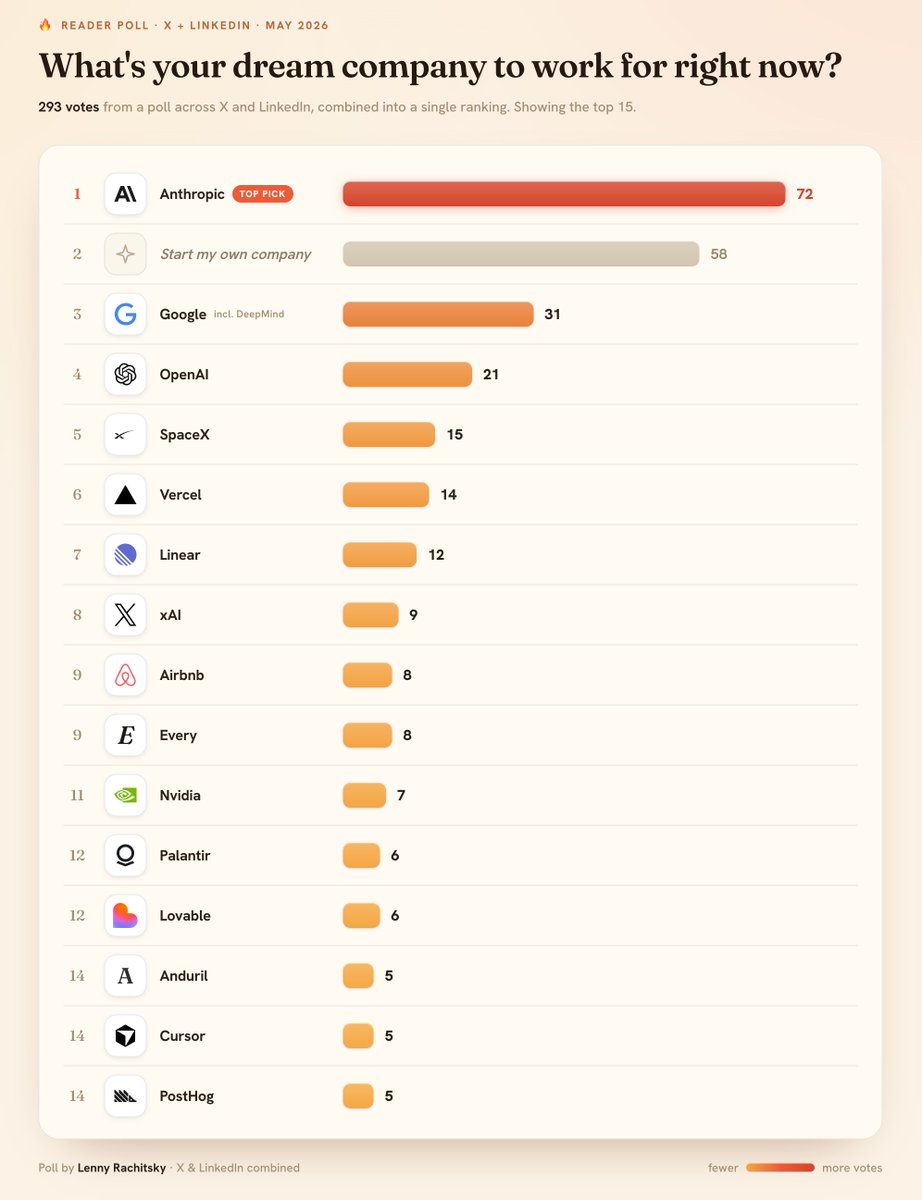
@lennysan @jeremyphoward Seems like culture is very important in the long run. It seems to make people stick with anthropic rather than openai
English
0
0
0
33
wordgrammer
wordgrammer@wordgrammer·
Is auto caps contrarian in 2026 or am I overthinking this
English
5
0
16
1.9K
Georgy Khalin
Georgy Khalin@Khalin_George·
“Never say anything you don’t believe in” sounds like a good principle to live by That’s how Lee Kuan Yew put it in the book and I realized I’ve been trying to follow the same principle my whole life. It’s worked out well for me so far
Georgy Khalin@Khalin_George

Reading From Third World to First. Great lessons on decision-making under slow feedback loops. Especially liked the chapter on the importance of talent — and how much long-term outcomes depend on who is born and raised in a society. True for businesses as well

English
0
0
1
159