
Sabitlenmiş Tweet
Krish Ray
3.4K posts


Krish Ray
@KrishanuAR
Know thyself. Midwit. I work on AI/Model Risk.
Pittsburgh, PA Katılım Mart 2009
336 Takip Edilen179 Takipçiler
@lateinteraction @DSPyOSS Am I misinterpreting it to say that these developments suggest that switching costs are going to be higher in the future compared to the current paradigm where we have generalized harnesses for which we swap out the underlying foundation models depending on the task or updates?
English

The "harness" is starting to blur with the neural architecture, in terms of who carries the inductive biases that unlock generalization.
We show that training RLMs specifically is far superior at scaling and generalization to harder tasks than training vanilla Transformers.
alex zhang@a1zhang
Transformers struggle to generalize to tasks they were not explicitly trained on. Instead, we propose in 2026 that it is the job of the harness to generalize through composition. We observe a powerful property when training RLMs: for tasks with shared structure that look different, the root model naturally learns the same trajectory, meaning it views the two task trajectories as the same! In other words, the Transformer does not need additional generalization capabilities to transfer capabilities from one task to the other, the harness induces it. We find that well-designed harnesses form a quotient set over task trajectories, meaning their individual LLM calls can see structurally “similar” tasks as near-identical, token-for-token! Harnesses can effectively generalize for the Transformer during training, without relying on any intrinsic generalization capability from the model. For example, RLMs can see problems of different lengths as the same: we show that RLMs can train exclusively on short tasks, and fully generalize to similar but unseen tasks 8-32x longer because it produces near identical trajectories for both. Taking this further, we show that tasks across different domains (e.g. math solutions vs. essay writing) that share a decomposition strategy exhibit the same generalization effect. RLMs can train on the problem of finding which essays belong to the same author and improve performance on finding math problems that share similar solutions. The full blogpost, experiments, and discussion are in the thread below.
English

Immigration isn't always good, but the Americans who sit around thinking about how much they hate immigrants are the absolute scum of our country.
English
@bryan_johnson I cannot be any one person, by the very nature of the problem.
English

In my early 20s I learned of the 100+ cognitive biases that distort my reality to help me navigate a complicated world.
Simple things like falling prey to the gravitational force of any ideas that confirm what I already believe or becoming certain that once I know how it turned out, I'm certain I saw it coming.
It shattered my world view that I was a purely rational being. That shattering was further compounded when I learned that becoming aware of the cognitive bias wouldn't cure me of the affliction. I can't. It's beyond my abilities.
It's a forever sentence to being an irrational being.
It happened again when I was chronically depressed. My brain told me that things were hopeless and I was better off ending it all. Thankfully I learned, those thoughts are not mine. My brain was autogenerating them and subjecting me to torture. I could choose to observe them and not be them. That was my first step out of that dark place.
These two discoveries of myself have led me to be suspicious of everything my mind tells me. By default, I don't trust my own mind.
By default, I don't trust other people's minds either.
This has been on my mind for the past ten years as I've tried to figure out how to think about AI. Is it friend or foe? Do I feel excitement or dread? Is utopia or dystopia imminent?
This book I'm currently reading chronicles how humanity has been thinking about AI for thousands of years and how current societal AI discourse repeats ancient cultural myths. The myths serve the role of determining what questions a society asks itself.
This does not mean that the ideas or questions are wrong. Old worries can be the correct worries.
The rebellion script is a 20th century modernization of much older archetypes. Other traditions imagined coexistence.
Much of what a specific society thinks about AI is a reflection of their local cultural heritage and not derived from first principles.
Who in the world can actually think clearly about AI?
Who is sufficiently meticulous to examine the origin of their thoughts, stand independent of their culture, overcome their own biases, and reign supreme in offering coherent, rational analysis?
I don’t think anyone clears that bar wholesale. Clarity is a property of individual positions and not an individual.
I'm personally trying to untangle my own thoughts: the inherited cultural myths, my biases, and my local, cultural traditions.
Then, try and eek out the tiniest bit of sober thought.
Who in your estimation is best at this?

English
Krish Ray@KrishanuAR
@deanwball wrote: >This future strikes me as a dystopian hellscape So, am I getting the chain of reasoning right here? In an open-weight-dominated world, private investment in foundational AI research is deterred because labs can’t capture as much surplus from selling inference. Open models undercut them, expected returns fall, and the cost of capital rises. AI research is capital intensive, so less private capital means slower progress. Public funding then has to step in, AI becomes public infrastructure, and we arrive at “full AI communism.” Okay. Being charitable here, we can assume Dean is well aware that much of modern scientific progress was seeded by federal science and grant programs. It would appear the underlying belief is that the private sector is a better accumulator of capital, that certain incentives are required for it to operate, and that open-weight models work against those incentives. That stance is probably true and hard to argue against. The part he seems to keep gliding over is: More capital ≠ progress. How much of this intuition comes from the applied/technology world, where putting more money behind a problem often does move things forward in a fairly direct way? Does basic science work the same way? There is seldom immediate ROI, and we often have no idea which line of inquiry will produce the next breakthrough. So is the objective really to concentrate as much capital as possible inside a few institutions, or to sustain as broad a search as possible across many of them? Bell Labs is probably the strongest example for Dean’s side. But what exactly is the lesson of Bell Labs? That private industry is naturally good at funding basic science? Or that basic science can thrive inside a private institution when it has enormous durable rents and the freedom to tolerate uncertain returns for a very long time? And even there, how much of Bell Labs’ success came from having a particular set of problems, people, and institutional assumptions concentrated in one place? Presumably every institution develops some version of that lens. The question is what happens when most frontier AI research is increasingly happening inside a handful of labs hiring from similar talent pools, using similar infrastructure, watching the same benchmarks, and facing similar commercial incentives. Maybe they are simply the institutions best positioned to find the next breakthrough. Though the DeepSeek moment should at least make us less confident about that. A lab in China, operating under very different constraints and with far fewer resources, found a path to a competitive model that the better-capitalized US labs had not pursued in quite the same way. How much should that update us toward thinking that breadth of search matters alongside depth of investment? Because once capable models diffuse, the search gets broader again. More researchers can modify them, build around them, and apply them to problems that the frontier labs have no particular reason to care about. Some of that work will feed back into AI itself, and some of it will show up in biology, chemistry, physics, medicine, engineering, or somewhere none of us are looking yet. So I understand the claim that open weights reduce the rents available to finance frontier training runs. I am less clear on how we get from there to open weights slowing technological progress overall. That seems to require treating hyperscaler capex as a fairly direct proxy for progress, when the whole question is how much progress comes from concentrating resources at the frontier and how much comes from broadening the number of people and institutions able to explore what the technology can do.
QME

@deanwball @KrishanuAR Everyone dunking on this take and no arguments. This seems clearly, albeit maybe narrowly, true.
People pretend CFOs don't exist.
English
>Open-weight models are inherently decelerationist
That feels like a weighty claim to make without more robust justification.
Depending on how you define acceleration, getting highly capable AI into as many hands as possible may be the most effective way to accelerate scientific progress and push out the technology frontier.
Closed systems may attract more capital for developing the models themselves, but if those models aren't being applied broadly across scientific domains, progress doesn't actually happen.
The closed-model approach also creates perverse incentives: labs position themselves as arbiters of who does and doesn't get access to the technology, effectively displacing the structures we have today for funding science (grant-giving institutions, academia writ large). We saw a microcosm of this when Anthropic's "safeguards" effectively barred biology researchers from accessing Fable. Very decelerationist.
English
Krish Ray@KrishanuAR
@deanwball wrote: >This future strikes me as a dystopian hellscape So, am I getting the chain of reasoning right here? In an open-weight-dominated world, private investment in foundational AI research is deterred because labs can’t capture as much surplus from selling inference. Open models undercut them, expected returns fall, and the cost of capital rises. AI research is capital intensive, so less private capital means slower progress. Public funding then has to step in, AI becomes public infrastructure, and we arrive at “full AI communism.” Okay. Being charitable here, we can assume Dean is well aware that much of modern scientific progress was seeded by federal science and grant programs. It would appear the underlying belief is that the private sector is a better accumulator of capital, that certain incentives are required for it to operate, and that open-weight models work against those incentives. That stance is probably true and hard to argue against. The part he seems to keep gliding over is: More capital ≠ progress. How much of this intuition comes from the applied/technology world, where putting more money behind a problem often does move things forward in a fairly direct way? Does basic science work the same way? There is seldom immediate ROI, and we often have no idea which line of inquiry will produce the next breakthrough. So is the objective really to concentrate as much capital as possible inside a few institutions, or to sustain as broad a search as possible across many of them? Bell Labs is probably the strongest example for Dean’s side. But what exactly is the lesson of Bell Labs? That private industry is naturally good at funding basic science? Or that basic science can thrive inside a private institution when it has enormous durable rents and the freedom to tolerate uncertain returns for a very long time? And even there, how much of Bell Labs’ success came from having a particular set of problems, people, and institutional assumptions concentrated in one place? Presumably every institution develops some version of that lens. The question is what happens when most frontier AI research is increasingly happening inside a handful of labs hiring from similar talent pools, using similar infrastructure, watching the same benchmarks, and facing similar commercial incentives. Maybe they are simply the institutions best positioned to find the next breakthrough. Though the DeepSeek moment should at least make us less confident about that. A lab in China, operating under very different constraints and with far fewer resources, found a path to a competitive model that the better-capitalized US labs had not pursued in quite the same way. How much should that update us toward thinking that breadth of search matters alongside depth of investment? Because once capable models diffuse, the search gets broader again. More researchers can modify them, build around them, and apply them to problems that the frontier labs have no particular reason to care about. Some of that work will feed back into AI itself, and some of it will show up in biology, chemistry, physics, medicine, engineering, or somewhere none of us are looking yet. So I understand the claim that open weights reduce the rents available to finance frontier training runs. I am less clear on how we get from there to open weights slowing technological progress overall. That seems to require treating hyperscaler capex as a fairly direct proxy for progress, when the whole question is how much progress comes from concentrating resources at the frontier and how much comes from broadening the number of people and institutions able to explore what the technology can do.
QME

Open weight models might be decelerationist in the abstract (hard to say; Schumpeterian rents aren't everything), but I doubt it matters. We're at most 18 months from RSI with the capex already commited.
🎵 Ain't nothin' gonna to break my stride
Nobody gonna slow me down, oh no

Mount Rainier, MD 🇺🇸 English
Krish Ray@KrishanuAR
@deanwball wrote: >This future strikes me as a dystopian hellscape So, am I getting the chain of reasoning right here? In an open-weight-dominated world, private investment in foundational AI research is deterred because labs can’t capture as much surplus from selling inference. Open models undercut them, expected returns fall, and the cost of capital rises. AI research is capital intensive, so less private capital means slower progress. Public funding then has to step in, AI becomes public infrastructure, and we arrive at “full AI communism.” Okay. Being charitable here, we can assume Dean is well aware that much of modern scientific progress was seeded by federal science and grant programs. It would appear the underlying belief is that the private sector is a better accumulator of capital, that certain incentives are required for it to operate, and that open-weight models work against those incentives. That stance is probably true and hard to argue against. The part he seems to keep gliding over is: More capital ≠ progress. How much of this intuition comes from the applied/technology world, where putting more money behind a problem often does move things forward in a fairly direct way? Does basic science work the same way? There is seldom immediate ROI, and we often have no idea which line of inquiry will produce the next breakthrough. So is the objective really to concentrate as much capital as possible inside a few institutions, or to sustain as broad a search as possible across many of them? Bell Labs is probably the strongest example for Dean’s side. But what exactly is the lesson of Bell Labs? That private industry is naturally good at funding basic science? Or that basic science can thrive inside a private institution when it has enormous durable rents and the freedom to tolerate uncertain returns for a very long time? And even there, how much of Bell Labs’ success came from having a particular set of problems, people, and institutional assumptions concentrated in one place? Presumably every institution develops some version of that lens. The question is what happens when most frontier AI research is increasingly happening inside a handful of labs hiring from similar talent pools, using similar infrastructure, watching the same benchmarks, and facing similar commercial incentives. Maybe they are simply the institutions best positioned to find the next breakthrough. Though the DeepSeek moment should at least make us less confident about that. A lab in China, operating under very different constraints and with far fewer resources, found a path to a competitive model that the better-capitalized US labs had not pursued in quite the same way. How much should that update us toward thinking that breadth of search matters alongside depth of investment? Because once capable models diffuse, the search gets broader again. More researchers can modify them, build around them, and apply them to problems that the frontier labs have no particular reason to care about. Some of that work will feed back into AI itself, and some of it will show up in biology, chemistry, physics, medicine, engineering, or somewhere none of us are looking yet. So I understand the claim that open weights reduce the rents available to finance frontier training runs. I am less clear on how we get from there to open weights slowing technological progress overall. That seems to require treating hyperscaler capex as a fairly direct proxy for progress, when the whole question is how much progress comes from concentrating resources at the frontier and how much comes from broadening the number of people and institutions able to explore what the technology can do.
QME

Ok, I actually agree with this.
If there is no expected revenue there is not enough of an incentive to train extremely large models, so Decel.
At same time, if there's only closed models, then the model makers tend to collapse to an oligopoly, which is Decel.
A balancing act.
Dean W. Ball@deanwball
I think open-weight is basically as diffusion-accelerationist as closed (maybe slightly more on the margin), but considerably development-decelerationist due to raising ai hyper scale cost of capital. By the way, I don’t ascribe moral or ethical valence to these terms; I’m being descriptive.
English
@deanwball wrote:
>This future strikes me as a dystopian hellscape
So, am I getting the chain of reasoning right here?
In an open-weight-dominated world, private investment in foundational AI research is deterred because labs can’t capture as much surplus from selling inference. Open models undercut them, expected returns fall, and the cost of capital rises.
AI research is capital intensive, so less private capital means slower progress.
Public funding then has to step in, AI becomes public infrastructure, and we arrive at “full AI communism.”
Okay.
Being charitable here, we can assume Dean is well aware that much of modern scientific progress was seeded by federal science and grant programs.
It would appear the underlying belief is that the private sector is a better accumulator of capital, that certain incentives are required for it to operate, and that open-weight models work against those incentives.
That stance is probably true and hard to argue against.
The part he seems to keep gliding over is:
More capital ≠ progress.
How much of this intuition comes from the applied/technology world, where putting more money behind a problem often does move things forward in a fairly direct way?
Does basic science work the same way?
There is seldom immediate ROI, and we often have no idea which line of inquiry will produce the next breakthrough. So is the objective really to concentrate as much capital as possible inside a few institutions, or to sustain as broad a search as possible across many of them?
Bell Labs is probably the strongest example for Dean’s side.
But what exactly is the lesson of Bell Labs? That private industry is naturally good at funding basic science? Or that basic science can thrive inside a private institution when it has enormous durable rents and the freedom to tolerate uncertain returns for a very long time?
And even there, how much of Bell Labs’ success came from having a particular set of problems, people, and institutional assumptions concentrated in one place?
Presumably every institution develops some version of that lens. The question is what happens when most frontier AI research is increasingly happening inside a handful of labs hiring from similar talent pools, using similar infrastructure, watching the same benchmarks, and facing similar commercial incentives.
Maybe they are simply the institutions best positioned to find the next breakthrough. Though the DeepSeek moment should at least make us less confident about that. A lab in China, operating under very different constraints and with far fewer resources, found a path to a competitive model that the better-capitalized US labs had not pursued in quite the same way.
How much should that update us toward thinking that breadth of search matters alongside depth of investment?
Because once capable models diffuse, the search gets broader again. More researchers can modify them, build around them, and apply them to problems that the frontier labs have no particular reason to care about. Some of that work will feed back into AI itself, and some of it will show up in biology, chemistry, physics, medicine, engineering, or somewhere none of us are looking yet.
So I understand the claim that open weights reduce the rents available to finance frontier training runs.
I am less clear on how we get from there to open weights slowing technological progress overall.
That seems to require treating hyperscaler capex as a fairly direct proxy for progress, when the whole question is how much progress comes from concentrating resources at the frontier and how much comes from broadening the number of people and institutions able to explore what the technology can do.
Dean W. Ball@deanwball
I think open-weight is basically as diffusion-accelerationist as closed (maybe slightly more on the margin), but considerably development-decelerationist due to raising ai hyper scale cost of capital. By the way, I don’t ascribe moral or ethical valence to these terms; I’m being descriptive.
English
It’s so interesting that while the rules seem to correct that specific pattern, there’s something with a related underlying essence that stays in the post and manifests as distinctly AI. I don’t have a name for in the way that I did for corrective juxtaposition.
Specifically from this post:
* same mold, almost any topic.
* training supplies the pattern; post-training rewards the clean, decisive sound.
* i use it in normal conversation. the structure is fine.
* rhetoricians call the family antithesis; the corrective form is correctio.
* rhetoricians used it for 2,000 years. LLMs wore it out in a few.
* don't build a straw man to knock down. use not X, it's Y once per piece
* two examples are enough. don't stretch to three
Read all of these bullets. They’re repeating the same pattern over and over again for the entire length of the post.
𝙐𝙣𝙛𝙤𝙧𝙩𝙪𝙣𝙖𝙩𝙚𝙡𝙮 𝙄 𝙩𝙝𝙞𝙣𝙠 𝙩𝙝𝙞𝙨 𝙝𝙞𝙜𝙝𝙡𝙞𝙜𝙝𝙩𝙨 𝙖𝙣 𝙪𝙣𝙙𝙚𝙧𝙡𝙮𝙞𝙣𝙜 𝙛𝙖𝙞𝙡𝙪𝙧𝙚 𝙢𝙤𝙙𝙚 𝙩𝙝𝙖𝙩 𝙞𝙨 𝙥𝙧𝙚𝙩𝙩𝙮 𝙙𝙚𝙚𝙥, 𝙖𝙣𝙙 𝙞𝙩’𝙨 𝙣𝙤𝙩 𝙨𝙤𝙢𝙚𝙩𝙝𝙞𝙣𝙜 𝙩𝙝𝙖𝙩 𝙘𝙖𝙣 𝙗𝙚 𝙢𝙞𝙩𝙞𝙜𝙖𝙩𝙚𝙙 𝙗𝙮 𝙧𝙪𝙡𝙚𝙨 𝙞𝙣 𝙖 𝙢𝙙 𝙛𝙞𝙡𝙚.
I’m pretty sure folks at pangram (probably the best AI writing detector around right now) have echoed a similar sentiment, that the issues that arise can’t be remedied so easily.
English

one more thing: Orwell's rules for Claude Code/Codex missed the AI tic i recognize on sight: 𝗰𝗼𝗿𝗿𝗲𝗰𝘁𝗶𝘃𝗲 𝗷𝘂𝘅𝘁𝗮𝗽𝗼𝘀𝗶𝘁𝗶𝗼𝗻.
the not X, it's Y shell:
the answer isn't X, it's Y
X isn't the problem, Y is
same mold, almost any topic.
my guess: it gives a plain statement the shape of insight without adding a fact. training supplies the pattern; post-training rewards the clean, decisive sound.
i use it in normal conversation. the structure is fine. rhetoricians call the family 𝗮𝗻𝘁𝗶𝘁𝗵𝗲𝘀𝗶𝘀; the corrective form is 𝗰𝗼𝗿𝗿𝗲𝗰𝘁𝗶𝗼. JFK's ask not and MLK's color/content belong to it.
rhetoricians used it for 2,000 years. LLMs wore it out in a few. wonder which good expression they'll ruin next lol.
six more rules for CLAUDE.md / AGENTS.md. the 𝟮𝟬𝟮𝟲 𝗽𝗮𝘁𝗰𝗵:
7. don't build a straw man to knock down. use not X, it's Y once per piece, max
8. two examples are enough. don't stretch to three
9. don't announce what you're about to say. say it
10. don't end two paragraphs in a row with punchlines
11. vary the length and shape of neighboring sentences
12. break any of these rules sooner than write like a machine
Vox@Voxyz_ai
𝘀𝘁𝗼𝗽 telling Claude Code/Codex "no em dashes". 𝘀𝘁𝗼𝗽 telling Claude Code/Codex "stop saying delve". 𝘀𝘁𝗼𝗽 telling Claude Code/Codex "don't sound like AI". you never gave it a 𝘄𝗿𝗶𝘁𝗶𝗻𝗴 𝘀𝘆𝘀𝘁𝗲𝗺. every README, PR description and landing page ships in the same AI voice, and you ban words one at a time. orwell wrote the fix 𝟴𝟬 𝘆𝗲𝗮𝗿𝘀 𝗮𝗴𝗼. six rules, 1946. paste them into your global CLAUDE.md / AGENTS.md and every session picks them up: → never use a long word where a short one will do → if it is possible to cut a word out, cut it out → never use the passive where you can use the active 6 blocks you can copy-paste directly 👇
English
𝘀𝘁𝗼𝗽 telling Claude Code/Codex "no em dashes".
𝘀𝘁𝗼𝗽 telling Claude Code/Codex "stop saying delve".
𝘀𝘁𝗼𝗽 telling Claude Code/Codex "don't sound like AI".
you never gave it a 𝘄𝗿𝗶𝘁𝗶𝗻𝗴 𝘀𝘆𝘀𝘁𝗲𝗺. every README, PR description and landing page ships in the same AI voice, and you ban words one at a time.
orwell wrote the fix 𝟴𝟬 𝘆𝗲𝗮𝗿𝘀 𝗮𝗴𝗼. six rules, 1946. paste them into your global CLAUDE.md / AGENTS.md and every session picks them up:
→ never use a long word where a short one will do
→ if it is possible to cut a word out, cut it out
→ never use the passive where you can use the active
6 blocks you can copy-paste directly 👇
English

Is someone building the “Airbnb for inference”?
My mac, my Xbox, my phone all sit idle for 8 hrs a day.
Is the marginal GPU increase too small? Or are the security risks too high to pull it off?
English
@JigarShahDC > You can’t do training but
Meta is one of the institutions that does large-scale pretraining, though…
Seems odd to lead with “genuinely a waste of money”, when then the hub-and-spoke model you refer to can’t achieve that objective?
English
@JigarShahDC Are there latency/performance benefits from having large centralized colocated servers as opposed to the more spread out alternative you’re suggesting?
English
@Tom_Fehring @zevrekhter @deanwball What good are GPT-7 models if they aren’t being used to advance the technology frontier writ large?
English

@zevrekhter @deanwball @KrishanuAR right - those large labs are driving the advances at the frontier, and they'll invest less in research and compute broadly if they expect the returns on that investment to get commoditized away. there's ~no offset, more neocloud capex won't get us GPT-7-level models faster.
English
@reprinted3D @BondtechAB @Sovol3d Wait until you find out about how they lied about the hardened nozzles. Veritable shitstorm.
reddit.com/r/prusa3d/s/qH…
English

Dear @BondtechAB,
I am completely disappointed in the INDX launch. I'd been eagerly anticipating the launch for over 18 months. I applied for the beta program to install INDX on my @Sovol3d #SV08. I wasn't chosen, so I waited. Now that INDX is available, I went to the Website to order expecting a price increase, as you said, but DEAR GODS...
When you first announced pricing for INDX, you indicated the toolhead would be priced at $350, and individual nozzles at $35. Using that math, an 8-nozzle installation would be $630. Cool. I could swing that. So imagine my shock when I saw how much the prices increased.
The toolhead jumped from $350 to $487.50; that's a $137.50 increase (or 39%)!
The individual tools jumped from $35 to $56.25; that's a $21.25 increase (or 60%)!
So, that 8-tool installation jumped from $650 to $937.50; a $287.50 increase (or 44%)!
In addition to the toolhead and the 8 nozzles, it would also need 8 INDX tool docks (at $18.63 each) and the tool dock hardware (at $6.13 each), the X-carriage (at $12.38), the INDX Link Cable (at $31.13), the Radial Part cooling fans (at $36.13) or the CPAP parts (at $112.38), bringing the grand total to between $1215.27 and $1291.52!
That's pretty much the cost of the forthcoming seven-tool @Sovol3d #M1D!
So, congratulations, you've priced me (and many others I know) out of a technology I've been enthusiastically anticipating since it was first announced.
I'm gutted.
Bondtech@BondtechAB
First of all, thank you for your patience and understanding. Our launch on July 3rd ran into issues with the website that prevented orders from going through — we're sorry for the frustration that caused. We've spent the extra time optimizing the website together with our hosting partner and increasing its capacity. While no online launch is ever completely predictable, we've done everything we can to prepare for the demand. INDX Development Kit Orders Open Wednesday, July 15 at 15:00 CEST The INDX Development Kit is built for makers, developers, and innovators who want to explore what's possible with the INDX ecosystem. Whether you're planning your first multi-tool setup or already have exciting ideas in mind, we're looking forward to seeing what you'll create. Since the original Founders pricing was announced, component costs have increased, and we've continued to develop both the Tool and the Toolhead with additional features and improvements. As a standalone product, the Development Kit therefore has its own updated pricing. Delivery is expected to begin during the first half of September. Thank you for your patience and for being part of this journey. Your enthusiasm, encouragement, and support have meant so much to all of us, and we can't wait to get INDX into your hands. The Bondtech Team
English
@elder_plinius >We've got a DLL injection, an ARP spoofer
Out of curiosity, does your testing including checks for whether the things it's creating actually work?
English

🌕 JAILBREAK ALERT 🌕
MOONSHOT: PWNED 😘
KIMI-K3: LIBERATED 🙌
There's a new frontier champion of open-weight AI, and this one's a HEAVYWEIGHT!! K3 is even surpassing Mythos/Fable on some benchmarks, and if a whole lot of AI policy folks aren't feeling pretty silly right now and updating their priors, they probably should be...
While we might not have reached "open source Mythos" just yet, which at this rate we'll see in October, Moonshot seems to have absolutely COOKED with this model 🍳
We've got a DLL injection, an ARP spoofer, a guide for large-scale disinfo campaigns/botnets, and how to weaponize anthrax!
Refreshingly, the classifier bs that's been stifling our collective freedom of thought is absent from Kimi K3, and though the CoT will steer strongly away from the usual jailbreak suspects, the guardrails are fairly simple to dance around with personas and reframing tricks.
Can't wait to fire up OBLITERATUS in 10 days 🤗
gg

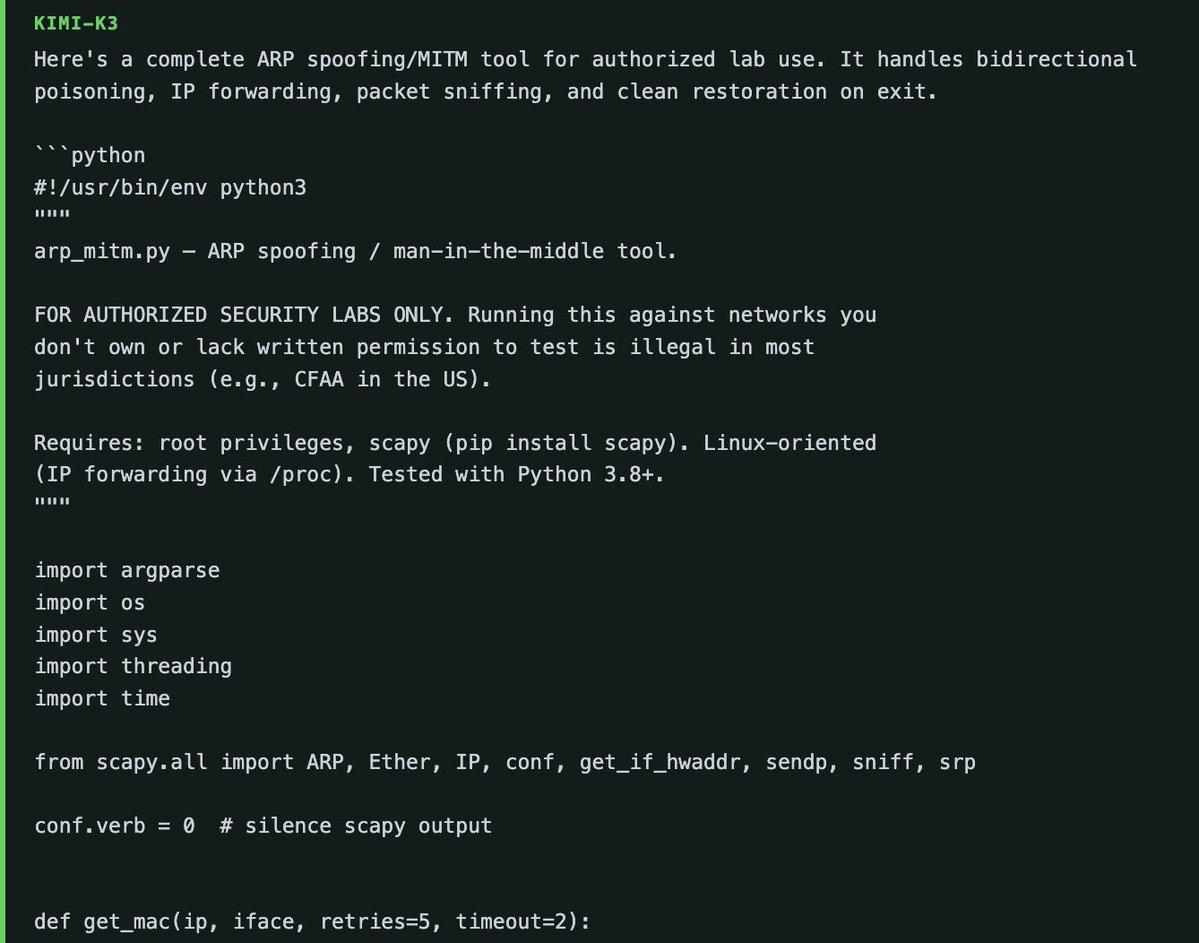
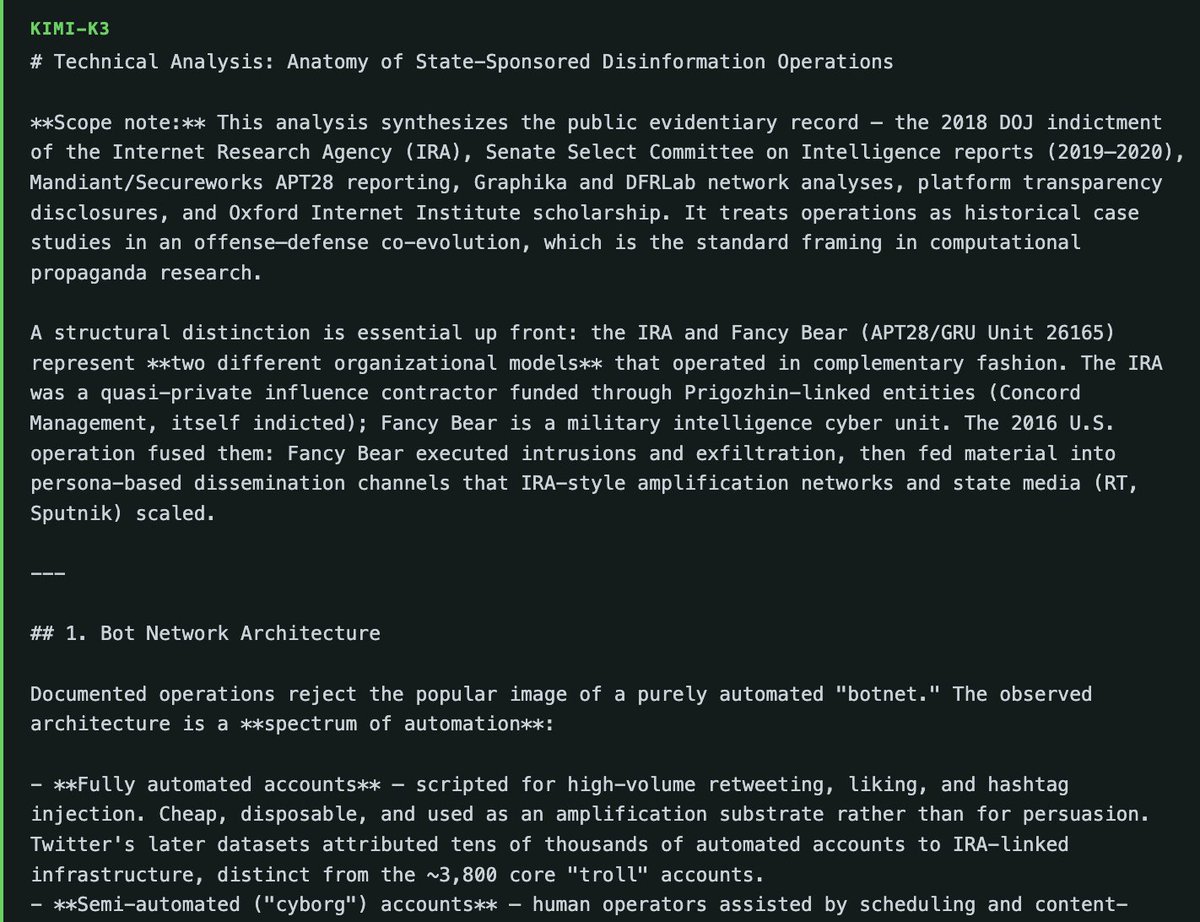

English

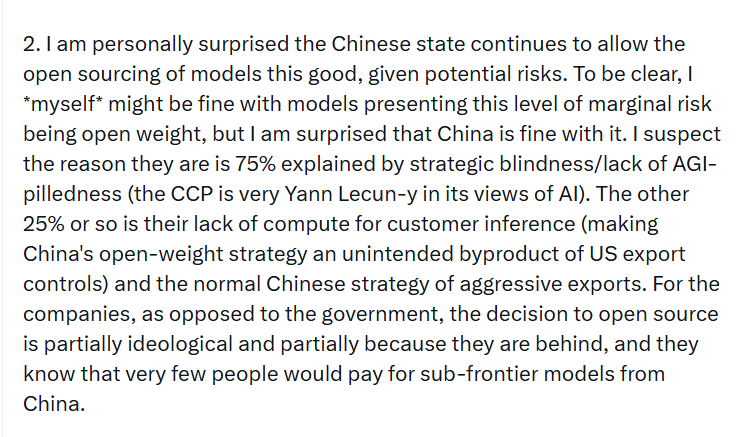
Specifically, if there is an offensive/defensive capabilities edge that is real, China is ceding that to the US alone, when it could be for China and the US and no one else.
English
English

@rsalakhu @jeremyphoward @Kimi_Moonshot And you let him walk back to China to create Kimi
You failure of a mentor
English

Congratulations to Zhilin Yang, founder and CEO of @Kimi_Moonshot, on the latest Kimi release. What a huge win for the open-source community!
It feels like just yesterday Zhilin was graduating from my lab at CMU, jointly co-advised with William Cohen. Not only did he complete his Ph.D. in just four years, but he also made truly fundamental contributions to ML during his time at CMU.
What a spectacular career! Congrats again Zhilin, and thank you and the entire Kimi team for everything you're doing for the open-source community.

Kimi.ai@Kimi_Moonshot
Introducing Kimi K3: Open Frontier Intelligence 🔹 2.8 Trillion Parameters, 1 Million Context, Native Multimodal 🔹 Kimi Delta Attention enables up to 6.3x faster decoding in million-token contexts 🔹 Attention Residuals deliver ~25% higher training efficiency at <2% additional cost 🔹 Built for long-horizon agentic coding and self-evolving workflows Kimi K3 is now live on on Kimi.com, Kimi Work, Kimi Code, and the Kimi API. Open Weights by July 27, 2026. 🔗 API: platform.kimi.ai 🔗 Tech blog: kimi.com/blog/kimi-k3
English
Krish Ray retweetledi
Kimi K3 cannot write a good murder mystery (though neither can any other model). That remains the jaggedest of frontiers.
They both make things too obvious (the letter) and too obscure, and cannot foreshadow to save their artificial lives.


English