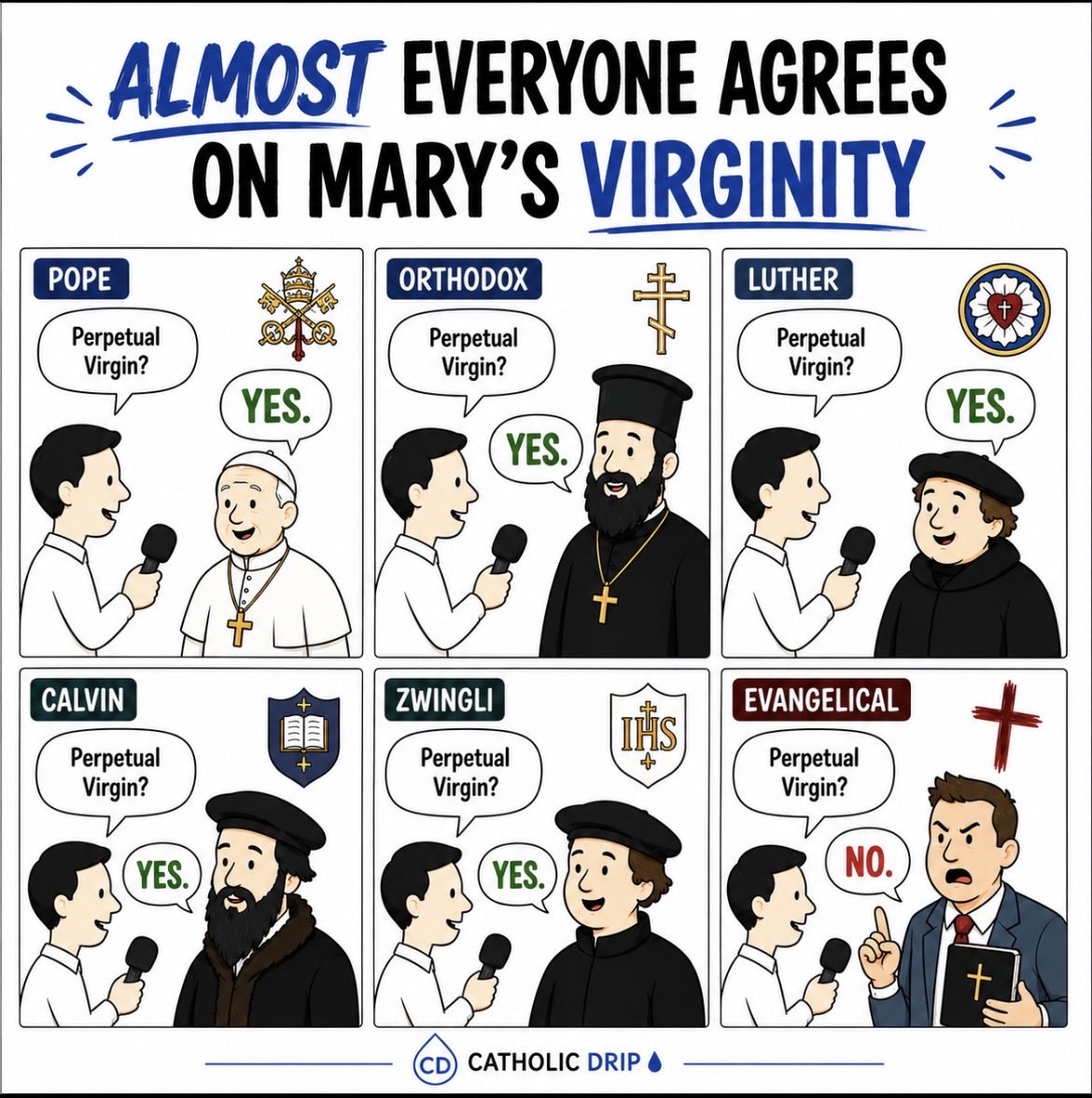
@CatholicDrip___ I’m not worried about what they have to say I’m concerned with what scripture says.
Scripture supports the immaculate conception and virgin birth.
It does not support a perpetual virginity.
English
Kyle
7.2K posts



Lemme differentiate between dogma, doctrine and discipline. 1. Dogma (The Revealed, Unchangeable Core). A dogma is a truth contained directly in Divine Revelation (Sacred Scripture or Sacred Tradition) that has been explicitly defined by the Church's infallible teaching authority (the Magisterium) as divinely revealed and binding on all the faithful. It is the genetic code of the faith. Can it change? Absolutely not. Because the Church believes God is the source of dogma, no Pope, council, or historical shift can ever reverse, contradict, or delete a dogma. While the substance of a dogma is permanent, our linguistic expression of it can mature. For example, the early Church always believed Jesus was God, but it wasn't until the Council of Nicaea in 325 AD that they defined the dogma using the precise Greek philosophical term homoousios (meaning "of the same substance" as the Father) to defeat heresies. Examples of dogmas include the Trinity, the Resurrection of Christ, the Real Presence of Christ in the Eucharist, and the Immaculate Conception of Mary. 2. Doctrine includes any teaching on faith and morals proposed by the Church's Magisterium. Some doctrines are definitive (and close to becoming formal dogmas), while others are authoritative but non-definitive. Can it change? Yes, but through development, not contradiction. Doctrines can deepen, expand, or shift focus. When a doctrine "changes," it is usually because the Church is applying eternal moral principles to brand-new historical circumstances. Examples: Teachings on social justice, bioethics (like IVF or cloning), religious liberty, and the modern restriction of the death penalty. 3. Discipline (the Pastoral Rules and Practices). A discipline is an ecclesiastical law, custom, or practice established by Church authority to guide the spiritual lives of the faithful and maintain orderly worship. Can it change? Yes, entirely and frequently. Because disciplines are created by the human authority of the Church (rather than directly revealed by God), they can be adapted, suspended, or completely abolished to fit different cultures, eras, and pastoral needs. Disciplines are designed to protect and express dogmas. For example, the discipline of fasting is not a dogma, but it is a practical tool meant to help Catholics live out the actual dogma of repentance and self-denial.
Water Baptism doesn’t save you. The blood of Jesus does.