You Can Leave My Country

484 posts

You Can Leave My Country

You Can Leave My Country

@LeaveMyCountryx

Katılım Nisan 2026
11 Takip Edilen2 Takipçiler
electricplug77
electricplug77@electricplug77·
@LeaveMyCountryx @escapefrommelos Mogging has many other benefits besides women. Attractive and healthy people make more money, have lower medical bills, and live longer. Not recognizing this is cope.
English
1
0
1
99
Liberty-Identitarian
Liberty-Identitarian@EricTropicalTX·
@graffanati19 Owen got destroyed. What happened to that dude? Only thing I can figure is some muslims raped him in prison and forced him to convert. How does one go from Tea Party libertarianism to apologist for islam in one decade?
English
4
0
1
186
graffanati19
graffanati19@graffanati19·
This was a beat down
Rex@rexjonesnewz

Total @OwenShroyer1776 W! American Imperialists are at least honest about their brutal policies of domination through collective punishment. The independent thinker knows we voted against this, and Shroyer, as a 3x Trump voter speaks to that here. Great debate!

English
11
5
111
2K
You Can Leave My Country retweetledi
Fight Back Podcast
Fight Back Podcast@ShieldsClips·
Our podcast just hacked the home camera of Andrew Wilson and this is crazy
English
584
657
8.7K
553K
Blackboa
Blackboa@BlackboaStreams·
@ShieldsClips hahahahah. I would rather have an OF thot than a woman who has been married and divorced 3 times any day of the week.
English
7
2
149
10.4K
You Can Leave My Country retweetledi
Swann Marcus
Swann Marcus@SwannMarcus89·
There is no profession in the world more hypocritical than streamers Every socialist streamer is the most heartless capitalist you’ve ever seen and every right-wing streamer is a sexual degenerate with substance abuse problems
English
34
272
2.8K
61.3K
electricplug77
electricplug77@electricplug77·
@escapefrommelos She got more attractive and he didn’t, she cheated with a rich hot doctor because he refused to looksmaxx , he killed her instead of just taking the L, lifting weights, and finding a new foid. It’s all right there for those with eyes to see.
English
5
0
45
9.9K
Third
Third@thirdmetax·
Caleb Hammer financial audit guest thinks George Floyd died from fentanyl
English
1.9K
59
3K
3.3M
Geriatrick
Geriatrick@GeriatrickGames·
@nypost Dudes need to just get divorce if things arent going well. Wholly fk, what a loser this guy was.
English
2
0
10
1.4K
New York Post
New York Post@nypost·
Husband kills high school sweetheart wife, commits suicide in woods less than 2 years into their marriage trib.al/F4CMqrZ
New York Post tweet media
English
359
252
3K
5.3M
EF B
EF B@EFB58072321·
@gcfascist @nypost My takeaway was unemployed loser jealous of his successful wife.
English
2
0
2
82
CariHero
CariHero@CariHero·
@nypost At this point we need mandatory counselling to prepare men for breakups and divorce before they get married so they can cope with it. I dont want more women dying due to weak men's mental health.
English
2
0
3
1.8K
Dee Sage
Dee Sage@TheDeeGroup·
@nypost I know it’s wrong to ask but……..I wonder what she did?
English
61
1
389
229.5K
ShadesOfBlueAndRed
ShadesOfBlueAndRed@ShadesOfBlueAn1·
woke right --> this is the cream of India’s elite, not “immigrants” in general Also, woke right --> low IQ, no skills, stealing jobs
Hany Girgis@SanDiegoKnight

This Cato ‘immigrants pay more taxes’ flex + Indian chart is peak cherry-picking. Impressive numbers… until you actually look under the hood. 🧐” 1. It’s median household income, not individual or per-capita — and Indian households are structured differently • The chart (and the “twice as much” claim) uses households, not people. Indian-American households are larger on average (~3.0–3.8 people vs. U.S. average ~2.5) and far more likely to have multiple full-time high earners (dual STEM/medical professionals is common). en.wikipedia. • Indian Americans still have high personal earnings (median ~$85k for ages 16+, ~$106k for full-time workers per 2023 Pew), but the “almost twice” headline evaporates when you adjust for household size and number of workers. This is a classic statistical sleight-of-hand when comparing groups with different living arrangements. 2. Extreme positive selection bias … this is the cream of India’s elite, not “immigrants” in general • Indian Americans aren’t a random sample of India’s 1.4 billion people. The vast majority arrived via H-1B, EB-2/3, or student visas …hyper-selective for advanced degrees and high-skill jobs. You’re comparing the top ~0.1–1% of India’s talent/IQ/education distribution to the broad U.S. average (which includes everyone from McDonald’s workers to retirees). • India’s own per-capita income and education levels are far lower. This doesn’t prove broad immigration is economically magical; it proves cherry-picked high-skill immigration works for the selectees. Second-generation outcomes are strong but show some regression toward the mean, and chain migration/family sponsorship often dilutes the skill level over time. 3. Cato’s overall “immigrants pay more taxes” claim has well-documented methodological holes • Cato (a libertarian think tank that favors more immigration) attributes welfare benefits received by U.S.-born children of immigrants to “natives,” not the immigrant parents. This understates immigrant fiscal costs. The Center for Immigration Studies (CIS) and others note this flips the picture: when you count the full household burden (including kids), immigrant-headed households use welfare at higher rates than native-headed ones. • Cato aggregates all immigrants (high-skill Indians + low-skill groups + illegals). The net positive they find is heavily driven by the high earners. Other studies (National Academies of Sciences, Heritage, etc.) have found first-generation immigrants often impose net costs, especially low-skilled/illegal cohorts. • Their data ends before the post-2021 border surge effects fully hit long-term budgets. 4. H-1B-specific issues (the main pipeline for Indian success) • Many Indian immigrants in tech come via H-1B, which has documented problems: outsourcing/body shops (e.g., Infosys, TCS), wage suppression (foreign workers often paid less for similar roles), and ethnic nepotism once Indians reach management (preferring co-ethnics for hiring/promotions). This displaces U.S. workers and depresses wages in STEM. • Fraud allegations are common (fake credentials, benching workers, etc.). Critics argue this isn’t “adding value” so much as arbitraging cheaper labor and networks. 5. Other drains and context • Remittances: Indian Americans send massive sums back to India (India receives over $100B+ in remittances annually, a huge chunk from the U.S.). That’s money leaving the U.S. economy. • Cost of living: Indians are heavily concentrated in high-cost metros (SF Bay, NYC, etc.), where nominal incomes are inflated anyway. Adjust for purchasing power and the gap shrinks. • The post uses Indian success to defend a general “immigrants = net positive” narrative from Cato. But Indians are ~1.4% of the U.S. population and an outlier. Broad policy implications (more low-skill immigration, open borders, etc.) don’t follow from one high-performing subgroup.

English
38
39
431
24.7K
John J.S. Soriano
John J.S. Soriano@JohnJSSoriano·
@MartinLukasMD He is obviously dismissive of their economic success to the extent that it is driven by their family structure.
English
2
1
23
721
John J.S. Soriano
John J.S. Soriano@JohnJSSoriano·
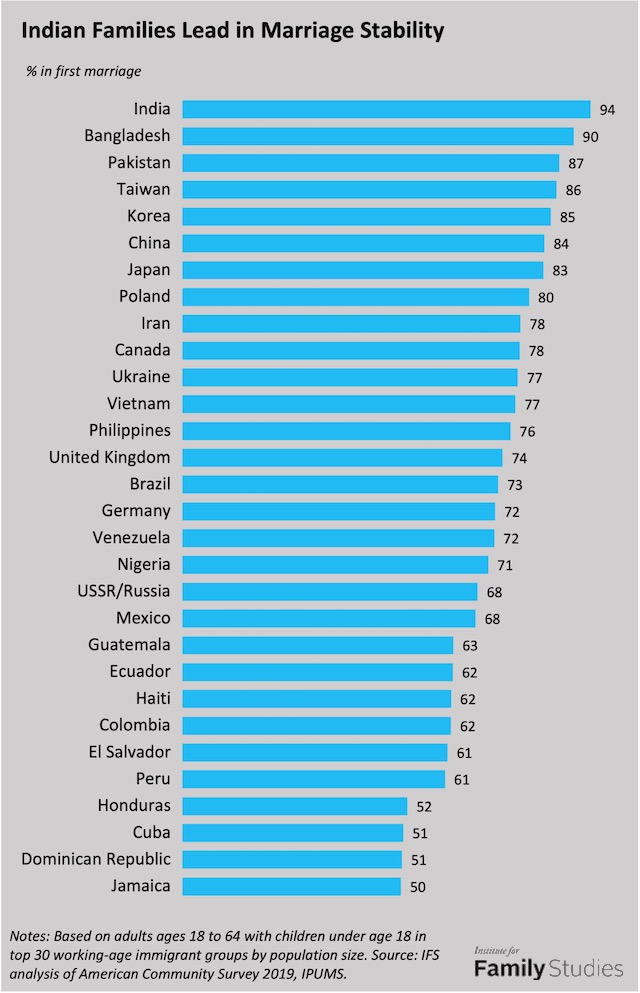
94% of Indian immigrants with children are stably married, compared to 66% of white Americans. That is something they are doing right, not something you control away! This guy is holding it against Indians that their children grow up in stable families. Very conservative!
John J.S. Soriano tweet media
Hany Girgis@SanDiegoKnight

This Cato ‘immigrants pay more taxes’ flex + Indian chart is peak cherry-picking. Impressive numbers… until you actually look under the hood. 🧐” 1. It’s median household income, not individual or per-capita — and Indian households are structured differently • The chart (and the “twice as much” claim) uses households, not people. Indian-American households are larger on average (~3.0–3.8 people vs. U.S. average ~2.5) and far more likely to have multiple full-time high earners (dual STEM/medical professionals is common). en.wikipedia. • Indian Americans still have high personal earnings (median ~$85k for ages 16+, ~$106k for full-time workers per 2023 Pew), but the “almost twice” headline evaporates when you adjust for household size and number of workers. This is a classic statistical sleight-of-hand when comparing groups with different living arrangements. 2. Extreme positive selection bias … this is the cream of India’s elite, not “immigrants” in general • Indian Americans aren’t a random sample of India’s 1.4 billion people. The vast majority arrived via H-1B, EB-2/3, or student visas …hyper-selective for advanced degrees and high-skill jobs. You’re comparing the top ~0.1–1% of India’s talent/IQ/education distribution to the broad U.S. average (which includes everyone from McDonald’s workers to retirees). • India’s own per-capita income and education levels are far lower. This doesn’t prove broad immigration is economically magical; it proves cherry-picked high-skill immigration works for the selectees. Second-generation outcomes are strong but show some regression toward the mean, and chain migration/family sponsorship often dilutes the skill level over time. 3. Cato’s overall “immigrants pay more taxes” claim has well-documented methodological holes • Cato (a libertarian think tank that favors more immigration) attributes welfare benefits received by U.S.-born children of immigrants to “natives,” not the immigrant parents. This understates immigrant fiscal costs. The Center for Immigration Studies (CIS) and others note this flips the picture: when you count the full household burden (including kids), immigrant-headed households use welfare at higher rates than native-headed ones. • Cato aggregates all immigrants (high-skill Indians + low-skill groups + illegals). The net positive they find is heavily driven by the high earners. Other studies (National Academies of Sciences, Heritage, etc.) have found first-generation immigrants often impose net costs, especially low-skilled/illegal cohorts. • Their data ends before the post-2021 border surge effects fully hit long-term budgets. 4. H-1B-specific issues (the main pipeline for Indian success) • Many Indian immigrants in tech come via H-1B, which has documented problems: outsourcing/body shops (e.g., Infosys, TCS), wage suppression (foreign workers often paid less for similar roles), and ethnic nepotism once Indians reach management (preferring co-ethnics for hiring/promotions). This displaces U.S. workers and depresses wages in STEM. • Fraud allegations are common (fake credentials, benching workers, etc.). Critics argue this isn’t “adding value” so much as arbitraging cheaper labor and networks. 5. Other drains and context • Remittances: Indian Americans send massive sums back to India (India receives over $100B+ in remittances annually, a huge chunk from the U.S.). That’s money leaving the U.S. economy. • Cost of living: Indians are heavily concentrated in high-cost metros (SF Bay, NYC, etc.), where nominal incomes are inflated anyway. Adjust for purchasing power and the gap shrinks. • The post uses Indian success to defend a general “immigrants = net positive” narrative from Cato. But Indians are ~1.4% of the U.S. population and an outlier. Broad policy implications (more low-skill immigration, open borders, etc.) don’t follow from one high-performing subgroup.

English
437
459
3.8K
2M
John J.S. Soriano
John J.S. Soriano@JohnJSSoriano·
1. So what you're saying is that these employer-sponsored visas are good at selecting immigrants that perform well on both economic and social measures? Nice refutation. 2. I picked white Americans to preempt the response that numbers that paint immigrants in a favorable light are merely just a story about American minorities (a favorite of the racists on here). The story would be the same if you just looked at all US natives.
English
11
9
276
18.3K