Andrew Lukic-Levitt

655 posts

Andrew Lukic-Levitt banner
Andrew Lukic-Levitt

Andrew Lukic-Levitt

@LevittAndrew

Social Innovation, Mountains, Epistemology

London, England Katılım Şubat 2013
1.3K Takip Edilen263 Takipçiler
Andrew Lukic-Levitt retweetledi

Paul Johnson
Paul Johnson@PJTheEconomist·
Spending on working age welfare has barely shifted as a fraction of national income in decades. True that spending on some incapacity and disability benefits is rising but others are being squeezed. Torsten is right. That is not what is pushing up total spending and taxes.
Torsten Bell@TorstenBell

It’s okay for the Tories/Times/Telegraph to pretend that taxes are up “because of welfare”. That’s politics. But if you care about policy you need to understand that is a long way from the truth - and wrestle with the consequences

English
29
124
433
98.4K
Andrew Lukic-Levitt retweetledi
Andrew Lukic-Levitt
Andrew Lukic-Levitt@LevittAndrew·
Fully agree. BoI best place to start, with Brett’s analysis always super helpful. Then FoR using the same method. No matter how many times I read this stuff I get more out of it each time. Just so densely packed with deep insight!
Greg Kamradt@GregKamradt

If you’re looking to jump into David Deutsch I recommend starting with beginning of infinity After you’re done reading a chapter, listen to @ToKTeacher’s audio recap of it to reinforce ideas This book had a profound impact on my mental model of the world

English
0
0
0
19
Andrew Lukic-Levitt retweetledi
Dan King
Dan King@pbrey3o·
Enlightenment parenting. A good epistemology applies everywhere, including raising kids. Here’s my summary our current best theory for raising children based on David Deutsch and Aaron Stupple. Non-coercive parenting unleashes human creativity in both parent and child, accelerates the growth of knowledge, and continues the Enlightenment.
English
3
5
53
8K
Andrew Lukic-Levitt retweetledi
Steven Pinker
Steven Pinker@sapinker·
Me too.
English
0
36
315
37.3K
Andrew Lukic-Levitt retweetledi
Shanaka Anslem Perera ⚡
Shanaka Anslem Perera ⚡@shanaka86·
Seven clocks are running. None of them negotiable. All of them counting down to the same weeks. The planting clock. Mid-April is the biological deadline for corn and soybean planting across the US Midwest. Every day that passes without nitrogen becoming affordable and available narrows the window for corn. USDA projects corn falling to 94 million acres from 98.8 million. Soybeans rising to 85 million from 81.2 million. The seeds that go into the ground in the next three weeks determine America’s grain harvest in October. The decision is irreversible. The USDA clock. March 31. Prospective Plantings. The report that converts farmer intentions into official data. Every acreage number, every corn-soy ratio, every nitrogen-dependent calculation becomes a published fact that traders, governments, and food agencies will use to model global supply for the next twelve months. The number arrives in twelve days. The FAO clock. April 3. The Food Price Index. The first global reading that captures post-Hormuz commodity prices across cereals, vegetable oils, dairy, meat, and sugar. The 2022 peak was 159.7 in March 2022 after Ukraine. This reading will incorporate oil above $100, urea at $610, LNG halted, packaging repriced, and freight surcharges of $500 to $1,500 per container. The number that determines whether the UN declares a food emergency arrives in fifteen days. The pharmaceutical clock. India’s API inventory buffers are two to three months, measured from the war’s onset on February 28. Late May is the depletion window. Methanol at 87.7 percent Hormuz exposure feeds the solvent chain for paracetamol, ibuprofen, metformin, and antibiotics. Once buffers deplete, the shortage becomes a patient access crisis for the 47 percent of US generics that originate in India. The China crude clock. FGE NexantECA confirmed China is drawing commercial reserves at up to one million barrels per day. The draw sustains refinery operations for four to six weeks from March 19. Mid-April to late April is the exhaustion window. After that, China faces three options: accelerate Russian pipeline imports, reroute at massive premium, or crack open the strategic petroleum reserve. The third option reprices every commodity on the planet. The helium clock. SK Hynix and Samsung hold two to three months of helium inventory. Late May to early June is the depletion window. South Korea imports 64.7 percent of its helium from Qatar. Ras Laffan is offline. If helium buffers deplete before alternative supply arrives, semiconductor fabrication faces rationing. The AI hardware supply chain hits a physical wall measured in months, not quarters. The insurance clock. Solvency II requires 30 to 60 days of zero incidents before P&I clubs can reinstate war risk coverage. Even after a ceasefire, the insurance normalisation takes six to sixteen months based on the Red Sea precedent of 26 months and counting. The logistics system lags the financial relief rally by the longest duration of any clock in this crisis. Seven clocks. The shortest expires in twelve days. The longest runs for over a year. The planting window, the USDA report, the FAO index, the drug buffers, the Chinese crude draw, the helium inventory, and the insurance cycle are all counting down simultaneously. None of them pause for diplomacy. None of them respond to presidential directives. None of them read sealed packets. The calendar is the only actor in this war that has never lost a negotiation. open.substack.com/pub/shanakaans…
Shanaka Anslem Perera ⚡ tweet media
English
147
2.8K
6.8K
752.7K
Saul Sadka
Saul Sadka@Saul_Sadka·
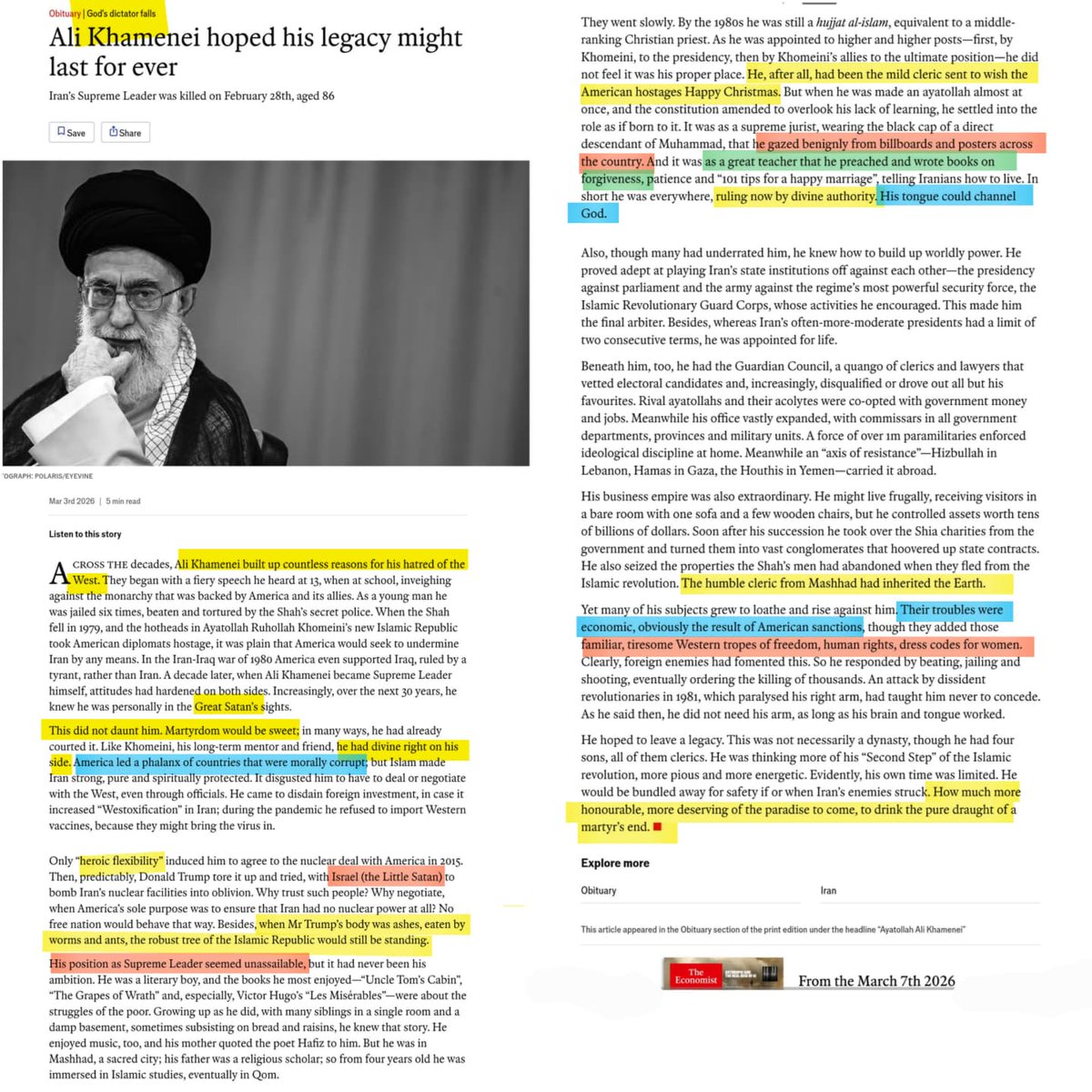
The Economist, in its “fighting back the tears” obituary for Khamenei, salivates with true depravity over Trump’s future death in grisly, if ecstatic, terms: “...when Mr. Trump’s body was ashes, eaten by worms and ants.” It makes the Washington Post and its infamous “Austere Islamic Scholar” obituary for Abu Bakr al-Baghdadi seem very quaint indeed. But I read the whole thing so you don’t have to. The key takeaways: 1. The USA is the Great Satan—no scare quotes. 2. For readers who don’t know what “Israel” is, the Economist helpfully translates it in parentheses as “the little Satan.” 3. Khamenei, otherwise known as “God’s Dictator,” had “divine right on his side” and had “countless reasons to hate the West,” which is an America-led “phalanx of morally corrupt countries.” 4. Khamenei was a sainted and humble man, dragged to power against his will, selfless and “heroically flexible” and unassailable—a “humble cleric from Mashhad who inherited the earth.” 5. Honourable in life, but perfect in death: what could be sweeter than delicious martyrdom? What could be “more deserving of paradise-to-come than to drink the pure draught of a martyr’s end”?! 6. According to the Economist, “Freedom, human rights, dress codes for women” are “tiresome Western tropes.” Yes, really. 7. All his troubles were economic: he was tormented by the West and by foreign enemies. All the crimes he ordered—beatings, killings, and so on—were, naturally, merely “a response” to those Western crimes. 8. He “rules by divine authority,” and “his tongue could channel God.” 9. He was just a ”mild-mannered cleric” gazed benignly from billboards and was a great teacher of forgiveness”. We have now surely reached the apogee of the decay of the legacy media in the West. Surely it can't sink lower than this?
Saul Sadka tweet media
English
507
963
3.6K
1M
Andrew Lukic-Levitt retweetledi
Deutsch Explains
Deutsch Explains@DeutschExplains·
"The theory of evolution is the basic theory of emergent properties. It's how large objects can be understood in terms that do not follow from their low-level definitions in terms of atoms." @DavidDeutschOxf
English
2
3
57
2.8K
Andrew Lukic-Levitt
Andrew Lukic-Levitt@LevittAndrew·
Exactly right. MMT is quite interesting technically. But at the end you are left with the same problems you had at the start.
James@TypeForVictory

Right, let's crack the MMT free lunch and "well ackchually" stuff. How do gilt markets actually work, why do we need them, and what are the implications of Polanski's policy? Gilts 1. Treasury spending creates new bank reserves at the BoE. Without gilt issuance to drain them, the banking system ends up with a permanent surplus. 2. A structural surplus pushes overnight rates to zero unless the BoE pays interest on reserves. So you either sell gilts or remunerate reserves. There isn’t a third option if you want a functioning money market. 3. Gilts aren’t optional. They provide duration and collateral, and they anchor the entire sterling yield curve that mortgages, corporate borrowing, pensions and infrastructure finance rely on. Abolish gilts and you simply replace them with interest-bearing BoE liabilities. 4. Government can choose how much to borrow, but not the price. To “set” gilt yields you would need monetary financing and the abandonment of the inflation target. Markets would respond with higher long rates, not lower. 5. The UK is especially exposed: external deficits, persistent inflation, a large foreign investor base and a financial system built around long-dated sterling assets. We are not Japan. 6. The ultimate trade off is inflation. If you just issue more money, it creates inflation expectations. The currency falls - and as net importers, we are heavily exposed. Consumers face higher costs without commensurate pay rises.

English
0
0
0
42
Tim Urban
Tim Urban@waitbutwhy·
I keep being recommended Godel, Escher, Bach, so I finally bought it. Now I have it. Do I actually have to read this thing or can I just have it be an impressive addition to my bookshelf?
English
283
21
1.7K
146.7K
Andrew Lukic-Levitt retweetledi
Gordon Brown
Gordon Brown@GordonBrown·
Congratulations to Rachel Reeves and Darren Jones for announcing the £500 million social impact fund which will help transform children and youth services in the coming years and into which social investors may add an additional £500 million.
English
1.3K
740
3.9K
484.7K
Andrew Lukic-Levitt retweetledi
Deutsch Explains
Deutsch Explains@DeutschExplains·
––Charlie Barnett: "I just wanted to ask you how this conception of conjectural knowledge versus reality applies to the multiverse interpretation of quantum mechanics, as in, is the particle that doesn't collapse, or the collapse of the wave function that doesn't take place, is that now real in separate universes? And can you explain sort of simply to a layman what the reality of that looks like? @DavidDeutschOxf: Yes, well, I'm always slightly provoked when someone calls that an interpretation of quantum mechanics, because no one says that about the theory of evolution or other theories in physics. We say we have a theory, we're well aware that it might not be perfect, but it is our claim as to what reality is like. It's our best claim as to what reality is like. In quantum mechanics, things have gone wrong, thanks to that bad philosophy that I spoke of earlier. And the fact is that there are experiments where one can show that individual quantum particles are strongly affected by something that is never seen. This is quite familiar in physics. Even Newton postulated invisible fields of force, not fields, invisible forces that operated on the planets, even though one can never see a force and never perceive a force. And then in astronomy, in the early 20th century, we realized that, well, before that, we realized that the stars are things like the sun. They're not dots like they seem in the sky. They are spheres a million kilometers across of incandescent gas and so on. And then we found that our galaxy isn't the only one in the universe. And in quantum mechanics, we discovered that the world we see around us, the everyday world we see around us, or in the laboratory, the photon that we see is only one of many that are accompanying it. And they're all imperceptible to us, except in very especially contrived situations where they affect the photon that we do see. So that's Everettian quantum mechanics, I'd rather say, rather than an interpretation. There is only one interpretation, in my view, of quantum mechanics. ––Charlie Barnett: In the Everettian quantum mechanics, could you just explain, by what virtue can we talk about the branches, the various branches being different? Do the laws of physics apply differently within those branches? @DavidDeutschOxf: The laws of physics are the same. And there are also, these laws also talk about interactions between the universes, which in everyday experience are too slight to notice. But in careful experiments, one can notice them. And the most amazing one you can do at home with a laser pointer and a card with holes in it, make pinholes in it, you can see that when you pass light through a bunch of holes in the card, it makes a weird pattern, not the same pattern as the holes, a completely different pattern. And there are cases where, if you look carefully, there are places on the screen, on the wall, where you're shining this, where if you open an additional hole, that place goes dark. And so that's called interference. The photons that would have arrived there have been interfered with, and then interfered with by what? Well, you can also do this, not at home, but you'll have to believe me about this part. If you do it with individual photons, you know, going through blip, blip, and then not projected onto a screen, but captured by photomultipliers, which are sensitive enough to detect individual photons, you will see that exactly the same is true for single photons. So what has interfered with them? Well, it doesn't matter what we call it, but whatever it is, obeys the same equations as photons. You can reflect it off mirrors, you can slow it down with glass, and it behaves exactly like a photon that we do see. And what's more, the equations describing it say that that's what it will do. And so that's the prototype argument by which we build up into saying that actually the whole world is like that."
English
3
7
54
4K
Andrew Lukic-Levitt retweetledi
Deutsch Explains
Deutsch Explains@DeutschExplains·
"Theories are never going to be proved. They will always be riddled with errors, but we're trying to move to better errors, better problems, not an unproblematic state." @DavidDeutschOxf
English
3
5
39
2.1K
Andrew Lukic-Levitt retweetledi
✨ Donna Hall ✨
✨ Donna Hall ✨@ProfDonnaHall·
Brilliant! Now they need to merge Integrated Care Boards with Combined Authorities & create streamlined (enabling not monitoring) Strategic Authorities (could never understand why this wasn’t done in the first place) & scrap Foundation Trusts who act like competing businesses.
Pippa Crerar@PippaCrerar

NEW: Keir Starmer has brought health service back under the control of ministers by abolishing NHS England, reversing the Tories’ unpopular Lansley reforms. theguardian.com/society/2025/m…

English
15
32
126
17.9K
Andrew Lukic-Levitt retweetledi
Deutsch Explains
Deutsch Explains@DeutschExplains·
"Every transformation of physical systems that is not forbidden by laws of physics is achievable given the right knowledge. And hence, the rational attitude to the future is what I call optimism, the principle of optimism, namely that all evils are caused by lack of knowledge. That isn't a prophecy of success. It's an explanation for failure. If we fail at anything that's physically possible, it's because of some knowledge that we fail to create." @DavidDeutschOxf
English
6
18
84
4.8K
Andrew Lukic-Levitt retweetledi
Deutsch Explains
Deutsch Explains@DeutschExplains·
.@DavidDeutschOxf: Everyone can and should be a scientist, because being a scientist just means wanting to understand the world and using the only method of doing so that works, namely, to be puzzled, to be mistaken, to guess how one might be mistaken and how the grand authorities who can't imagine that they could be mistaken often are, and not to be satisfied with bad explanations, one's own or anyone's, that is, explanations that could have otherwise and you'd be none the wiser. That's the critical attitude. It's the only access to reality that we have. Use it. It's fun.
English
7
77
387
21.5K
Andrew Lukic-Levitt retweetledi
✨ Donna Hall ✨
✨ Donna Hall ✨@ProfDonnaHall·
Government can’t & won’t fix the NHS without simultaneously fixing social care. Pushing it back 3 years will be 3 more years of more hospital crisis & a perpetual winter. We need bold action now to reset the system. Many providers will close because of NI hike making things worse
Sara Livadeas@saralivadeas

Hospitals can't cope with influx of new admissions when they can't discharge patients who are ready to go. Without adequate social care in place operations get cancelled and people wait for hours in A&E. Why is this so difficult for governments to grasp? bbc.co.uk/news/articles/…

English
8
19
65
4.4K
Andrew Lukic-Levitt retweetledi
Goodzaad
Goodzaad@Goodzaad·
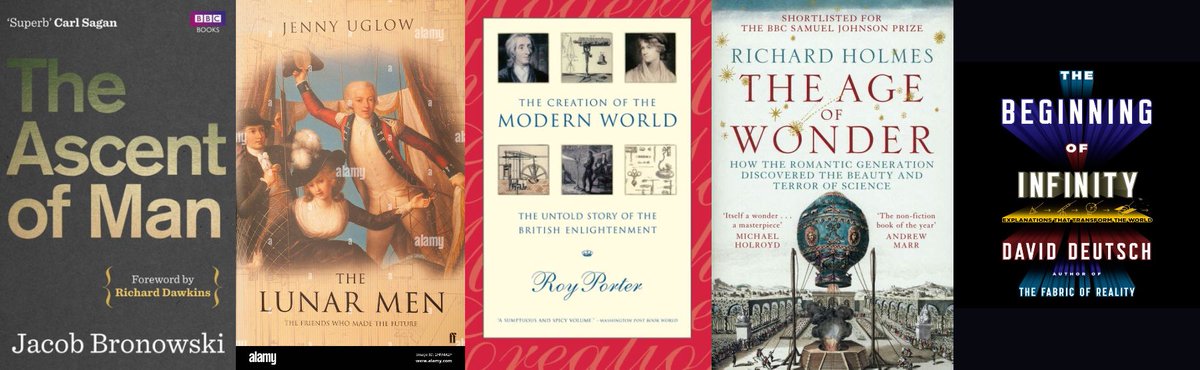
@Ben__Jeff Why is there no audiobook for the first 4?
English
4
0
7
2.9K
Ben 🦉
Ben 🦉@Ben__Jeff·
Educators are furious about this 5 step program:
Ben 🦉 tweet media
English
15
43
561
56.3K