THIS GUY JUST BUILT A DRONE THAT TRACKS TARGETS WITH A LASER USING CLAUDE
> No robotics degree
> No research lab
> No team
He used Claude Code to write the entire vision and control system in Python - a robotic arm that watches you perform a task through a cheap webcam, breaks your movement into steps and replicates it on its own.
Every time it fails it analyzes exactly what went wrong and corrects itself on the next attempt.
After 10 tries it moves like a human hand.
Total hardware cost: $180.
Total build time: 2 weekends.
Total lines of code he wrote himself: 0.
You have access to the exact same tool he used.
Most people are using it to write emails.
The article below is about how to actually use it to its full potential.
A POLYMARKET TRADER TURNED $5 BETS ON WEATHER PREDICTIONS INTO $4,700 EARNED AND $9,200 IN OPEN POSITIONS.
3,779 predictions. $42 into $876 on Munich weather. $28 into $494 on London. He just bets on the weather.
Do you even know what a miracle you are???
You are so much more than just a body, way more than just a mind. You are a holographic fragment of the entire universe!!!
latest discovery really help shift your mindset towards abundance?
Some experts believe that a unique ritual, inspired by historical brainwave studies, may help individuals attract positive financial opportunities.
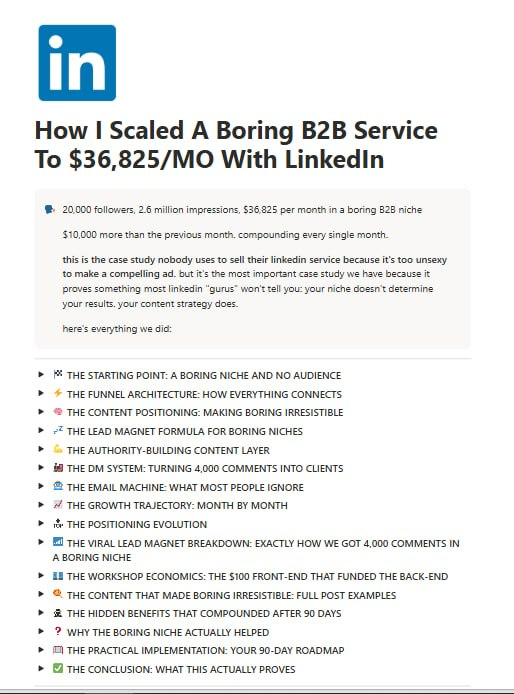
i scaled a “boring” B2B service to $36,825/mo
we didn't:
- run paid ads
- rebrand the offer
- pretend the niche was exciting
we just made the pain visceral and built a system that turned linkedin content into compounding MRR
and i documented EVERYTHING into a 16 section breakdown
covering every content format, lead magnet structure, DM sequence, email system, and offer architecture we used to make a boring niche print
here's what's ACTUALLY inside:
→ the full funnel architecture from post to profile to three conversion paths (custom button, featured section, DMs)
→ the content positioning framework that makes boring niches irresistible (write about the pain, not the niche)
→ the lead magnet formula that generated 4,000 comments in a niche nobody thought could go viral (social proof anchor + pain mirror + aspirational resource)
→ the notion document structure (8 pages, diagnosis first, templates included, 3 CTAs embedded)
→ the DM system that turned 4,000 comments into paying clients (5-step sequence from resource delivery to soft close)
→ the $100 workshop front-end that filtered buyers from freeloaders (and converted 35-40% into core recurring service clients)
→ the email machine running underneath everything (3 emails/week, segmentation by behavior, 40% of total MRR came from email alone)
→ the authority content layer (misconception-demolishing posts, founder narratives, case studies with surprising angles)
→ the profile rebuild that converted 8-12% of visitors (headline, about, featured, custom button)
→ the month-by-month growth trajectory ($15k → $26.8k → $36.8k and the specific levers at each stage)
→ the hidden benefits that compounded after 90 days (podcast invitations, google credibility for cold outreach, inbound partnerships)
everything backed by what we learned after adding $950k+ to our B2B clients' MRR through linkedin inbound funnels
like + comment "36" and i'll send the full breakdown
(must be following + RT for priority access)
i booked 103 calls in 12 days with a 2-line email
then documented the ENTIRE system
- the 2-line script (exact framework)
- untapped leads (not apollo)
- settings that got 2.3% reply rates
- response system (52% booked calls)
- warm calling method
14,000 emails sent. 103 calls booked.
i wouldve KILLED for this when i first started cold email
like + comment "CALLS" and i'll send it over
(must follow + RT for priority access)
This works really well btw, at the end of your query ask your LLM to "structure your response as HTML", then view the generated file in your browser. I've also had some success asking the LLM to present its output as slideshows, etc.
More generally, imo audio is the human-preferred input to AIs but vision (images/animations/video) is the preferred output from them. Around a ~third of our brains are a massively parallel processor dedicated to vision, it is the 10-lane superhighway of information into brain. As AI improves, I think we'll see a progression that takes advantage:
1) raw text (hard/effortful to read)
2) markdown (bold, italic, headings, tables, a bit easier on the eyes) <-- current default
3) HTML (still procedural with underlying code, but a lot more flexibility on the graphics, layout, even interactivity) <-- early but forming new good default
...4,5,6,...
n) interactive neural videos/simulations
Imo the extrapolation (though the technology doesn't exist just yet) ends in some kind of interactive videos generated directly by a diffusion neural net. Many open questions as to how exact/procedural "Software 1.0" artifacts (e.g. interactive simulations) may be woven together with neural artifacts (diffusion grids), but generally something in the direction of the recently viral x.com/zan2434/status…
There are also improvements necessary and pending at the input. Audio nor text nor video alone are not enough, e.g. I feel a need to point/gesture to things on the screen, similar to all the things you would do with a person physically next to you and your computer screen.
TLDR The input/output mind meld between humans and AIs is ongoing and there is a lot of work to do and significant progress to be made, way before jumping all the way into neuralink-esque BCIs and all that. For what's worth exploring at the current stage, hot tip try ask for HTML.
Since 1900, humans have cleared 1.1 billion hectares of forest.
This is a comparison between the pre-industrial forests and the current ones.
[🎞️ globaia]
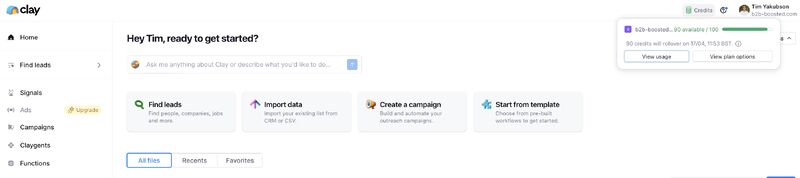
I finally cancelled my Clay subscription.
(And before the "how do you live" comments start: I’m officially on the Free Plan now. Screenshot attached.)
I haven’t stopped using it.
I just stopped paying for it.
A year ago, this wouldn’t make sense.
Now?
Claude Code can handle a big chunk of what people were using Clay for.
→ Lead sourcing
→ Enrichment
→ Filtering
→ Basic workflows
All doable without paying for Clay.
Which raises a slightly uncomfortable question:
How many people are paying for Clay… out of habit?
And not necessity.
Because if you’re running things yourself…
You probably don’t need a paid plan anymore.
You can offload way more than you’d expect.
Things like:
→ lead sourcing, enrichment & qualification
→ personalization of messages
→ campaign top-ups into your sequencer of choice
Which means you’re not burning credits on every step.
That said…
This doesn’t mean Clay is “dead”.
It just means the role is changing.
Something that I Slacked Mohamed Chahin about this weekend.
So, I recorded a video explaining:
→ what the tech stack for 2026 looks like
→ where Clay can be replaced by Claude Code
→ where Clay cannot be replaced
→ how to decide if you need to explore the new tools like Claude Code
This is exactly how I’m running things right now.
If you want in:
Comment “STACK” and I’ll send it over.
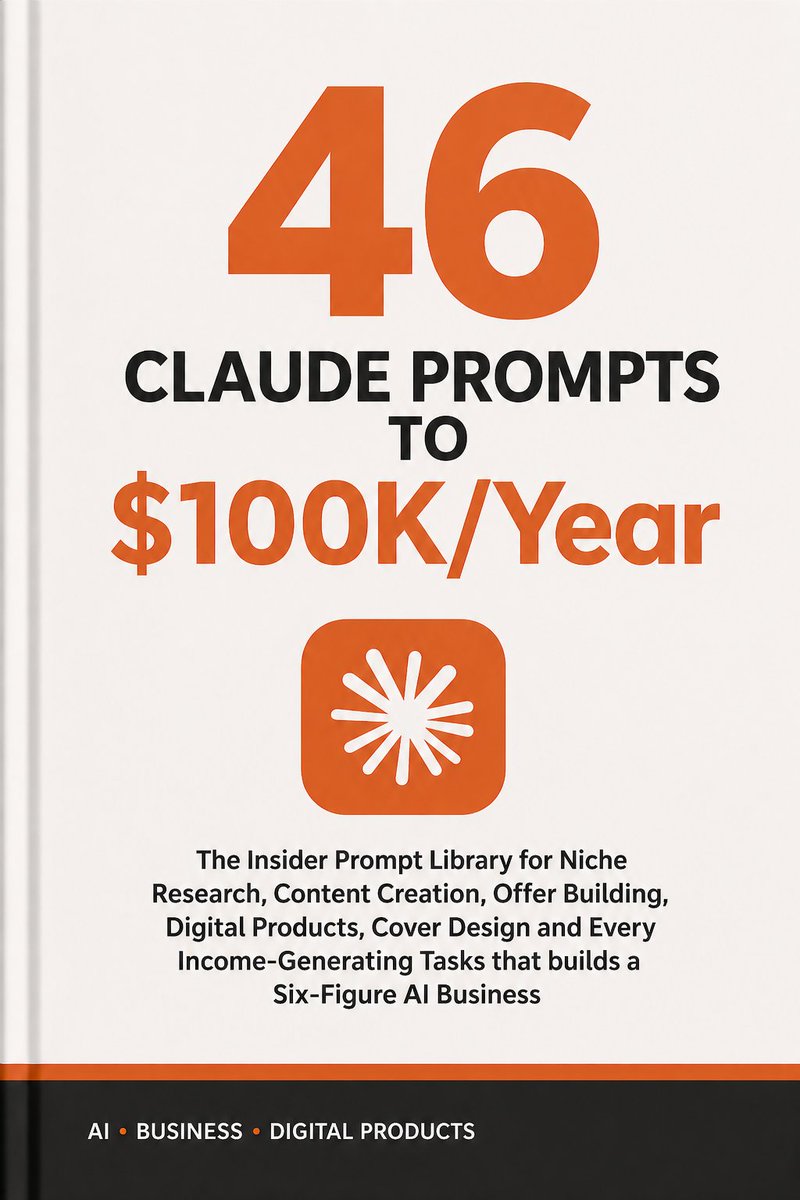
1 laptop.
1 Claude account.
1 winning prompt stack.
= $10k/month landing freelance clients on autopilot.
I compiled my entire client-getting workflow into a 38-page guide.
Was going to charge $197.
For 24 hours → completely FREE.
Like + comment 'Need' and I'll DM you my step-by-step guide for FREE.
You must be following me to receive the DM.