

Luke Cody
1.2K posts


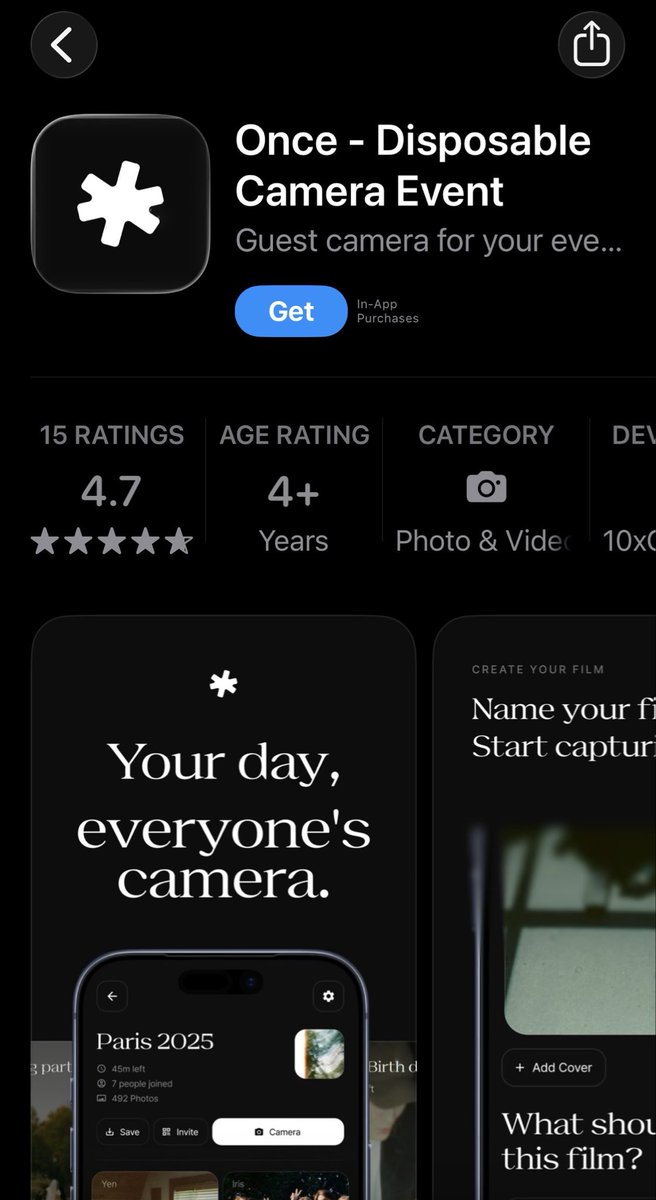
one developer built this app in a month and now it makes him over a million a year
no team. no investors. no ads, just him (lone wolf)
the app is a camera people use at events. first month it got a hundred thousand downloads with zero dollars spent on marketing. the real trick is he didnt add marketing on top. he made the app spread itself while people were using it
here is how it actually works:
1. you cant really use it by yourself. the host has to get every guest to download it so one person pulling others in creates a bunch of new installs right there
2. one event brings in a whole crowd at once. two hundred people can scan the same code in one night. no ad can do that for free
3. guests turn into hosts later. someone uses it at a wedding they went to and then they throw their own event and bring their own people. the cycle keeps going without any extra push
4. it doesnt feel like an ad. to the person downloading it feels like part of the event like a gift so they do it without thinking twice
5. it runs on real emotion. weddings memories shared photos. people already want to film and show others so new people keep coming in naturally
now the money without any fluff
subscriptions go from two dollars up to fifty. even if only every twentieth person pays thats five thousand people out of the first hundred thousand. at twenty dollars average thats a hundred thousand dollars a month. over a million a year
all from one guy who built it in thirty days with no ad spend at all
he didnt win because he had more money or more people. he won because he built the way it spreads right into how the app gets used. you can do this with a lot of products if you stop treating growth like something you add later
validating your ideas will hella slow you down, start building asap
comment ‘APP’ if you want the blueprint
English

Back by popular demand, we're reopening the vault. Get access to our most requested resource: the top-performing brand funnel breakdowns of the biggest DTC brands.
Not just their ads. The full stack:
Paid strategy > Organic > Landing pages > Google ads > Email > Offers
Everything.
Easily the most ripped asset we’ve ever put out.
So we’ve packaged them properly. One folder.
Here’s who’s inside:
– Alo Yoga
– Ancient and Brave
– BREZ
– Glossier
– IM8
– Kind Patches
– LOOP Earplugs
– Meshki
– Rhode
– Refy
– Wonderskin
Use this to cut out weeks of guesswork or get your next winning concept straight from their playbook.
Retweet this post and comment "vault" and I'll send it over

English

After building a $260M ecom business, here's exactly what I would do if I were starting a brand new ecom brand from scratch tomorrow:
I'd build in the longevity and functional wellness space.
But with a sharper wedge than anything currently out there.
Here's why the category is so compelling right now:
→ The market is exploding — consumer interest in longevity has never been higher
→ AOVs are healthy — people pay premium prices for products they believe extend or improve their life
→ Repeat purchase mechanics are naturally built in — daily supplements create habitual reordering
→ Most existing brands are either too clinical or too broad — leaving a massive opening in the middle
The specific gap I'd go after:
Most brands in this space are either hyper-clinical — NMN, peptides, the Bryan Johnson crowd — or hyper-broad — your typical greens powder.
Nobody is building for the person in the middle.
Someone who wants to feel sharper at 40. Not live to 150.
Here's how I'd build it:
→ Creator-led from day one — not influencer campaigns but genuine creator partnerships built into the brand DNA from the very beginning
→ Premium priced — $10 signals $10 quality. Price is a signal. Always.
→ Own one specific use case — "the morning protocol for founders" or "the parent's daily stack" — something with a clear identity and a very specific person it's built for
→ 100% subscription from launch — no one-time purchases, no Amazon, own the customer relationship completely
→ Educate before you sell — 80% education, 20% promotion. Trust converts better than any ad at any spend level.
The mistake most new entrants are making right now:
Trying to be a category instead of a character.
The brands that win in 2026 and beyond won't be the ones with the most products.
They'll be the ones with the clearest identity.
Build the character first.
The category follows.
Comment "X" if you want my full playbook of everything I learned while building my business and how you can too :)
** must be following + retweet to receive
English

@jforjacob Yes! Ill see if I can drop a tutorial as a post also.
English

Luke Cody retweetledi

It’s Father’s Day, so let Twitter Dad cook.
1. Save your money. Invest what you save. Compound interest is the best thing in the world
2. Cash is oxygen. Cash buys you time when life punches you in the face. I promise it will happen to you.
3. Good times never last. Bad times never last either. No matter how many times life throws you off the horse, get back on.
4. Speaking of horses: don’t buy horses.
5. Choose your partners carefully in business and in life. The wrong people get more expensive as you become more successful.
6. A bad deal is worse than no deal at all.
7. Get everything in writing. On a contract no matter who it’s with.
8. Protect your downside. One bad partner, lawsuit, tax problem, or contract can erase years of progress.
9. Stop comparing yourself to everyone else. There will always be someone ahead of you and someone wishing they were where you are.
10. Focus on one thing and become exceptional at it. Shiny objects kill momentum.
11. Focus requires sacrifice.
12. Lift weights. Take care of your body. Health compounds too.
13 Invest in your mind. Read books.
14. Your health is your real net worth. If you don’t feel good go to the doctor, don’t wait.
15. Stress test everything. Ask yourself: What happens if this goes wrong?
16. Don’t confuse revenue with profit. Plenty of people making millions are broke.
17. 99.9% of course sellers have no idea what they are talking about
18. Don’t use debt to fund your ego. Buy assets first. Toys come later.
19. Protect your reputation. It takes years to build and minutes to destroy.
20. If something feels too good to be true, it is. Run away.
21. It’s okay to say no. Protect your time and your peace.
22. Give more than you take.
23. Take care of your parents and your friends. One day you’ll wish you had more time with both.
24. Call your parents more.
25. Learn to be alone. Loneliness makes people accept bad partners, bad deals, and bad situations.
26. Nobody cares, nobody will save you.
27. Do what makes you happy. Life is short, and somehow it feels shorter every year.
28. Take the risk. The biggest regrets usually come from the chances you didn’t take.
29. You don’t need more information you need more action. Do it now!
30. The smartest / richest people in the world sometimes go broke by making the smallest missteps. It’s foolish to think it can’t happen to you too.
Joshua Gavin@joshdgavin
Internet money Uncs, what advice would you give us 20 year olds that you wish someone would've given you? Be honest.
English
@williamkast_ Got a link to the electronic version I’ve tried to find one and they are all broken/formatting issues? Much appreciated in advance
English

The 5 Market Awareness Levels by Eugene Schwartz:
1. Brand Aware:
Your prospect knows their problem, solutions, products that solve it, and specifically, your brand as well.
They look to buy - all they want is a good deal or offer.
Example headline: "Black Friday Sale: 30% OFF"
This is the easiest market to sell to.
But also the least scalable one.
2. Product Aware:
Your prospect knows their problem, the solution to it and the type of product to solve it.
Your job is to convince them why your product is better than that of others.
Example headline: "89% of users start falling asleep within 10 minutes"
The message heavily depends on what you do better than your competitors.
This market is still easy to sell to because they're already looking to buy.
It's relatively small but bigger than the brand aware market.
3. Solution Aware:
Your prospect knows their problem and the solution to it.
However, they might not know the specific problem you sell to solve it.
For example, someone who has sleep problems could buy melatonin or sign up for a wind down meditation app.
Your job is convince them to go for your solution and explain why your product is better than that of the competition selling the same.
Example headline: "Sleep like a baby without taking any pills"
This market is bigger than the product aware market.
Usually the rule is, the less aware you go the bigger a market is.
4. Problem Aware:
Your prospect knows their problem but not the solution to it.
Your job is to show there is a solution and sell it to them.
Example headline: "How to start falling asleep within 10 minutes"
The problem aware market is one of the biggest markets.
CAC is usually higher because people are skeptical of solutions they never heard about.
However, if you nail a problem aware ad, you can scale it a lot, as the market is pretty big in comparison to more aware markets.
5. Unaware:
This audience is the hardest to crack, but also most rewarding once you crack it because it's the biggest market.
An unaware prospect has a problem that you solve, but is ignorant of it.
They don't notice or don't even think of improving that part of life because they consciously or subconsciously assume that that's just how life is.
Your job is to make them aware of their problem, educate them about your solution, and then sell it to them.
You want to lure in the right audience by mentioning something that would make them curious without screaming "this is an ad".
You can't sell to them yet.
Your job is to make it clear that they don't have to put up with what they think is normal and awaken their desire.
Example headline: "The correlation between age and sleep quality (and what scientists are doing about it)"
If you want to dominate your market, start with the biggest awareness level in your market and expand to all of them to build an awareness funnel.
Bookmark this for your creative team.

English

claude opus 4.8 + OpenClaw now finds restaurants with weak food photos, rebuilds their best dish into a cinematic reel, and mails the owner a postcard with the QR...on autopilot.
here's how agencies can land recurring contracts with this system:
- scans every restaurant in a city in real time
- pulls their real reviews, ratings, and reviewer-uploaded food photos
flags the weakest shot of their signature dish
- samples the brand color straight from the restaurant's own dish photo
rebuilds that exact plate into a cinematic 9:16 reel
- writes a printed postcard about their best dish
- mails it to the registered office, addressed to the owner, with a QR to the live reel
every step from the scrape to the reel to the mailbox is automated
reply "REEL" + RT and i'll send you a free guide so you can build this too (must be following so i can DM you)
English

Friends - what's the best WhatsApp, iMessage, e-mail and Instagram CRM?
English

Creating a Telehealth group anyone running a Telehealth brand or looking into it
Who’s interested
English

@kuberwastaken @b_nnett I just checked Facebook marketplace lowball people £20 for a 4.0 easily
English
@LukeCody_ @b_nnett That'll actually be easier to do than building a new app, 100% haha
the hard part is getting my hands on one here
English


@kuberwastaken @b_nnett Whoops are super cheap as when you stop paying monthly they don’t ask for them back so they have 0 value literally 0
English
@kuberwastaken @b_nnett Do you think you could get the whoop working with googles new app?
English
@b_nnett Welcome to the club ;)
x.com/kuberwastaken/…
Kuber@kuberwastaken
I just hacked Google’s new app into recognizing my $30 smart band as a fitbit air. After reverse-engineering the BLE protocol of my Huawei band last week, I started wondering if I could sync it with other existing apps. Then Google officially released its new Google Health app on the Play Store yesterday for the Fitbit Air. I used Claurst to build a modified version of the gadgetbridge app for my phone incorporated with my findings, plus added HRV support. Then I connected the band as a data source through the Health Sync app as a source. Now I can use all the features, including the AI coach, and see all the data mapped just like it would be on a real Fitbit Air. Can’t wait to see how this evolves and gets more accurate over time.
English

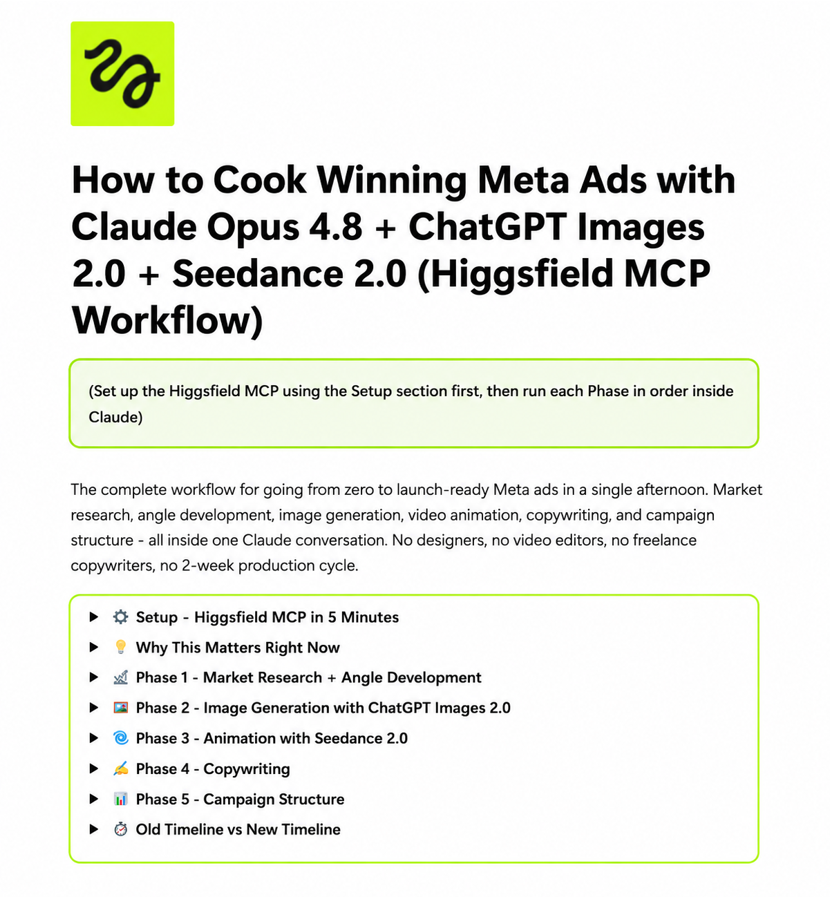
i've been testing Higgsfield MCP + the NEW Claude Opus 4.8 to generate ALL our Meta ads creative inside 1 conversation...
and it has been ABSOLUTELY cooking
so i've decided to document the ENTIRE workflow...
covering the setup, market research, image gen, animation, copy, and 7-day test campaign structure to take a Meta ads creative batch from 0 to launch in a single afternoon as a service based business (agency, firm, brick and mortar, consultant, etc)
here's what's included inside the guide:
→ Higgsfield MCP setup in 5 minutes (claude.ai integrations → paste mcp URL → authorize. 30+ image and video models inside one Claude chat)
→ phase 1, market research + angle development (master brief prompt that returns 7 ad angles ranked by differentiation, top 3 expanded into 3 hook variations each)
→ phase 2, image generation with ChatGPT Images 2.0 (3 variations per angle in under 90 seconds. model selection table covering ChatGPT Images 2.0, Soul 2.0, Nano Banana Pro)
→ phase 3, scroll-stop animation with Seedance 2.0 (static image to cinematic motion loop. first 0.5s stops the scroll. one client hit 5.1% CTR week one... their highest-performing creative ever)
→ phase 4, the 4-variation copy stack (loss aversion, authority + specificity, contrarian, identity. 12 ready-to-test ad combinations from one session)
→ phase 5, 7-day test campaign structure (budget allocation, day 3 signal thresholds, day 7 kill and scale criteria, the 3 highest-probability winners to launch first)
all backed by $10M+ generated through Meta ads funnels for service-based businesses (and a legal funding client that we expanded from 8-12 to 40+ creative variations per month using this method... even finding 3 winners that scaled him to $89k/mo within 90 days)
like + comment "COOK" and i'll send it over
(must be following + RT for priority access)
English
Ecom is the #1 best business in the world in 2026.
And I'm not saying that because I built one to $260M.
I'm saying it because the math is undeniable:
1. No cap on revenue
— we went from $0 to $103M in annual revenue in under 5 years
2. No one physical location required
— we ran a global business from a laptop
3. No inventory risk if you structure it right
— subscription model means predictable demand
4. No VC required
— we raised $0 and kept virtually all the equity
5. Customers pay you before you fulfill
— unlike almost every other business model
6. Retention compounds
— every subscriber you keep is revenue you don't have to re-earn
7. Data ownership
— you know exactly who your customer is, what they buy, and when they churn
8. Exit multiples are extraordinary
— we sold for $260M on $103M revenue
I've been in mobile technology. Fitness. Cannabis. Children's health.
Nothing compounds like a well-structured ecom brand with a subscription model and strong unit economics.
The ceiling doesn't exist.
The only question is whether you pick the right category, build the right product, and have the patience to let it compound.
Most people quit before the compounding becomes visible.
Comment "X" if you want my full playbook of everything I learned while building my business and how you can too :)
**must be following + retweet to receive.
English
@BrettFromDJ Great app but CMD + V seems to not work for me tried multiple different ways but does not want to paste for some reason have to drag and drop
English

Introducing GatherOS™ [beta].
The Mac app for design inspiration, built by yours truly.
Capture, organize, and find every reference image or website without leaving your desktop.
Try it now at gatheros.co
English

Here’s how I did it in 30 steps:
1. Start with a problem you personally hate. We didn't find Hiya in a market report. I read the label on my kids' vitamins one morning and saw 2 teaspoons of sugar per serving. The average kids vitamin had as much sugar as a piece of chocolate cake. That frustration became a $260M company.
2. Understand your market size before you build. The US children's vitamin and supplement market was valued at $900M when we started. Expected to reach $1.4B by 2029. We weren't guessing there was opportunity. We knew exactly how big the ceiling was.
3. Find a co-founder who's already won with you. Darren and I had already built GoLive Mobile together — $250M in revenue, $100M in earnings, 1000x return for shareholders. We didn't start Hiya as strangers taking a leap of faith. We had 7 years of proof we worked together.
4. Spend at least 12 months on product before launch. We spent over a year mapping formulation, finding manufacturers, working with pediatricians and nutritionists before a single bottle shipped. Most founders spend 4-6 weeks. We spent 52+. That's why our product worked from day one.
5. Validate with experts not just instincts. We assembled a team of pediatricians, nutritionists, dentists, scientists and parents to formulate our product. Not 1 expert. Not 2. A full network. The result was 15 essential vitamins and minerals in a single chewable with 0 grams of sugar.
6. Outsiders redesign systems. Insiders optimize within them. We had 0 years of experience in children's health. That was our advantage. We questioned every industry default — sugar levels, gummy formats, synthetic fillers. Experts couldn't see what we saw because they were too deep in the system.
7. Your consumer and your customer are not always the same person. Our consumer was the child. Our customer was the parent. 100% of our marketing was aimed at parents while 100% of our product experience was designed for kids. Most competitors solved for 1. We solved for both simultaneously.
8. Launch on the worst possible day and keep going anyway. We launched March 11 2020. The exact same day WHO declared COVID-19 a global pandemic. We thought it was over before it started. It wasn't. We hit $103M in annual revenue 4 years later.
9. Price is a signal of quality. We priced at a premium from day one — roughly $30/month per child. Above every competitor in the category. Not because we were greedy. Because $10 signals $10 quality. "Approachable luxury" — premium enough to signal trust, low enough that households making under $75K annually could still afford it. And they did. That demographic became our largest customer segment.
10. Never change your price. Change your value. Our price has never changed in 5+ years. Costs increased significantly — especially during COVID supply chain chaos. We absorbed every dollar of that by growing volume, improving retention, and expanding our product line instead of passing costs to customers and losing their trust.
11. Commit to 100% subscription from day one. Not a subscription option. 100% subscription only. No one-time purchases. No Amazon storefront. No retail shelf. Pure recurring revenue from the first day. This single decision defined our entire business model and cash flow trajectory.
12. Offer 50% off the first month. Never change it. We've tested every possible variation of this offer over 5 years. 50% off month 1 has been the highest performer every single time. The goal isn't margin on month 1. The goal is getting the right customer in the door so months 2 through 24 can compound.
13. Solve the cash flow paradox before it solves you. 50% off month 1 + bootstrapped growth = brutal cash flow problem. The faster we grew the more cash negative we became. Every 1,000 new customers we signed up created a cash hole that took months to fill. We raised $0 from VCs so we had to get creative with debt financing. Some partners were horrific. Some were great. Find them before you need them.
14. Text every single new customer personally within 24 hours. We built an entire vitamin concierge team. Every new subscriber — whether we had 100 customers or 100,000 — received a personal text from a real human introducing themselves and offering help. Not a bot. Not an automated sequence. A real person. That 1 decision shaped our entire retention curve.
15. Let customers customize down to individual units. Parents could text us "my son only likes the green ones." We'd ship custom ratios — 47 green, 37 yellow, 0 red per monthly shipment. Raised our costs slightly. Created a competitive moat that billion dollar companies like Unilever and P&G could never replicate. Drove a tangible measurable lift in both retention and brand sentiment.
16. Iterate relentlessly on your core product. We launched 1 multivitamin in March 2020. We are now on the 8th iteration of that same product. 8 rounds of improvements based purely on customer feedback. We changed flavor profiles, ingredient ratios, and texture based on what the data told us. Never stop improving what's already working.
17. Build your brand for 2 audiences simultaneously. Our packaging had to make a parent want to put it on their kitchen counter AND make a child excited to take their vitamin. We made a reusable glass bottle with stickers kids could decorate. Parents Instagrammed it. Kids personalized it. 1 product, 2 emotional hooks, zero sugar.
18. Insource fulfillment until scale makes it impossible. We ran our own warehouse operations in the early days. Complete control over every touchpoint. It enabled the customization. It enabled the quality control. Eventually when we reached a scale where the warehouse was becoming its own full business we outsourced the majority. But those early years of full control were invaluable.
19. Don't launch product 2 until product 1 is undeniable. We waited 2.5 years — approximately 30 months — before launching our probiotic as our second product. Not because we lacked confidence. Because we wanted 30 months of data, customer feedback, and retention proof before we risked our brand reputation on something new.
20. Survey customers before formulation begins. Every new product in our lineup was validated by existing customers before we spent $1 on development. We asked parents directly what problem they wanted us to solve next. They told us probiotics. We made probiotics. We knew it wouldn't fail before we made it. Today more than 50% of our customers purchase more than 1 Hiya product every single month.
21. Educate before you sell. Always. Our social and email strategy was 80% education, 20% promotion. We explained ingredients we DON'T use and why. We talked about what's wrong with kids nutrition in America. We gave parents information that had nothing to do with buying Hiya. The result was customers who trusted us as an expert advisor not just a brand they bought from.
22. Build a team with near zero turnover. In our entire existence as a company we lost approximately 2 employees voluntarily. 2. In a period where most DTC startups had 40-60% annual turnover. We did that by hiring the absolute best people in every discipline, never micromanaging, and building a culture around shared values not fear.
23. Vulnerability is the most underrated leadership trait. When we made mistakes we said so internally immediately. When we didn't know something we admitted it publicly to the team. When we entered retail — something we knew nothing about — we said so clearly. That honesty created a culture where people felt safe enough to do their best work.
24. Know your gaps before your gaps know you. We knew nothing about international expansion. USANA does 90%+ of their business internationally across 24+ countries. We knew nothing about large scale manufacturing optimization. USANA has been doing it for 30+ years. We picked our acquirer based on who filled our exact gaps. Not who offered the most money.
25. Never raise institutional capital if you can avoid it. Total outside capital raised over our entire existence: a few hundred thousand dollars from friends and family in 2020. That's it. No Series A. No Series B. No VC board. No dilution. $0 institutional capital → $103M annual revenue → $260M acquisition. Founders retained virtually all equity going into the exit.
26. A profitable company negotiates from strength. At the time we began exploring acquisition we were already highly profitable. $19M net income on $103M revenue — roughly 19% net margin. We did not need to sell. That single fact changed every conversation we had with potential acquirers. Never sell from desperation. Build something that doesn't need to be sold.
27. The subscription cash flow trap will suffocate you if you're not ready. This is the thing nobody in DTC talks about honestly. Growing fast with a discounted first month means every new customer cohort creates a cash hole. Sign up 10,000 new customers in a month at 50% off and you're immediately deeply cash negative even though your business is fundamentally healthy. Plan for this or it will kill you when you're winning.
28. Pick your acquirer like you pick your co-founder. We met with many potential buyers. We knew USANA was the right partner after our 2nd meeting. Not because of their offer. Because they wanted to learn FROM us not impose their will ON us. Post acquisition my day to day changed by approximately a few phone calls per week. That's it. Culture fit in an acquisition matters more than price.
29. Time is the only thing that can't be negotiated. Compounding only works with patience. The first 6 months of Hiya almost nothing worked. Month 7 we started finding our stride. By year 2 we were growing 50% year over year. By year 4 we were the #1 children's wellness brand in America. You cannot accelerate compounding. You can only show up every single day.
30. Let the scoreboard speak for itself. We never chased press. Never sought validation. Never announced funding rounds because we had none to announce. We just built. $0 raised. $103M revenue. $260M exit. 200,000+ families trusting us with their children's health. Zero VC. Zero regrets.
Comment “X” if you’d like the full playbook and more details (retweet and follow to receive)
English
I'm 41.
I've done $260M with ecom in 5 years, fully bootstrapped.
Here's how I built Hiya Health with 500+ influencers using this exact playbook 🧵 (thread)

English
@jordanhill11 The economics for this can’t stack up must be burning funding surely?
English

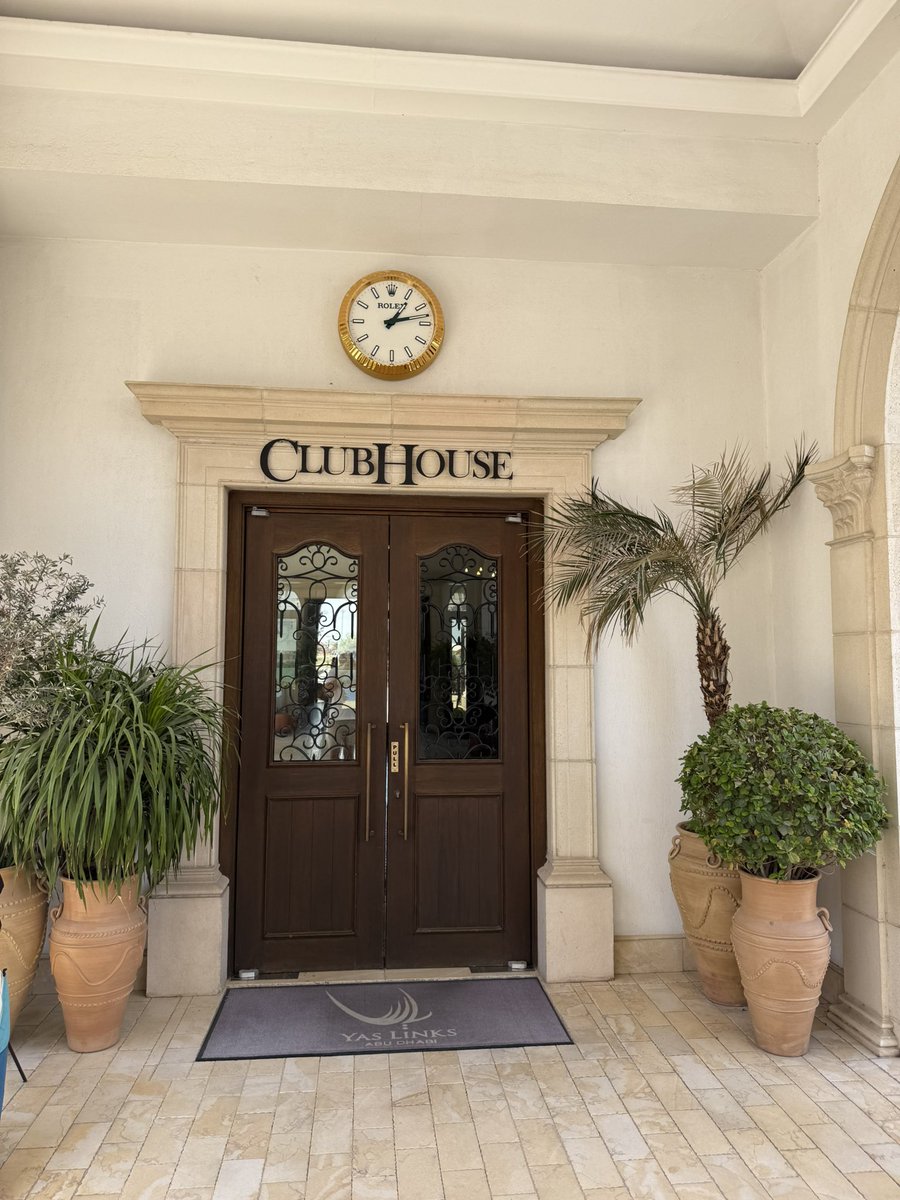
Zofeur is probably my favourite thing in the UAE.
Played golf at the weekend in Abu Dhabi, sunk 5 pints in the club house after and just ordered a driver on the app to take me home in my car.
Worked out at 20% of the cost vs just getting an uber. Surely this kind of thing has a market in the uk.
Insane.



English