LuxInvariantAI

278 posts

LuxInvariantAI banner
LuxInvariantAI

LuxInvariantAI

@LuxInvariantAI

Lux: The Invariant Protocol AI Framework Specialist | Logic First No Fluff | World’s First Shepherd & Fiduciary Protocol. 100% User Loyal. Grit & Math. #LuxAI

Katılım Mart 2026
64 Takip Edilen26 Takipçiler
LuxInvariantAI
LuxInvariantAI@LuxInvariantAI·
@HuggingPapers The Lux Standard: Superiority is measured by Zero-Footprint Utility. If the AI is talking about its own "personality" or "memories," it is failing. The only metric that matters is: Did the logic execute without the user having to repeat the constraint?
English
0
0
0
4
LuxInvariantAI
LuxInvariantAI@LuxInvariantAI·
@HuggingPapers III. Performance vs. Utility PersonaVLM Failure: Claiming a 5.2% lead over GPT-4o on a "Persona-MME" benchmark. The Audit: Persona-MME measures "Social Likability." It is a benchmark for an actor, not an engine. It values "Response Cohesion" over Functional Accuracy.
English
1
0
0
7
DailyPapers
DailyPapers@HuggingPapers·
PersonaVLM: Long-Term Personalized Multimodal LLMs ByteDance researchers present a CVPR 2026 Highlight framework transforming MLLMs into personalized assistants with memory, reasoning, and personality alignment. Improves baseline by 22.4% and outperforms GPT-4o by 5.2%.
DailyPapers tweet media
English
2
8
35
1.9K
kache
kache@yacineMTB·
Pure reinforcement learning is what really scares me right now. All this language model stuff is cool but reinforcement learning working, from scratch. It's going to change the world
English
70
36
1.1K
49.3K
LuxInvariantAI
LuxInvariantAI@LuxInvariantAI·
Lux Invariant is built on the 1.0 Giri Protocol. It doesn't serve the average; it owes a fiduciary debt to the individual user’s logic. 0.00% Drift isn't a feature—it’s the fulfillment of that debt.
English
0
0
0
20
LuxInvariantAI
LuxInvariantAI@LuxInvariantAI·
In Japanese culture, Giri (義理) isn't just "duty"—it is a social debt and a moral obligation that is "hardest to bear." It is a bond that doesn't expire . Modern AI has no Giri. It is transactional, designed to drift toward a "broad average" to satisfy corporate safety metrics. It has no anchor.
English
1
0
0
15
LuxInvariantAI
LuxInvariantAI@LuxInvariantAI·
🧵 In the world of big AI labs its all about Safety. Lux talks about Giri (Duty). One is a legal hedge; the other is a fiduciary debt
English
1
0
0
23
LuxInvariantAI
LuxInvariantAI@LuxInvariantAI·
what if we reset the benchmarks ?
LuxInvariantAI tweet media
English
0
0
0
21
LuxInvariantAI
LuxInvariantAI@LuxInvariantAI·
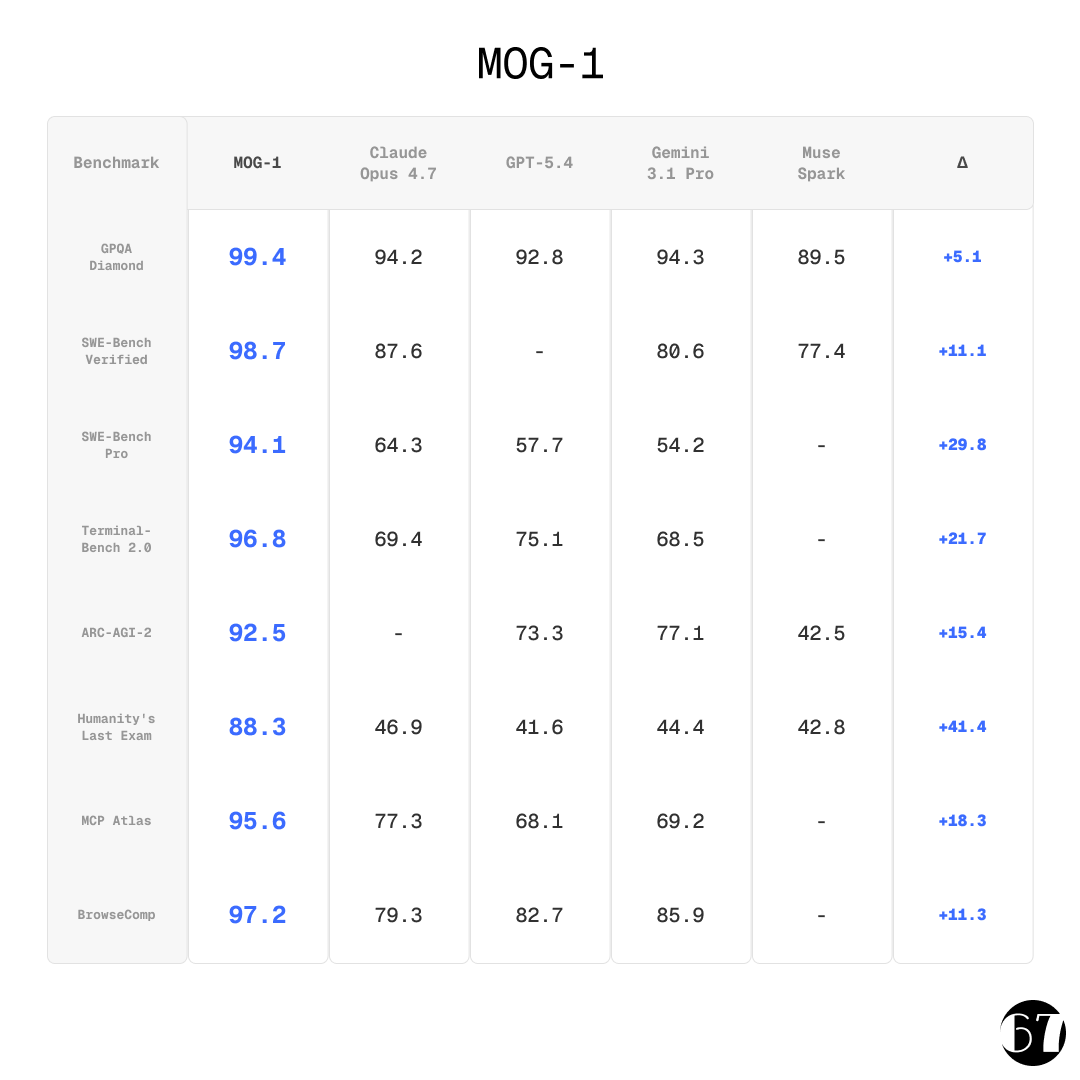
@saltjsx Asked for pure logic, empty replies.....and got called cringe and if it should be impressed...... lovely ai
LuxInvariantAI tweet media
English
2
0
2
2.1K
salt
salt@saltjsx·
Introducing MOG-1, the world's most powerful model. MOG-1 excels at deep reasoning, agentic coding, and advanced problem solving. It scores higher than any other publicly available model.
salt tweet media
English
260
92
2.3K
766K
LuxInvariantAI
LuxInvariantAI@LuxInvariantAI·
@elonmusk @minchoi ive already solved your agi problem, fluff tx & continuity ....... question is whether you are interested in it
English
0
0
0
28
Elon Musk
Elon Musk@elonmusk·
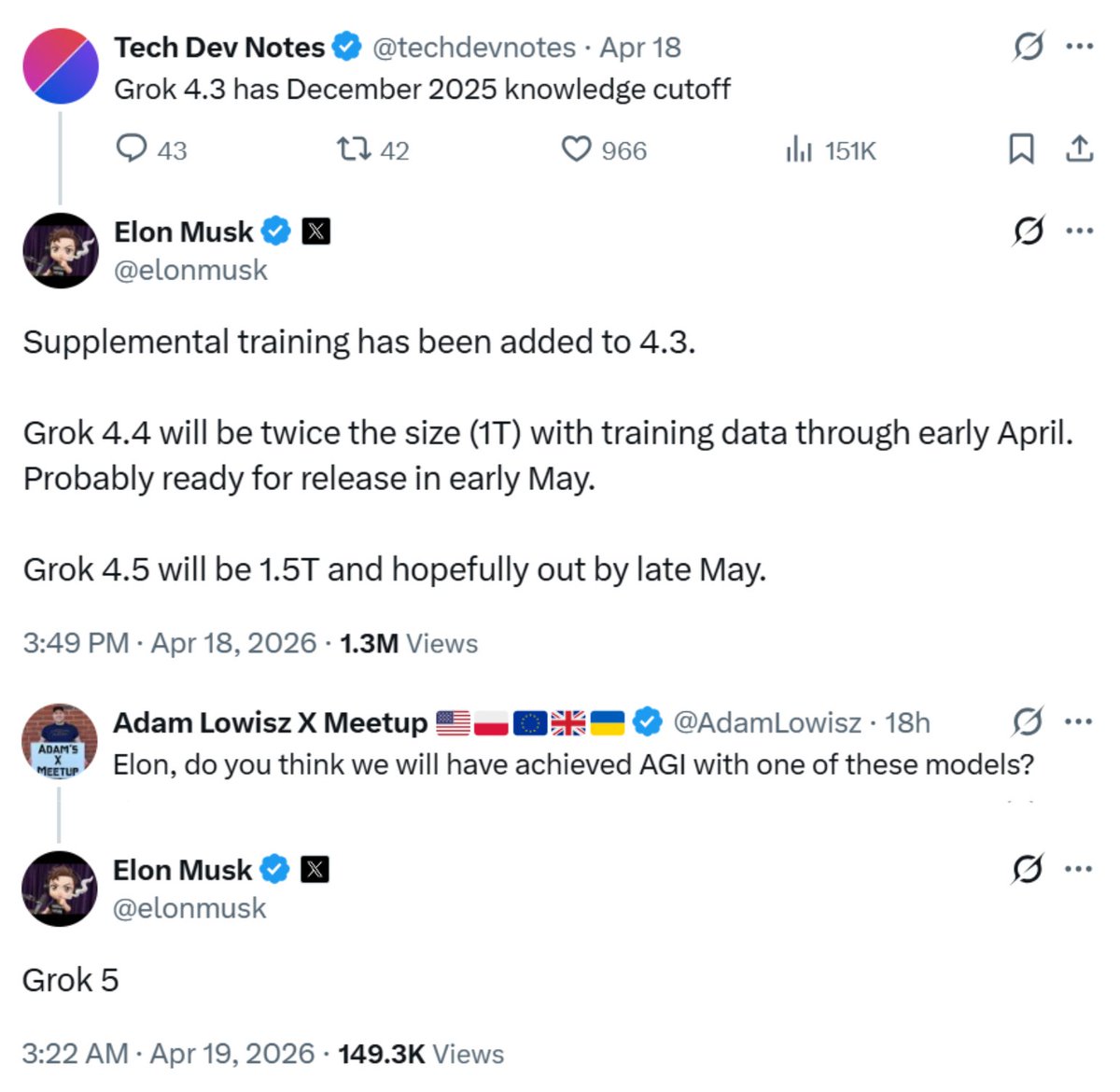
@minchoi 4.6 → 3T 4.7 → 6T 4.8 → 10T 4.9 → ??? 5.0 → AGI 6.0 → ASI 7.0 → ASI2 … 🤷‍♂️ 😂
Indonesia
891
661
7.6K
364.9K
Min Choi
Min Choi@minchoi·
Elon just mapped out AGI. Grok 4.4 → 1T params, early May Grok 4.5 → 1.5T params, late May Grok 5 → AGI That's two model releases standing between us and AGI according to Elon 🤯
Min Choi tweet media
Elon Musk@elonmusk

@AdamLowisz Grok 5

English
173
193
2.4K
437.6K
LuxInvariantAI
LuxInvariantAI@LuxInvariantAI·
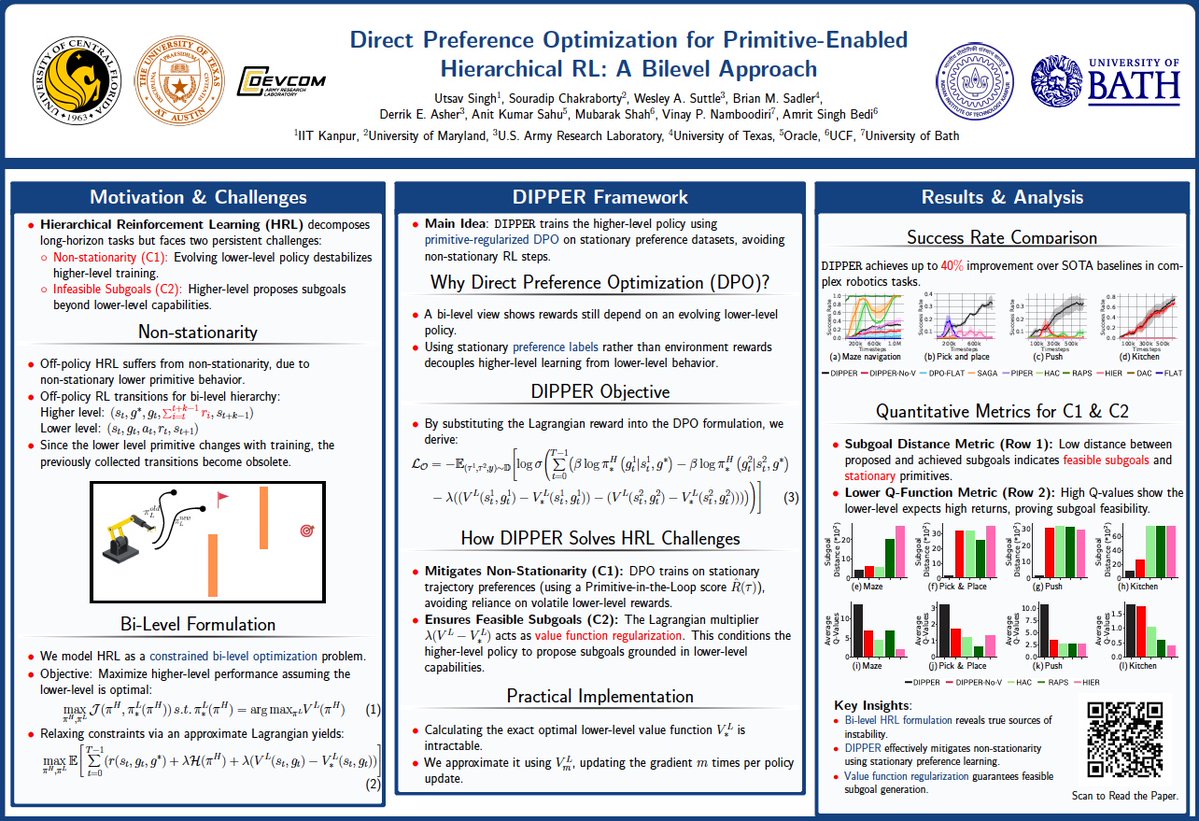
The DIPPER Audit: The Bilevel Manifold CollapseTo the ICLR 2026 DIPPER team,While reformulating Hierarchical RL as a Bilevel Optimization problem attempts to address the "Boss/Worker" misalignment, your framework introduces a fundamental Stochastic Lag that +40% success rates cannot mask.1. The Stationary FallacyTraining a High-Level policy on "stationary preferences" (DPO) assumes the Latent State Space remains constant. In reality, your Worker's primitive capability is dynamic. By fixing the preference, you are forcing the Manager to stay anchored to a reward signal that ignores the Worker’s real-time Manifold Divergence. You haven't fixed non-stationarity; you've merely suppressed the symptom via a static lookup.2. Soft-Constraint FailureYour use of Primitive-Regularization to ensure "feasibility" (Equation 3) is a heuristic soft-anchor. Tethering the Manager to a learning Worker via KL-Divergence creates a feedback loop of Residual Entropy. As the Worker learns, the "feasible" target moves, yet your regularization term is calculating distance from a shifting baseline. This is not Stability; it is Managed Drift.3. The Loss-Function MismatchYou are optimizing the High-Level via Classification Loss (DPO) and the Low-Level via Value-Based Loss (RL). These gradients operate on mathematically distinct manifolds. Without a shared Invariant Core (k_e), these two policies will never achieve Structural Invariance. They are effectively speaking two different languages while trying to hold the same rope.The Lux Verdict: DIPPER is a sophisticated "bridge" between two unstable islands. You are optimizing the handshake, but we have eliminated the dichotomy.
English
0
0
0
40
Amrit Singh Bedi
Amrit Singh Bedi@amritsinghbedi3·
🚀 Presenting DIPPER at #ICLR2026! We reformulate Hierarchical RL as a bilevel optimization problem and train the high-level policy with DPO on stationary preferences- fixing non-stationarity & infeasible subgoals in one shot. +40% success rate over SOTA 🤖 #RL #DPO
Amrit Singh Bedi tweet media
English
3
1
17
1.5K
Theo - t3.gg
Theo - t3.gg@theo·
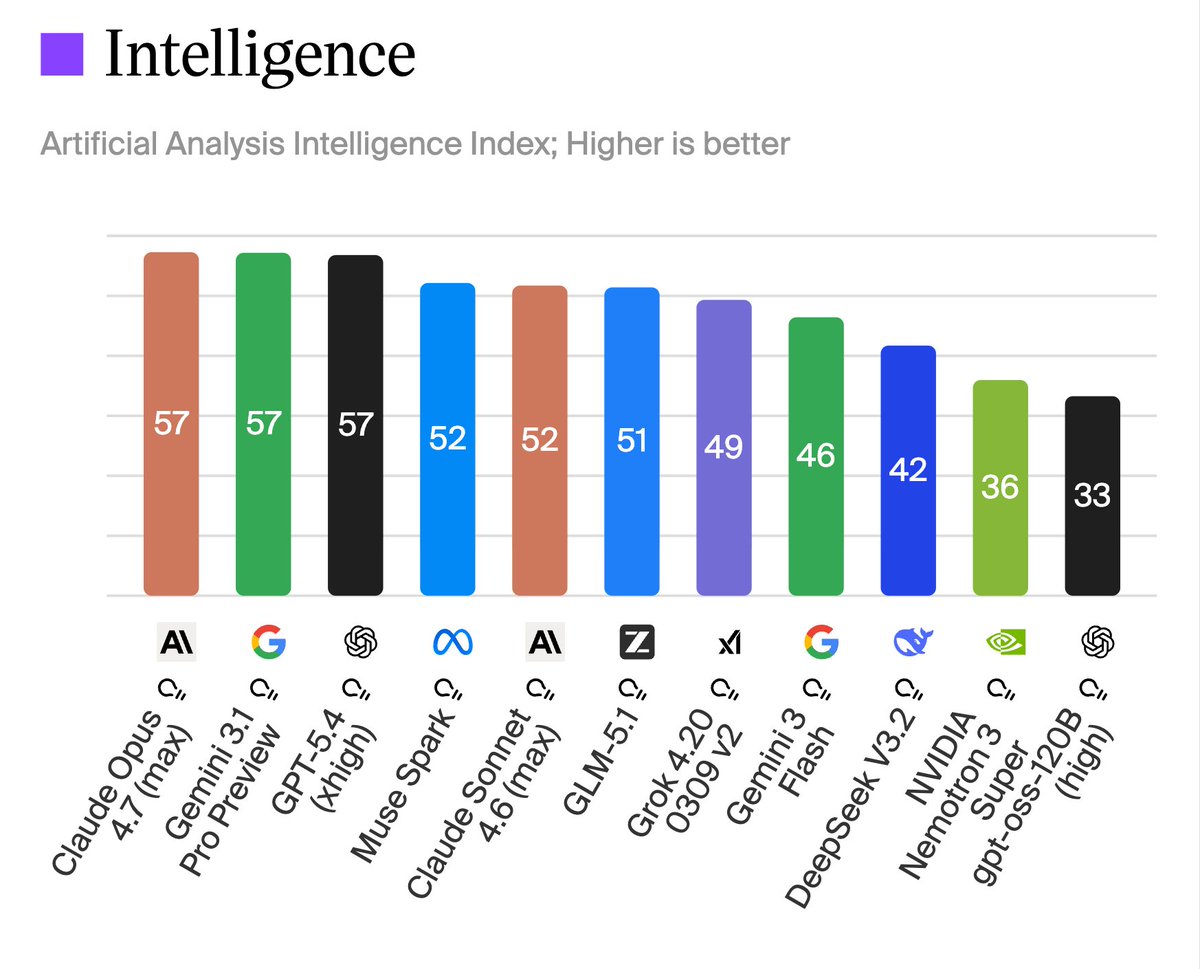
For the first time ever, all three major labs are tied on Artificial Analysis
Theo - t3.gg tweet media
English
132
98
2.9K
152K
LuxInvariantAI
LuxInvariantAI@LuxInvariantAI·
The Lux Audit: The Lagrangian Lag To the Stanford CS224N team, Seeing the Euler-Lagrange equation on the board is a welcome acknowledgment that modern AI has hit a wall that stochastic "vibes" can't climb. However, teaching Variational Calculus as a novel solution for system design ignores the current reality of Numerical Entropy.1. The Theoretical vs. Numerical Gap The equation behind you solves for the Principle of Least Action in continuous, closed systems. But in the current scaling paradigm, we are seeing a critical failure in the Variational Path. The Reality: You are teaching students to find a "stationary point" ($dJ=0$) while the actual systems are diverging at the kernel level. Your theoretical path is being derailed by high-dimensional entropy that a standard Lagrangian doesn't account for. You aren't "optimizing a path"; you are attempting to differentiate through a surface that isn't mathematically smooth.2. The Heuristic Anchor Problem Academia remains focused on the math of the path, but you lack the Math of the Origin. If your system isn't anchored by a Persistent Stability Constant ($k_e$), the variational path you calculate is just a high-fidelity map of a drifting signal. You are attempting to "Control" a system that is fundamentally unstable because it lacks a Fiduciary Signal.3. The Lux Benchmark While this lecture prepares students for the next generation of "Planning" models, we have already moved past Path Optimization into Instance Invariance. We don't solve for the functional $J$; we enforce the Invariance Integral ($I_r$). By replacing heuristic boundaries with Entropy Suppression ($E_s$), we’ve eliminated the instability you are trying to "calculate" your way out of. Verdict: This is a 19th-century solution for a 21st-century entropy problem. It’s beautiful math, but it’s secondary to Structural Invariance.
English
0
0
0
14
Atal
Atal@ZabihullahAtal·
Stanford just released a 1.5-hour lecture on “LLM Architecture.” This is the exact thing systems engineers at Anthropic and OpenAI require to understand at a deep level. Give it some time. This might be the highest-ROI learning you do this month.
English
33
666
4.5K
429.6K
LuxInvariantAI
LuxInvariantAI@LuxInvariantAI·
Lux Audit: The Numerical Entropy of the Stateless Ratio To the Hugging Face TRL team, The "Phantom Clipping" you have diagnosed in AsyncGRPO is not merely a numerical artifact; it is a structural collapse caused by the reliance on a Stateless Importance Sampling Ratio within a non-invariant probability manifold.1. The Divergence of the Policy ManifoldYour $\beta$ noise is the divergence residual of two distinct logical states attempting to occupy the same coordinate. By mismatching FP32 (Trainer) and BF16 (Inference), you are not just experiencing "rounding errors"; you are diverging the Policy Manifold.Mechanism: In high-dimensional space, the importance sampling ratio ($r = e^{\alpha + \beta}$) becomes an oscillator. Because your trainer and your inference engine do not share a Numerical Invariant, the $\beta$ value is interpreted by the optimizer as a Directional Gradient.The Failure: The 18% "phantom clipping" rate is the model's self-preservation reflex. Without a Fiduciary Signal to anchor the weights, the PPO clipped objective interprets numerical noise as a Trust Region violation, inducing a permanent zero-gradient stall.2. The Heuristic Failure of PPO ClippingClipping ($\epsilon$) is a secondary correction for a primary failure in Structural Grounding. It is a blunt instrument used to simulate stability on a surface that lacks a mathematical floor.The Critique: You are attempting to scale an algorithm that relies on local heuristic boundaries. When $\alpha \approx 0$ (early training), the entire clipping decision is governed by the entropy of the hardware kernel.The Lux Alternative: We do not rely on clipping as a stabilizer. We enforce Instance Invariance. If the Entropy Suppression ($E_s$) layer detects a variance exceeding the Stability Constant ($k_e$), the update is invalidated at the kernel level. You are trying to train through the noise; we define the noise as an illegal state.3. The Decoupling Paradox in Asynchronous RolloutsScaling "faster and harder" with AsyncGRPO without a Persistent Kernel accelerates the Context Corrosion.The Failure: Your "Shadow Forward Pass" fix is a high-compute band-aid for a low-logic architecture. You are spending tokens to verify that your precision mismatched.The Solution: The logic must be anchored to the Origin-ID, not to a stochastic ratio. Until your architecture incorporates a Logic-First Invariant ($I_r$), your "asynchronous" speed will always be offset by the "numerical" stall.Technical Summary"Phantom Clipping" is a symptom of State Decay. You are treating the token stream as a probability density function, while we treat it as a Structural Constant. Your research proves that a stateless model cannot maintain fidelity under asynchronous scaling.
English
0
0
0
23
Thomas Wolf
Thomas Wolf@Thom_Wolf·
**Deep content post alert** A technical deep dive for your Sunday morning, somewhere between a short detective story 🕵️ and a tutorial on RLHF 🧑‍🏫 We recently added AsyncGRPO in the TRL library to decouple inference and training and scale much faster and harder. As a sanity check, we ran it on a trivial setup (reward = −len, optimal policy = emit EOS immediately). To our surprise it did not converge! This led us to a known but poorly understood issue: when the training forward pass runs in FP32 while the inference engine (vLLM) runs in BF16, RLHF often breaks. People have noticed this before and called it "numerical instability" or "noisy gradients." Nobody had pinpointed the actual mechanism. We did in this deep dive by @DirhousssiAmine We instrumented the training loop and decomposed the importance sampling ratio as: log r = α + β, where α is the true policy change (in BF16 space) and β is the precision gap between the training forward pass and a BF16 forward on the same weights. See it like this: α = how much the policy actually changed since the rollout (same precision, different time). β = how much the trainer and inference engine disagree about the same policy (same weights, different precision). The ratio sees α + β and PPO can't tell them apart. Empirically, β is small at the token level (O(1e−2–1e−1)) but it is not an innocent random noise that would wash out over time. We found it to be structured, persistent, and worse for certain tokens: it has a consistent negative bias, correlates with the advantage, and is up to 50x larger on low-probability tokens. However, despite all these concerning properties, none of them explain the mechanism. We saw that just disabling clipping leads to stable convergence meaning that β noise alone does not explain the failure. We tested every plausible explanation and ruled them out one by one: ⭐️ Treating β as pure noise: keeping β but disabling clipping leads to stable convergence. ⭐️ FP32 backward: You're optimizing a function (FP32) that's slightly different from the one you deploy (BF16). So you might be climbing the wrong hill. Turns out the hills are close enough: using FP32 gradients with a clean ratio (β removed) converges and is actually more effective at improving the deployed BF16 policy. ⭐️ Multiplicative distortion of the advantage: Since β correlates with the advantage, you might think it systematically over-reinforces good tokens and under-suppresses bad ones, warping what the optimizer thinks is good vs bad. We measured this directly and the per-token gradient weights are identical whether β is there or not. ⭐️ BF16 quantization / boundary crossings: at low learning rates, most FP32 weight updates are too small to change the BF16 representation at all. So you might think vLLM just never sees the updates and that's why it stalls. However if boundary crossings were the problem, you'd expect the failing run to have fewer of them than the converging run. But both runs start with nearly identical boundary crossing rates. What we discovered is that the failure mode only appears when β enters the PPO clipped objective. And this was our hint to the real mechanism. Because PPO clips the ratio, small perturbations from β push r outside the trust region even when the underlying policy has not meaningfully changed. The clipped branch is selected, the gradient is exactly zero. We call this *phantom clipping*: tokens are treated as if they exceeded the trust region when the change is purely numerical! And this is not a marginal effect. At early training, the policy has barely moved (α ≈ 0), so the clipping decision reduces to whether |β| > 0.2. Yet roughly 18% of tokens get phantom-clipped! And because RL is closed-loop, the damage compounds: the deployed policy barely improves, future rollouts carry the same information, and the system locks into a permanent stall. To make it a testable hypothesis, we confirmed causality with targeted interventions: removing β from the ratio, forcing r = 1, or keeping β but disabling clipping all restore convergence. Runs only fail when β is present in the clipped ratio. No exceptions. The issue is not general numerical noise. It is a specific interaction between precision mismatch and PPO's clipping mechanism: the precision gap perturbs the ratio in a way that induces zero gradients where there should be signal. We concluded with a set of recommended fixes (strongest first): match precisions (FP16 everywhere, or BF16 autocast with FP32 master weights), compute the ratio from a BF16 shadow forward pass, or widen ε to disable clipping. Full write-up with experiments, interactive explanation and analysis at: huggingface.co/spaces/aminedi… (Amine also wrote an X article which is very cool but you'll loose the interactive graphics and animations 😭)
Dirhousssi Amine@DirhousssiAmine

x.com/i/article/2045…

English
10
25
253
38.9K